



The treatment room is full, the booking calendar is tight, and a device failure never arrives at a convenient time. A diode laser displays an error during a client's appointment, the next patient is already waiting, and the clinic manager is suddenly calling technicians, moving bookings, and explaining delays. Maintenance becomes expensive when it's treated as a reaction instead of a clinic decision.
For aesthetic practices in South Africa, the practical question isn't when a manufacturer says a device should be serviced. It's how to schedule maintenance around treatment demand, device criticality, warranty obligations, electricity instability, technician capacity, and patient safety. The right programme protects uptime without over-servicing equipment or creating unnecessary disruption.
Table of Contents
- The Cost of a Reactive Maintenance Calendar
- What a Solid Maintenance Schedule Must Include
- Daily, Weekly, Monthly, and Annual Service Rhythm
- Building a Practical Maintenance Checklist
- In-House Technicians Versus Manufacturer Service
- Compliance and Record-Keeping in South Africa
- Integrating Omega Lasers Support and Warranty Service
The Cost of a Reactive Maintenance Calendar
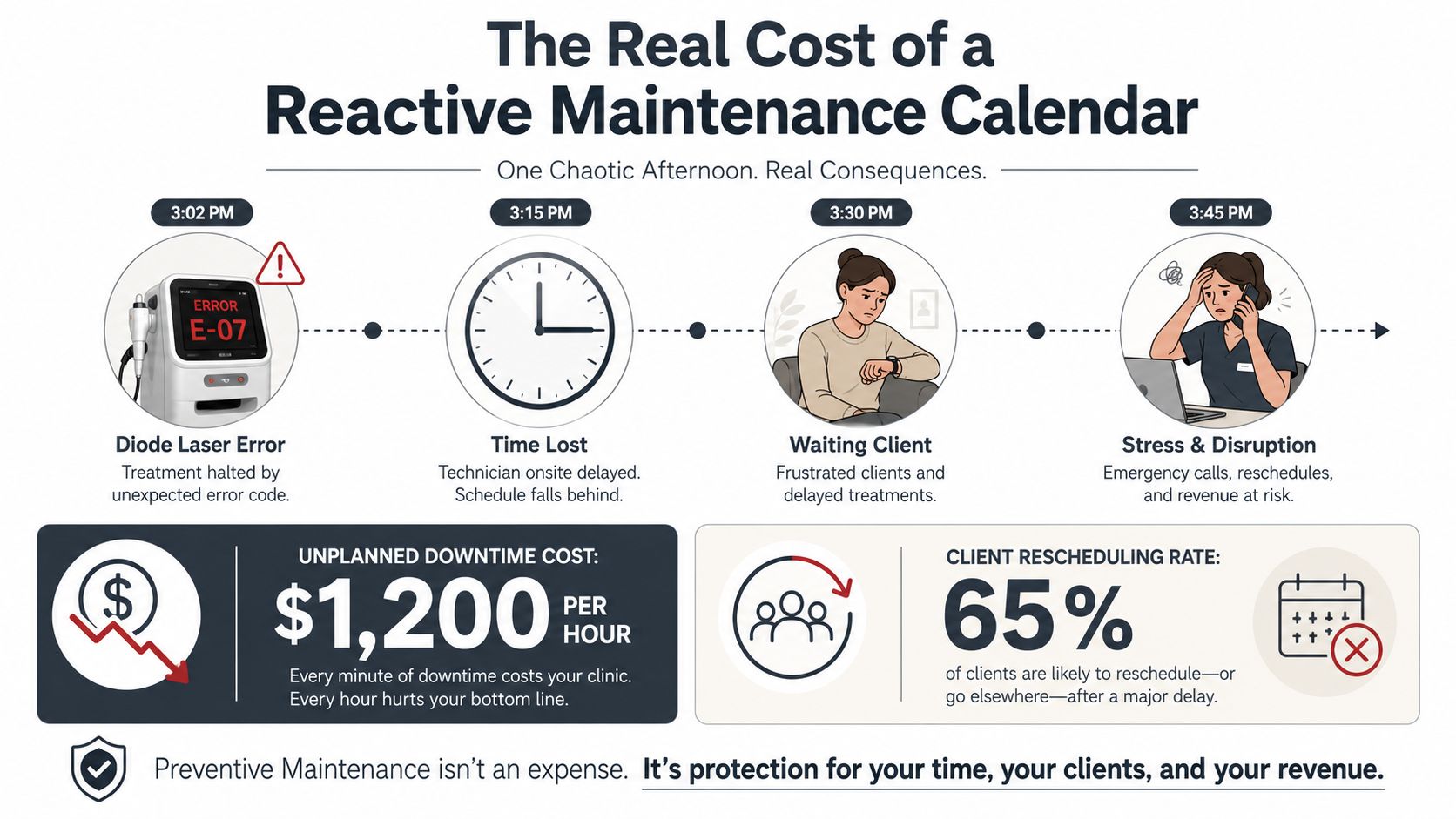
A busy treatment day can turn on one small warning. A handpiece runs warmer than usual, an output reading shifts, or an unfamiliar error appears on the screen. If staff continue using the device without checking the cause, a minor fault can become a treatment-room stoppage.
The operational response is immediate. Someone must assess whether the device is safe to inspect, contact technical support, find a suitable replacement or loan unit, and reschedule affected clients. The cost includes more than an engineer's visit. Cancelled appointments, urgent transport, replacement consumables, staff time, and lost client confidence can all follow.
South African industrial maintenance research recorded average schedule attainment of 78.7%, so only about four in five scheduled tasks were completed within 30 days of their planned date. Planned work accounted for 24.1% of maintenance hours, while unplanned work accounted for 58.1%. The upper quartile achieved more than 90.3% schedule attainment. For a clinic, the practical lesson is to track completed work against the plan, not merely count maintenance entries on a calendar. South African industrial maintenance research
Planned downtime versus emergency disruption
Planned downtime gives the clinic control. The booking system can block the room, staff can move treatments before clients arrive, and the technician can prepare with the relevant device history and parts. An emergency fault removes that preparation. The clinic discovers the outage after appointments, staffing, and client travel have already been arranged.
Over-servicing creates its own risk. A case study at ArcelorMittal South Africa in Vanderbijlpark recorded system availability of 67.86% and noted that excessive maintenance activity also reduced availability. Aesthetic devices require the same discipline. Set service intervals using failure history, usage, reliability requirements, manufacturer guidance, and warranty conditions. Do not add visits just because an anxious calendar feels safer. ArcelorMittal South Africa maintenance case study
Practical rule: Planned downtime is a booking problem. Unplanned downtime is a trust, revenue, and safety problem.
Condition-based monitoring can help clinics adjust service timing when equipment signals a developing fault. The Finchum Fixes IT predictive maintenance guide explains that approach. Before escalating a call, follow the approved checks for the specific device, including common aesthetic device troubleshooting guidance. Record the warning, action taken, and outcome so repeated faults influence the next maintenance decision.
What a Solid Maintenance Schedule Must Include
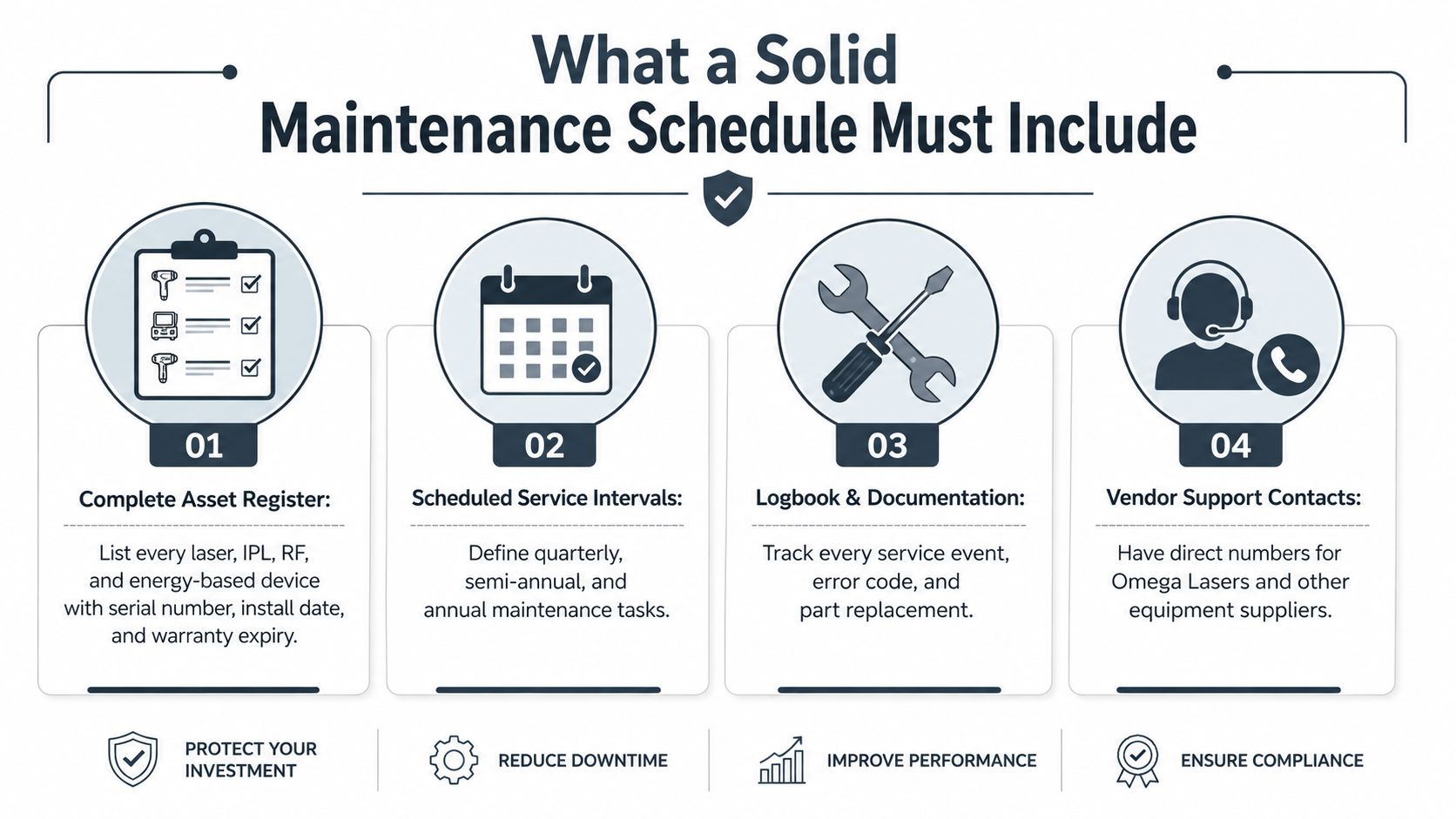
A schedule without an asset register is guesswork. A register without service records is only an inventory list. A workable programme connects every device to an interval, an owner, a documented result, and a clear response when the result fails.
Start with the equipment record
List every laser, IPL, RF system, cryolipolysis unit, facial platform, cooling system, and other energy-based device. Record the make, model, serial number, installation date, location, warranty status, manufacturer interval, and current usage information.
Usage data may differ by device. A laser handpiece might need flash-count tracking, while a cryolipolysis applicator may be better monitored through operating hours and cycle history. Capture both where the equipment supports them. If the device has firmware, calibration requirements, or approved consumables, add those fields to the record.
South African health-technology regulations state that institutions using medical devices must maintain an up-to-date inventory, implement preventive maintenance according to manufacturer specifications, and keep repair and maintenance records in an equipment-management system. South African health-technology regulations
Assign the work to a named person
“Clinic team” isn't an owner. The treating practitioner can own daily inspection, the clinical lead can review weekly findings, and a manager can control service bookings and warranty documents. A technical provider can own specialist calibration, internal repairs, and safety testing.
Write the person's name or role beside every task. When staff change, reassign the task during handover. This prevents the common failure where everyone assumes somebody else has checked the device.
Choose a logging method that people will use
A spreadsheet can work for a small clinic if it includes protected fields, clear version control, and a reliable backup. A purpose-built maintenance system can be useful when the clinic has multiple rooms, several devices, recurring work orders, and more than one person recording service activity. A paper logbook kept on the device trolley still has value for immediate operator entries, especially when it's transferred into the clinic's controlled digital record.
Every service entry should capture:
- Date and device identity, including the serial number.
- Technician identity, whether internal or external.
- Work performed, error codes, parts replaced, and consumables used.
- Calibration results, including readings before and after service where applicable.
- Release decision, such as passed for use, restricted use, or removed from service.
South African medical-device rules require maintenance instructions for technical IVD machines where applicable, while SAHPRA's national framework provides the regulatory basis for medical-device oversight. Government Gazette No. 40480 SAHPRA medical-device regulations
Daily, Weekly, Monthly, and Annual Service Rhythm
The most reliable rhythm separates operator checks from technical interventions. A practitioner shouldn't open a sealed optical system, and an engineer shouldn't be called for a task that takes a trained operator a few minutes.
| Interval | Typical Tasks | Owner | Time Required |
|---|---|---|---|
| Daily | Inspect handpiece and cables, check filters and water levels, disinfect tips, verify startup calibration, confirm safety accessories | Treating practitioner | About 5 minutes |
| Weekly | Deep-clean handpieces, inspect coolant reservoirs, review software status, scan error logs, check accessories | Senior therapist or clinical lead | About 20 minutes |
| Monthly | Verify output energy with a calibrated meter, test cable integrity, review consumable stock and reorder requirements | Designated trained operator or in-house technician | About 60 minutes |
| Annual | Complete electrical safety testing, inspect internal optical alignment, replace approved wear items such as flashlamps and O-rings, issue a formal service report | Manufacturer or authorised service partner | About 240 minutes |
The daily check should happen before the first client, not after the final appointment when fatigue and closing duties make omissions more likely. The operator should look for cracked lenses, damaged cables, contamination, fluid warnings, unusual sounds, and visible changes in the device's startup behaviour.
Weekly review is where small signals become useful maintenance information. A recurring error code, a coolant level that keeps dropping, or a handpiece that needs repeated cleaning may justify a technical review before the annual visit.
Monthly output verification needs more discipline. Use the correct calibrated measurement method for the device, record the actual reading, and compare it with the manufacturer's accepted range. Don't mark a device “checked” when the clinic hasn't measured the relevant output.
Annual service is the point for work that carries higher technical and safety risk. It should be booked early enough to account for technician availability, travel, parts, and the clinic's busiest treatment periods. The service report should state whether the device was released for normal operation and identify any follow-up action.
The useful distinction is simple: operators check condition and function. Authorised technical personnel validate the systems that operators can't safely access.
Building a Practical Maintenance Checklist
A checklist becomes useful when it tells the next person exactly what to inspect and what to do after a failure. Use five core columns: task, frequency, owner, pass or fail threshold, and corrective action.
Start with the device's treatment path. Inspect the handpiece lens for damage, residue, clouding, or contamination. Check fibre-optic continuity where the device uses a fibre system. Confirm coolant level and quality, inspect hoses and connectors, and follow the approved filter replacement cycle. Record flash counts, operating hours, or cycle information when the device provides those signals.
Calibration entries should use output verification, not calendar assumptions. A date tells you when somebody looked at the device. A dated reading tells you what the device produced and whether it was safe to release.
| Task | Frequency | Owner | Pass/Fail Threshold | Corrective Action |
|---|---|---|---|---|
| Handpiece lens inspection | Daily | Treating practitioner | No crack, clouding, residue, or treatment obstruction | Remove from use, clean according to instructions, escalate damage |
| Fibre-optic continuity check | Monthly or manufacturer-defined | Trained operator or technician | Reading within the approved device range | Tag device, stop use if unsafe, arrange technical assessment |
| Coolant level and quality | Daily and weekly review | Operator, then clinical lead | Level, clarity, and condition meet device requirements | Top up or replace only with approved material, document action |
| Output calibration against test load | Monthly or usage-triggered | Qualified technical person | Reading within manufacturer's accepted tolerance | Restrict use and arrange calibration or repair |
| Emergency stop, interlocks, door switches, and foot pedal | Daily functional check | Treating practitioner | Safety function activates correctly | Stop treatment use and report immediately |
| Electrical earth continuity | Annual or as specified | Authorised service provider | Test result passes the applicable safety requirement | Remove from service pending corrective work |
| Tips, gel, goggles, and single-use disposables | Weekly stock review | Clinic manager | Stock supports planned treatments and service needs | Reorder before the next booking cycle |
Add the serial number, firmware version, date-stamped reading, and person completing the entry to every form. If a technician changes a part, record the part number and retain the service report.
A laminated card works well for daily checks because it stays beside the machine. Use a controlled digital form for deeper monthly and annual tasks, with restricted editing and a clear approval field. The same framework can support both a quick morning wipe-down and a formal engineer sign-off.
The principle also applies outside the treatment room. A well-maintained digital workflow needs its own upkeep, and practical guidance on how to keep your site healthy illustrates the same broader discipline, scheduled checks, clear ownership, and documented corrective action.
In-House Technicians Versus Manufacturer Service
The choice between internal staff and manufacturer or authorised service isn't a matter of pride. It's a risk decision. A fast internal response is valuable, but speed doesn't compensate for an intervention that voids warranty cover, alters a protected setting, or leaves the clinic without a defensible calibration record.
Score each option against five questions before assigning the work:
- Warranty exposure: Does the contract require authorised service or approved parts?
- Downtime cost: How quickly must the device return to service?
- Parts access: Can the proposed technician obtain the correct components?
- Compliance traceability: Will the clinic receive a complete, auditable report?
- Competency scope: Does the person have the training and equipment for this fault?
| Factor | In-House Technician | Manufacturer or Authorised Service |
|---|---|---|
| Routine cleaning and checks | Fast, familiar, and appropriate when staff are trained | Usually unnecessary for basic operator tasks |
| First-line fault review | Useful for error capture and safe isolation | Appropriate when the fault needs specialist diagnosis |
| Warranty repair | May create warranty risk if unauthorised | Preserves the contractual service pathway |
| Proprietary firmware or settings | Often outside the safe scope | Better suited to validated authorised intervention |
| Sealed optics and high voltage | Should not be opened without the required competency | Suitable for specialist inspection and repair |
| Annual calibration and certification | May lack equipment or traceability | Provides formal service documentation |
| Travel and scheduling | Usually quicker onsite | Lead times and travel charges may apply, especially outside metropolitan areas |
A hybrid model works for most clinics. Keep daily, weekly, consumable, and first-line diagnostic tasks internal. Assign annual calibration, warranty repairs, firmware changes, sealed optics, and high-voltage work to the manufacturer or an authorised agent.
South African clinical-engineering guidance emphasises asset registers, priority ranking, manufacturer-based intervals, and trained personnel. It also supports the broader point that maintenance capability, not software alone, determines whether a schedule functions in practice. South African clinical-engineering optimisation guidance
Compliance and Record-Keeping in South Africa
For a South African aesthetic clinic, maintenance records aren't merely an administrative convenience. They demonstrate that the clinic knows which devices it owns, how those devices are maintained, who performed the work, and whether the equipment was returned to service safely.
SAHPRA publishes medical-device regulations in Government Gazette No. 40480, dated 9 December 2016, and its quality-management guidance remains part of the formal regulatory environment for medical devices. The dedicated SAHPRA quality-management document, SAHPGL-MD-05, was updated on 14/03/2023, reinforcing the need for controlled quality processes rather than informal servicing habits. SAHPRA medical-device quality-management guidance
Build an audit-ready service file
Every maintenance entry should identify the device make, model, and serial number. Add the date, technician identity, parts replaced, applicable batch or part numbers, calibration readings before and after service, and the service report or certificate number.
A complete file should also contain:
- Manufacturer instructions, including the approved service interval.
- Warranty documents, exclusions, and end dates.
- Training records, showing who is authorised to operate or inspect the device.
- Fault history, including error codes, treatment interruptions, and corrective actions.
- Release status, confirming whether the device returned to normal use.
Store the record in a tamper-evident system with restricted edit rights. If the clinic uses paper at the point of care, scan or transfer the completed entry into the controlled record and keep the original according to the clinic's document policy. Don't overwrite failed readings. Add a dated correction with the reason and the person who approved it.
A clinic should align internal intervals with the manufacturer's service plan and map tasks to the applicable SAHPRA requirements and quality controls. The regulatory compliance checklist for aesthetic clinics can help organise that mapping, but the device's own approved instructions remain the controlling technical reference.
Schedule around patients and electricity risk
Booking data belongs inside the maintenance decision. Identify the clinic's high-demand periods, including the pre-summer and pre-wedding periods, then avoid placing calibration, handpiece replacement, or extended inspections on the days when the affected device carries the heaviest treatment load.
Electricity instability adds another constraint. Eskom's weekly reporting cited planned maintenance at 12.33% during the first 28 weeks of 2026, showing why grid conditions deserve consideration when clinics plan technical downtime. South African reporting on Eskom planned maintenance
For devices supporting refrigeration, HVAC, sterilisation, water systems, or other critical clinical functions, coordinate maintenance with backup-power capacity and known outage patterns. A laser service visit that runs into an unstable supply can create avoidable risk, particularly if calibration or software validation is incomplete.
| Window | Booking Risk | Load-Shedding Risk | Revenue Exposure |
|---|---|---|---|
| Quiet midweek morning | Lower, with filler appointments easier to move | Manageable if the local schedule is checked | Limited if the device is isolated |
| Peak treatment day | High, because several appointments may depend on one device | High if backup capacity is limited | Significant due to direct cancellations |
| Known outage period | High for powered service and calibration work | Highest | Potentially extended if the visit cannot be completed |
| Planned annual service block | Controlled when booked around demand | Reduced when power conditions are confirmed | Budgeted downtime |
| Emergency call-out | Uncontrolled | Unpredictable | Highest because bookings and technician access collide |
Anchor the service window to the booking system, not a separate spreadsheet. Grey out the device's unavailable slots so therapists can't double-book them, and reserve an emergency half-day each month for a slipped visit or urgent manufacturer call-out.
South African generator-maintenance and railway scheduling research points to the same operational principle: maintenance succeeds when planners model scarce access windows, criticality, and service disruption together, rather than adding tasks to a calendar without constraints. South African outage-constrained maintenance scheduling research
Integrating Omega Lasers Support and Warranty Service
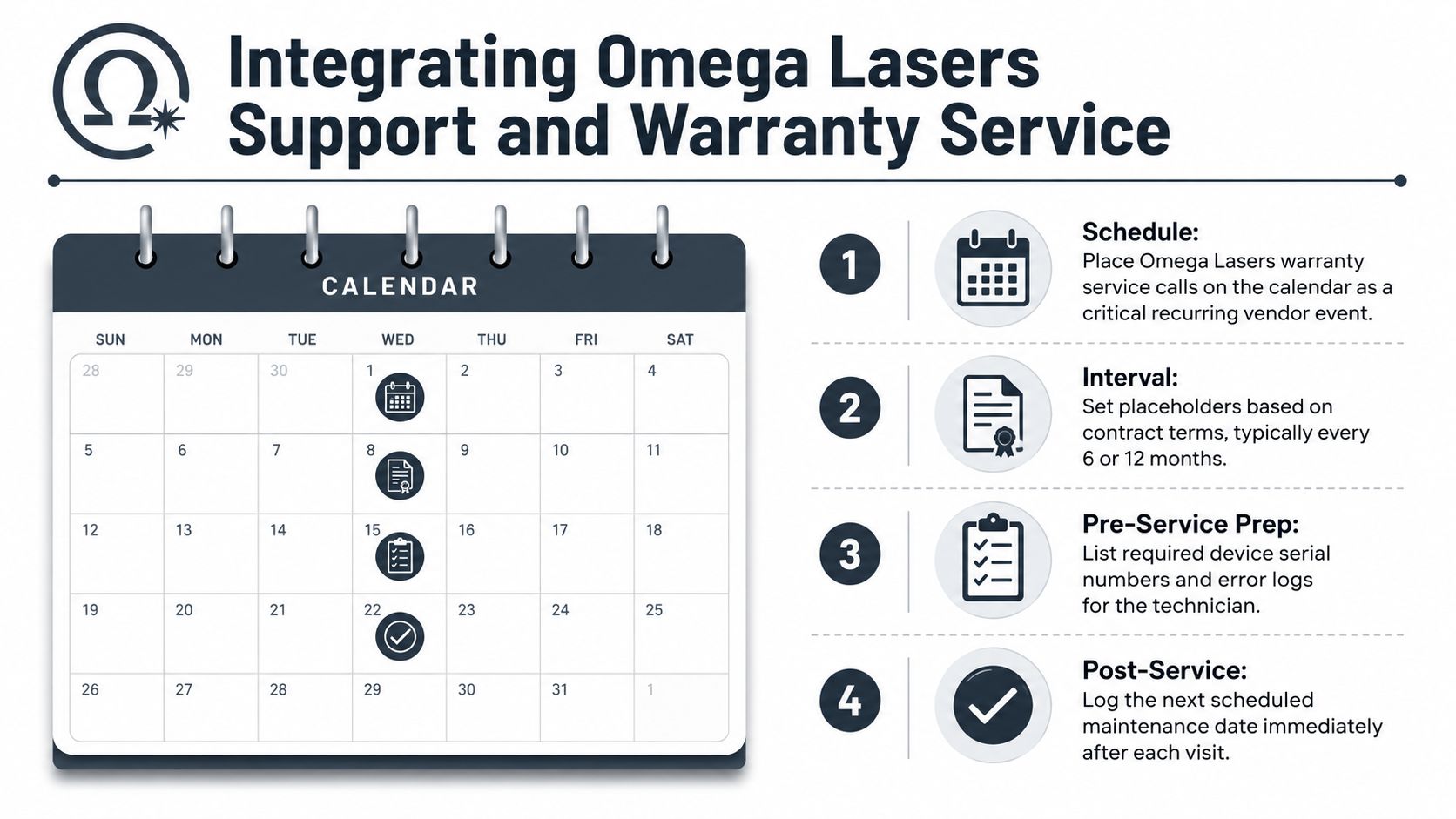
A warranty provider should sit inside the clinic's maintenance calendar, not outside it as a number staff call only after a failure. Record the contract interval for each device, create a recurring service placeholder, and contact Omega Lasers support at least two weeks before planned work so the visit can be coordinated with device availability and treatment demand.
Keep a separate fast-track route for warranty faults. A handpiece fault or calibration drift shouldn't wait for the next routine visit if the device is affecting patient safety, treatment quality, or booked revenue. Log the date, technician, work performed, parts replaced, and next scheduled service immediately after every visit.
Use training as part of the maintenance system. When therapists understand cleaning, startup checks, consumable handling, and safe fault isolation, they reduce avoidable service requests and give the technical provider better information when escalation is necessary. Store service certificates and calibration reports alongside the internal equipment record, so warranty reviews, compliance checks, and financing inspections rely on one consistent file.
The recurring mistakes are predictable:
- Skipping the asset register: Register every device on day one.
- Bundling every device into one service day: Stagger service across the month.
- Ignoring consumable lead times: Order required consumables well before the planned visit.
- Letting one person own all records: Train a second staff member to maintain the log.
- Treating warranty dates as optional: Diarise warranty end dates and review them before they expire.
The practical support pathway is described through Omega Lasers' after-sales service. If a clinic also relies on online booking or ecommerce during a planned closure, it should clearly communicate availability and, where relevant, temporarily close your online store rather than accepting orders it can't fulfil.
A disciplined Monday-morning start is more valuable than a perfect schedule drafted months later. Review overdue tasks, open faults, upcoming warranty dates, critical devices, and the week's booking pressure, then assign the next action to a named person.
Omega Lasers supplies aesthetic laser and multi-technology systems with training, technical support, warranty coordination, and after-sales service that can support a structured maintenance programme. Visit Omega Lasers to discuss a device and support plan that aligns service intervals with your clinic's bookings, compliance records, and uptime priorities.