



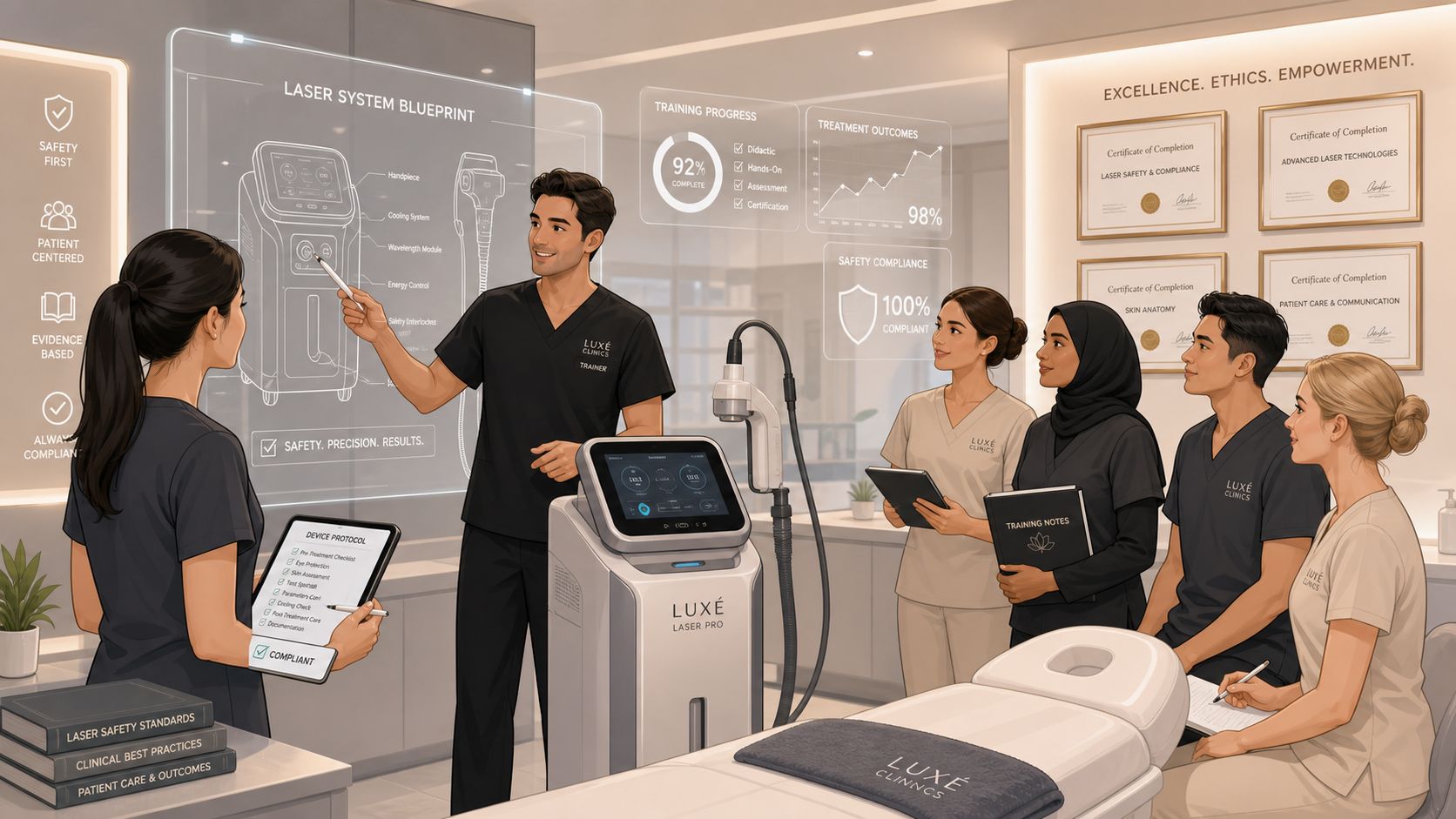
Training failures in aesthetic clinics usually show up first in retention, rebook rates, treatment consistency, and avoidable compliance risk. By the time an owner sees the financial impact, the underlying problem has often been sitting in the training plan for months.
In South Africa, staff training and development needs to do more than teach someone how to operate a device. It needs to produce safe clinical decisions, accurate documentation, stronger consultations, and better conversion from first visit to repeat treatment. That is the gap many clinics miss. They train for treatment delivery, but not for the client journey or the commercial discipline that keeps a clinic profitable.
I see this often when clinics invest heavily in technical instruction and still struggle with cancellations, weak retail performance, inconsistent consent records, or low utilisation on expensive equipment. The issue is rarely effort. The issue is scope. A therapist or clinician can know a protocol and still lose revenue through poor communication, weak expectation-setting, or failure to identify the right treatment pathway for the patient in front of them.
That is why a strong programme covers compliance, onboarding, device competency, soft skills, and business development as one operating system rather than five separate tasks. Clinics that verify qualifications properly, document training clearly, and close communication gaps usually protect patient safety better and recover their training spend faster. A good starting point is a formal practitioner credential verification process, followed by role-specific training that reflects actual clinic workflows.
The commercial case matters. Soft skills training is not a nice extra in aesthetics. It affects consultation quality, treatment acceptance, client confidence, complaints, and long-term value per patient. Compliance training matters for the same reason. It reduces preventable errors, supports cleaner processes, and lowers the risk of expensive operational problems, a point reinforced by HubEngage workforce compliance insights.
For clinic owners and managers, the priority is straightforward. Train staff to work safely, communicate clearly, sell ethically, and use clinic systems properly. That combination protects patients and gives the business a better return on every hire, every machine, and every marketing rand.
Índice
- Building Your Training Programme on a Foundation of Compliance
- A Strategic Onboarding Plan for New Hires
- Developing Advanced Device-Specific Competency
- Integrating Soft Skills for Higher Client Retention
- Measuring Training Effectiveness and ROI
- Frequently Asked Questions about Staff Training
Building Your Training Programme on a Foundation of Compliance
Aesthetic training fails when clinics start with treatments instead of rules. Before anyone learns settings, consultation flow, or sales language, the clinic has to define what's legally permitted, what's clinically safe, and what documentation proves both.
Start with the legal setting
Na África do Sul, all laser aesthetic treatments must be performed exclusively in a clinical setting to protect patient safety and align with laser safety requirements, as outlined by South African laser safety guidance. That single fact should shape your entire training model. If a team member is being prepared to operate energy-based devices outside that framework, the clinic is building bad habits from day one.
The second critical aspect sits with laser safety education. According to the ANSI Z136.3 standard, the gold standard for laser safety, any staff member operating, assisting, or present near a Class 3B or Class 4 laser must complete formal laser safety education, with certification valid for one to three years before renewal is required according to this ANSI Z136.3 laser safety summary. That applies wider than many clinic owners assume. It's not just the primary operator. It includes support staff and anyone routinely present in the treatment environment.
Regra prática: If someone can enter the room, prep the room, assist in the room, or operate the device, train them formally and document it.
A helpful operational model is to borrow from broader HR governance. The same discipline used in workplace policy training applies here. Structured records, role-based learning, renewal cycles, and audit trails are standard practice in strong compliance systems, which is why HubEngage workforce compliance insights are useful reading for clinic owners trying to professionalise staff oversight.

Build the five compliance pillars
Most clinics need a written training framework built around five pillars:
Clinical setting control
Define where treatments may happen, who may supervise them, and how room readiness is checked before the first patient.Laser safety roles
Assign operator responsibilities, support staff limits, and Laser Safety Officer oversight. If nobody owns safety, nobody manages it consistently.Device credentials and verification
Keep a single credential register for every operator and every system they're cleared to use. A simple way to structure this is to maintain an internal process for credential verification and training status checks.Documentation standards
Record induction dates, competency assessments, incident reviews, refresher training, and certification expiry dates. Clinics often think they have a training programme when they really have scattered WhatsApp messages and supplier emails.Audit readiness
Training only counts if you can prove it. Keep signed attendance records, observed practical assessments, SOP acknowledgements, and room safety checklists.
What doesn't work is vague instruction such as “follow the protocol” or “shadow the senior therapist”. Staff need exact boundaries. Who can patch test. Who can adjust parameters. Who can obtain consent. Who escalates an adverse reaction. Who signs off before independent practice.
The ethical reason for this is obvious. The commercial reason is just as important. A clinic with poor compliance training loses time to mistakes, cancellations, rework, and reputation damage. A clinic with disciplined compliance training creates a safer treatment environment and a more predictable business.
A Strategic Onboarding Plan for New Hires
New hires rarely fail because they lack potential. They fail because clinics overload them with theory, leave gaps in process, and let them interact with patients before they can handle the basic workflow cleanly.
What a strong first month looks like
A rigorous step-by-step onboarding method should establish software and technology proficiency before the first patient interaction, including check-in, medical records, standardised photos, payments, and reporting, because weak process control can lead to compliance failures and even licence risk, as explained in this aesthetic clinic onboarding guide. That order matters. If a clinician can fire a laser but can't document consent, capture photographs consistently, or complete a treatment note, the clinic is exposed.
The first month should focus on controlled observation and repeatable routines rather than speed. New staff need to see how your clinic runs under pressure. That includes late patients, anxious patients, patients with unrealistic expectations, and patients whose records aren't complete.

A practical onboarding sequence looks like this:
Foundation first
Start with clinic policies, room flow, infection control, emergency escalation, and the exact route a patient takes from arrival to checkout.System fluency next
Make new hires complete supervised tasks inside the clinic software before they join live consultations. They should be able to open records, log notes, attach imagery, and follow reporting requirements without guessing.Observation before hands-on work
Let them shadow consultations and treatments with a checklist in hand. Passive watching doesn't teach much. Directed observation does.
New staff don't need early freedom. They need early clarity.
How to use the full 90 days properly
The remaining onboarding period should move from supervised application to narrow independence. Not full autonomy. Narrow independence in defined tasks.
Use the five pillars of effective onboarding as your internal scorecard:
Clinical protocols
Teach consultation flow, contraindication checks, consent handling, photography standards, aftercare instructions, and escalation rules. Don't sign off skill by skill in isolation. Sign off full treatment workflow.
Patient communication
Train staff to explain what the treatment can do, what it cannot do, what downtime may look like, and when a client should call the clinic. The wording matters. Confused clients don't become loyal clients.
Conformidade regulamentar
Make every hire show they understand what is allowed in your setting, what must be documented, and when to stop rather than proceed.
Software proficiency
This is still the most overlooked part of onboarding. If a therapist can't complete records properly, your reporting, continuity of care, and defence against disputes all weaken.
Continuous development
End the first 90 days with a documented competency review, identified gaps, and a training plan for the next quarter. Good onboarding doesn't stop at day 90. It shifts from close supervision to managed development.
What doesn't work is throwing every manual, every protocol, and every product sheet at a new hire in week one. Retention drops, confidence collapses, and standards drift. Sequenced onboarding works better because it mirrors real clinical responsibility.
Developing Advanced Device-Specific Competency
Device-specific competency protects margin as much as it protects patients. Clinics lose money when staff under-treat, over-treat, rely on presets, or call for help halfway through a booked session. In the South African market, where replacing equipment is expensive and retention matters, advanced training needs to produce confident judgement at the bedside, not basic familiarity with a handset.

Why manuals are not enough
As noted earlier, South Africa's wider skills gap makes one-time training a weak model. In aesthetics, the problem shows up quickly. A therapist may know the treatment name, but not the tissue response to watch for. Another may follow preset parameters correctly, but fail to adjust for skin condition, recent sun exposure, medication changes, or poor client compliance before the appointment.
That is the gap between operating a machine and using a device safely in a commercial clinic.
Advanced competency usually needs three distinct layers:
| Layer | What staff must learn | Common failure if skipped |
|---|---|---|
| Foundational science | Energy behaviour, tissue interaction, indications, contraindications | Preset dependence and weak treatment planning |
| Device operation | Interface logic, treatment sequencing, consumables, shutdown and fault response | Delays, inconsistent delivery, avoidable errors |
| Clinical judgement | Parameter adjustment, patient selection, endpoint recognition, escalation decisions | Unsafe choices under pressure |
The business consequence is straightforward. Weak device training increases rework, complaints, free review appointments, and inconsistent outcomes. It also drags down conversion into treatment packages because clients notice uncertainty fast.
How to structure practical competency
Good training starts with treatment logic. Staff need to understand why settings change, what a normal endpoint looks like, what should trigger a pause, and when the correct decision is to stop and escalate. Without that grounding, practical sessions become memorisation exercises.
Then build supervised repetition in stages.
Live demonstration
A senior trainer completes the full treatment and explains each decision in real time, including checks, parameter choice, endpoint assessment, and aftercare wording.Observed practice
The trainee performs the treatment under direct supervision and must explain each choice clearly. If they cannot explain it, they are not ready to repeat it on a paying client.Exception handling
Training should include off-script scenarios such as incomplete prep, unexpected erythema, anxious patients, equipment faults, or a history point that changes the plan.Competency sign-off
Sign-off should cover the entire treatment event. Assessment should include patient selection, setup, delivery, documentation, adverse response handling, and post-treatment instructions.
A certificate only confirms attendance. Profitability comes from consistent outcomes, safe decisions, and fewer avoidable refunds.
For clinics introducing a new platform, assess supplier training on depth and supervision time. Ask direct questions. How many live cases are included? Who signs off competency? Does the training cover adverse events, documentation standards, and realistic South African skin-type variation? If you are reviewing education for a new hair removal service, compare it against dedicated laser hair removal training pathways rather than accepting a short handover as sufficient preparation.
I advise clinic owners to track advanced competency with commercial measures as well as clinical ones. Look at retreatment rates, complaint frequency, average package uptake, review booking patterns, and device downtime linked to user error. That is where the return shows up. Strong device training improves safety first, but it also improves schedule efficiency and client confidence, which usually lifts retention and revenue per patient.
Omega Lasers is one provider active in this area, offering device training with technical and business support for clinics using its systems. The useful test is practical. Training should produce operators who can assess, choose, explain, document, and escalate properly under real clinic pressure.
Integrating Soft Skills for Higher Client Retention
Technical quality gets a client through the first treatment. Soft skills usually decide whether they return.
The business case for soft skills
South Africa's labour data is unusually clear on this point. The Labour Market Information report identifies soft skills as a primary deficit in the workforce and notes that vocational training needs specific soft-skills programmes for the current workforce, as set out in the South African LMI skills gap report. That matters in aesthetic clinics because the treatment is only part of what the client is buying. They're also buying reassurance, clarity, dignity, consistency, and trust.
Many clinic owners still train communication informally. They expect staff to “pick it up” from senior team members. That approach doesn't hold. One therapist overexplains risk and scares the client. Another therapist underexplains downtime and creates dissatisfaction. A third sounds abrupt when trying to be efficient. The clinical result may be acceptable, but the relationship weakens.
Where soft skills belong in clinic training
Soft skills shouldn't sit in a separate motivational workshop. They belong inside operational training, especially at the points where revenue and retention are won or lost.
Focus on five areas:
Consultation listening
Staff should learn to identify the client's stated goal and the unspoken concern behind it. A client asking for “faster results” may really be asking whether the treatment is worth the cost.Expectation setting
Good teams explain the likely treatment journey in plain language. They don't promise outcomes they can't control.Education without jargon
Clients need understandable explanations of benefits, limits, side effects, and aftercare. Technical language can sound impressive while still leaving the client confused.Professional demeanour
Calm tone, organised handover, and confident body language affect how safe the client feels.Complaint handling
A defensive response can destroy a recoverable situation. Staff need scripts and role-play for dissatisfaction, delays, discomfort concerns, and result anxiety.
A simple way to train this is to map every key client touchpoint and define the expected communication behaviour at each stage. First enquiry. Consultation. Consent. Treatment day. Follow-up. Review visit. Then role-play those moments using difficult but realistic scenarios.
Clinics often think they have a retention problem when they actually have a communication problem.
The ROI sits in fewer misunderstandings, cleaner consent conversations, stronger follow-up adherence, and more trust in treatment plans. You don't need invented metrics to see it. In practice, clients return to clinics where they feel informed and respected. In aesthetics, that's not a soft outcome. It's commercial infrastructure.
Measuring Training Effectiveness and ROI
Training isn't valuable because it happened. It's valuable when staff behaviour changes, treatment quality becomes more consistent, and the clinic performs better with less operational friction.
What to measure beyond attendance
South African programme data gives a useful baseline for why structured development matters. Impact assessments of South African skills programmes show that 86% of learnership completers experienced a smooth transition into employment, with 75% holding permanent contracts and earning better wages, de acordo com o World Bank document citing South African skills programme outcomes. The lesson for clinic owners is straightforward. Formalised training produces stronger workforce outcomes than informal exposure.
In a clinic, though, training ROI has to be tracked at operational level. Attendance sheets and quiz scores won't tell you enough. You need evidence that staff can perform, document, communicate, and convert treatment plans into repeatable service delivery.
Measure training in four layers:
Knowledge acquisition
Did the staff member understand the protocol, safety rules, and workflow?Observed competence
Can they perform under supervision without skipping steps or needing rescue?Behaviour on the floor
Are records complete, photos standardised, aftercare explained correctly, and handovers consistent?Commercial and quality impact
Are consultations cleaner, complaints easier to resolve, and treatment journeys more consistent over time?
If you want a broader business lens for discussing learning returns with management, MEDIAL's guide to training ROI is a useful external reference because it frames training as a measurable investment rather than a vague people initiative.
A practical internal dashboard might include competency sign-off dates, audit findings, treatment note quality, before-and-after image consistency, rework triggers, and client feedback themes. For clinics that want tighter reporting, structured data collection methods for treatment operations and performance reviews can make trend analysis far easier.
Training Assessment Methods at a Glance
| Assessment Method | Purpose | Ideal para | Frequência |
|---|---|---|---|
| Written knowledge check | Confirm understanding of protocols, contraindications, and workflow rules | Early-stage training and refresher learning | At induction and after updates |
| Direct practical observation | Verify live technique, room discipline, and treatment sequencing | Device competency and onboarding sign-off | Before independent practice |
| Scenario-based role-play | Test communication, consent, objections, and escalation judgement | Soft skills and complaint handling | Monthly or during coaching cycles |
| Record audit | Check documentation quality, photo standards, and completeness | Compliance and workflow accuracy | Routine internal review |
| Peer review | Surface inconsistencies in real-world practice | Experienced staff development | Periodically |
| Client feedback review | Identify communication gaps and service friction | Retention-focused improvement | Ongoing |
| Manager competency review | Decide readiness for greater independence or retraining | Quarterly development decisions | Quarterly |
The trade-off is simple. If you only measure what's easy, you'll miss what matters. If you only test theory, you won't catch workflow failures. If you only rely on manager opinion, you'll get inconsistency. The best clinics combine objective checks with observed practice and documented review.
Frequently Asked Questions about Staff Training
Who should act as the Laser Safety Officer
The Laser Safety Officer should be someone with enough authority and operational access to enforce rules, not just someone who wants the title. In most clinics, that means a senior clinician, clinical manager, or another designated person who can control room protocols, documentation, renewal schedules, and incident response.
The role shouldn't be symbolic. The LSO needs to verify that safety training stays current, that operators remain within scope, and that the clinic can produce evidence of compliance if challenged. If the LSO can't stop unsafe practice, the appointment has no value.
How should clinics handle mobile or part-time technicians
Many clinics lose control because a part-time or mobile technician may have practical experience, but that doesn't automatically mean they're aligned with your setting, your device protocols, or your documentation standards.
South Africa's skills policy discussion offers a useful lens here. The OECD has highlighted Recognition of Prior Learning (RPL) as an important but underused way to validate existing skills in South Africa, particularly when implementation is supported by employers, as discussed in the OECD report on skills in South Africa. For clinics, the practical answer is to assess prior experience properly, not dismiss it and not trust it blindly.
Use a simple internal pathway:
Review prior experience
Ask for previous training records, treatment exposure, and scope of work.Assess against clinic standards
Run the technician through your consultation, safety, documentation, and communication requirements.Sign off only what is proven
Don't grant blanket clearance. Clear the person for specific workflows and devices they can demonstrate safely.
This matters for inclusion as well as safety. Experienced technicians often have strong hands-on ability but weak paper trails. Clinics that use structured assessment can widen access without lowering standards.
How do you evaluate vendor training before buying a device
Don't ask whether training is included. Ask what training contains.
You want specific answers to practical questions. Is there supervised hands-on practice. Does the programme cover contraindications and adverse event response. Are staff trained on consultation quality, photography, and record-keeping or only on device controls. Is there a clear re-training path when your team changes.
A useful vendor checklist includes:
Scope of education
Theory, practical work, safety, consultation, and aftercare should all be covered.Role-based design
Operators, assistants, and managers don't need the same depth, but they all need defined learning outcomes.Proof of completion
Certificates matter less than competency records, but you should still receive proper documentation.Apoio pós-venda
Real training includes troubleshooting, refresher access, and a way to address drift in standards.
The wrong question is “Will they train us?” The right question is “What will our staff be able to do safely and consistently when the trainer leaves?”
Staff training and development only works when clinics stop treating it as an event. It's an operating system. In aesthetics, that system has to protect patients, satisfy regulators, shorten ramp-up time, improve consistency, and strengthen retention. If any one of those pieces is missing, the clinic usually feels it somewhere else in the business.
If you're building or tightening a training system around energy-based treatments, Lasers Omega can be a practical starting point. The company supplies SAHPRA-licensed, FDA-approved and CE-certified medical-aesthetic platforms and supports clinics with device training, technical guidance, and business development support, which makes it relevant for teams that need both equipment education and stronger day-to-day operating standards.