



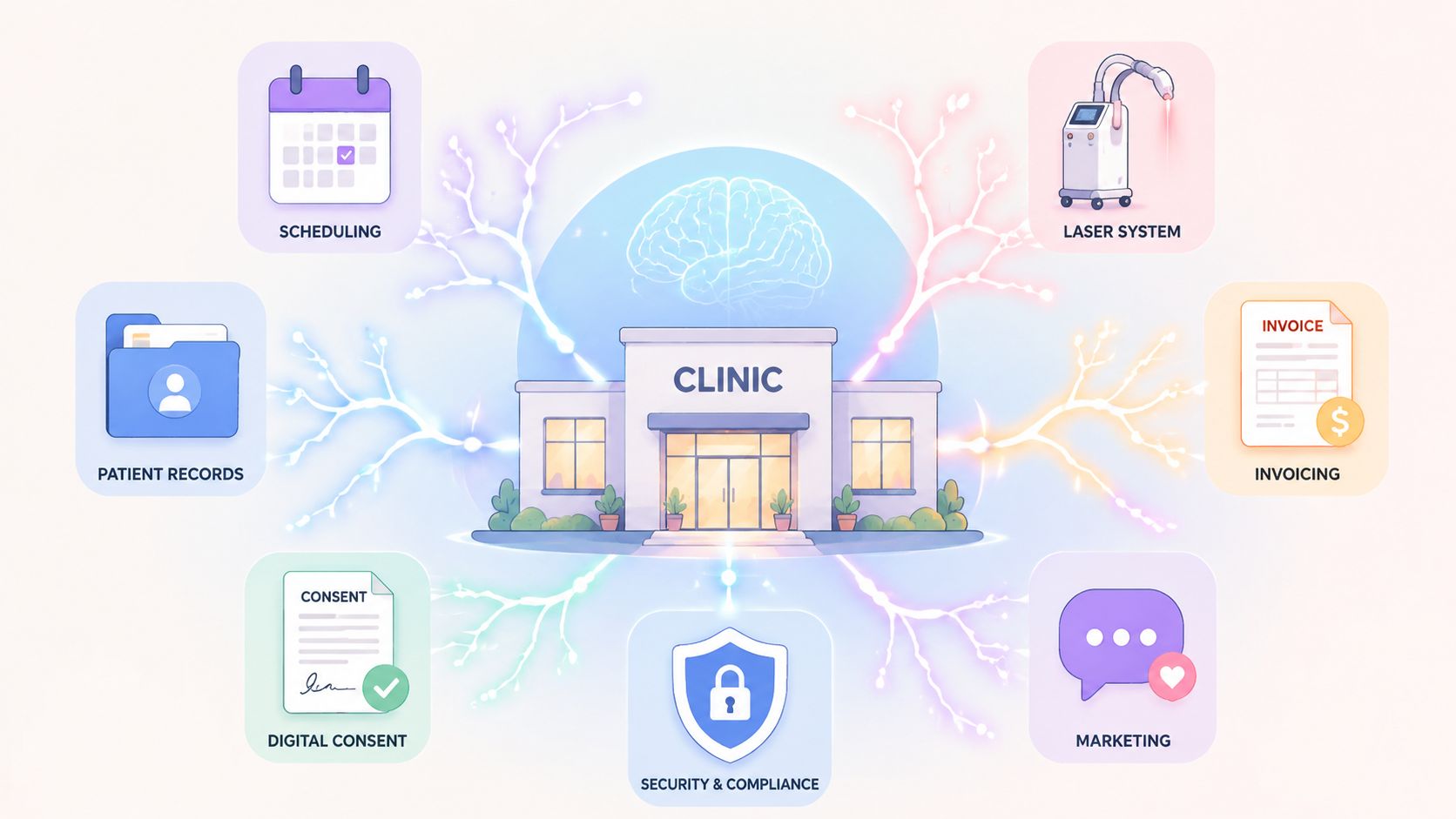
Your clinic probably isn't short on demand. It's short on control.
A client arrives for laser hair removal and your receptionist can't find the signed consent form. Another client was promised a follow-up slot that never made it into the diary. A therapist asks which settings were used last time, and someone digs through WhatsApp messages, a paper file, and a photo folder on a laptop that nobody has organised properly. By 18:00, the team is still capturing notes, chasing payments, and trying to remember who needs an aftercare check-in.
That's not a software problem. That's an operating model problem.
A proper patient management system fixes it. For a South African aesthetic clinic, it should do far more than hold bookings. It should connect your front desk, treatment rooms, compliance records, communication, billing, and device data so the business runs cleanly and profitably. Always ensure the information is accurate and true, as this concerns aesthetic lasers, energy-based devices, and health.
Índice
- The Hidden Costs of a Disorganised Clinic
- What Is a Patient Management System Really
- Core Features That Drive Clinic Profitability
- Ensuring Compliance and Security in Your Practice
- Integrating Your System with Aesthetic Devices
- Choosing and Implementing the Right PMS
- Measuring ROI and Maximising Client Retention
The Hidden Costs of a Disorganised Clinic
A growing clinic often looks successful from the outside. The diary is full. The phones don't stop. Staff are busy all day. But inside, the business leaks money through small failures that repeat every week.
One receptionist is juggling calls, card payments, and handwritten booking notes. A practitioner is waiting for treatment history before starting a session. A manager is trying to check whether a device file, a consent form, and a payment record all match. Nobody's doing one big thing badly. Everyone's doing ten small things manually, and that's the problem.

Where the real losses sit
The expensive part of disorder isn't paper. It's friction.
- Missed rebookings: Staff forget to prompt the next session while they're busy fixing admin issues.
- Slow check-ins: Clients wait while files, forms, or treatment notes are hunted down.
- Weak follow-up: Post-treatment communication becomes inconsistent, so retention suffers.
- Compliance gaps: Records exist, but they're scattered across places that don't speak to each other.
- Management blindness: Owners can't see what's driving revenue and what's wasting chair time.
The public sector's shift tells you where healthcare is going. The Gauteng Department of Health has set a target to digitise a minimum of 800 million patient records within 36 months across 37 public hospitals to eliminate manual file searches, reduce operational costs, and improve compliance under its eHealth initiative, according to the Gauteng Department of Health digitisation programme. Private clinics that still rely on fragmented processes are moving in the opposite direction.
A clinic can look busy and still be operationally weak.
If your booking system, consent process, billing flow, and treatment records live in separate silos, your team spends the day reconciling information instead of serving clients. That's why many clinic owners start looking at solving compliance challenges with integration only after the admin burden becomes unmanageable.
A patient management system isn't an add-on. It's the structure that stops growth from becoming chaos.
What Is a Patient Management System Really
Most clinic owners buy a patient management system for appointments. That's too narrow. A real Patient Management System is the clinic's central nervous system. It carries information from the first enquiry to the final follow-up, and it keeps each part of the business responding to the same record.
If your clinic still works from a mix of diary entries, paper forms, spreadsheets, bank references, and staff memory, you don't have a system. You have workarounds.

One record, one workflow
South Africa still lacks a national unique patient identifier in general rollout. That matters more than many clinic owners realise. The lack of a national unique patient identifier has led to fragmented manual records, inflating patient waiting times by 30–45% in some facilities, as noted in the South African Health Review discussion of health information systems.
For an aesthetic clinic, the business implication is obvious. If one client has multiple versions of their history across the reception desk, therapist notes, image folders, and payment logs, every visit takes longer and every decision becomes riskier.
A proper patient management system should create one reliable client profile that includes:
- Identificação e dados de contacto: So the right person gets the right reminders and consent requests.
- Clinical history: So practitioners don't guess what happened at the previous session.
- Treatment records: So settings, outcomes, reactions, and aftercare are linked.
- Financial records: So quotes, deposits, packages, and balances are visible in the same workflow.
- Communication history: So the team can see what was sent, promised, confirmed, or missed.
It's software, but it's also management discipline
Think of the system this way. The front desk enters a booking. The practitioner sees the treatment plan. The consent form is attached before the appointment starts. The session note is completed in the same record. The invoice reflects what was done. The follow-up is scheduled automatically. That's operational continuity.
Without that continuity, staff spend their time bridging gaps manually. With it, the clinic behaves like one business instead of five disconnected tasks.
Regra prática: If a team member has to ask, “Where would I find that?”, your system is too fragmented.
If you want a broader primer on the category itself, understanding medical practice management software is useful background reading. But for aesthetic clinics, the standard definition still isn't enough. You need a system built around treatment continuity, consent, safety, client retention, and revenue visibility.
That's why the best patient management system isn't the one with the most menus. It's the one that gives your clinic a single source of truth and gets your team to use it every day.
Core Features That Drive Clinic Profitability
Features only matter if they change behaviour in the clinic. A long feature list means nothing if your receptionist still has to chase forms manually, your therapist still duplicates notes, and your manager still can't see who's due for a rebooking.
The profitable patient management system is the one that removes friction at the exact points where clinics lose time, revenue, and trust.
Scheduling that protects treatment capacity
An aesthetic clinic doesn't sell appointments. It sells utilisation of rooms, practitioners, and devices. Your scheduling system should reflect that reality.
A good setup should stop double-bookings, account for treatment duration, flag prep time, and trigger reminders before the appointment. It should also make it easy to pre-book package sessions while the client is still in the clinic.
That matters because follow-up discipline drives revenue. A multi-centre study of South African clinics found that integrating telemedicine and automated communication modules into patient management systems increased follow-up adherence by 41% and reduced administrative overhead by 1.8 hours per clinician weekly, de acordo com o South African clinic study on integrated telemedicine and communication modules.
Aesthetic clinics should read that as a direct business signal. If your system handles reminders, check-ins, and follow-up communication inside one workflow, your staff gets time back and more clients return for the next session.
Records that support consistent clinical delivery
Every repeatable result starts with repeatable documentation.
If one therapist writes detailed notes and another writes almost nothing, the client experience becomes inconsistent. That's where clinics lose confidence, especially with treatments that rely on progression over several sessions. Your system should hold consultation notes, contraindications, patch test history, treatment settings, reaction notes, aftercare, and progress images in one place.
For clinic owners refining internal processes, this guide to data collection methods for aesthetic clinics is worth reviewing because better data capture leads to better commercial decisions as well as safer treatment delivery.
Payments and packages that don't create admin drag
Many clinics still separate treatment records from invoices. That's a mistake. If your practitioner performs one service, your front desk shouldn't have to rebuild the commercial side of that visit from memory.
Use a patient management system that links the booked service, completed treatment, product sales, package balances, and outstanding amounts in the same record. That gives you cleaner handovers between treatment room and reception. It also makes reporting useful instead of theoretical.
Here's what that looks like in practice:
| Área | Weak setup | Strong setup |
|---|---|---|
| Booking | Staff book a slot only | Staff book the service, duration, provider, and resource |
| Treatment note | Captured later or inconsistently | Completed in the same client workflow |
| Payment | Re-entered separately | Pulled from services delivered |
| Reagendamento | Left to memory | Prompted during checkout |
Communication that keeps clients coming back
Aesthetic businesses don't just need reminders. They need timed communication.
Use the system to send pre-care instructions before a treatment, aftercare after the visit, and rebooking prompts when the next session is due. Segment clients by treatment type, stage of plan, and attendance behaviour. A client who completed session one of a course needs a different message from a client who disappeared after consultation.
The clinics that grow fastest usually aren't doing more treatments per day. They're losing fewer clients between treatments.
Reporting that drives decisions
Most owners don't need more dashboards. They need a few numbers they can trust.
Track cancellation patterns, package redemption, practitioner utilisation, repeat visit behaviour, and average revenue per client. If your patient management system can't show that clearly, it won't help you improve margin.
Profitability comes from operational control. The software should make your next best action obvious.
Ensuring Compliance and Security in Your Practice
Manual compliance used to be inefficient. Now it's reckless.
Aesthetic clinics handle consent, images, treatment records, medical histories, device information, and incident details. If those records are spread across paper files, personal phones, shared inboxes, and disconnected folders, your clinic is exposed. It only takes one missing document, one delayed report, or one access mistake to create a serious problem.
Compliance has to live inside the workflow
The strongest clinics don't treat compliance as a separate admin function. They build it into every step of the patient journey.
That means the patient management system should control who can view records, log who changed what, store consent forms with timestamps, and keep treatment history attached to the correct client file. It should also support structured incident documentation, because deadlines matter.
Under South Africa's National Guideline for Patient Safety Incident Reporting, all Severity Assessment Code 1 incidents must be reported within 24 hours and finalised within 60 days, de acordo com o National Guideline for Patient Safety Incident Reporting and Learning. If your clinic relies on memory, email threads, or a paper incident file, you're making a time-sensitive obligation harder than it needs to be.
What secure practice looks like day to day
A secure system should make good habits automatic.
- Access control: Reception shouldn't see everything a clinical lead can see.
- Audit trail: Every edit, upload, and form completion should be traceable.
- Record integrity: Consent, notes, images, and treatment details should stay attached to one file.
- Incident readiness: Staff should be able to log safety concerns immediately and escalate them properly.
- Operational continuity: The clinic should still function when one staff member is absent or leaves.
For owners tightening their documentation standards, this practical guide to aesthetic clinic record keeping is a good place to sharpen internal processes.
Security isn't just an IT topic
Clinic owners often underestimate cyber risk because they think healthcare data breaches happen only in large organisations. That's false. Smaller clinics are often less protected and more dependent on informal workarounds.
If you want a clear view of what secure healthcare-grade systems should account for, this resource on securing HIPAA-regulated data helps frame the security mindset, even though your clinic operates in a South African context.
If your team can bypass the system to “save time”, the system is creating future risk.
Security and compliance aren't side benefits of a patient management system. They're part of the return on investment. A clinic with reliable records, controlled access, and audit-ready workflows protects revenue, protects reputation, and protects the owner from avoidable legal exposure.
Integrating Your System with Aesthetic Devices
Most clinic software stops at the screen. That's a missed opportunity.
For an aesthetic clinic, the primary benefit emerges when the patient management system connects to treatment delivery itself. When software and devices work together, the clinic stops relying on memory and handwritten notes to explain what happened in the room.

Why device integration changes the game
In a non-integrated clinic, a practitioner performs a session, then writes down selected details later. Sometimes the notes are complete. Sometimes they aren't. Settings may be abbreviated. Maintenance logs may sit somewhere else. If a client asks what changed between sessions, the team may not have a clean answer.
Integrated workflows fix that. The system can link the session to the client profile, capture treatment parameters, and keep the record consistent across future visits. That gives practitioners a better base for adjusting protocols and gives owners a cleaner operational history.
A critical point: All medical devices used in South African health establishments, including aesthetic lasers, must be registered with SAHPRA. Operating an unregistered device is illegal and can lead to fines or imprisonment up to 10 years, tal como descrito no South African medical devices and telemedicine regulatory overview. Device tracking inside your patient management system supports that compliance mindset because it ties treatment activity to the equipment used.
What to connect
You don't need complexity for its own sake. You need useful data flow.
- Treatment parameters: Link the session to the selected settings used on that client.
- Device usage history: See how often each machine is used and by whom.
- Maintenance prompts: Keep service scheduling visible instead of reactive.
- Outcome review: Compare treatment records with progress notes and images over time.
The clinics that document treatment variables properly don't just defend themselves better. They improve protocols faster.
The commercial upside
Better integration improves consistency. Consistency improves trust. Trust improves retention.
It also helps with staffing. When a practitioner is off, another trained team member can review the file and continue care with far less guesswork. That protects continuity for package-based treatments where interruption often leads to drop-off.
A modern clinic shouldn't treat devices as isolated assets. It should treat them as connected parts of a controlled treatment system.
Choosing and Implementing the Right PMS
Most clinics choose badly for one reason. They buy software based on a demo instead of a workflow.
A polished interface doesn't mean the system fits your operation. You need a patient management system that matches how your clinic books, consults, treats, records, invoices, follows up, and reports. If it can't support that chain cleanly, don't buy it.

The shortlist criteria that actually matter
Use this filter before you speak about price.
| Área de decisão | O que verificar |
|---|---|
| Adaptação clínica | Can it handle consultations, consent, treatment notes, photos, aftercare, and follow-up in one record? |
| Compliance fit | Does it support secure access, audit history, and reliable record storage? |
| Adaptação comercial | Can it manage packages, invoices, balances, and rebooking prompts without manual duplication? |
| Operational fit | Will reception, practitioners, and managers all use the same workflow? |
| Technical fit | Can it support device-linked processes and the way your clinic actually runs? |
| Growth fit | Will it still work when you add rooms, staff, sites, or services? |
Don't let your team ask only, “Is it easy to use?” Ask, “Does it stop us from working around it?”
How to implement without wrecking the month
Software transitions fail when owners underestimate behaviour change. Staff don't resist because they hate systems. They resist because bad rollouts make their day harder.
Use a staged approach:
- Map the current workflow. Write down how a client moves from enquiry to completed follow-up.
- Clean your data first. Remove duplicates, outdated fields, and junk records before migration.
- Set rules early. Decide where notes live, who completes what, and when records must be finished.
- Train by role. Reception needs one workflow. Practitioners need another. Managers need reporting and oversight.
- Go live in phases. Start with booking and records, then layer in payments, automation, and reporting.
What owners should insist on
Don't delegate the important decisions entirely to admin staff or an external implementer. The owner or clinic lead must define the essential requirements.
- One source of truth: No parallel paper process unless legally required for a specific reason.
- Mandatory completion points: The system should force critical steps before the visit closes.
- Clear responsibility: Every task needs an owner, from consent checks to follow-up booking.
- Review discipline: Check adoption weekly in the first phase, not months later.
Staff adoption improves when the system removes confusion on day one.
The best implementation mindset is simple. Don't digitise bad habits. Fix the workflow, then put the workflow into the system.
Measuring ROI and Maximising Client Retention
If you can't measure the return, you won't manage the system properly.
A patient management system should show whether the clinic is getting tighter operationally and stronger commercially. Focus on indicators that reveal behaviour, not vanity. Look at rebooking rates, follow-up completion, package redemption, therapist utilisation, late cancellations, and revenue per returning client.
Retention is the key. Clinics usually chase new leads while existing clients slip away unnoticed between sessions. A better system changes that by turning treatment plans into visible follow-up actions. Use segmented communication, timed reminders, and targeted recall lists to bring clients back at the right moment, not weeks too late.
For practical ideas on turning operational data into repeat business, this guide to client retention strategies for aesthetic clinics is worth applying inside your workflow.
A short checklist helps keep the focus sharp:
- Watch attendance patterns: Find who books once and disappears.
- Track incomplete plans: Flag clients who started a course but didn't finish it.
- Reward loyalty intelligently: Identify clients with strong repeat behaviour and offer relevant next-step treatments.
- Review provider performance: Look for differences in rebooking and follow-up completion across the team.
A patient management system isn't just admin software. In a well-run clinic, it becomes the mechanism that protects margins, strengthens compliance, improves consistency, and keeps clients returning.
If your clinic is investing in better systems, better treatments, and stronger long-term profitability, Lasers Omega is worth speaking to. Beyond supplying advanced medical-aesthetic platforms, the team supports clinics with training, technical guidance, and business development that helps turn compliant treatment delivery into sustainable growth.