



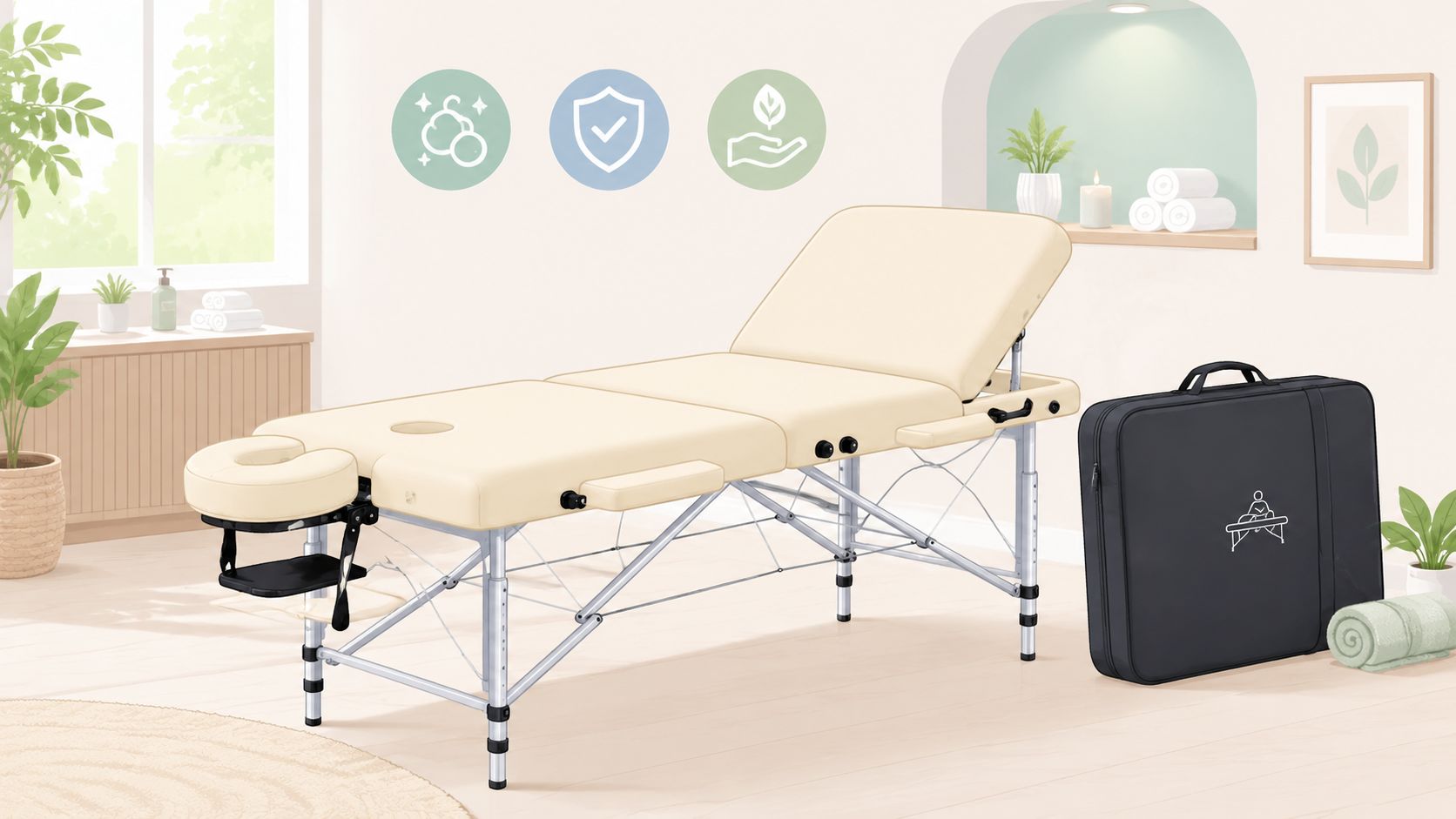
A lot of clinic owners reach the same point. The treatment list has grown, one room is always full, mobile bookings are increasing, and the standard fixed bed no longer fits the way the business runs. You need something that folds, stores easily, travels when needed, and still feels professional enough for paying aesthetic clients.
That's where a portable bed for massage becomes more than a convenience item. In a modern aesthetic setting, it can support overflow bookings, skin consultations, facials, lash work, body treatments, and selected laser or energy-based workflows when room flexibility matters. It also gives smaller practices a way to expand service capacity without committing immediately to another permanent room fit-out.
The catch is that many buyers still shop for these beds as if they're only for relaxation massage. That's a mistake. In an aesthetic clinic, the bed affects treatment positioning, therapist posture, cleaning routines, room turnover speed, and the client's sense of safety. A poor bed slows the day down. A good one protects workflow.
Return on investment comes from use, not from the lowest purchase price. If one bed can handle overflow consultations in the morning, facials in the afternoon, and mobile appointments on certain days, it becomes a productive asset rather than spare furniture. But that only works if the frame is stable, the upholstery tolerates clinical cleaning, and the setup suits precise treatment work.
Índice
- Introduction Why Your Clinic Needs a Professional Portable Bed
- Understanding Portable Bed Specifications
- Must-Have Features for Aesthetic Treatments
- Hygiene and Disinfection Protocols for Clinical Use
- Ensuring Safety with Lasers and Aesthetic Devices
- Tips for Transport Setup and Therapist Ergonomics
- Your Procurement and Investment Checklist
Introduction Why Your Clinic Needs a Professional Portable Bed
A professional portable bed belongs in more clinics than most owners realise. Not because every clinic plans to offer mobile massage, but because treatment businesses change faster than furniture does. Staff rotate between rooms. Demand spikes on certain days. New services start as trials before they become permanent menu items.
For aesthetic businesses in South Africa, flexibility has direct value. A portable bed can help when a therapist needs a second room for facials, when a consultation area must convert into a treatment space, or when a team offers off-site services for events, home visits, or satellite locations. That kind of adaptability supports revenue without forcing a major build.
The bed also shapes the client experience. If the surface feels narrow, unstable, too low, or poorly padded, clients notice it immediately. In facials, lashes, skin analysis prep, and device-led body treatments, comfort matters because stillness matters. The more secure the client feels, the easier it is to work accurately.
Regra prática: Buy the bed for the most demanding treatment you plan to perform on it, not the easiest one.
A clinic owner should also think operationally. Can one person carry it? Can it be cleaned quickly between clients? Does it fold without fighting the frame? Will it support a broad range of client sizes and treatment positions? Those are business questions, not just product questions.
A portable bed for massage works best when you stop seeing it as a backup item. In the right clinic, it becomes a scheduling tool, a space-management tool, and a client-care tool all at once.
Understanding Portable Bed Specifications
Product listings often look similar until you understand what the specifications mean in practice. Then the weak options become obvious.
Start with the numbers that affect daily use
Industry buying guides note that standard massage tables are usually about 76 cm wide by 183 cm long, with height ranges of roughly 56 to 96 cm. Professional portable models are generally kept at 14 kg or less, with working weight capacities commonly supporting 135 to 270 kg, de acordo com o seguinte portable massage table guide. Those figures give you a useful baseline for what “portable” should look like in a professional setting.
Think of it like a vehicle. The transport weight tells you what you have to lift, load, and carry. The dimensions tell you whether clients will fit comfortably and whether the bed will suit your room. The working capacity tells you whether the bed is fit for real treatment conditions, not just for a showroom display.
In a clinic, the wrong specification usually shows up as friction:
- Too heavy: Staff avoid using it because moving it becomes a task.
- Too narrow: Clients shift more and therapists compensate with poor posture.
- Too short: Taller clients don't settle properly, especially during longer sessions.
- Too limited in height: The therapist bends, reaches, and tires faster.
A bed can tick the “folding” box and still be a poor purchase. Portability only matters if the bed remains usable once unfolded.
Frame material changes how the bed behaves
Most buyers choose between aluminium and wood-framed options. Each has a place, but the better choice depends on workload.
A lighter metal frame usually makes more sense for mobile technicians and clinics that move the bed between rooms. It's easier to lift, easier to load into a vehicle, and usually quicker to handle during repeated setup cycles. A wood frame can feel more substantial and may suit a bed that stays mostly on-site, especially where appearance matters in a premium room.
Use this simple comparison when reviewing stock:
| Fator | Better for mobile use | Better for semi-fixed use |
|---|---|---|
| Carry weight | Aluminium-style frames | Wood-style frames can be heavier |
| Frequent folding | Lighter structures tend to be easier | Acceptable if moved less often |
| Visual warmth | Functional look | More furniture-like finish |
| Moisture tolerance | Often practical for varied environments | Needs careful long-term care |
If a supplier talks mainly about appearance and not about transport weight, dimensions, stability, and usable adjustment, you're not looking at a serious clinical buying conversation.
Must-Have Features for Aesthetic Treatments
A portable bed for massage in an aesthetic clinic has to do more than hold a client. It has to support accurate work, repeated cleaning, and a wider treatment mix than most generic buying guides acknowledge.

Comfort has to support precision
Soft isn't the goal. Stable comfort is.
In facials, lashes, skin consultations, and body contouring prep, clients may stay in one position for a long time. If the foam compresses too easily, the body settles unevenly and the head position changes. That creates small alignment problems which become annoying during precise work. You don't want to keep adjusting the client when your focus should be on the treatment.
Look for these basics:
- Supportive padding: The surface should feel comfortable without swallowing the client.
- Balanced head support: A face cradle can help in prone work, but for many aesthetic treatments a backrest and neutral head position are more useful.
- Even upholstery tension: Wrinkled or loose upholstery tends to wear badly and looks less clinical.
Versatility matters more than showroom appearance
Many buyers still evaluate these beds as if the only job is massage. That misses how clinics put them to use. Retail listings already present portable beds as suitable for spa, tattoo, and esthetician services, com adjustable height e foldable designs, which reflects the multi-service reality many businesses work in today, as seen in these portable treatment bed listings for esthetician and spa use.
Aesthetic use often favours features that a basic massage setup doesn't prioritise:
- Adjustable backrest: Useful for facials, consultations, waxing, lash work, and treatments where the client shouldn't lie completely flat.
- Quick setup hardware: Valuable when a room changes purpose during the day.
- Accessory compatibility: You may need the bed to work alongside trolleys, magnifying lamps, and devices such as infrared heat lamp systems used in aesthetic settings.
A fixed flat surface can still work well, but only if your treatment menu is narrow. Once the clinic offers multiple services, adjustability usually earns its place.
The frame must stay calm under pressure
Many cheap beds often fail in practical use. A supplier may advertise a large static load number, but that doesn't tell you how the bed behaves while someone climbs on, shifts position, or receives pressure during treatment. Professional tables commonly support a working weight of 225 to 360 kg and a static weight of 1130 to 1590 kg, and that distinction matters because real treatment pressure is dynamic, as explained in this guide to portable massage table load ratings.
For clinics, the practical takeaway is simple. Working weight is the safety figure. Static load is not useless, but it doesn't answer the question you care about, which is whether the bed remains stable during real use.
Watch for signs of a poor frame:
- Side-to-side sway: Bad for client confidence and therapist control.
- Noise under load: Creaking and clicking often point to stress at joints or fittings.
- Uneven feet contact: Small movement at floor level becomes larger movement at treatment level.
A wobble that seems minor during a demo becomes a daily irritation once a therapist is trying to hold a handpiece steady.
For laser and device-led aesthetics, that steadiness matters even more. You're not just protecting comfort. You're protecting treatment accuracy, workflow speed, and staff confidence.
Hygiene and Disinfection Protocols for Clinical Use
A bed that looks clean isn't enough. In an aesthetic clinic, every surface has to be easy to disinfect without being destroyed by the cleaning process itself.

Choose surfaces that can survive clinic reality
Some upholstery looks premium on day one and starts cracking once it meets repeated wiping, friction, body oils, and treatment residue. That's expensive because deterioration doesn't just affect appearance. Split seams and damaged surfaces are harder to clean properly and undermine the clinic's professional standard.
Ask suppliers direct questions about disinfectant compatibility, seam construction, and replacement parts for high-contact accessories such as face cradles and arm supports. If they can't answer clearly, treat that as a warning sign.
For teams formalising infection-control routines, this expert guide for facility managers is a useful reference point because it helps frame surface hygiene as a systems issue, not just a wipe-down habit.
A workable between-client protocol
The best protocol is the one staff will follow under pressure. Keep it practical and consistent.
- Remove used linens immediately. Don't let folded blankets or used towels sit on the bed while the room is reset.
- Wear appropriate protective gear. A reliable supply of black nitrile gloves for cleaning and treatment room turnover helps protect staff hands during repeated disinfection tasks.
- Clean first, then disinfect. If product residue, makeup, oil, or gel remains on the upholstery, the disinfectant step becomes less effective.
- Cover all high-touch points. Wipe the mattress surface, headrest, handles, frame rails, locking knobs, and any adjustment levers.
- Respect contact time. Staff often wipe too fast and dry the surface too soon. Follow the product instructions.
- Inspect before remaking the bed. Look for cracks, lifting seams, or residue around stitched areas.
Clean-looking upholstery can still hide residue around seams, face cradle joins, and adjustment points. Those are the areas staff skip when turnover gets rushed.
A clinic should also schedule deeper checks. Hinges, cables, underside supports, and fold joints collect dust and debris over time. They may not contact the client directly, but if they aren't maintained, the bed becomes harder to clean and less reliable to use.
Ensuring Safety with Lasers and Aesthetic Devices
A portable bed that works for general spa use may still be the wrong bed for a room that uses lasers or other energy-based equipment. That difference matters.

Bed choice affects treatment safety
In laser and advanced aesthetic work, the bed becomes part of the treatment environment. If it shifts while the practitioner is aligning a handpiece, treatment precision suffers. If the upholstery reacts badly to heat, friction, or repeated disinfection, the room standard drops. If the frame design creates awkward access to the treatment area, the operator starts compensating with poor posture or poor positioning.
Clinic owners should also think beyond obvious comfort features. Upholstery and foam should be appropriate for professional use around heat-generating or electrically powered equipment. The frame should feel mechanically stable and predictable. A bed that rocks slightly during basic use can become a real concern once a client is positioned for a device-led procedure that depends on control.
What tends to go wrong?
- The bed is too narrow for controlled positioning. The client keeps adjusting.
- The frame flexes when the operator leans in. Hand stability drops.
- The surface finish is hard to maintain. The room starts looking tired despite good clinical work.
Simple checks before the first treatment
Don't place a new portable bed straight into a laser room without testing it under realistic conditions.
Run through a short acceptance check:
- Set it up on the floor surface where it will be used. Tiles, vinyl, and slightly uneven surfaces can change stability.
- Test entry and exit movement with someone getting on and off from both sides.
- Apply treatment-position pressure from the angles a practitioner uses.
- Check room clearance around cables, trolleys, foot traffic, and device positioning.
- Confirm the upholstery tolerates your cleaning products before the first full clinical week.
If the bed shifts during setup drills, it will shift during a live treatment. That's enough reason to reject it for laser use.
Aesthetic devices are expensive, but the treatment environment around them matters just as much. A stable, cleanable, professionally specified bed reduces avoidable risk and supports better treatment discipline.
Tips for Transport Setup and Therapist Ergonomics
A portable bed's practicality shows up at the car boot, the staircase, the narrow doorway, and the end of a long day. That's where good buying decisions start paying you back.
What daily transport actually feels like
A mobile technician doesn't judge the bed by how it looks folded in a storeroom. They judge it while carrying it from parking to client site, setting it up alone, and packing it away when they're already tired.
This is why transport details matter more than many catalogues suggest. A balanced carry case, secure clasps, manageable folded shape, and a folding mechanism that opens cleanly all reduce setup friction. If a bed pinches fingers, swings awkwardly, or feels badly balanced, staff will avoid using it for the jobs where it was supposed to create flexibility.
For teams that also help clients reposition safely, this guide on mastering patient movement safety is worth reading. It's useful because transfer technique and room setup often affect staff strain just as much as bed weight does.
A practical mobile-use checklist looks like this:
- Carry comfort: The bed shouldn't dig into the shoulder or twist while walking.
- Fast opening sequence: Staff should be able to unfold and level it without improvising.
- Secure closure when packed: Loose parts and shifting panels wear out faster.
- Vehicle fit: Measure the folded unit against your actual transport routine, not your assumption.
Height adjustment protects your body and your work
Ergonomics isn't a luxury feature. It's one of the main reasons some therapists last comfortably through a full week and others end up with back, neck, or shoulder fatigue.
Some professional portable tables offer a height adjustment range from 46.8 cm to 115 cm, which helps clinicians reduce lumbar flexion and improve their working position during different treatments, according to this guide on massage table dimensions and adjustment. A wide adjustment range matters because facials, waxing, body treatments, and consultations don't all demand the same working height.
The simplest rule is to adjust the bed to the treatment, not to leave it at one default setting all day.
- Lower settings often help with client transfers and seated-to-supine transitions.
- Mid-range heights usually suit detailed facial work where elbow support and line of sight matter.
- Higher settings can provide a better mechanical advantage for work that requires more downward control.
If the bed doesn't adjust easily, staff stop adjusting it. Once that happens, posture suffers and treatment quality follows.
Your Procurement and Investment Checklist
The best purchase decision usually comes from asking better questions than the supplier expects. A portable bed for massage should earn its place operationally, not just look acceptable in a product photo.

Questions to settle before you order
Start with use case, not price. A bed for occasional overflow in a fixed clinic can be chosen differently from one that travels every day or supports device-led treatments.
Many product listings emphasise a static load of 160 kg, but professional buyers should focus on working weight, which is often around 225 to 270 kg. That gap matters because it reflects real treatment stress rather than simple hold-at-rest capacity, as noted in this professional portable table buying reference.
Use this shortlist before procurement:
- Âmbito do tratamento: Will the bed be used for facials, lashes, body work, consultations, or mobile treatments?
- Working capacity: Is the quoted figure a real working load or only a static claim?
- Adjustability: Does the backrest and height range support your actual services?
- Cleaning tolerance: Can the upholstery handle your disinfection routine without early wear?
- Storage logic: Does it fit the room, the cupboard, and the transport route?
- Support after purchase: Can you get replacement accessories and service help in South Africa?
You can also review broader beauty salon equipment options for clinic setup planning when mapping how the bed fits into the rest of your treatment room investment.
What to test before signing off
If you can inspect the bed physically, don't waste that opportunity. Sit on it. Lean on it. Adjust it. Fold it. Ask the therapist who will use it most often to do the same.
Check these points in person:
| Test | What you want to see |
|---|---|
| Lateral push test | Minimal side movement |
| Entry and exit | No sudden shift or foot lift |
| Height change | Quick, secure adjustment |
| Upholstery finish | Tight seams and easy-clean surface |
| Fold and carry | Manageable handling by the actual user |
Buy for total cost of ownership. A bed that wears badly, cleans poorly, or frustrates staff becomes expensive long before it breaks.
A strong procurement process protects ROI in a simple way. It lowers the chance of buying twice.
Se está a criar ou a modernizar um consultório de estética, Lasers Omega can help you plan beyond devices alone. Their team supports clinics, salons, and aesthetic professionals with treatment technology, training, and business guidance that fits real operational workflows. That's useful when you want every part of the room, including support equipment, to contribute to safe treatments, efficient turnover, and long-term profitability.