



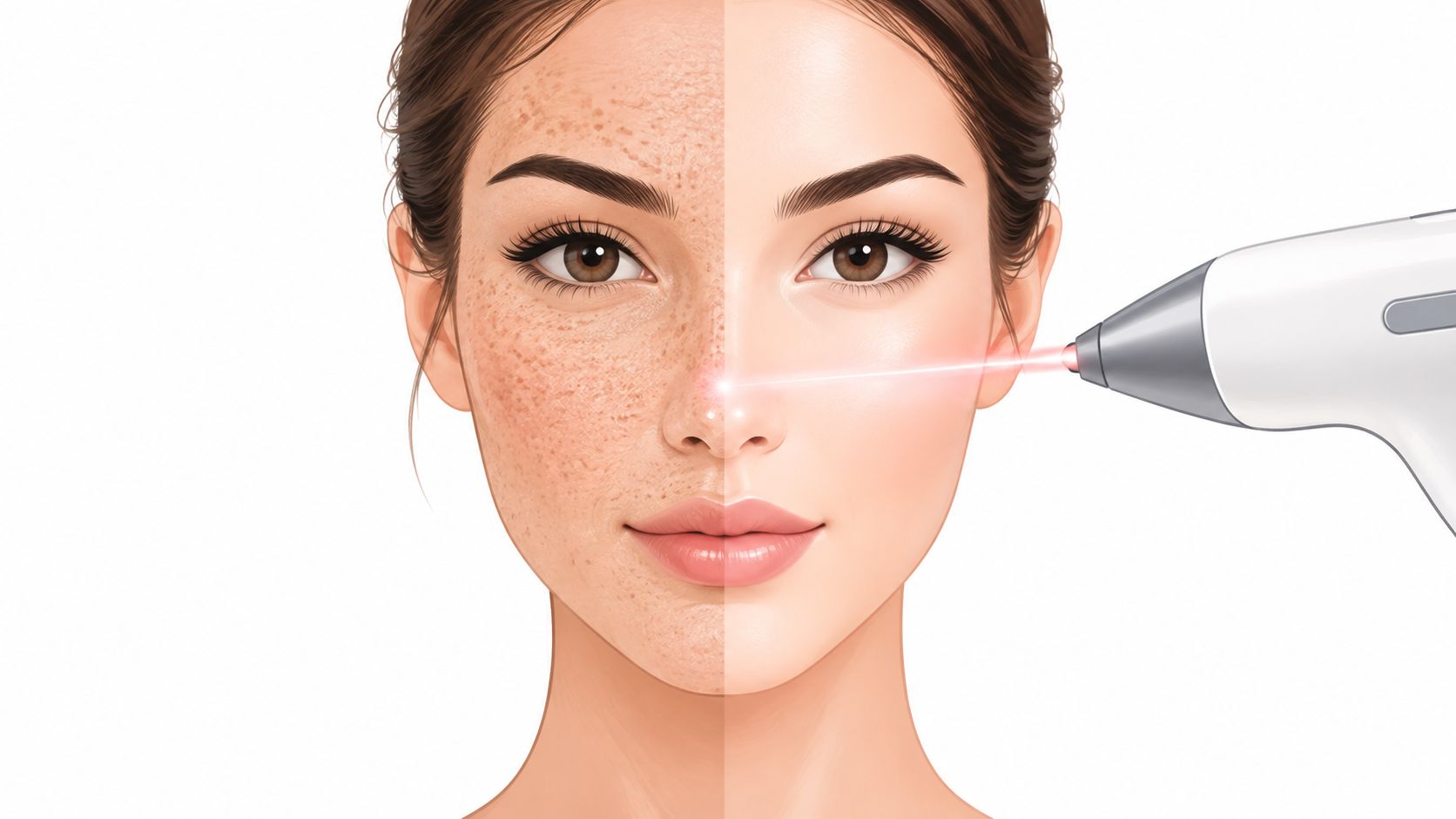
You may be noticing deeper lines around the mouth, rough acne scars, or pigmentation that seems to return after every summer. Perhaps you're also comparing clinic prices and wondering why one facial laser resurfacing quote looks modest while another is several times higher. The answer usually sits in the treatment plan, not just the device name.
In South Africa, high ultraviolet exposure makes photoaging, uneven pigmentation, significant facial lines, deep wrinkles and acne scarring important reasons for considering resurfacing. Local clinics also present the treatment as a structured dermatological service, with different prices for the face, neck and décolleté rather than as a single one-size-fits-all procedure. This guide focuses on the decisions that are easiest to overlook: depth versus downtime, headline price versus total cost per result, and intensity versus pigment safety.
Índice
- Introduction to Laser Resurfacing for the Face
- How Laser Resurfacing Works on Facial Skin
- Types of Facial Resurfacing Lasers Compared
- Who Is a Good Candidate and What Results to Expect
- Recovery Timeline Risks and Aftercare Essentials
- Treatment Planning Session Timelines and Cost Considerations
- Choosing a Clinic and Device With Safety and Compliance in Mind
Introduction to Laser Resurfacing for the Face
A patient might arrive at a consultation wanting “smoother skin” but have several separate concerns. The forehead lines may be superficial, the acne scars may be deeper, and the uneven colour may be linked to sun exposure. Treating all three with the same energy, depth and number of passes would be poor planning.
South African providers position facial laser resurfacing for significant facial lines, deep wrinkles, acne scarring and uneven pigmentation caused by sun damage. That makes the treatment particularly relevant in a high-UV environment, where repeated sun exposure can contribute to visible photoaging. The procedure isn't about removing a surface layer. It uses controlled energy to alter selected skin tissue and encourage a remodelling response.
Patients often begin their research by searching for examples outside South Africa, then need to translate that information into local clinical, regulatory and cost realities. A useful general resource is this overview of laser skin resurfacing in Beverly Hills, but an overseas page can't replace an assessment of your skin tone, medical history, sun exposure, healing pattern and local provider standards.
What the consultation should clarify
A sound consultation should answer practical questions before anyone discusses a package price:
- What is being treated? Lines, scars, pigment and laxity may need different settings or even different technologies.
- How deep is the proposed treatment? Greater depth can change discomfort, healing time and the number of sessions.
- What is the pigment risk? Melanin-rich skin may require a more conservative protocol and closer follow-up.
- What is the full treatment area? Face-only treatment isn't comparable with a plan covering the neck or décolleté.
- Who is responsible for device safety? The clinic should be able to explain its licensing and laser-safety controls.
A professional team should also explain what resurfacing won't do. It can improve texture, colour irregularity and selected lines, but it won't correct every cause of facial ageing, and it shouldn't be sold as a guaranteed replacement for other treatments.
By the end of the decision process, you should understand the mechanism, the available laser families, your candidacy, the recovery demands, the likely session strategy and the total financial commitment. For clinics, the same framework supports clearer consent conversations and more disciplined treatment planning.
How Laser Resurfacing Works on Facial Skin
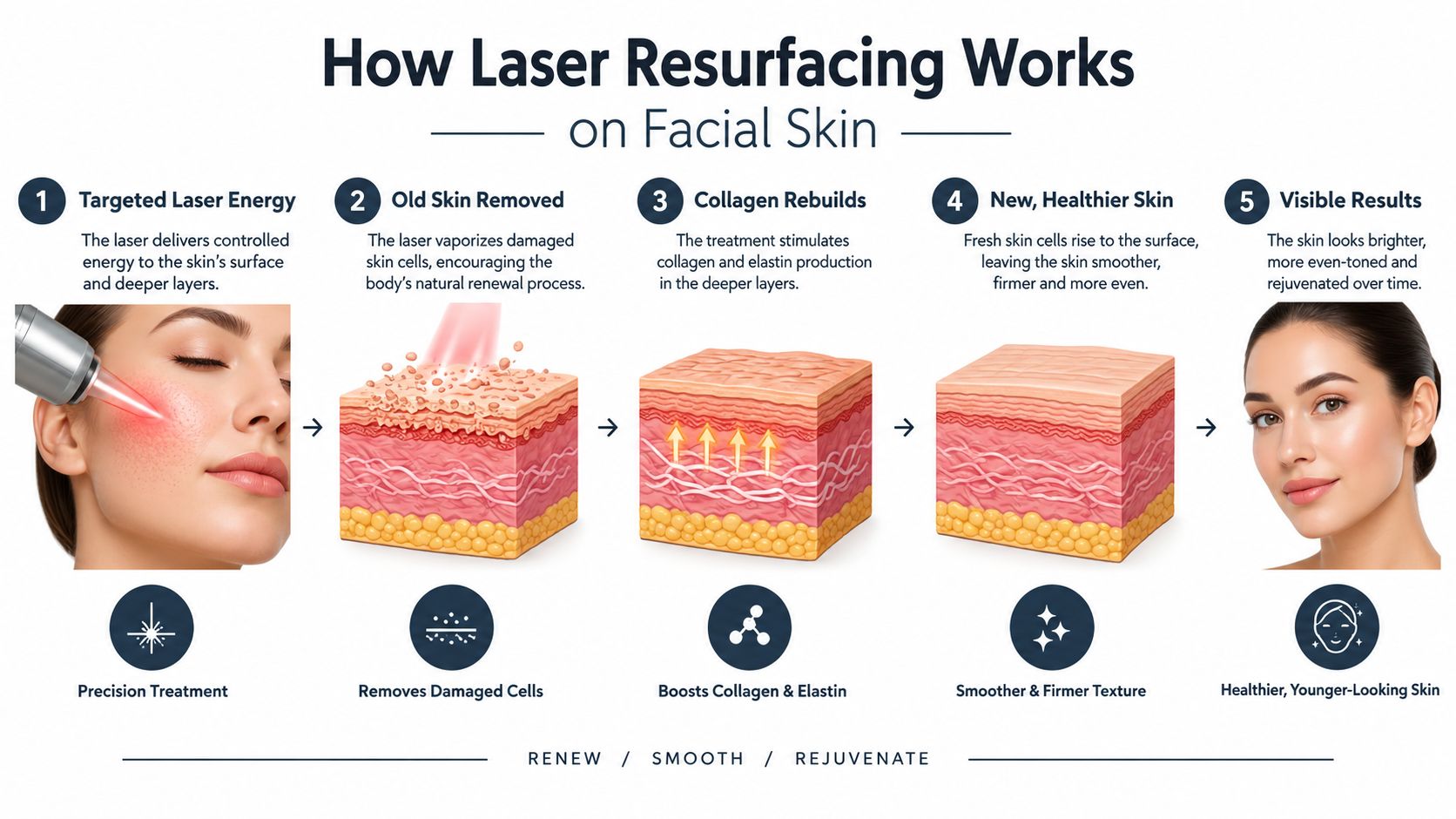
Think of facial skin as a layered surface rather than a flat sheet. A laser can remove tiny columns of tissue, heat tissue without removing it, or treat a broader surface depending on the technology and settings selected. The clinician's aim is controlled change, not uncontrolled burning.
Ablative resurfacing removes part of the targeted skin. The body then repairs the treated area and produces a healing response that can improve texture and stimulate collagen remodelling. Non-ablative resurfacing heats tissue while keeping the outer surface more intact, which usually means a gentler treatment and a different balance between recovery and visible change.
Fractional treatment adds another layer of control. Instead of treating every millimetre, the laser creates a pattern of microscopic treatment zones separated by untreated skin. Those intact areas act like neighbouring repair sites, while the treated columns address the concern. Fully ablative treatment covers a much broader surface and can produce a more intensive effect, but it demands more careful recovery planning.
Energy determines the treatment experience
Energy density, spot pattern, pulse behaviour and the number of passes influence how much tissue receives heat and how the treatment acts. More energy or repeated passes can increase the intended effect, but they can also increase redness, swelling, discomfort and the risk of complications if the plan isn't matched to the patient.
A useful explanation for patients is precision sanding. A light pass refines the surface. A deeper or repeated pass changes more of the underlying structure. The analogy isn't perfect, because laser energy also creates thermal effects beneath the visible surface, but it helps explain why two treatments with similar names can have very different recovery periods.
Core principle: Controlled thermal injury must be precise enough to stimulate repair, while limiting unnecessary damage to surrounding skin.
The same principle applies when comparing protocols described in this guide to skin resurfacing. The device label alone doesn't tell you the clinical intensity. Ask what the clinician is treating, how the energy is delivered, how many passes are planned and how the settings will be adapted for sensitive or thinner facial areas.
Types of Facial Resurfacing Lasers Compared
Laser families differ in how strongly their energy interacts with water in skin, how they can affect tissue and whether they treat continuous areas or fractional columns. Patients don't need to memorise wavelengths, but they do need to understand the practical consequences.
CO₂ fracionado is generally selected when the clinician wants a stronger resurfacing effect for etched lines, deeper texture changes, acne scarring or more advanced photoaging. It can deliver significant thermal action, particularly when the treatment plan uses higher density or deeper passes. Fractional delivery leaves untreated bridges between treatment zones, which can support healing compared with fully ablative coverage.
Erbium systems, including treatments marketed with light, medium or deep settings, can be adjusted across a broader range of resurfacing intensity. A lighter approach may suit surface texture or colour concerns, while a deeper protocol may address more established irregularities. The practical result depends on settings, area, passes and the operator's technique, not the word “erbium” alone.
Non-ablative fractional options heat the deeper skin without removing as much of the surface. They can be useful when a patient prioritises a gentler recovery or when the clinician wants to stage treatment. The trade-off is that a softer session may require a course rather than a single intensive intervention.
| Laser Family | Depth and Downtime | Ideal para |
|---|---|---|
| CO₂ fracionado | Moderate to deeper fractional action, with recovery increasing as intensity rises | Deeper lines, acne scarring, pronounced texture and selected laxity concerns |
| Erbium resurfacing | Adjustable from lighter to deeper treatment, with downtime linked to the selected setting | Texture, pigmentation, lines and staged resurfacing plans |
| Non-ablative fractional | Heat-based treatment with a more intact surface and generally gentler recovery | Early texture changes, tone concerns and patients with limited downtime |
How to choose without chasing a device name
If your main concern is deep scarring and you're able to plan meaningful recovery, a stronger fractional discussion may be appropriate. If uneven pigmentation or a history of dark marks dominates, the clinician may favour a staged and more conservative plan. If you can't manage visible recovery, a non-ablative option may be easier to fit into your life, though the overall course can involve more visits.
For readers interested in the lifting and tightening side of treatment, an educational overview of CO2 resurfacing for skin tightening can provide additional context. For South African clinic teams evaluating a CO2 treatment category, the CO2 laser treatment overview is another useful reference point. Neither should replace local assessment, because skin type, indication and treatment depth determine the appropriate plan.
Who Is a Good Candidate and What Results to Expect
The strongest candidate isn't the person with the deepest wrinkles. It's the person whose concern matches the technology, understands the recovery and can follow aftercare consistently.
Facial resurfacing may be considered for significant facial lines, deep wrinkles, acne scarring and sun-induced pigmentation. It can also help refine rough texture and uneven tone. The clinician should first determine whether the problem sits mainly in the surface, deeper scar structure, pigment pathway or facial laxity. A laser may improve some components while leaving others relatively unchanged.
Skin tone changes the risk conversation
Darker skin tones can have a higher risk of hiperpigmentação pós-inflamatória, particularly after procedures that create substantial inflammation. That doesn't automatically rule out resurfacing. It means the clinician should take skin tone, pigment history, current tanning, melasma tendency, medication, previous procedures and aftercare reliability seriously.
A gentler fractional or staged protocol may be preferred for some melanin-rich patients, even if visible improvement develops more gradually. The safer choice isn't always the most aggressive option. A conservative treatment that the skin tolerates can be more useful than an intense session followed by prolonged pigment disturbance.
A responsible provider should explain:
- The primary target, such as scars, wrinkles, texture or pigmentation.
- The likely direction of change, rather than promising perfect correction.
- Whether a course is more suitable than one session.
- How long redness or colour change may remain visible.
- What could delay treatment, including active infection, uncontrolled inflammation or recent excessive sun exposure.
Results develop in stages
The first visible change may be smoother surface texture once the skin has healed, but collagen remodelling takes longer. Wrinkles and scars can soften rather than disappear, and pigmentation can improve while remaining sensitive to future ultraviolet exposure. Longevity also depends on sun protection, skincare, ageing, hormones and the original severity of the concern.
Patients often judge treatment too early, especially when pinkness or uneven colour temporarily distracts from the underlying improvement. A clinician should use consistent photographs and agreed review points, rather than relying on day-to-day mirror checks. The before-and-after resurfacing guide can help patients understand why comparison images need consistent lighting, angles and healing time.
Recovery Timeline Risks and Aftercare Essentials
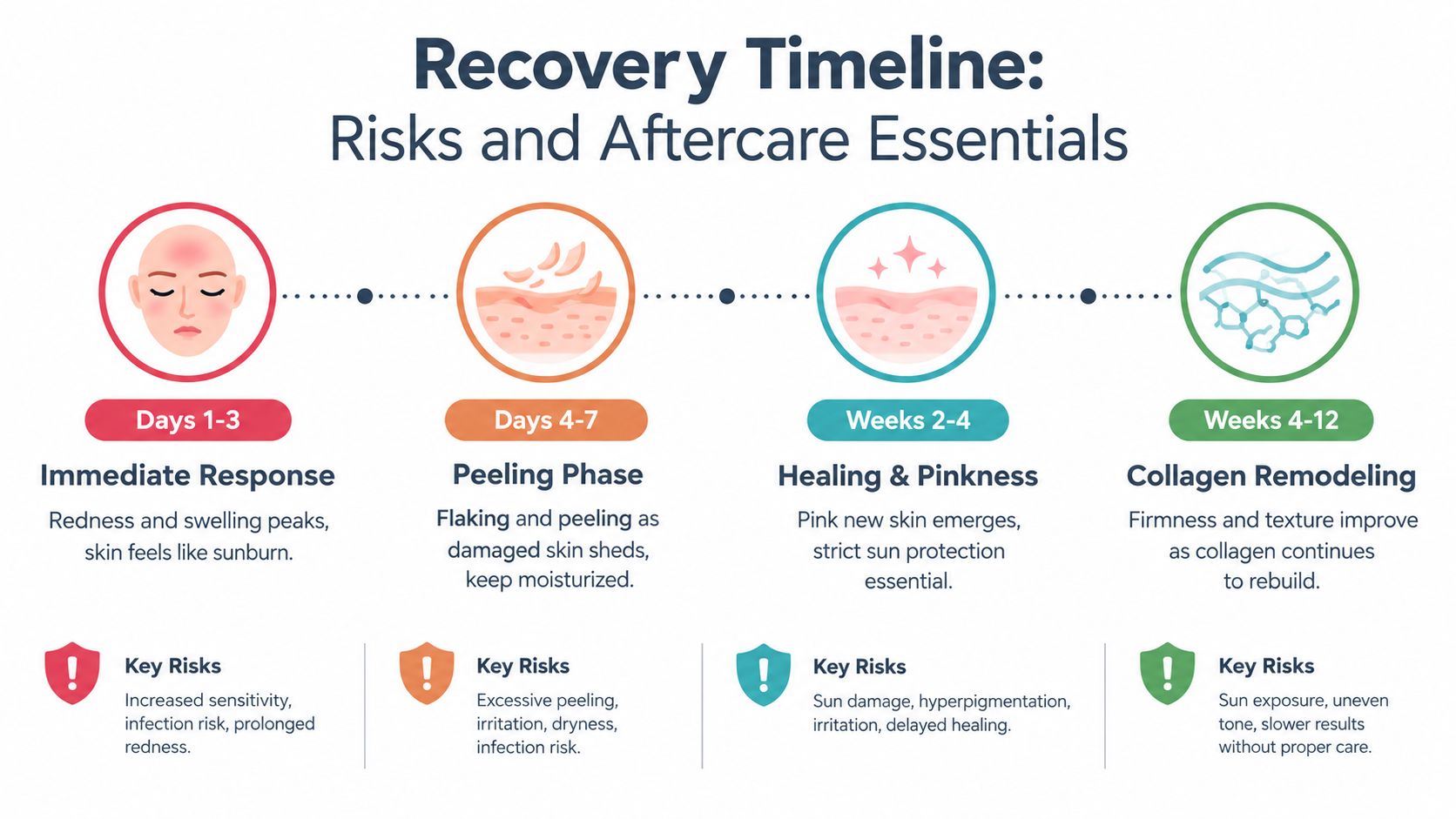
Recovery begins immediately after the laser passes. The treated skin may feel hot, tight or sunburned, with redness and swelling that can be more noticeable around delicate areas. That response can be expected, but the patient still needs clear instructions because normal inflammation and a complication can look similar at first.
During the peeling phase, the surface may flake or shed. Cleanse only as directed, apply the recommended bland moisturising or barrier-support product, and resist the urge to pull away loose skin. Picking can increase irritation and may raise the risk of delayed healing or unwanted colour change.
A practical healing sequence
Immediately after treatment: Follow the clinic's cooling, cleansing and product instructions. Avoid applying unapproved active ingredients, makeup or fragranced products until the provider confirms that the barrier is ready.
As the surface sheds: Keep the skin comfortable and hydrated according to the treatment plan. Don't scrub, peel or use heat to accelerate flaking. Sauna exposure, strenuous heat and direct sun can add stress during a vulnerable period.
As new skin appears: Use strict sun protection and physical avoidance of strong ultraviolet exposure. Freshly treated skin can react unpredictably to sunlight, and pigment protection matters especially for patients prone to post-inflammatory hyperpigmentation.
Common reactions and warning signs
Redness, swelling, warmth, sensitivity, dryness and peeling can form part of recovery. The clinic should explain what progression is expected for the selected intensity and what would be unusual for that patient.
Seek prompt clinical review if pain is escalating rather than settling, swelling becomes severe, blisters or spreading erosions appear, discharge develops, or the skin shows signs of infection. New or worsening pigmentation also deserves assessment, particularly when it persists beyond the expected healing pattern.
Treatment planning must account for facial anatomy. South African clinical guidance describes standard facial areas at 100–125 mJ and thinner periorbital areas at 60–90 mJ, with the lower range intended to reduce thermal injury risk, as outlined in this facial laser treatment guidance. These figures aren't a self-treatment guide. They illustrate why a trained operator should adjust energy for the treatment zone rather than use one setting across the whole face.
Treatment Planning Session Timelines and Cost Considerations
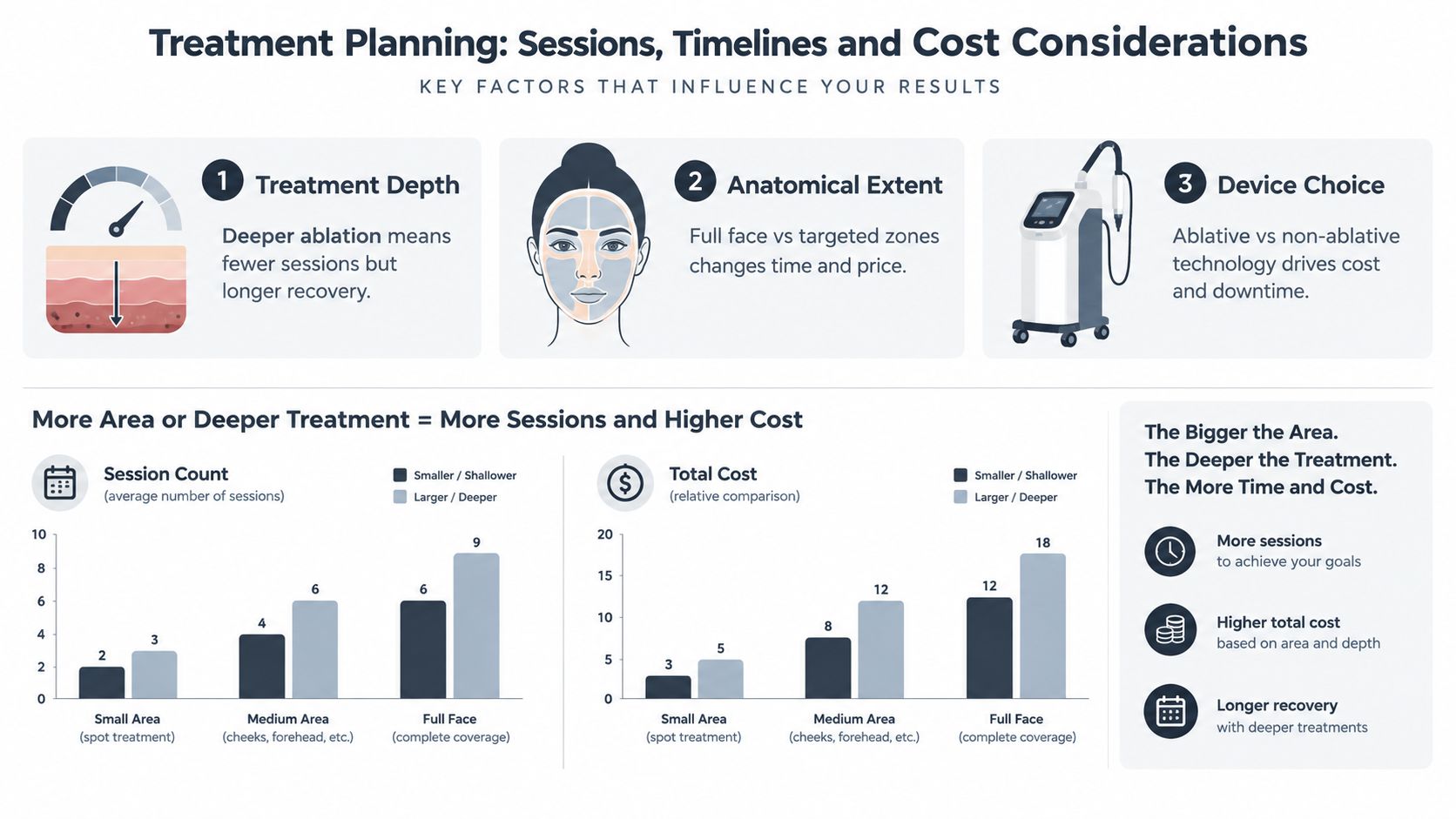
A facial resurfacing quote only makes sense when you know three things: how deep the treatment is, how much skin is covered and which device category is being used. A face-only session and a face, neck and décolleté session aren't equivalent services. Nor is a light fractional treatment equivalent to a deeper resurfacing protocol.
South African pricing shows this tiered structure clearly. One clinic lists CO2 resurfacing at R2,450 for the face, R3,450 for the face and neck, and R4,600 for the face, neck and décolleté (local CO2 resurfacing pricing). Another provider lists fractional resurfacing at R6,400 for the face, R8,000 for the face and neck, and R10,600 for the face, neck and chest (fractional resurfacing pricing). These figures are benchmarks from specific providers, not universal tariffs.
Compare the whole course
A lighter session may have a lower headline price but require more visits. A deeper session may cost more upfront and demand a longer recovery period. The correct comparison is therefore not “What does one treatment cost?” but “What will this plan cost in money, appointments, travel and recovery time before I can fairly judge the result?”
A separate South African practice lists erbium iPIXEL Pro treatments from R5,750 to R10,150, depending on light, medium or deep settings (iPIXEL Pro treatment pricing). Another local source places CO2 fractional treatment at approximately R28,000 to R40,000, reinforcing how much deeper resurfacing can differ from lighter fractional work (CO2 fractional treatment pricing).
Build a realistic cost worksheet
Ask the clinic to separate:
- Treatment area: Face, face and neck, or an extended field.
- Treatment depth: Light, medium, deep or another named protocol.
- Planned sessions: Whether the quote covers one visit or a course.
- Recovery costs: Time away from work, products and support appointments.
- Travel: Particularly important when the provider is in a major metro centre.
- Review policy: Whether follow-up assessment is included.
Additional South African listings show fractional facial resurfacing ranging from about R2,850 for face-only CO2 treatment in Johannesburg to R6,400 for a Frax 1550 face session, while marketplace listings show ranges from R550 to R5,800 depending on provider and area. Those ranges make provider, technology and treatment definition essential parts of any comparison.
Choosing a Clinic and Device With Safety and Compliance in Mind
A safe laser resurfacing service depends on more than a polished consultation room. Patients should be able to ask who operates the device, how the clinic manages risk, what training the team has completed and whether the machine fits South African regulatory requirements.
For clinic owners, the compliance chain starts before treatment begins. South African guidance states that Class 3b and Class 4 lasers or laser systems fall under a SAHPRA safe-use framework, with a guideline for use-licence applications and safe use published by SAHPRA in September 2026 (SAHPRA document library). The same regulatory summary states that each machine requires an appointed Responsável pela Segurança no Uso de Lasers and a valid SAHPRA import licence before registration.
A clinic-ready verification checklist
- Device documentation: Confirm the machine's regulatory and import records.
- Use licence: Ask how the clinic manages the relevant SAHPRA use-licence requirements.
- Laser Safety Officer: Verify that responsibility is assigned for each machine.
- Competência do operador: Ask about training, supervision and treatment protocols.
- Patient screening: Confirm that skin tone, pigment history, active conditions and medications are assessed.
- Facility controls: Review ventilation, electrical planning, warning systems and room design. A practical overview of clinic HVAC and code requirements can help owners plan the wider treatment environment.
- Aftercare pathway: Make sure patients know whom to contact if healing deviates from expectations.
A compliant platform also needs repeatable settings, maintenance, documentation and staff education. Omega Lasers supplies FDA-approved, CE-certified and SAHPRA-licensed medical-aesthetic systems, along with training and technical support for clinics building or expanding resurfacing services. Owners should still verify the specific device, licence status and intended use directly before purchase.
Omega Lasers can help your clinic evaluate facial resurfacing technology, staff training, compliance requirements and the support needed for consistent patient care. Visit Lasers Omega to discuss a suitable platform and plan the next step for your practice.