



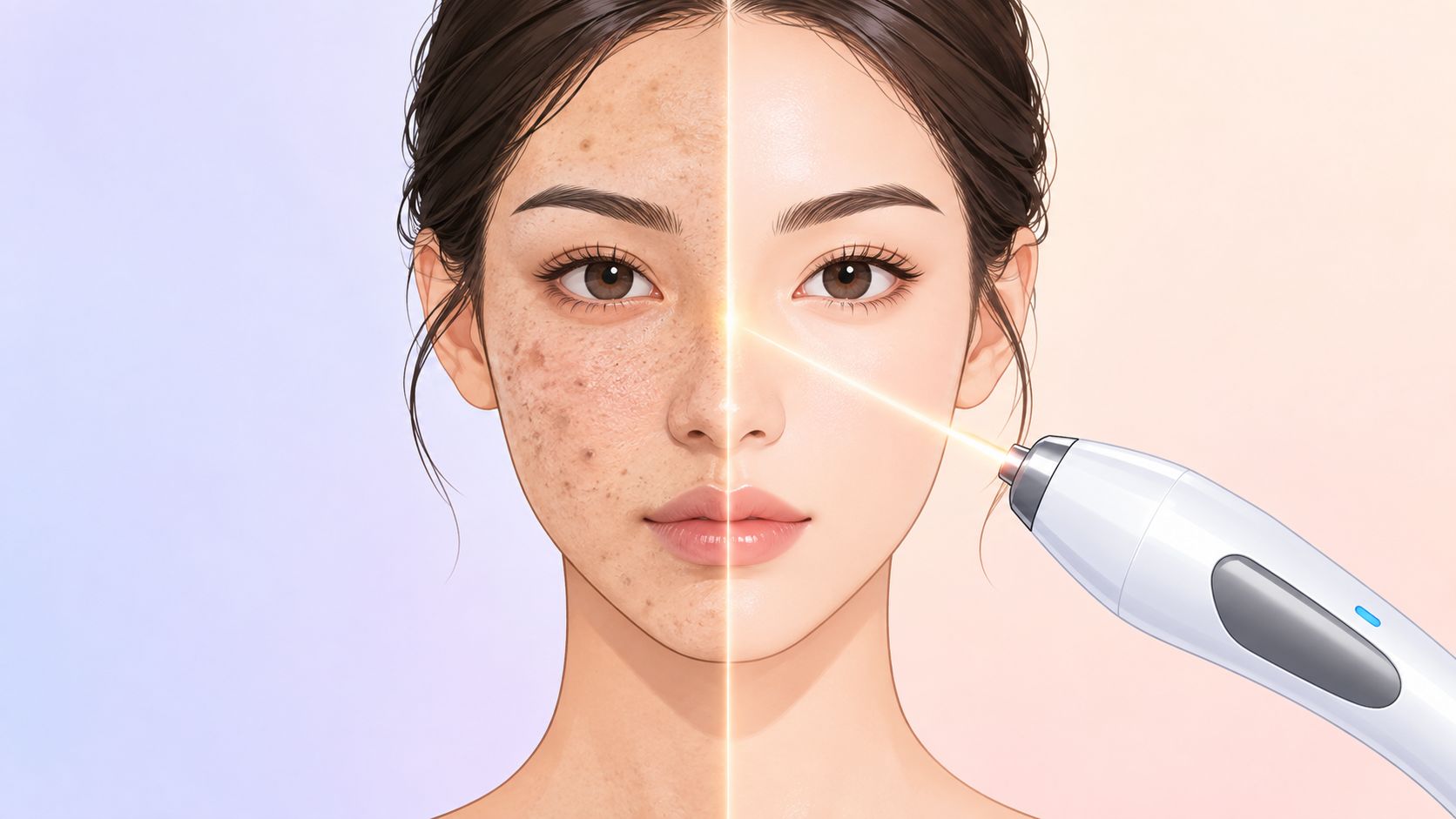
You're probably looking at a clinic gallery after midnight, comparing smooth, evenly lit “after” photographs with your own skin in a bathroom mirror. The images may look convincing, but they rarely show the details that determine whether laser resurfacing is appropriate for you: your Fitzpatrick skin type, scar pattern, treatment depth, recovery period, camera conditions, and risk of post-inflammatory hyperpigmentation.
A useful laser resurfacing before and after assessment is more than a dramatic photograph. It's a clinical comparison that explains what changed, what didn't, how long healing took, and whether the result justified the downtime and pigment risk. In South Africa, that conversation also needs to account for strong ultraviolet exposure, darker skin tones, and the safety systems behind the device.
Índice
- What a Real Before and After Actually Looks Like
- How Resurfacing Technologies Differ Behind the Results
- Case Studies by Concern and Skin Type
- Who Makes a Good Candidate and Who Should Wait
- Recovery Timelines and Pigment-Safe Aftercare
- Device Safety, Regulation, and What It Means for Results
- Reading Before and After Galleries with a Clinician's Eye
What a Real Before and After Actually Looks Like
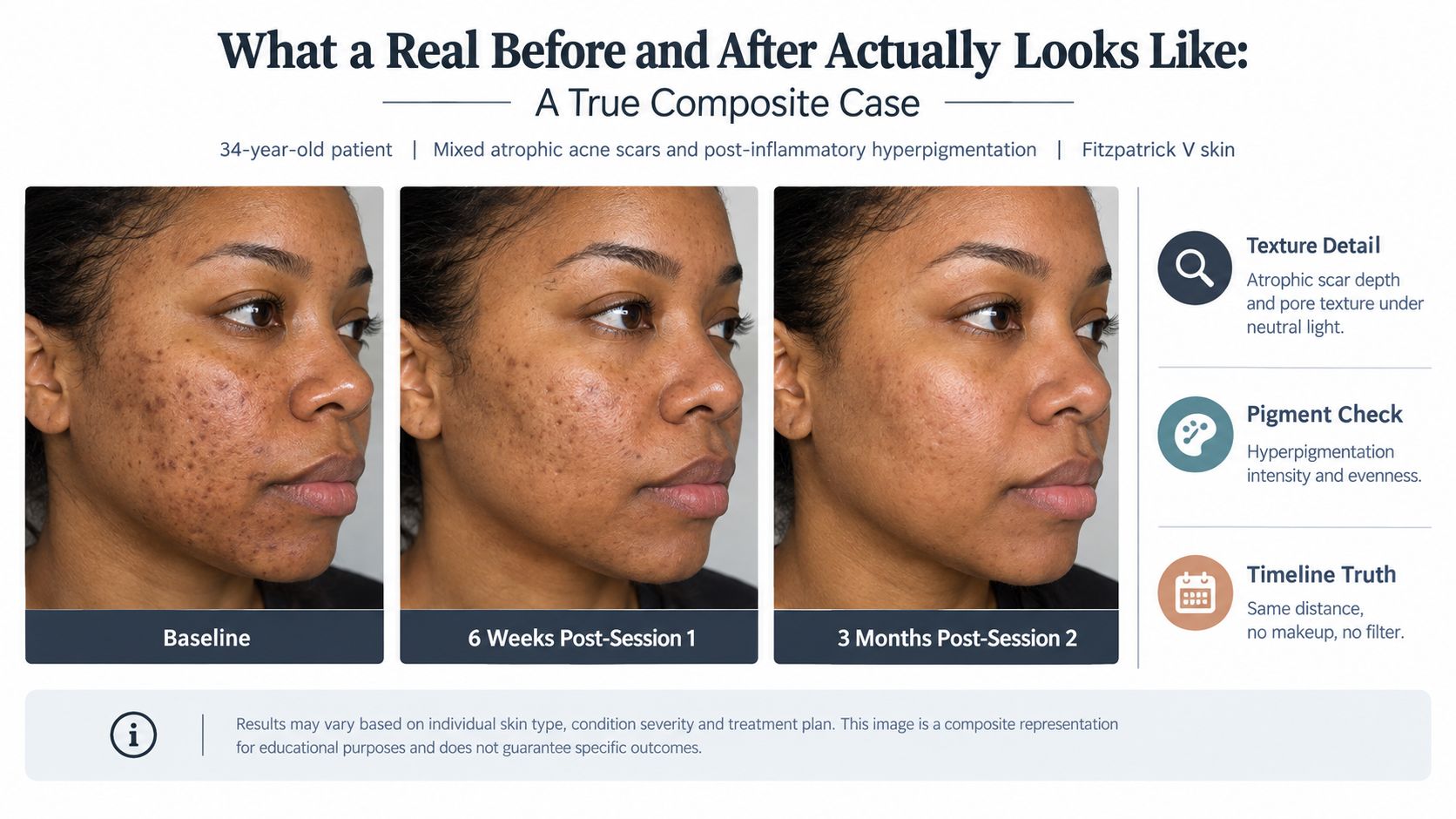
Consider a representative patient, a 34-year-old woman with Fitzpatrick V skin, mixed rolling and boxcar acne scars, and post-inflammatory hyperpigmentation. Her baseline photographs show shallow depressions that catch side lighting, uneven brown marks after previous breakouts, and enlarged-looking pores in the central cheeks. In a consultation, the important finding isn't only that her skin looks “textured”. The clinician needs to map scar depth, identify tethered rolling scars, distinguish pigment from shadow, and check whether active acne is still creating new inflammation.
A fractional ablative treatment may be selected because it can address both surface texture and selected scar depressions while leaving untreated skin between microscopic treatment columns. The primary goal isn't flawless skin. It's a measurable reduction in the apparent depth of scars, more even colour, and a smoother way that light reflects from the cheeks. Some rolling scars may still need a separate release technique, while deep boxcar edges can remain visible even when the overall texture improves.
A palavra improvement percentage needs careful handling. It can describe a combined clinical judgement involving texture, pigmentation, and scar depth, but those elements don't always improve at the same speed. A scar may look shallower while the surrounding pigment temporarily darkens. Conversely, colour may even out before the depression has remodelled.
What the evidence can and cannot promise
In a clinical study of fractional ablative treatment for acne scars, 13 completed subjects received three sessions spaced 6–8 weeks apart. At three months after the final treatment, mean improvement was 47.3% ± 14.2%, enquanto 80.6% rated themselves as having at least mild improvement immediately after treatment. At the 3-year follow-up, 61.3% still reported at least mild improvement. These findings provide a useful benchmark, not a guarantee for every skin type or scar pattern. The published fractional ablative acne-scar study is particularly helpful because it separates early impressions from longer-term patient-reported benefit.
Photography should be as controlled as the treatment. Use the same camera distance, angle, lighting, facial expression, and background. Leave out make-up and filters, and record the device, treatment mode, date, session number, and healing stage. A clinic's before-and-after photography process should make those details clear rather than relying on a flattering close-up.
Regra prática: A credible photograph shows the skin in comparable conditions. It doesn't hide peripheral scarring, redness, or uneven pigmentation outside the most flattering angle.
How Resurfacing Technologies Differ Behind the Results
Ablative and non-ablative resurfacing create different kinds of before-and-after change. Ablative devices remove or vaporise part of the outer skin, producing a stronger wound-healing response and more visible textural change, but they also demand stricter wound care and carry greater pigment risk. Non-ablative systems heat the dermis without removing the same amount of surface tissue, so the result is usually more gradual and the recovery easier to manage.
Fractional delivery changes the risk and recovery profile again. Fractional treatment creates microscopic treatment zones with untreated skin between them. Fully ablative treatment treats the complete surface of the selected area and therefore creates a more demanding healing course. A fully ablative CO2 or erbium treatment may suit a carefully selected lighter phototype with severe surface damage, while fractional treatment is often the more cautious choice for scars or for patients who need staged improvement.
South African market data shows why both approaches remain relevant. Skin resurfacing revenue in South Africa was estimated at USD 3.5 million in 2020 e prevê-se que atinja USD 5.7 million by 2027, o que implica um 7.3% CAGR across that period. Ablative treatments represented 57.14% of revenue in 2020, while non-ablative treatment was identified as the fastest-growing segment. The South Africa skin resurfacing market outlook suggests that clinics are serving patients who want both high-intensity correction and lower-downtime maintenance.
| Tecnologia | Tempo de inatividade | Sessions | Ideal para |
|---|---|---|---|
| CO₂ totalmente ablativo | The longest recovery, with strict wound care | Often planned as an aggressive treatment rather than a light series | Selected deep wrinkles, extensive surface damage, and carefully chosen scars |
| Ablative erbium | Significant healing, generally selected for controlled surface ablation | May be staged according to the concern | Surface texture and selected scars where controlled ablation is appropriate |
| Fractional ablative CO2 | Visible redness, crusting, peeling, and a staged recovery | Often delivered as a series | Atrophic acne scars, texture, and moderate photoageing |
| Fractional non-ablative | Shorter visible recovery, with gradual colour and texture changes | Normalmente, requer sessões repetidas | Mild texture change, early ageing, and patients prioritising limited downtime |
Match the treatment to the scar
Deep, sharply edged boxcar scars don't behave like shallow rolling scars. Pigment concerns don't behave like etched wrinkles. A treatment plan should therefore answer three questions: how deep is the injury, how much recovery can the patient accept, and how likely is pigment disruption at the planned intensity?
A stronger single session can produce a more obvious early change, but it creates a larger recovery and safety burden. A staged series trades dramatic immediacy for more controlled healing. The relevant comparison isn't “which laser is strongest?” It's whether the treatment can create enough change without exceeding the patient's pigment tolerance or practical downtime.
For clinics reviewing their resurfacing offering, Tratamento com laser de CO₂ should be positioned as a medical procedure with adjustable depth, not as one uniform service. The device, scanner, settings, operator, and aftercare all influence the photograph that eventually appears in a gallery.
Case Studies by Concern and Skin Type
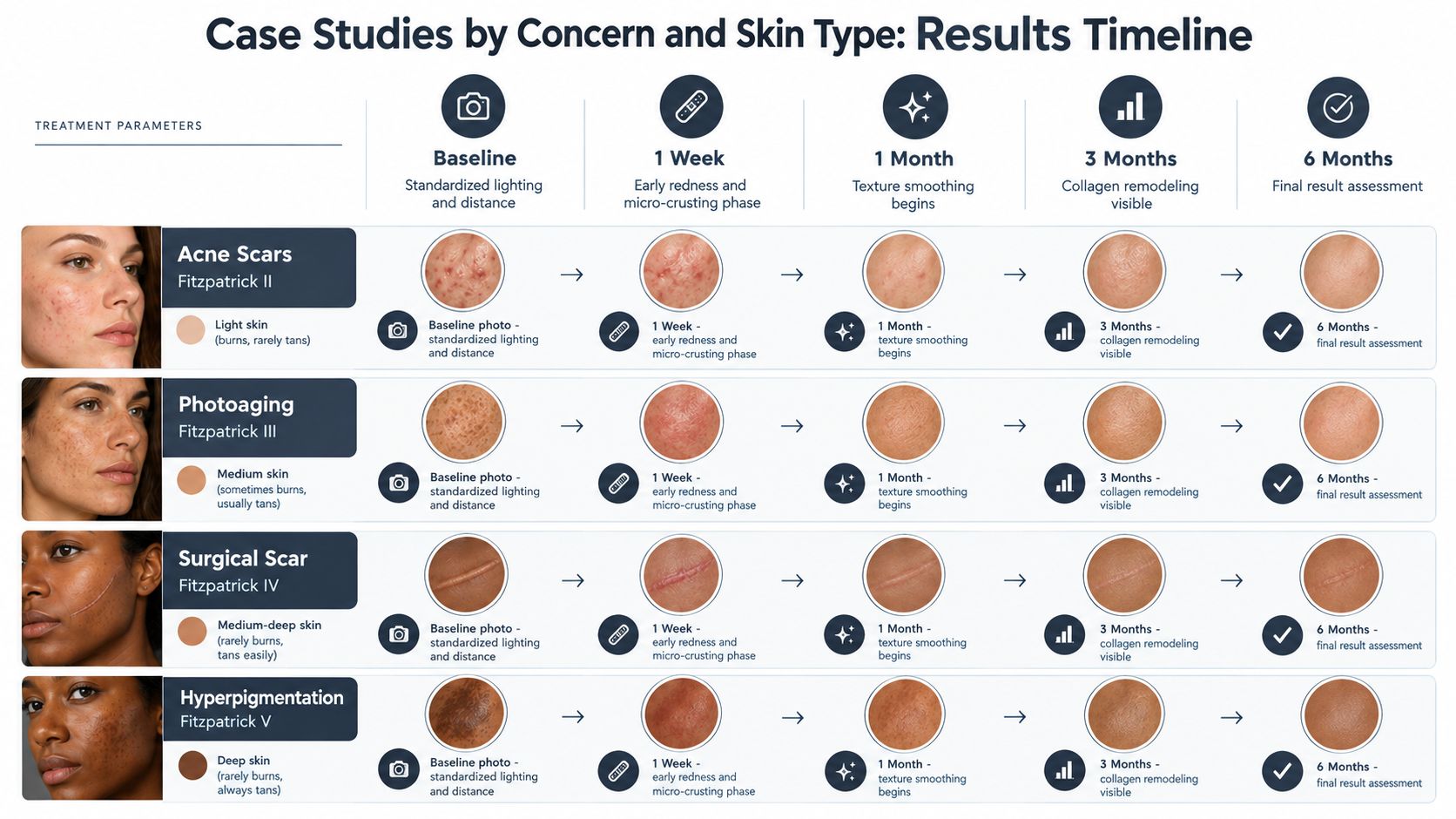
Before-and-after photographs become more useful when the concern, skin type, and review point are visible together. The following vignettes are representative clinical frameworks, not promises of a fixed result. Exact energy settings, passes, and adjunctive treatment must be selected after examination rather than copied from a photograph.
Rolling and boxcar acne scars on Fitzpatrick IV
A patient with stable mixed acne scarring may be assessed at baseline, 1 week, 1 month, 3 months, and 6 months. Fractional ablative treatment can improve surface texture, but rolling scars may remain tethered and deep boxcar margins may plateau. A clinician may therefore combine carefully selected laser passes with scar-specific treatment and a pigment-safe topical plan, rather than assuming laser alone will correct every depression.
Em 1 week, redness, swelling, and micro-crusting can make the skin look worse. At 1 month, surface roughness may have settled while collagen remodelling is still incomplete. The three-month image is more meaningful, and the six-month image helps identify whether improvement has stabilised or whether residual scars need another modality.
Solar lentigines and crepey texture on Fitzpatrick II
A lighter phototype with sun-related pigmentation and fine crepey texture may tolerate a more assertive resurfacing approach, but individual lesions still require diagnosis before treatment. Baseline and interval photographs should show whether pigment has lightened evenly or whether untreated areas create a misleading contrast.
Em 1 week, peeling and redness can dominate the image. By 1 month, the surface may appear clearer, but the final texture assessment belongs later, after the skin has matured. Sunscreen remains central because resurfacing doesn't remove the patient's future exposure to ultraviolet damage.
Established burn scarring
A South African case series found that one ablative fractional laser treatment for established burn scars improved the mean Modified Vancouver Scar Scale from 14 before treatment to 5 at 3 months and 5.5 at 6 months, with statistical significance between pre- and postoperative scores, p = 0.024. The report also described major gains in pliability and symptom relief, with more than half reduction in key components for many patients. The South African burn-scar case series offers a useful local benchmark because scar revision concerns include movement, firmness, and symptoms, not only appearance.
The interval photographs should still include the early phase. A 1-week photograph may show inflammation and crusting, while the 1-month photograph can show improved flexibility before the final visual result is obvious. Burn scars often require a broader rehabilitation plan, and the laser result shouldn't be judged without considering scar maturity, contracture, and ongoing care.
Scars in skin of colour
In a study of fractional carbon dioxide treatment for scars in skin of colour, physician global assessment recorded 45.4% overall improvement, while investigator global assessment recorded 32.7%. The study reported that 13.43% of scars exceeded 50% improvement by investigator assessment and 41.78% exceeded 50% improvement by physician assessment. The authors concluded that fractional CO2 was efficacious and that earlier intervention produced more satisfactory outcomes. The PubMed-indexed scar study reinforces why assessment method and treatment timing belong beside every gallery image.
For melasma or pigment-dominant concerns, aggressive resurfacing can create a disappointing cycle of temporary lightening followed by pigment rebound. A pigment-focused consultation, such as one discussing tratamento a laser para o melasma, should address whether resurfacing is appropriate at all, what will protect the skin during healing, and what happens if pigmentation becomes uneven.
Who Makes a Good Candidate and Who Should Wait
Good candidacy isn't a marketing label. It's a risk assessment that matches the patient's concern, skin response, health history, and ability to follow aftercare.
A clinician should record the Fitzpatrick type from I through VI, but skin type alone doesn't decide treatment. Lighter phototypes may tolerate ablative treatment more readily. Fitzpatrick IV, V, and VI patients can still be treated, but usually need more cautious parameters, careful preparation, and a clear plan for pigment changes.
The clinical checklist
- Stable concern: Acne scars should be stable for at least 6 meses, surgical scars for 12 meses, and burn scars should be fully healed before resurfacing is considered.
- No active inflammation: Active acne, infection, or uncontrolled rosacea can complicate healing and make photographs impossible to interpret.
- Revisão da medicação: Treatment is generally deferred when isotretinoin has been used within the previous 6 meses, unless the treating medical practitioner makes a different evidence-based decision.
- Health clearance: Pregnancy, immunosuppression, and a personal tendency towards keloid or problematic hypertrophic scarring require postponement or medical clearance.
- Sun exposure: Recent tanning or planned intense sun exposure is a poor match for an ablative procedure, particularly in South Africa.
- Downtime agreement: A patient who can't accept peeling, redness, restricted exercise, or temporary social limitations shouldn't be pushed towards the strongest available setting.
The evidence anchor should remain realistic. Fractional ablative acne-scar treatment produced the measurable improvement described earlier, but outcomes vary with scar type and skin tone. Don't replace that evidence with unsupported promises of a particular percentage for every patient.
Ask directly: Which part of my concern is the laser expected to improve, and which part is likely to remain?
Red flags at consultation include pressure to treat active acne, no discussion of pigment risk, no medical history review, and a promise that one setting suits every Fitzpatrick type. The wait list should include patients with recent tanning, unstable scars, active infection, pregnancy, recent isotretinoin exposure, uncontrolled inflammatory disease, or no realistic capacity for aftercare.
Recovery Timelines and Pigment-Safe Aftercare
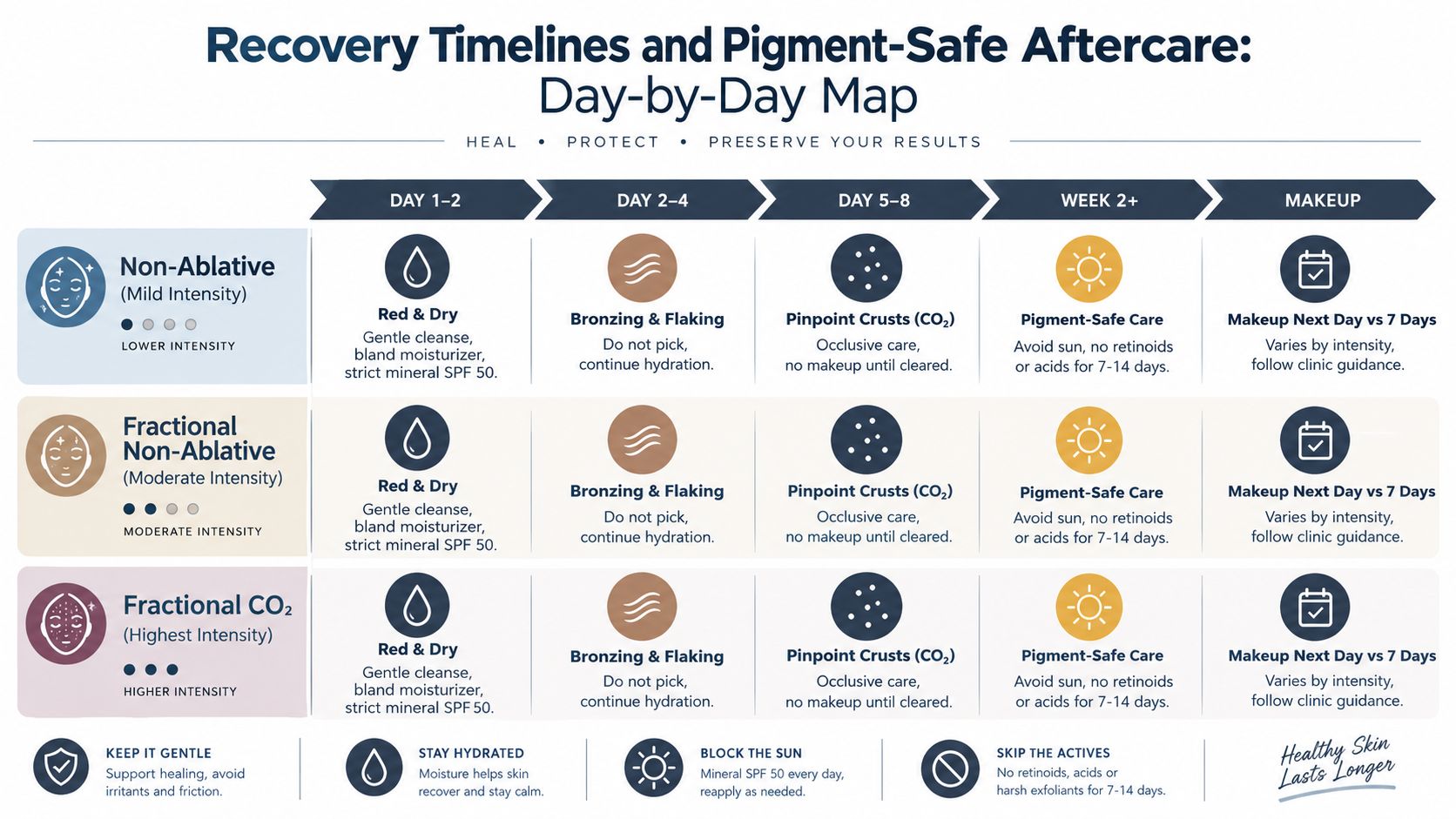
Recovery depends on how much skin was injured, not on the device name alone. A light non-ablative treatment may leave redness and dryness that settle quickly, while fractional CO2 creates a more visible wound-healing phase. Fully ablative resurfacing carries the most demanding aftercare and should never be sold as a social-event treatment.
A practical recovery map
Immediately after treatment, the skin may feel hot, tight, swollen, or tender. Use only the cleanser, ointment, moisturiser, and dressings prescribed by the clinic. Do not scrub, peel, or remove crusts manually.
During the first several days, redness, dryness, bronzing, pinpoint crusting, or peeling may appear depending on intensity. Local South African guidance varies, which is why your written clinic protocol matters. One local recovery guide describes Vaseline immediately after treatment and four times a day for the first six days, with the skin described as virtually healed by day seven and normal make-up from day ten using green cosmetic base to conceal pinkness. The Cape Town resurfacing recovery guidance provides a concrete example, but your treatment may differ.
One South African source advises avoiding exercise for 7 days and sun exposure for 14 dias, while another recommends avoiding sun for 6 weeks after fractional CO2 resurfacing. Local erbium iPixel aftercare guidance shows why patients need scenario-based instructions rather than a generic “few days of downtime”. Other local guidance recommends strict moisturising, tepid washing, and sunscreen, without defining when work, make-up, or exercise can safely resume.
Preventing pigment complications
South Africa's high ultraviolet exposure makes pigment protection a clinical priority, particularly for skin of colour. Use the clinic's prescribed broad-spectrum sunscreen, protective clothing, and a hat, and avoid direct sun during the healing phase. Don't add retinoids, exfoliating acids, bleaching agents, or fragranced products until the treating clinician confirms that the barrier has recovered.
South African aftercare sources commonly recommend SPF 50 and strict sun avoidance. Local laser-resurfacing guidance advises minimising sun exposure before and after treatment, while another local source recommends SPF 50 twice daily and avoiding sun for 14 dias after erbium resurfacing. These recommendations should be adapted to treatment depth and skin type rather than treated as interchangeable rules.
Contact the clinic if you develop persistent erythema beyond 4 weeks, hyperpigmentation patches, or unexpected scarring. Escalate sooner for worsening pain, spreading redness, pus, fever, or any symptom your provider identified as urgent. Early review is safer than trying to correct a pigment or infection problem with home products.
Device Safety, Regulation, and What It Means for Results
Regulatory language can sound like paperwork, but it affects how safely and consistently a clinic can treat you. FDA clearance isn't the same as FDA approval, and CE marking relates to conformity with European regulatory requirements. Neither label, by itself, guarantees that a particular operator will choose appropriate settings for your skin.
In South Africa, industry education materials state that Class 3 and Class 4 laser devices must be registered with SAHPRA, and that a Responsável pela Segurança no Uso de Lasers must be appointed for each machine. Orientações sobre segurança no uso de lasers na África do Sul explains why device registration and operator oversight belong in the patient's pre-treatment questions.
A responsible clinic should control access to the treatment room, provide wavelength-appropriate protective eyewear, maintain the device, and follow the manufacturer's service and calibration requirements. Consumables such as tips or fibres also need appropriate provenance. These systems won't guarantee a perfect result, but their absence creates avoidable uncertainty.
| Signal | What It Confirms | Why It Matters for Your Results |
|---|---|---|
| Estatuto da FDA | The device has a defined regulatory status in the United States | Helps clarify what the manufacturer has claimed, but doesn't replace local oversight |
| Marcação CE | The platform has a documented European conformity pathway | Provides regulatory context for European-sourced technology |
| SAHPRA registration | The device has legally entered the South African market through documented channels | Supports traceability, local compliance, and confidence in the platform being used |
| Responsável pela Segurança no Uso de Lasers | A named person oversees laser safety for the machine | Reduces preventable exposure and treatment-room risks |
| Service records | The clinic maintains the platform according to manufacturer requirements | Supports consistent energy delivery and repeatable clinical photography |
Ask which exact device will be used, whether it's registered with SAHPRA, who the Laser Safety Officer is, and whether the before-and-after photographs come from that platform. A newer scanner may distribute energy more evenly than an older, poorly maintained system, but the operator's diagnosis and settings still matter more than branding.
Reading Before and After Galleries with a Clinician's Eye
A gallery can be technically real and still be misleading. Different lighting can flatten texture, make pigment appear lighter, or hide redness. Make-up can disguise colour variation, while a changed camera angle can reduce the appearance of scars around the cheeks and temples.
Use this six-point audit before treating a photograph as evidence:
- Compare the conditions. Is the lighting, background, camera distance, facial expression, and angle consistent?
- Check the timing. Does the caption state how long after treatment the photograph was taken?
- Look for preparation details. Does the clinic disclose sunscreen, prescription creams, scar release, peels, or other concurrent treatment?
- Identify the skin type. Is the patient's Fitzpatrick type recorded, especially when the gallery features darker skin tones?
- Confirm the modality. Are the images from one treatment platform, or has the clinic combined several interventions without saying so?
- Request unretouched images. Ask to see the original photographs, including views that show the full treatment area.
The questions should be specific: “Was any make-up worn in the after image?” “How many weeks after treatment was this photograph taken?” “Were the scars treated with anything else?” “Can I see a patient with a similar Fitzpatrick type and scar pattern?” “What happened during the healing stage?”
Be cautious if a clinic won't discuss pigment complications, refuses unedited photography, doesn't identify the skin type, or makes blanket claims above 80% improvement for deep atrophic acne scars without clinical context. A gallery should include ordinary outcomes, not only the most flattering cases. It should also make room for redness, pigment rebound, incomplete correction, and the possibility that a patient needed combination treatment.
A credible clinician won't promise that your skin will look like someone else's photograph. They'll explain which feature is likely to improve, how long the change may take, what the treatment cannot fix, and what you'll need to do to protect the result.
Omega Lasers supports aesthetic practices with fractional laser technology for skin resurfacing and rejuvenation, alongside device training, technical support, and clinic enablement. Visit Lasers Omega to explore systems and support for delivering more consistent, well-documented resurfacing outcomes.