



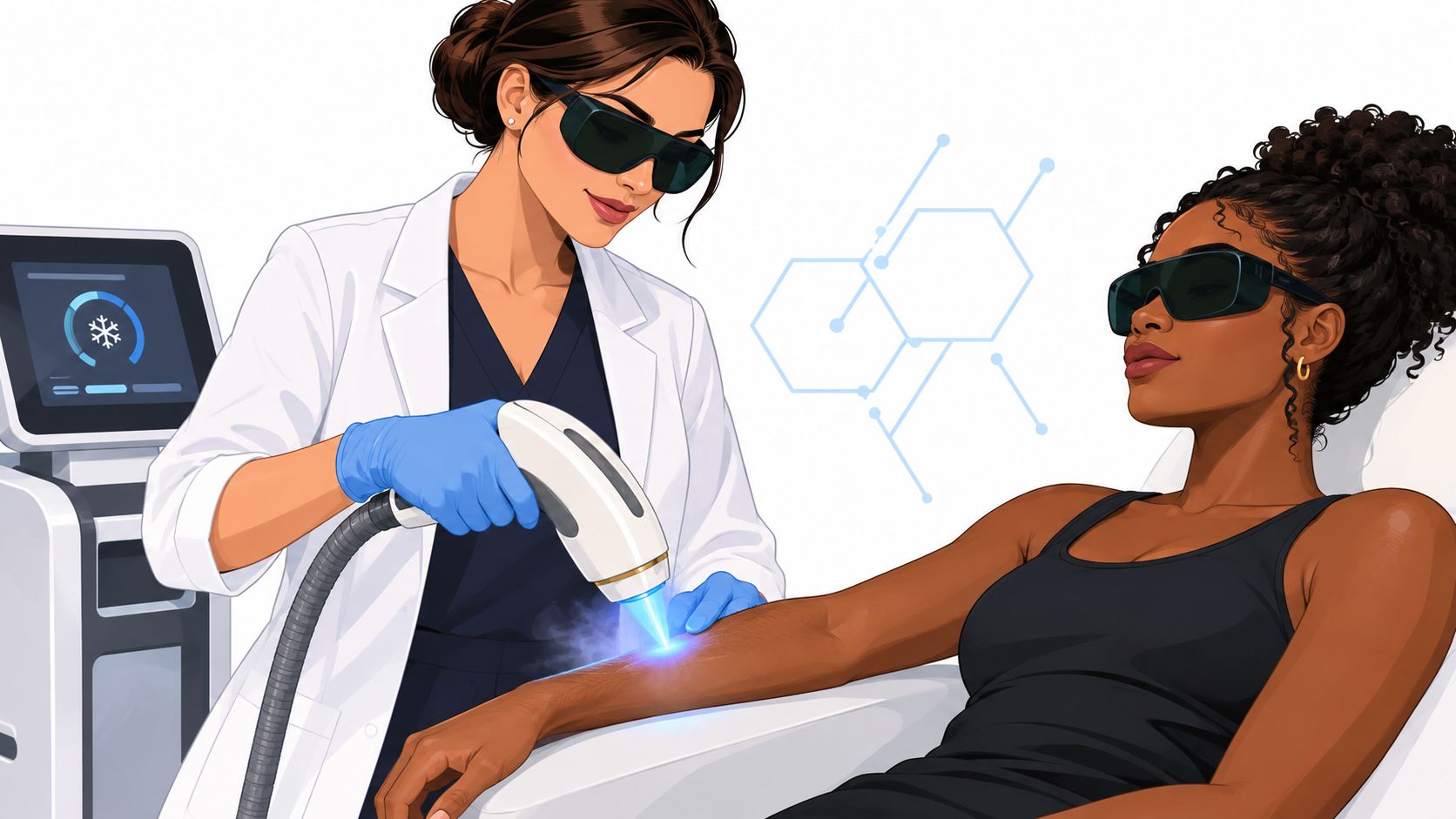
You've booked a consultation for laser hair removal, but the clinic's answer to your skin tone is vague: “We use the same machine for everyone.” That should make you pause. For Fitzpatrick IV to VI skin, safe treatment depends on the relationship between wavelength, pulse duration, cooling, hair calibre, current pigmentation, and operator judgement. Darker skin isn't a reason to avoid laser hair removal. It is a reason to demand a more disciplined protocol.
Índice
- Why Dark Skin Needs a Different Laser Approach
- How Lasers Interact with Melanin in Darker Skin
- Choosing the Right Wavelength for Fitzpatrick IV-VI
- What the Clinical Evidence Actually Shows on Darker Skin
- Building a Safe Treatment Protocol for Dark-Skinned Clients
- Devices, Training, and the South African Regulatory Picture
- Turning Safe Dark-Skin Treatments into a Profitable Niche
Why Dark Skin Needs a Different Laser Approach
A Fitzpatrick V client arrives expecting a routine consultation. The operator has extensive experience with phototypes I to III, but limited supervised practice with melanin-rich skin. The machine is familiar and the treatment menu looks organised. Then the client asks why that wavelength was selected, how the test patch will be judged, and what will change if the epidermis shows an early reaction. The operator cannot answer clearly.
That gap is a clinical warning. In darker skin, epidermal melanin competes with the hair follicle for laser energy. Settings copied from a lighter-skinned client can heat the surface excessively instead of creating controlled follicular injury. Possible outcomes include burns, post-inflammatory hyperpigmentation, hypopigmentation, or treatment so cautious that hair reduction remains limited.
A medical-grade system, correctly configured and operated, can deliver more consistent follicular heating than a home-use device. Home-use systems generally use lower energy and depend heavily on repeated, careful application. They may offer convenience, but they cannot replace assessment of skin condition, hair calibre, pulse duration, cooling, and treatment response. The device category changes the margin for error. It does not remove the need for competent decisions.
South Africa's clinical context adds another concern. A Balanço de 2019 described laser hair removal as operating in a weakly regulated environment, with no mandatory competency systems for operators and no legislation governing the supply or purchase of laser devices. It also discusses the greater risk of epidermal injury in melanin-rich skin when shorter wavelengths, including ruby and alexandrite, are used. The South African review of laser hair removal regulation and safety should inform any practice treating darker phototypes.
The operator carries more responsibility than the brochure suggests
Device choice is only one clinical decision. The operator must grade the skin consistently, check for recent sun exposure or inflammation, assess hair colour and calibre, choose suitable pulse parameters, cool the epidermis, perform a test patch, and recognise a warning response before it becomes an injury.
Training can leave practical gaps. A course may explain selective photothermolysis while providing limited supervised experience on Fitzpatrick IV to VI skin. Practitioners then need a protocol that links wavelength, fluence, pulse duration, cooling, test-patch review, consent, and documented follow-up.
Regra clínica: If an operator cannot explain why the chosen wavelength protects the epidermis, how the test patch will be assessed, and what will happen if the skin reacts, the consultation is incomplete.
The stakes are clinical and commercial. Pigmentation complications may require prolonged management, damage trust, and expose a clinic to complaints or medico-legal scrutiny. A repeatable protocol protects the client, the practitioner, and the practice's reputation.
How Lasers Interact with Melanin in Darker Skin
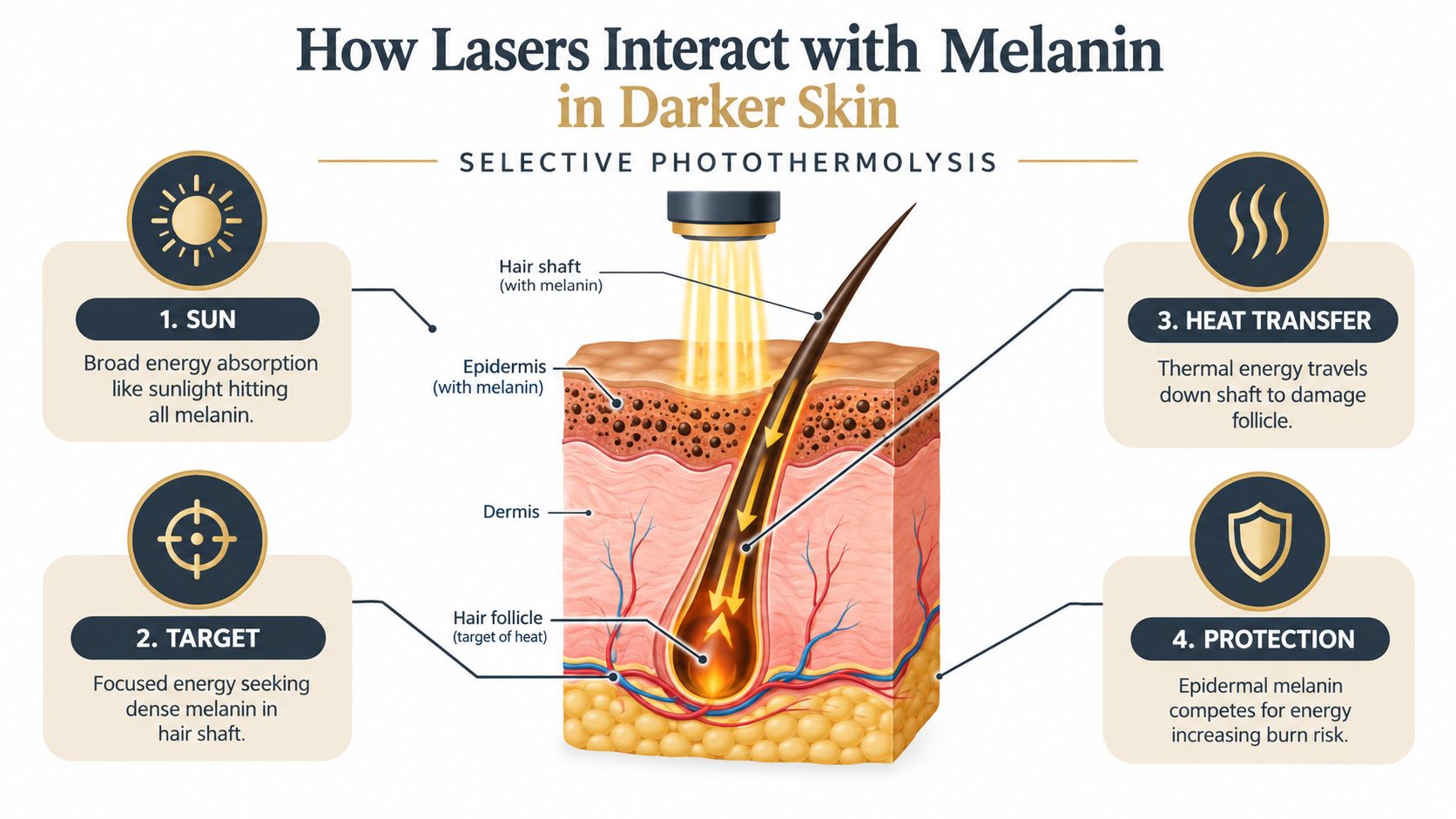
Think of the laser as a beam entering a room where both the target and the walls can absorb light. The hair shaft and follicle are the intended target, but epidermal melanin sits closer to the surface and can absorb energy before it reaches the follicle. In lighter skin, the “walls” absorb less. In Fitzpatrick IV to VI skin, they absorb more, so the operator has less room for careless parameter choices.
Selective photothermolysis works when the laser delivers enough energy to a pigmented hair structure to create controlled thermal injury while limiting damage to surrounding tissue. The hair's melanin acts as the target. Heat travels down the shaft towards the follicle, where it disrupts structures involved in hair growth.
The difficulty is that the epidermis also contains melanin. Shorter wavelengths are absorbed more strongly by that surface pigment, increasing the risk that the skin heats before the follicle receives useful energy. Longer wavelengths penetrate more and generally encounter less epidermal melanin absorption, which is why 1064 nm Nd:YAG is commonly favoured for darker phototypes. This explanation of how laser hair removal works provides a useful foundation for understanding the treatment mechanism.
Wavelength, pulse width, and cooling work together
Wavelength affects where energy travels and which chromophores absorb it. It isn't the same as penetration depth, and a deeper-reaching wavelength can still cause injury if the fluence, pulse duration, repetition, or cooling is poorly matched to the client.
Pulse width determines how quickly energy is delivered. A longer pulse spreads heat over more time, helping the operator limit abrupt epidermal heating while still building thermal injury in a coarse, pigmented hair. The correct choice depends on the hair structure, area, skin response, and device design. There's no universally safe setting because a machine offers it.
Cooling is the protective layer between useful follicular heating and excessive epidermal heat. Contact cooling, chilled air, or another integrated cooling method can reduce surface temperature before, during, and after pulses. On melanin-rich skin, cooling isn't a luxury or a comfort upgrade. It's part of the safety system.
Choosing the Right Wavelength for Fitzpatrick IV-VI
A client with Fitzpatrick V skin, coarse dark hair, and recent sun exposure needs a different decision from a client with stable Fitzpatrick IV skin and finer hair. For Fitzpatrick IV to VI, long-pulsed 1064 nm Nd:YAG is the usual default because it reaches the follicle with lower epidermal melanin absorption than shorter wavelengths. A 2023 clinical review also distinguishes professionally supervised treatment from home-use devices. The review of laser hair removal in darker skin supports using the wavelength as part of a protocol, not as a guarantee of safety.
An 810 nm diode can work for selected clients when the device allows extended pulse durations and provides strong contact cooling. A South African review describes a six-month multicentre prospective study involving patients with Fitzpatrick skin types III to V treated with an 810 nm diode laser. Its relevance is practical: results depend on matching wavelength and settings to skin type, hair, and treatment area. Operator training and device selection remain part of that decision.
Alexandrite at 755 nm and ruby at 694 nm require greater caution. Their stronger melanin absorption raises epidermal heating and therefore the risk of burns or post-inflammatory pigment change in Fitzpatrick V and VI, especially after tanning, during inflammation, or on areas with substantial epidermal pigment. South African guidance places alexandrite more appropriately with lighter to olive skin and favours Nd:YAG for darker South African skin tones. This wavelength comparison for laser hair removal outlines that distinction.
| Comprimento de onda | Melanin Absorption | Fitzpatrick IV-VI Suitability | Recommended Use |
|---|---|---|---|
| 1064 nm Nd:YAG | Lower epidermal absorption, deeper penetration | Preferred option | Default choice for darker skin, with conservative escalation and active cooling |
| Díodo de 810 nm | Intermediate absorption profile | Viable with careful selection | Consider when pulse duration and cooling are appropriate |
| 755 nm alexandrite | Stronger epidermal melanin absorption | Higher risk in darker phototypes | Generally avoid for Fitzpatrick V to VI unless exceptional specialist justification exists |
| 694 nm ruby | Strong melanin absorption | High risk | Not a routine choice for Fitzpatrick IV to VI |
A practical selection rule
Begin with the client's current Fitzpatrick grade, then assess hair calibre, pigment density, treatment area, recent sun exposure, and cooling capacity. Use longer wavelengths, longer pulse times, conservative energy escalation, and appropriate spot sizes, particularly on the face and hormonally influenced areas. Perform a test patch when the risk profile is uncertain, record the response, and obtain consent that covers delayed pigment change as well as incomplete reduction. This guide to Nd:YAG laser hair removal explains why 1064 nm is commonly selected for deeper skin tones.
What the Clinical Evidence Actually Shows on Darker Skin
A client with Fitzpatrick V skin may achieve meaningful reduction in a clinic, while the same treatment goal produces a weaker result with a home-use device. Clinical evidence supports laser hair removal for darker skin, but it does not justify identical promises across clients, wavelengths, or devices. Outcomes depend on skin type, hair calibre and colour, treatment area, fluence, pulse settings, cooling, and the operator's ability to adjust the protocol.
The clearest comparison is between professionally supervised treatment and lower-powered home-use treatment. A professional diode laser produced 85% hair reduction on one axilla and 88% on the other after six treatments, while a home-use device produced 52% and 46.3% reduction over the same treatment pattern. The clinical review reporting these comparative outcomes supports a practical conclusion: consumer devices should not be presented as equivalent to a medical-grade clinic system.
The same review describes a prospective study of 36 subjects, com 54% classified as Fitzpatrick V to VI. After four sessions, mean hair reduction reached 41.5% in the axilla and 48.1% in the bikini line, with no serious adverse events reported. Those results are useful during consent because they show meaningful reduction without suggesting complete clearance or a permanent guarantee.
What the numbers do, and don't, tell you
A 2025 study of low-fluence 1064 nm Nd:YAG found that fluence significantly affected outcomes. In that study, 25 J/cm² was effective, while skin type, age, and geographic location were not significant factors. No adverse events or paradoxical hypertrichosis were observed, and many participants reported improved skin tone. The 2025 Nd:YAG study adds useful support for conservative Nd:YAG protocols, although longer-term and multi-site research remains necessary.
The evidence does not support transferring outcome ranges from lighter skin or shorter-wavelength trials directly into Fitzpatrick V and VI consultations. It also does not establish home-use IPL or diode devices as clinically equivalent to professional systems. Lower energy output can limit treatment of terminal hair, while incorrect use can still create avoidable irritation or pigment change.
| Device/Wavelength | Avg. Hair Reduction | Typical Sessions Needed | Notable Adverse Events |
|---|---|---|---|
| Professional diode, 810 nm | 85% and 88% in the cited axillary comparison after six treatments | Six treatments in the cited comparison | Clinical settings and supervision remain important |
| Home-use device | 52% and 46.3% in the cited axillary comparison | Six treatments in the cited comparison | Lower efficacy does not remove the risk of inappropriate use |
| Low-fluence Nd:YAG, 1064 nm | 25 J/cm² was effective in the cited 2025 study | Study-specific protocol | No adverse events or paradoxical hypertrichosis reported in that study |
| Nd:YAG in a prospective darker-skin study | 41.5% axilla and 48.1% bikini line after four sessions | Four sessions in the cited study | No serious adverse events reported |
Consultations should describe laser as progressive hair reduction, not guaranteed total removal. Hair colour, calibre, hormonal activity, treatment consistency, and the growth cycle all affect the final result. The practitioner must explain what the evidence supports, document realistic expectations, and avoid promising an outcome that the chosen wavelength and protocol cannot defend.
Building a Safe Treatment Protocol for Dark-Skinned Clients
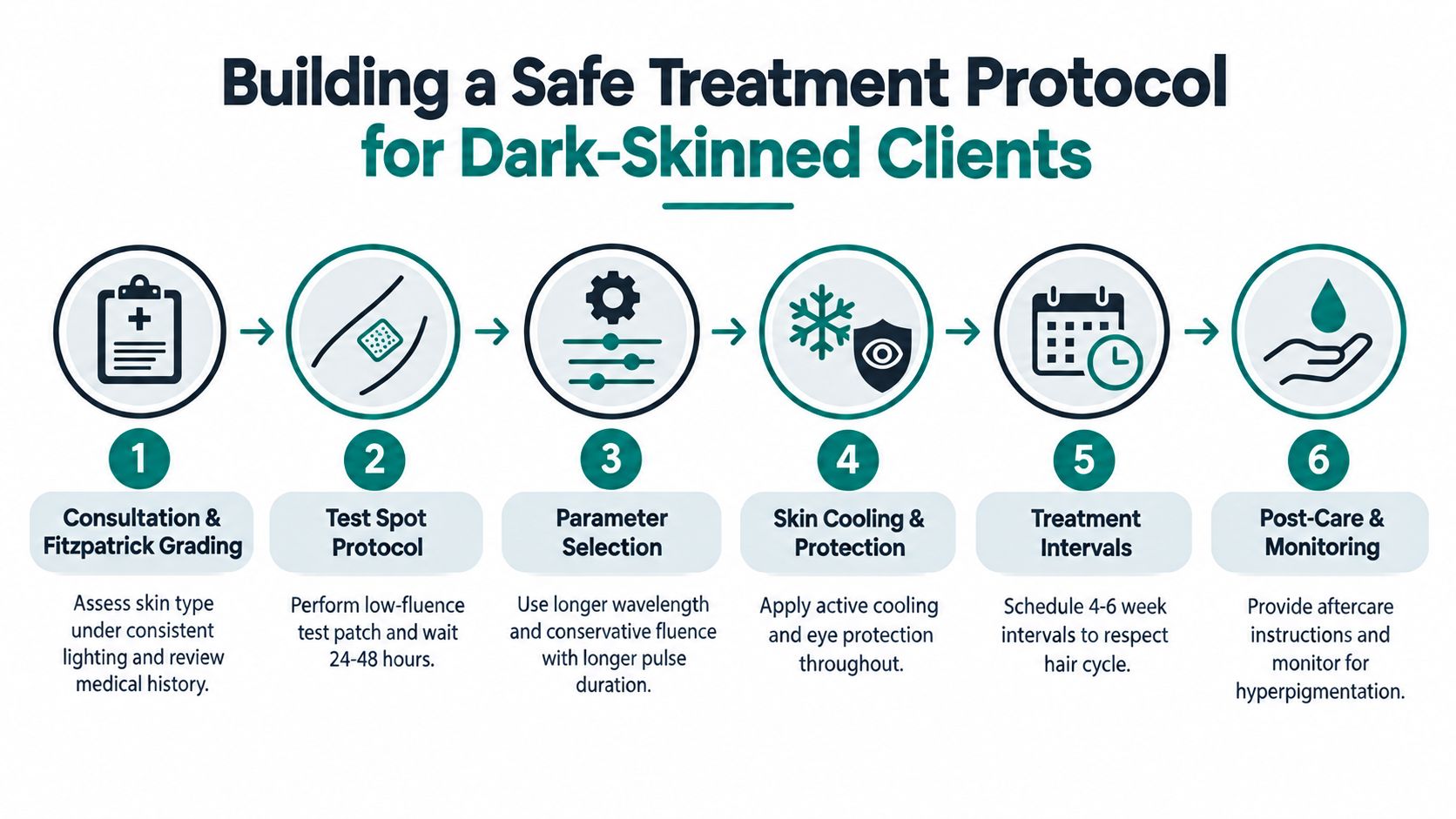
A safe protocol starts before the handpiece touches the skin. Grade the client's Fitzpatrick type under consistent lighting, document the current skin tone, and ask about recent sun exposure, self-tanner, inflammation, previous pigmentation changes, photosensitising medicines, hormonal symptoms, and past reactions to energy-based treatments.
Review the treatment goal with care. Facial and hormonally driven hair can behave differently from coarse body hair, and a client may need a longer-term management plan rather than a simple series. Explain that reduction is gradual and that the clinic will reassess the response rather than repeating the same settings automatically.
Use the test patch as a decision point
A test patch should use a conservative, low-fluence approach appropriate to the chosen device, commonly beginning with long-pulsed 1064 nm Nd:YAG where clinically indicated. Observe the area for 48 to 72 hours before treating a larger zone. A response beyond mild, short-lived erythema should trigger a review of the wavelength, fluence, pulse duration, cooling, and treatment qualification.
The patch test isn't a ritual that guarantees safety. It gives the operator information about the client's current skin state and the selected parameters. Document the location, settings, cooling method, endpoint, and delayed response so the full treatment plan has a clear clinical record.
Consent must name the risks
Informed consent should explicitly cover paradoxical hypertrichosis, post-inflammatory hyperpigmentation, and the rare but documented risk of hypopigmentation. It should also explain that recent tanning, active inflammation, hormonal influences, and unsuitable hair pigment can alter the outcome.
Absolute contraindications commonly include:
- Active infection: Delay treatment until the area has recovered.
- Recent isotretinoin use: Do not treat within six months unless an appropriately qualified clinician has assessed the situation and cleared it.
- Recent sun exposure: Postpone treatment when the skin's melanin load has increased or the area is sunburned.
- Keloid history in the treatment area: Assess the risk carefully before proceeding.
Relative contraindications, including photosensitising medicines, active dermatitis, poorly controlled hormonal conditions, pregnancy-related considerations, and unexplained pigmentary disorders, may require medical clearance.
Prepare the skin by avoiding retinoids around the treatment period, stopping waxing or tweezing four weeks before the series, and shaving rather than removing the follicle between sessions. Use active cooling throughout treatment, provide appropriate eye protection, and discuss topical anaesthetic timing only when it's clinically suitable and used according to professional guidance.
Regra prática: Mild perifollicular redness can be an expected endpoint. Blistering, marked whitening, severe pain, or a pronounced epidermal response means stop, document, and reassess.
Devices, Training, and the South African Regulatory Picture
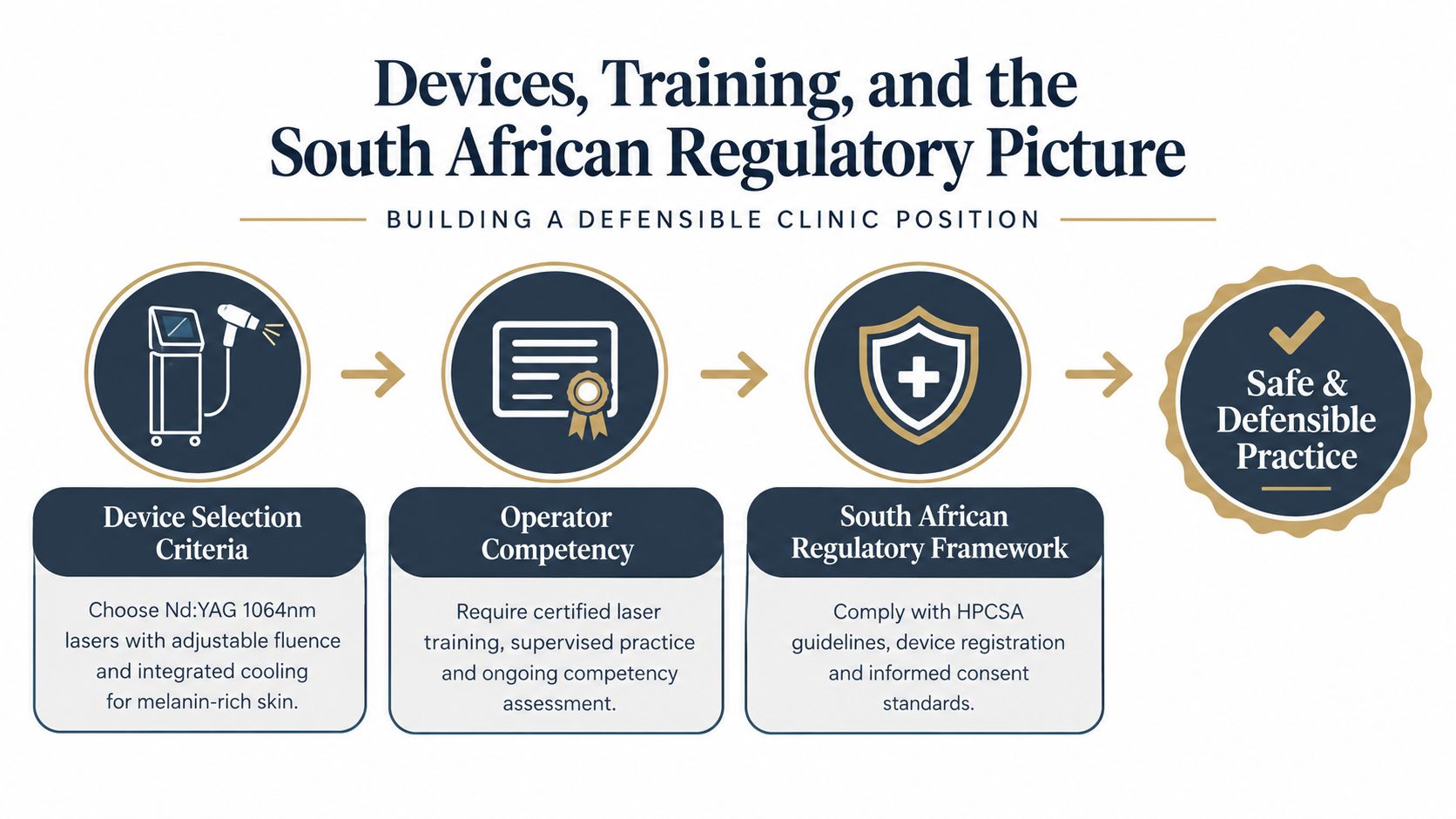
A defensible clinic position rests on the right device, demonstrated operator competence, and documented governance. For Fitzpatrick IV to VI, a professional long-pulsed 1064 nm Nd:YAG platform should provide control over fluence, pulse duration, spot size, and cooling. These settings let the practitioner adjust treatment for hair calibre, treatment area, epidermal response, and current pigmentation rather than applying one fixed protocol.
Diode systems and IPL may suit selected cases, but their limitations need to be stated clearly for darker skin. A broader or less precise light source can make epidermal melanin harder to manage, especially when cooling is weak or parameter control is restricted. Device category alone does not establish safety. Wavelength, pulse settings, cooling, test-patch results, and the operator's response to those results determine the usable margin.
Training must include real darker-skin cases
South Africa's regulatory position does not remove the need for a clinic-defined competency pathway. Operators should not treat limited uniform oversight as permission to improvise. Training must include Fitzpatrick IV to VI cases, parameter selection, test patching, consent that explains pigmentary risks, and a documented plan for delayed reactions or complications.
A responsible pathway includes:
- Supervised case exposure: Keep a documented log of Fitzpatrick IV to VI cases before independent practice.
- Manufacturer training: Learn the platform's cooling system, pulse controls, indications, and contraindications from a qualified trainer.
- Clinical mentorship: Arrange access to a dermatologist or experienced medical aesthetic practitioner for complex cases and complications.
- Ongoing assessment: Review photographs, treatment endpoints, delayed reactions, and outcomes. Certification is not the end of learning.
Medical-grade systems can provide stronger fluence control, cooling, and repeatable settings than home-use devices, but those advantages only matter when the operator can configure them correctly. Home-use devices generally use lower energy and may offer gradual, limited reduction rather than the same clinical outcome. Clinics should explain that difference during consent instead of allowing device ownership to imply equivalent results.
South African clinics should confirm applicable premises, device, radiation-control, professional-scope, consent, and record-keeping requirements with relevant authorities and professional bodies. Requirements may depend on the setting, device, operator, and service structure. Keep the advice current and document the basis for the clinic's procedures.
Omega Lasers provides professional laser equipment, training, technical support, and business-development support for aesthetic practices. Its Tetra Cool platform uses a 1064 nm wavelength and is described for darker skin types when used with correct parameters and training. Explore Omega Lasers' laser hair removal training as one part of a broader competency and governance plan, not a substitute for clinical responsibility.
Turning Safe Dark-Skin Treatments into a Profitable Niche
A clinic serving Fitzpatrick IV to VI clients can turn careful treatment into a specialised service. The opportunity rests on competence, not broad promises. Clients return when consultations address their concerns, treatment remains comfortable, skin reactions are handled promptly, and the team communicates clearly.
A mid-sized Johannesburg practice that once declined darker-skinned clients because staff had trained mainly on IPL and diode protocols could reposition its service through retraining. A practical plan would centre on long-pulsed Nd:YAG, 30-minute free consultations, and before-and-after imagery showing Fitzpatrick V to VI results. As a hypothetical illustrative example, the clinic might aim to double monthly bookings within a quarter and seek a 40% rise in referrals from melanin-rich communities. Those are planning targets, not measured outcomes or universal forecasts. Results depend on clinical delivery, local demand, pricing, consent quality, and reputation.
Credibility becomes a growth system
Marketing should answer the questions clients already ask. Which wavelength do you use? Who performs the treatment? How do you assess skin tone? What happens if the skin reacts? Can clients see results on skin like theirs?
Use photography responsibly. Obtain written consent, keep lighting and positioning consistent, and show a range of Fitzpatrick IV to VI clients rather than only the most dramatic result. Explain treatment progression, expected reduction, and why complete removal cannot be promised.
| Métrica | Before retraining | After 90 days |
|---|---|---|
| Dark-skin capability | Clients with darker phototypes were often declined | Long-pulsed Nd:YAG pathway established |
| Consultation experience | Device-first assessment | 30-minute free consultations |
| Visual proof | Limited relevant imagery | Before-and-after examples featuring Fitzpatrick V to VI |
| Monthly bookings | Baseline practice level | Aiming to double in the representative scenario |
| Community referrals | Baseline referral activity | Aiming for a 40% increase in the representative scenario |
A practical 90-day plan begins with a clinical audit, device review, and training needs assessment. The team then documents consultation, test-patch, parameter-selection, and follow-up procedures, updates consent forms, and photographs suitable results with permission. Training should cover wavelength choice, pulse duration, fluence, cooling, endpoint recognition, and when to postpone treatment. The clinic can publish educational content, brief the front desk, track consultations and repeat bookings, and review every adverse response with the treating team.
A safe service earns more than one appointment. It builds trust, referrals, retention, and a reputation stronger than generic “one machine fits all” messaging.
Omega Lasers supplies professional aesthetic laser systems, including 1064 nm technology suited to darker skin when used with correct parameters, alongside training, technical support, and clinic-growth guidance. Visit Lasers Omega to explore equipment and support for building a safe, defensible laser hair removal service for Fitzpatrick IV to VI clients.