



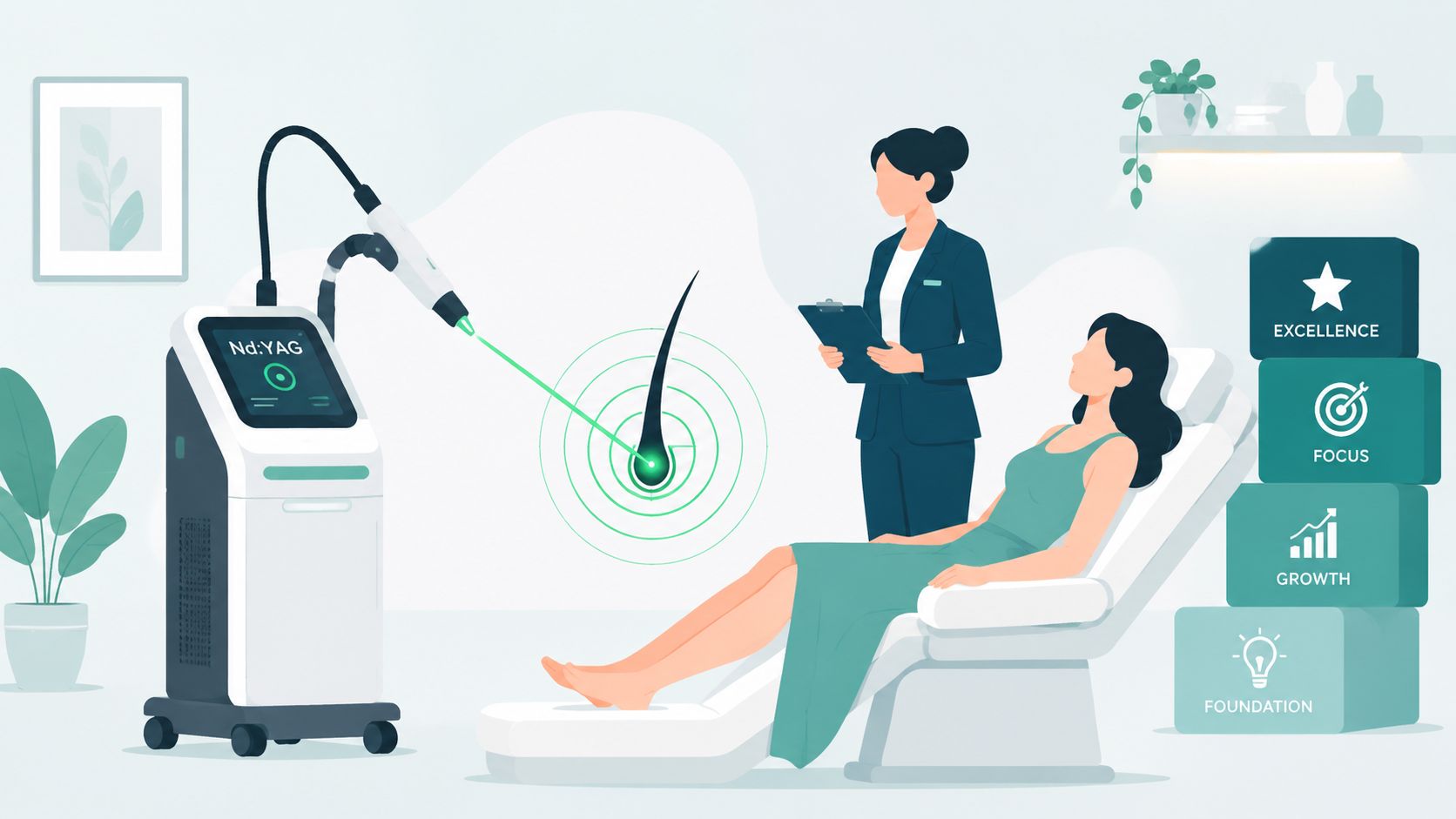
You're probably seeing the same shift many clinic owners are seeing. More clients are asking for hair removal that works on darker skin, fewer are willing to accept vague promises, and almost all of them want an answer to the same question: what's the safest option that still delivers strong results?
That's where YAG laser hair removal moves from being a line item on a device brochure to a real clinical and commercial decision. In a South African practice, device choice isn't just about having a hair removal system. It's about matching wavelength, protocol, staff training, and patient selection to the skin types you treat every day.
Done properly, Nd:YAG gives you a service that fits modern demand. It treats a wider range of melanin-rich skin safely, supports repeat bookings, and opens a credible conversation around concerns like ingrown hairs and pseudofolliculitis barbae. Done badly, it becomes another machine that sits underused because the team doesn't know how to set expectations or build treatment plans around it.
Índice
- Why YAG Is the Future for Your Aesthetic Clinic
- Understanding the Nd YAG Laser Mechanism
- YAG vs Diode vs Alexandrite vs IPL A Clinical Comparison
- Achieving Superior Results on Darker Skin Tones
- The Complete YAG Treatment Protocol From Start to Finish
- Evaluating YAG Laser Device Features for Your Clinic
- Integrating YAG Services to Maximise Your Return on Investment
- Frequently Asked Questions About YAG Hair Removal
Why YAG Is the Future for Your Aesthetic Clinic
Monday starts with three consultations in a row. One patient has coarse terminal hair on a darker phototype. One has post-inflammatory hyperpigmentation from prior treatment elsewhere. One wants a package but asks a hard question first: “Can you treat my skin safely and consistently?” Clinics that answer that well build more than bookings. They build a service line that fits the patient mix most South African practices see.
Nd:YAG has become a strong commercial choice because it supports a broader treatment population and a repeatable course of care. In practice, that means more consults converted, fewer exclusions at assessment, and better continuity from first session to maintenance. If your team already explains the basics during consultation, this guide on como funciona a depilação a laser is useful for staff alignment and patient education.
The commercial case for clinical range
A clinic that can treat diverse phototypes with clear protocols has a measurable advantage. It widens the pool of eligible patients, reduces the number of consults that end in “not suitable here,” and supports course-based revenue rather than one-off visits. That matters in hair removal, where profitability depends on retention, rebooking discipline, and consistent outcomes across different hair and skin presentations.
I advise clinics to assess Nd:YAG investment in three operational buckets:
- Adaptação ao doente: A broader phototype range means fewer missed opportunities in a diverse catchment area.
- Protocol consistency: Standardised settings frameworks, test spot rules, and review intervals improve predictability and reduce avoidable complications.
- Reputation for clinical excellence: Patients talk about results, but they also talk about whether your clinic understands melanin-rich skin and sets expectations properly.
Regra prática: Buy technology for the patient base you have, not for the brochure model you wish you had.
Strategy turns wavelength into revenue
Owning a Nd:YAG platform does not automatically create demand or good outcomes. The clinics that perform well usually train reception and consulting staff to qualify correctly, document contraindications carefully, price treatment courses properly, and monitor conversion from consultation to package sale.
Local positioning matters too. Many clinics say they treat “all skin types,” but their consultation process, consent language, and treatment confidence often tell a different story. If you want to conduct competitor analysis around service gaps, package structure, and positioning, use that work to identify where your practice can offer clearer protocols and more credible messaging.
The strongest Nd:YAG businesses do not market “safe for dark skin” as a slogan. They build training, protocols, consultation scripts, photography standards, and follow-up systems around it. That is what improves clinical outcomes and makes the service financially reliable.
Understanding the Nd YAG Laser Mechanism
A common consultation in a South African clinic goes like this: the patient has Fitzpatrick V skin, coarse chin or neck hair, post-inflammatory marks from ingrowns, and a reasonable concern about burns or pigment change. In that scenario, wavelength selection is not a technical detail. It shapes safety margins, treatment confidence, and whether the patient commits to a full course.
Nd:YAG hair removal uses a 1064 nm wavelength, which penetrates further and is less readily absorbed by epidermal melanin than shorter wavelengths. Clinically, that gives the operator a better chance of concentrating heat in the follicular target while limiting unnecessary surface heating.

For teams refining consultations or patient education, this explanation of how laser hair removal works at the follicle level is a useful support resource.
Why 1064 nm matters
The working principle is selective photothermolysis, but the practical point is simpler. The treatment must deliver enough thermal injury to the hair follicle to interrupt regrowth, without creating excess epidermal injury on the way in.
The significance for darker skin is its higher concentration of epidermal melanin. A wavelength with heavy superficial absorption leaves less room for error. Nd:YAG gives more operating latitude, especially when pulse duration, fluence, spot size, overlap, and cooling are selected with discipline.
When explaining this to patients, I often describe the difference as a targeted spotlight versus a floodlight. Nd:YAG is still powerful, but its behaviour is better suited to reaching the follicle with less competition from pigment at the skin surface.
In clinic terms, the mechanism has three treatment implications:
- Follicular targeting depends on pigment and depth: Coarse, dark hair is the best target because it contains enough melanin and sits at a depth the wavelength can reach effectively.
- Epidermal protection depends on technique: Cooling, conservative test spots where indicated, and accurate parameter selection are part of the mechanism in practice, not optional extras.
- Results depend on timing: Only follicles in the right growth phase respond well in a given session, which is why treatment courses and review intervals matter.
A useful clinical tip is to watch the endpoint, not just the screen settings. Perifollicular erythema and oedema usually indicate effective follicular heating. Excess diffuse surface redness without a clear perifollicular response often means energy is being wasted in the wrong place or the skin is absorbing more than it should.
Why the mechanism affects service design
Nd:YAG is often introduced as a hair reduction treatment, but in many practices the stronger commercial opportunity is management of ingrown-prone areas and shaving-related inflammation in melanin-rich skin. That changes how the consultation should be framed. The primary goal may be fewer bumps, less inflammation, and a cleaner beard line, not complete long-term clearance.
A published review in PMC notes meaningful improvement in pseudofolliculitis barbae with Nd:YAG treatment in affected patients (PMC review on Nd:YAG for PFB). For clinics treating men with curly beard hair or women with recurrent ingrowns on the face, axillae, or bikini line, this is clinically relevant and commercially valuable. It broadens the service from cosmetic demand to problem-solving medicine.
That also improves case acceptance. Patients often understand "less irritation and fewer ingrowns" more clearly than "permanent hair removal," and the outcome is easier to measure in follow-up photography and review notes.
Nd:YAG still has limits. Blonde, red, grey, and very fine hair remain poor targets because the mechanism depends on sufficient pigment in the follicle. Practices that understand that boundary tend to get better reviews, fewer refund conversations, and stronger package conversion because expectations are set correctly from the start.
YAG vs Diode vs Alexandrite vs IPL A Clinical Comparison
A device decision should start with one blunt question: who walks through your door most often?
If your clinic serves a high proportion of Fitzpatrick IV to VI patients, the wrong hair removal platform won't just lower satisfaction. It will force your team into conservative treatment choices, awkward exclusions, and more risk management than treatment confidence.

If you're clarifying the distinction between broad-spectrum light and true laser systems for your team or your booking pages, this overview of Depilação a laser IPL helps frame that difference clearly.
The device decision starts with your patient mix
Nd:YAG's major advantage is safety latitude on darker skin. Its trade-off is that it's generally less impressive on very fine or light hair. Alexandrite tends to be more efficient on lighter skin and finer pigmented hair, but it has a narrower comfort zone on darker phototypes. Diode sits in the middle as a versatile option in many practices. IPL is not a laser and is less specific in how it delivers energy.
That means there is no universal winner. There is only a better fit for your clinic's daily caseload.
Hair Removal Technology Comparison
What wins clinically and what wins commercially
A good clinical comparison doesn't stop at wavelength.
Consider the trade-offs:
- For darker skin safety: Nd:YAG is the most dependable reference technology because its wavelength better spares epidermal melanin.
- For fine hair expectations: Other technologies may perform better in selected lighter-skin cases, but they bring more caution when skin gets darker.
- For treatment comfort: Cooling, handpiece design, and operator technique often matter as much as the technology label.
- For operational simplicity: A clinic with a highly diverse patient base usually benefits from systems and protocols that reduce exclusion and complicated screening.
The cheapest mistake in hair removal is saying no to the wrong candidate. The expensive mistake is saying yes with the wrong device.
From a business standpoint, over-specialising in a technology that only suits a limited patient segment can shrink utilisation. Under-specifying for your population can create complication risk and poor results. In South Africa, where darker phototypes are common, Nd:YAG often gives the most practical balance of safety, applicability, and service continuity.
Achieving Superior Results on Darker Skin Tones
A patient with Fitzpatrick IV or V does not need another vague promise about a laser being “safe.” She wants a clear answer on expected reduction, how many sessions to budget for, which areas will respond well, and whether your clinic can treat melanin-rich skin without causing avoidable pigment problems. That is the standard this consultation has to meet.

What strong results actually look like
Published facial hair reduction data in darker phototypes shows a useful pattern for practice owners and clinicians. Long-pulsed Nd:YAG can produce meaningful improvement in skin types IV and V, but outcomes differ by treatment area and hair characteristics.
In a prospective analysis of 200 female patients com skin types IV and V, treated for facial hair reduction with long-pulsed Nd:YAG, more than 50% improvement after 6 sessions was reported in 89.69% of chin cases, 68.7% of lower-face cases, and 59% of upper-lip cases, with no worsening reported at follow-up (prospective analysis of 200 patients with type IV and V skin).
Those figures are useful because they help clinics stop selling all facial areas as if they respond the same way.
They do not.
The chin often gives stronger visible reduction than the upper lip. In practice, that usually reflects differences in hair calibre, follicle depth, growth cycling, and hormonal influence. Coarse terminal hair is a better target. Finer mixed hair is slower, less predictable, and easier to oversell if the consultation is weak.
How to turn that into better consultations and fewer complaints
Patients with darker skin usually arrive with one of two bad assumptions. They have either been told laser is too risky for them, or they have been told every area will clear at the same speed if they buy a package. Neither message helps the patient or the clinic.
A better consultation is more specific.
Set expectations around the points that affect outcome:
- Hair type matters: Coarse, dark terminal hair gives the strongest Nd:YAG response.
- Area matters: Chin, jawline, neck, and upper lip should be quoted with different expectations.
- Consistency matters: Reduction builds over a treatment series. Early shedding is not the final result.
- Maintenance matters: Some regrowth management is normal, especially in hormonally influenced facial areas.
One honest sentence improves consent quality and package retention. Nd:YAG hair removal is a reduction treatment that depends on repeated sessions, not a one-visit fix.
Why this matters commercially in South Africa
For a South African clinic, mastery of Nd:YAG on darker phototypes is not just a safety point. It affects utilisation, package design, review quality, and repeat revenue.
A clinic that understands which hair responds well, which areas require more caution, and how to price a realistic series can treat a broader share of the local market with fewer complications and fewer refunds. A clinic that stays vague tends to create the opposite outcome. Disappointed upper-lip patients, underpriced facial packages, and preventable post-inflammatory pigment concerns all erode margin.
Good Nd:YAG work on darker skin starts with precise selection, precise counselling, and precise follow-through. That is what produces better clinical outcomes and a stronger return per device hour.
The Complete YAG Treatment Protocol From Start to Finish
A patient arrives for her second upper-lip session after a beach weekend. The booking is only fifteen minutes, the room is running late, and the operator is tempted to proceed because the settings worked well last time. That is how preventable pigment problems start.
A profitable Nd:YAG service depends on discipline at every stage. Protocol protects the patient, gives the operator a repeatable method, and protects package revenue by reducing poor outcomes, complaints, and dropped treatment plans.
Before the first pulse
The consultation is where clinical suitability and commercial fit are decided. A weak consult usually shows up later as undertreatment, overtreatment, unrealistic expectations, or a package that was sold to the wrong patient.
The assessment should answer four practical questions. Is the patient safe to treat today. Is the hair likely to respond well. What is the treatment goal. What treatment cadence will the patient realistically maintain.
Focus on these checkpoints:
- Skin and hair assessment: Record phototype, recent sun exposure, tanning behaviour, hair colour, calibre, density, and whether the hair is terminal or fine.
- Medical screening: Check medications, active infections, inflammatory skin conditions, past post-inflammatory pigment change, scarring tendency, and anything that may alter healing.
- Area-specific planning: Facial areas, underarms, bikini, and larger body zones should not be quoted or scheduled as if they behave the same way.
- Objetivo do tratamento: Separate cosmetic reduction from ingrown-hair control. The endpoint, treatment interval, and patient satisfaction criteria can differ.
- Testes de contacto: Use it when skin history is unclear, the patient is new to laser, the area has recent sun exposure, or the phototype warrants extra caution.
As noted earlier, Nd:YAG works best as a course of treatments, especially on coarse dark terminal hair. That should shape how the clinic prices, books, and explains the treatment plan from day one. Single-session selling creates poor compliance and weaker retention. Series-based planning usually produces better timing, better photography, and better revenue per patient.
Durante o tratamento
A good session is methodical. The room setup, skin check, parameter selection, overlap control, and endpoint observation all matter more than speed alone.
Start with a same-day review. Confirm there has been no change in medication, sun exposure, skin irritation, or hair removal method since the last visit. Then check preparation. The area should be shaved or trimmed appropriately so energy is directed to the follicle, not wasted on visible shaft above the surface.
Parameter choice should be deliberate. Use the patient's phototype, hair characteristics, body area, response at prior sessions, and patch-test behaviour to guide settings. On darker phototypes, restraint is part of skill. Chasing high fluence to impress a patient often creates the opposite result. More downtime, more anxiety, and less trust.
Use cooling properly and maintain consistent coverage. Missed strips reduce visible outcomes. Excess overlap raises risk without improving the commercial result. In a busy South African clinic serving a broad range of phototypes, consistency is what keeps outcomes reproducible across operators and across treatment days.
Watch for the correct clinical endpoint. Mild perifollicular erythema and oedema are expected signs that follicular heating has occurred. Whitening, excessive epidermal reaction, or escalating discomfort should prompt an immediate reassessment of settings and technique.
Controlled endpoints produce better outcomes than aggressive settings.
Aftercare and expectation management
The session is not finished when the handpiece stops. A large share of callbacks, anxiety messages, and negative reviews come from poor aftercare explanation rather than poor laser delivery.
Give the patient clear verbal instructions and document them. Explain what normal post-treatment redness and swelling look like, what heat and friction to avoid, and when to contact the clinic. Sun protection matters, especially in a market where incidental exposure is common and many patients underestimate how quickly skin condition can change between sessions.
Hair-cycle education also affects retention. Patients need to understand that treated hairs often shed over time and that early regrowth does not mean the treatment failed. If that conversation is skipped, the clinic ends up defending a normal biological process as if it were a service error.
DermNet guidance on Nd:YAG treatment and darker skin supports the point every experienced operator learns early. Darker skin can be treated effectively with 1064 nm Nd:YAG, but poor parameter choice still increases the risk of unwanted pigment change, and some patients will require more sessions than others.
Before the patient leaves, book the next appointment at the correct interval, update photographs, and record the response in a way the next operator can use. That is how a clinic turns Nd:YAG from a device purchase into a reliable treatment system. Better notes lead to better settings. Better settings lead to better outcomes. Better outcomes protect margin.
Evaluating YAG Laser Device Features for Your Clinic
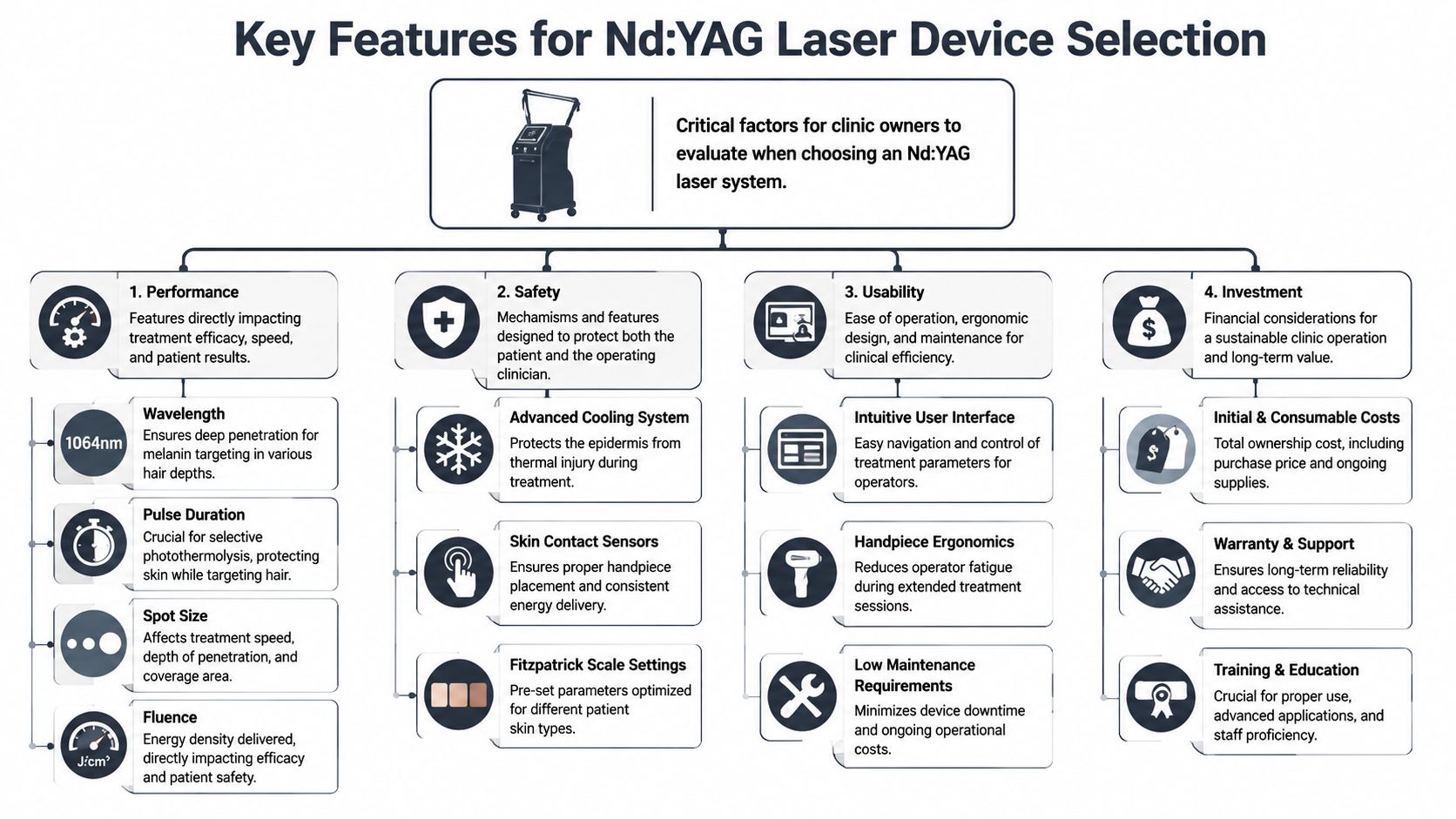
Two Nd:YAG devices can both say 1064 nm on the spec sheet and still perform very differently in practice. The difference shows up in treatment speed, epidermal protection, operator confidence, and how often your team uses the machine.
Specs that matter in practice
Para Fitzpatrick IV to VI skin, a commonly used long-pulsed 1064-nm Nd:YAG starting approach includes about 3 ms pulse duration, um 12-mm spot sizee 24 to 32 J/cm² fluence, combined with dynamic device cooling to reduce epidermal injury risk (Candela clinical paper on Nd:YAG protocols for Fitzpatrick IV to VI).
That single fact tells you what to look for in a device. Not marketing adjectives. Functional control.
Focus on these buying criteria:
- Pulse duration range: You need control that supports selective heating without forcing one-size-fits-all operation.
- Spot size options: Larger spot sizes can improve coverage and help with treatment efficiency on bigger areas.
- Stable fluence delivery: Output consistency matters more than brochure language.
- Qualidade do sistema de refrigeração: On darker skin, epidermal protection isn't optional.
- Usable interface: If the team can't manage settings quickly and confidently, protocol quality drops.
Buy for uptime not just for purchase price
The best financial decision is often the platform your team can use safely, repeatedly, and without avoidable downtime.
When you assess vendors and systems, ask practical questions:
| Feature area | What to check in real life |
|---|---|
| Performance | Can the system deliver appropriate long-pulsed Nd:YAG settings with sufficient flexibility for different treatment areas and hair types? |
| Segurança | Is cooling integrated and reliable? Are there safeguards that support consistent handpiece contact and disciplined use? |
| Formação | Does the supplier provide meaningful education on darker skin treatment, not just installation-day basics? |
| Suporte | If the machine stops producing, how quickly can service and parts be arranged? |
| Compliance | Are approvals and local regulatory requirements clear and documented? |
One relevant example is Lasers Omega, which supplies medical-aesthetic platforms and states that its systems are Aprovado pela FDA, com certificação CE e licenciado pela SAHPRA, with training and support available. That kind of operational backing matters because hair removal profitability depends on treatment consistency, staff confidence, and machine uptime, not just the initial sale.
A YAG device should be judged as a service platform. If it protects the epidermis, gives the operator enough parameter control, and comes with proper training and support, it has a far better chance of becoming a productive asset instead of an expensive ornament.
Integrating YAG Services to Maximise Your Return on Investment
The return on a YAG platform is decided after purchase, not at purchase. Clinics lose money on good equipment all the time because they fail to integrate the service operationally.
Build the service before you market it
Before you launch, make sure the following pieces are already in place:
- Train the full team: Not just the laser operator. Reception, coordinators, and consultation staff must understand candidate selection, package logic, and realistic outcomes.
- Standardise consultation language: Every team member should explain reduction, maintenance, and suitability the same way.
- Update booking workflows: Build treatment intervals, review points, and maintenance recalls into your system.
- Prepare targeted education: Your website, treatment menus, and social content should speak clearly to darker skin concerns, coarse dark hair, and ingrown-prone clients.
If your team uses AI to help draft campaign pages, FAQs, or treatment education, it's worth reviewing AdCrafty's AI content strategies so the messaging stays useful and human rather than generic and overpromised.
Package the treatment around the real journey
Your commercial model should mirror the actual clinical pathway. Patients don't buy a pulse. They buy a treatment course, follow-up structure, and confidence that the clinic knows how to manage the full process.
Practical integration usually looks like this:
- Sell a series, not a single hope: Build packages around the expected course rather than isolated appointments.
- Include review points: Reassess response, tolerance, and areas that may need adjustment.
- Position maintenance clearly: Don't bury it. Explain that some clients will need periodic top-ups.
- Track service economics: Measure consultation conversion, rebooking rate, package completion, and maintenance uptake.
For clinics working through purchase planning, this guide to custo da depilação a laser is a useful starting point because ROI only makes sense when you connect device cost to package design, utilisation, and repeat business.
The practices that get strong returns from Nd:YAG don't market it as another beauty add-on. They build it as a clinical programme for hair reduction, ingrowns, and long-term maintenance.
Frequently Asked Questions About YAG Hair Removal
Is YAG laser hair removal permanent?
The better term is redução permanente do cabelo. Hair can be reduced substantially, but some follicles may recover or produce finer regrowth over time. That's why maintenance is part of honest treatment planning.
How often are maintenance sessions needed?
A common pattern after the initial course is maintenance every 6 a 12 meses, based on StatPearls guidance on laser hair removal protocols (StatPearls treatment interval guidance). The exact interval depends on area, hair type, and the patient's regrowth pattern.
Can clients with PCOS still be treated?
Yes, but consultation quality matters. Hormonal drivers can make facial or body hair more persistent, so these clients often need careful expectation setting and long-term maintenance planning.
Can you treat over tattoos?
No. Avoid tattooed skin directly. The pigment creates an unnecessary risk because the laser is attracted to pigment. Work around the tattoo with a clear safety margin and document it.
Is YAG suitable for every hair colour?
No. Nd:YAG performs best on dark, coarse hair. Blonde and grey hair are poor candidates because there isn't enough pigment for reliable targeting.
If you're evaluating a YAG platform for your practice, Lasers Omega is one option to explore for regulated medical-aesthetic systems, training, and clinic support. The right next step isn't just requesting a price. It's reviewing how the device will fit your patient mix, protocols, staff capability, and long-term revenue model.