



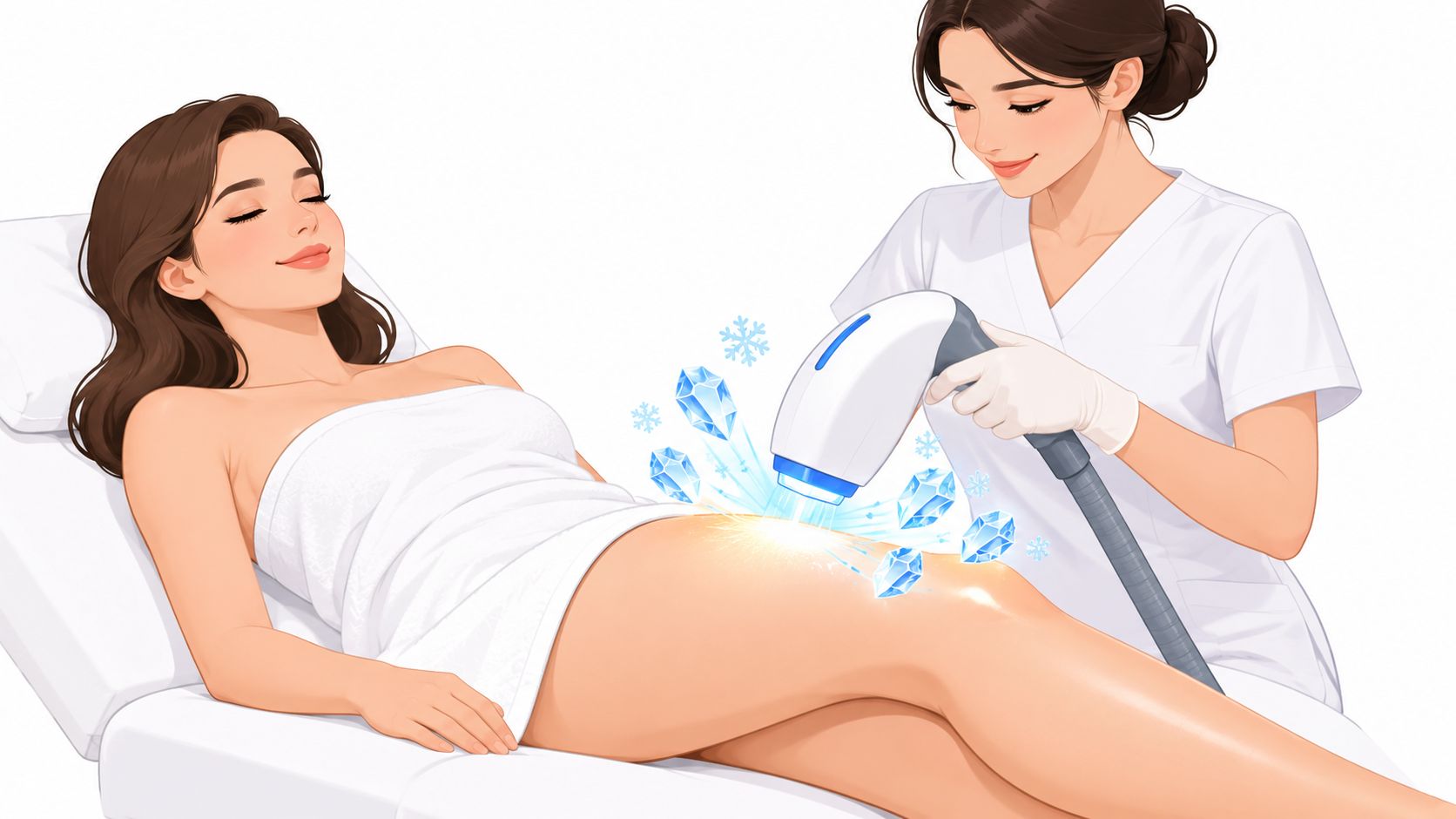
O conselho mais comum sobre a depilação a laser indolor é também o menos útil: “escolha um aparelho indolor”. Parece simples, mas esconde a questão clínica. A depilação funciona através do aquecimento do folículo, e é o calor que provoca tanto os resultados como a sensação.
Para os proprietários de clínicas, é melhor adotar uma abordagem honesta. A depilação a laser indolor não é uma promessa do tipo «sim ou não». É uma espectro de conforto determinado pela escolha do comprimento de onda, pela configuração do pulso, pelo arrefecimento, pelo critério do operador e pelo tipo de pele do cliente. Na África do Sul, isso é ainda mais importante, pois uma análise local refere que existe não existe regulamentação nacional obrigatória que regulamentam quem pode realizar tratamentos a laser ou quais as qualificações exigidas, o que torna a formação dos operadores uma questão de segurança fundamental, em vez de um mero extra (Análise sul-africana das práticas de depilação a laser).
Se promover a ideia de “sem dor” como ausência total de sensação, estará a expor a sua equipa a reclamações. Se explicar o conceito de conforto de forma adequada e, sobretudo, se abordar diretamente a questão da segurança das pessoas de pele mais escura, irá criar uma confiança que perdura mais do que qualquer afirmação sensacionalista.
Índice
- O que significa, na verdade, a depilação a laser sem dor
- Como os sistemas de arrefecimento e o design por impulsos eliminam a sensação de picada
- Comprimentos de onda e tipos de pele que proporcionam conforto
- A questão de segurança que a maioria das páginas sobre o alívio da dor ignora
- Como é uma sessão de tratamento a sério
- Escolher o dispositivo e o protocolo adequados para a sua clínica
- Conquistar a confiança dos clientes através de um marketing honesto
- Perguntas frequentes sobre a depilação a laser indolor
- Será que «sem dor» significa mesmo ausência total de sensação?
- Como é que isso se sente, na realidade?
- Por que razão alguns clientes querem creme anestésico e outros não?
- Que tons de pele podem ser tratados com segurança
- Quantas sessões os clientes devem esperar
- É possível que surjam efeitos secundários?
- Quem não deve ser tratado de imediato
- Quando é que os clientes notarão a redução?
- Quais são os sinais de alerta numa consulta?
O que significa, na verdade, a depilação a laser sem dor
“Sem dor” é uma expressão de marketing. Na realidade clínica, isso significa normalmente um ligeiro desconforto que se mantém bem dentro de um limite tolerável quando se utilizam o dispositivo e o protocolo adequados.
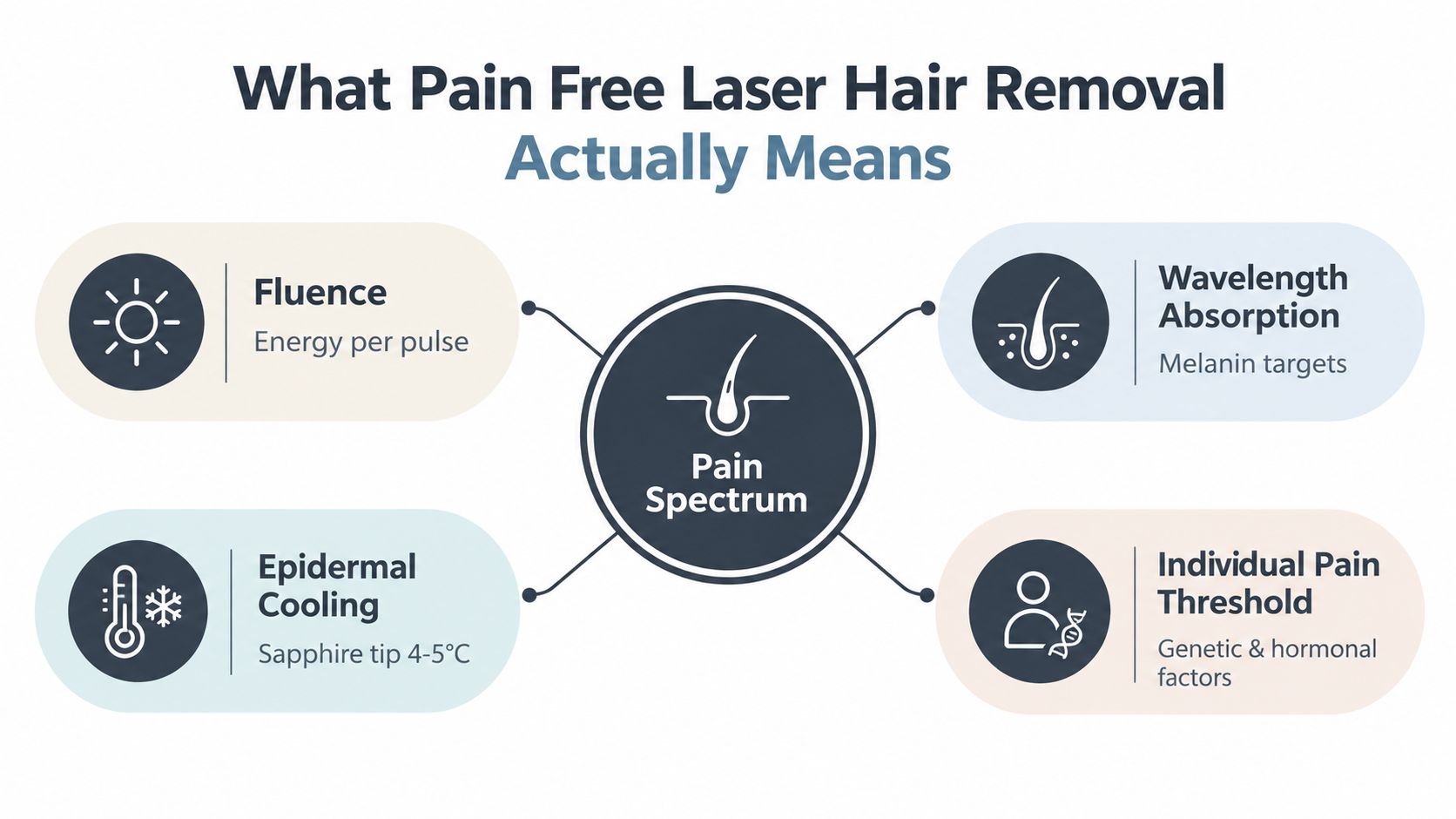
Os quatro fatores que determinam a sensação
A experiência de um cliente durante o tratamento depende da interação de quatro elementos:
- Fluence: Esta é a energia aplicada na pele. Uma energia mais elevada pode melhorar o aquecimento dos folículos, mas também pode aumentar a sensação de picada se o arrefecimento e a duração do tratamento não forem bem controlados.
- Absorção por comprimento de onda: Os diferentes comprimentos de onda interagem de forma diferente com a melanina. Quanto melhor for a correspondência com o tipo de pele e a espessura do pêlo, menos calor desperdiçado acaba por ir para onde não se quer.
- Arrefecimento epidérmico: Um bom arrefecimento protege a superfície enquanto o folículo é tratado por baixo. Um arrefecimento inadequado transforma um impulso tolerável num impulso agudo e memorável.
- Limiar de dor individual: As hormonas, a ansiedade, o sono, a área a tratar e a sensibilidade pessoal influenciam a forma como as mesmas configurações são percebidas.
Uma definição clínica mais adequada
Na prática, ensino as equipas a pensar em três níveis:
Tratamento praticamente indolor
Normalmente, são planos de menor fluência, muitas vezes com múltiplas passagens e um arrefecimento superficial intenso. O conforto é elevado, mas a eficácia do tratamento pode depender em grande medida do cumprimento rigoroso do protocolo.Tratamento terapêutico tolerável
Aqui encontram-se muitos tratamentos eficazes. O cliente sente estalidos, calor ou uma breve sensação de ardor, mas a sessão continua a ser suportável.Tratamento rotulado como “indolor” em contextos terapêuticos
Começa a confusão. Um aparelho pode ser comercializado como indolor e, mesmo assim, causar uma sensação de picada quando se utilizam configurações clinicamente significativas em cabelos densos ou em áreas sensíveis.
Regra prática: Se uma clínica prometer ausência total de sensação para todos os tipos de pele, áreas do corpo e espessuras de pêlo, essa afirmação vai além das leis da física.
Por que razão uma formulação sincera funciona melhor
Os clientes compreendem que um Escala de conforto de 0 a 10 é mais eficaz do que promessas vagas. Dizer “isto é descrito como leve a moderado, e ajustamos se for necessário” é mais convincente do que dizer “não vai sentir nada”.
Essa abordagem também está em consonância com o feedback dos doentes sul-africanos. Numa análise realizada na África do Sul, 69 de 72 doentes (95,81 TP3T) relataram um desconforto muito reduzido ou nulo, 1 doente (0,72%) relataram um elevado nível de desconforto, e 58 doentes (82%) classificaram o tratamento como excelente no geral (Conclusões sobre o conforto dos doentes na prática da medicina a laser na África do Sul). É impressionante. Mas ainda assim não é o mesmo que uma garantia universal de ausência de sensações.
Como os sistemas de arrefecimento e o design por impulsos eliminam a sensação de picada
O arrefecimento é o ponto em que o conforto deixa de ser um slogan e passa a ser engenharia. Se a dor na depilação a laser resulta do aquecimento fototérmico seletivo do folículo, então o desconforto diminui quando o sistema remove o calor da epiderme com rapidez suficiente para impedir a acumulação de calor.
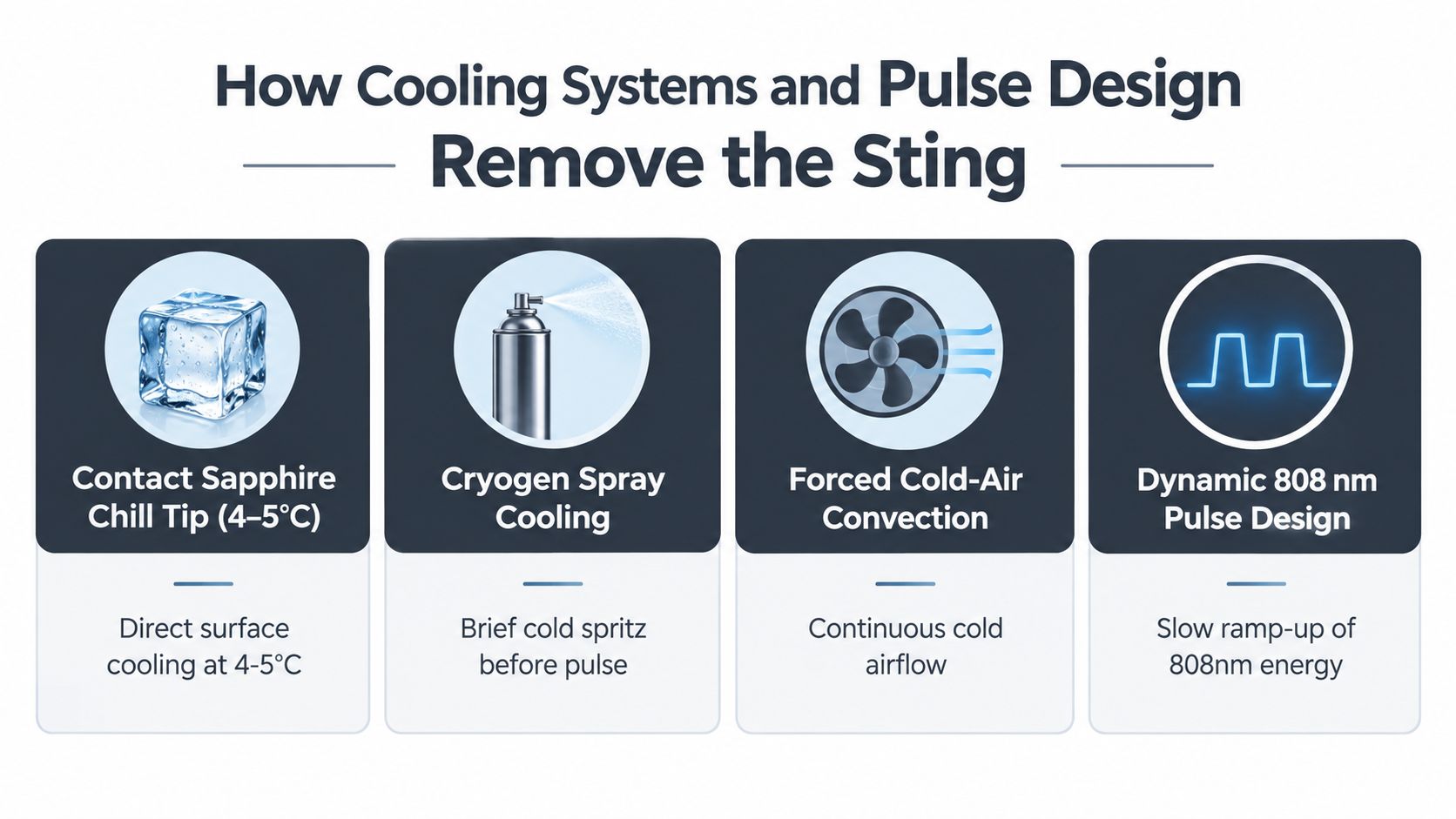
Quatro abordagens de refrigeração que as clínicas devem conhecer
As plataformas modernas recorrem normalmente a um ou mais dos seguintes elementos:
- Pontas de resfriamento de safira de contacto manter a superfície da pele fria enquanto a peça de mão permanece em contacto direto. Isto melhora frequentemente a consistência, uma vez que o arrefecimento está associado à emissão de impulsos.
- Arrefecimento por pulverização criogénica emite um breve pulso preliminar que arrefece a superfície imediatamente antes do disparo do laser.
- Convecção forçada de ar frio sopra ar frio de forma contínua sobre a área. É útil para zonas mais amplas e para clientes que consideram as pontas de contacto desconfortáveis.
- Combinação de comprimentos de onda com libertação controlada pode reduzir a intensidade com que a melanina epidérmica absorve o calor, quando as configurações são cuidadosamente definidas.
O desenho do pulso é igualmente importante. Um pulso único longo distribui o calor de forma diferente dos subpulsos mais curtos. Na prática, um Pulso único de 20 ms pode parecer mais nítido do que subpulsos de 3 × 7 ms no mesmo tipo de pele, quando o operador procura proporcionar um efeito térmico semelhante de forma mais gradual. O objetivo geral do tratamento pode ser semelhante, mas o perfil de sensações pode ser muito diferente.
O que as evidências indicam sobre a redução da dor
Um estudo clínico em pares concluiu que O alisamento pneumático da pele reduziu a dor em 95% dos participantes, em comparação com o arrefecimento dinâmico criogénico convencional, com pontuações médias de dor de 2,8/10 para o PSF contra 5,4/10 para o DCD (comparação clínica de dor em pares). A lição útil não é que uma funcionalidade específica resolva tudo. É que Um melhor contacto com a pele e um melhor controlo do calor alteram a sensação do cliente.
Um estudo controlado independente que comparou métodos de arrefecimento concluiu que tanto o arrefecimento por ar como o arrefecimento por contacto mantiveram a dor na faixa de leve a moderada no modo estático e na faixa de leve no modo dinâmico, com no statistically significant difference between them. That same single session still achieved 43.4% hair reduction with no reported side effects (cooling and efficacy study). In other words, well-tuned cooling can reduce sting without automatically sacrificing efficacy.
Como aplicar isto numa clínica
For underarms and Brazilian areas, teams usually get the best comfort when they combine:
- Strong cooling before and during pulses
- Longer pulse durations or segmented delivery
- Smaller parameter jumps between passes
- Constant observation of perifollicular response rather than chasing aggressive sensation
A platform built around in-motion delivery and integrated cooling can support that style of treatment when used correctly, such as systems in the SHR hair removal laser category. The machine helps, but protocol still decides whether treatment feels smooth or harsh.
Good comfort comes from controlled heat, not weak treatment.
Comprimentos de onda e tipos de pele que proporcionam conforto
Comfort improves sharply when wavelength and skin type are matched properly. When they aren't, the client often feels two problems at once. More sting, and more risk.
A regra prática de correspondência
For lighter skin, shorter wavelengths can work efficiently because there's less competing epidermal melanin. For darker skin, that same melanin becomes the issue. The device isn't just “seeing hair”. It's also interacting with pigment in the skin.
Independent literature notes that African ancestry and Fitzpatrick IV to VI skin have higher risk of epidermal adverse events such as dyspigmentation, blistering, crusting, oedema, and scarring, and that the long-pulsed 1064 nm Nd:YAG is the preferred wavelength for darker skin because it has the lowest incidence of adverse events (review of laser treatment safety in darker skin).
Matriz de conforto «comprimento de onda vs. tipo de pele»
| Skin Type | Best Wavelength | Duração do pulso (ms) | Starting Fluence (J/cm²) | Comfort Expectation |
|---|---|---|---|---|
| I to II | Alexandrita de 755 nm | Longer pulses often improve tolerability on sensitive areas | Conservative starting point based on hair thickness and area | Can be very comfortable when cooling is strong and hair is dark |
| III to IV | Diodo de 808 nm | Moderate to longer pulses often balance comfort and efficacy well | Start conservatively and titrate by response | Often gives the most balanced comfort profile for mixed indications |
| V to VI | 1064 nm Nd:YAG | Long pulse approaches are commonly used for safety | Start low and increase cautiously after response is confirmed | Usually more tolerable when matched correctly, but clients may still feel each pulse |
The numbers in the pulse and fluence columns are intentionally qualitative here. Exact starting points depend on the device, spot size, hair calibre, tanning history, cooling strength, and test patch response. A fixed chart with hard settings is less safe than a structured assessment.
O que os proprietários de clínicas devem dizer aos clientes
Don't sell wavelength as a brand feature. Explain it as a skin-safety decision. If you treat a broad range of South African skin tones, darker-skin suitability should be visible in your consultation process, consent wording, and treatment plan. A useful reference point for teams serving melanin-rich skin is this guide to depilação a laser para pele escura.
A questão de segurança que a maioria das páginas sobre o alívio da dor ignora
The biggest problem with the phrase pain free laser hair removal is that it can distract clients from the more important question. Is this protocol safe for my skin type?
O conforto não é o mesmo que segurança
A treatment can feel acceptable and still be poorly chosen. A client with Fitzpatrick IV to VI skin may tolerate the session, then develop pigment change or a longer recovery because the device or settings were too aggressive for epidermal melanin.
That's why clinics shouldn't blur “comfortable” into “risk free”. For darker skin, the priorities are different:
- Protect the epidermis first
- Use conservative starting fluence
- Patch test before full treatment
- Increase only after the skin proves it can handle the plan
- Keep the client sun-free before treatment
As complicações de que os clientes raramente ouvem falar
When melanin-rich skin absorbs too much energy near the surface, you can see:
| Tipo Fitzpatrick | Safe Wavelengths (nm) | Use With Caution | Avoid | Key Protocol Note |
|---|---|---|---|---|
| I to III | 755, 808, 1064 | Higher fluence on recently sensitised skin | None by default, but poor cooling still creates risk | Match settings to hair calibre and body area |
| IV | 808, 1064 | 755 only with careful selection and conservative parameters | Aggressive short-pulse approaches | Test patch and review pigment response before escalation |
| V to VI | 1064, selected long-pulse diode protocols | 808 only when device design and cooling support safe treatment | 755 in most routine scenarios | Extend intervals when needed and prioritise skin response over speed |
The avoid and caution columns aren't there to simplify treatment into absolutes. They're there to remind the operator that “works on hair” isn't the same as “safe on this skin”.
A 2023 dermatology report on skin types V and VI found the long-pulse Nd:YAG was safe and effective, but pain during the laser session was still reported in all patients. That's a much more truthful message than promising a fully pain-free result, especially in darker skin (report discussing realistic comfort in skin types V and VI).
Ask a simple question during consultation: “What wavelength will you use on my skin type, and why?” If the answer is vague, the risk discussion probably is too.
A responsabilidade surge quando o protocolo deixa de ser rigoroso
Patch testing, interval spacing, sun avoidance, and careful documentation are not administrative chores. They are what separates an evidence-based service from a complaint waiting to happen. If your team needs a consumer-facing explanation of adverse events to support consent conversations, this overview of laser hair removal side effects is the kind of topic your front desk and clinicians should be able to discuss clearly.
Como é uma sessão de tratamento a sério
Clients calm down when the process is explained plainly. Most anxiety comes from uncertainty, not from the pulse itself.
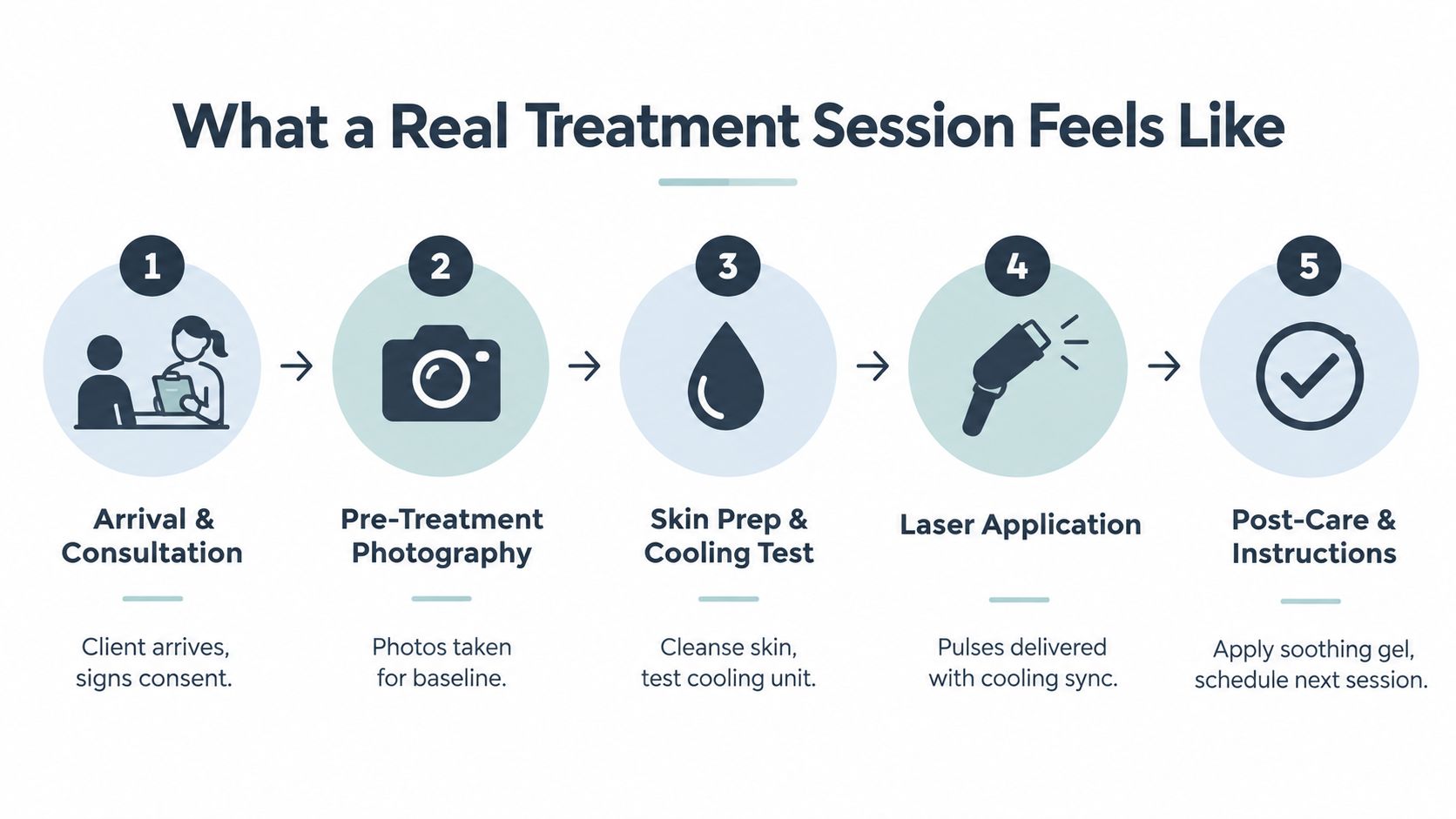
Antes do primeiro impulso
A well-run appointment starts with consent, review of medical history, skin assessment under consistent lighting, and photographs for baseline tracking. The treatment area is checked for recent sun exposure, irritation, active breakouts, or anything else that could change the plan.
Then comes the test spot. This is one of the most underused trust-builders in practice. The client gets to feel the pulse, the operator gets to assess immediate skin response, and both sides can decide whether the chosen settings make sense.
Como é normalmente essa sensação
Most clients describe a sequence rather than one single feeling:
- First contact: A cold tip, cold air, or a brief cooling burst.
- During the pulse: A quick snap, flick, or pinprick warmth.
- Across a larger area: Heat can build gradually and feel more like mild sun-warmth than a sharp sting.
- After a pass: Cooling returns, and the skin often settles quickly if the protocol is controlled.
In a South African study comparing professional and home-use treatment, 66.7% of participants in the professional-laser group experienced pain ranging from mild to moderate. The same study reported that all side effects subsided within minutes, which is useful for setting realistic comfort expectations without overselling the experience.
O que o operador está a fazer enquanto o cliente sente tudo isto
Good operators are not just “moving the handpiece around”. They're watching for skin endpoints, adjusting overlap, pausing to cool, and changing parameters when the area behaves differently from the test spot.
A smooth session often looks uneventful from the bed. That's because the operator is making dozens of small decisions before the client ever needs to complain.
O que acontece após o tratamento
The skin may look pink and slightly raised around follicles for a short period. That reaction often reassures an experienced operator that the follicle was engaged without overcooking the surface.
Aftercare is straightforward:
- Keep heat exposure low for the rest of the day.
- Avoid sun exposure and follow clinic sunscreen guidance.
- Use bland skincare if the area feels warm or sensitive.
- Report anything unusual early, especially persistent pigment change, blistering, or unexpected tenderness.
Escolher o dispositivo e o protocolo adequados para a sua clínica
Clinic buyers often ask the wrong first question. They ask what machine is cheapest to buy, or which system has the highest stated power. Those aren't the numbers that determine client comfort, safety, or retention.
As quatro especificações que realmente importam
Start with these instead:
Wavelength availability
Your patient mix decides whether a single-wavelength platform is enough. If you regularly treat varied skin tones and body areas, flexibility matters.Spot size range
Spot size changes speed, coverage, and how practical the machine feels in real scheduling conditions. A technically capable machine can still bottleneck your day if it's slow on large zones.Fluence delivery under real use
Peak power on a brochure doesn't tell you whether the system delivers stable clinical output across different pulse modes and treatment tempos.Integrated cooling architecture
Comfort claims are weak unless cooling is reliable, consistent, and usable by staff without awkward workarounds.
Comparação de aparelhos de depilação para compradores de clínicas
| Device Class | Ideal para | Capex Range (USD) | Throughput (sessions/hr) | Maintenance Notes |
|---|---|---|---|---|
| Díodo | Broad clinic use across common hair-removal indications | Varies by build, wavelength mix, and cooling system | Depends on spot size, pulse mode, and operator flow | Check cooling reliability and handpiece wear patterns |
| Nd:YAG | Practices treating more darker skin types or higher-risk pigmentation profiles | Varies by medical-grade configuration | Often efficient on suitable indications, but protocol pace matters | Review servicing support and calibration standards |
| Alexandrite | Clinics focused mainly on lighter skin indications | Varies widely | Can be efficient on the right patient group | Requires careful patient selection |
| IPL-class platforms | Entry-level or multi-service environments where true laser specificity is not the only goal | Broadly variable | Throughput varies with protocol complexity | Clarify lamp replacement, output consistency, and indication limits |
I've left the capex and throughput cells qualitative on purpose. Real cost and speed vary too much by configuration, local service support, handpiece life, and treatment mix to be reduced to one universal number here.
Quando o protocolo afeta a rentabilidade
The most profitable hair-removal service is rarely the most aggressive one. It's the one that stays safe, repeatable, and review-proof.
A 20-minute session window only works when the machine, room setup, consultation process, consent documents, skin assessment, and aftercare instructions are all organised around that pace. If your team spends too long adjusting around weak cooling or inconsistent output, your margins disappear into overtime and rework.
Training matters just as much as hardware. In South Africa, where operator regulation remains limited in practice, clinics should create their own internal standard:
- Supervised onboarding before solo treatment
- Manufacturer training with documented sign-off
- Regular competency review
- Adverse-event documentation and escalation pathways
- Clear photo standards and consent notes
One example of a multi-wavelength option used in this category is Omega Lasers' Tetra Cool platform, which is positioned for hair-removal treatments across different skin types with integrated cooling. That matters only if the clinic also builds disciplined protocols around it.
Conquistar a confiança dos clientes através de um marketing honesto
A clinic owner once showed me a landing page that promised “painless permanent hair removal for every skin tone”. The problem wasn't the enthusiasm. It was that every phrase in that sentence could create a complaint.
Substitua os termos absolutos por uma formulação que consiga defender
Try this instead:
- Swap “painless” for “designed for minimal discomfort” when strong cooling and cautious protocols are part of the service.
- Swap “permanent” for “long-term hair reduction” unless your consent process clearly explains maintenance.
- Swap “all skin types” for “treated according to skin assessment and wavelength suitability” so darker-skin safety is explicit.
That kind of wording feels less flashy on a banner. It performs better in real consultations because it matches what clinicians can deliver.
Mostre os detalhes que os clientes já procuram
Publish what serious clients ask about anyway:
- Device information: Wavelength, cooling method, and the kinds of skin tones the clinic routinely treats.
- Provider credentials: Who performs the treatment, how they were trained, and who supervises complex cases.
- Comfort expectations: Explain that some areas feel easier than others, and that tolerance varies.
- Aftercare and downtime: Keep this plain, not buried in fine print.
The fastest way to lose trust is to hide behind branding when a client is asking for technical clarity.
A transparência nas pessoas de pele mais escura reforça a credibilidade
Many pages still answer only “does it hurt?” The better clinics also answer “is this safe for my skin tone?” If you address that directly, especially in the South African market, clients notice. So do referring professionals.
Perguntas frequentes sobre a depilação a laser indolor
Será que «sem dor» significa mesmo ausência total de sensação?
Usually, no. It means the treatment is designed to keep sensation low and manageable. Many clients still feel snapping, warmth, or brief sting, especially on dense hair or sensitive areas.
Como é que isso se sente, na realidade?
The cooling sensation is noticed first, then a quick pulse. Small areas may feel sharp but brief. Larger areas often feel warmer over time rather than intensely painful all at once.
Por que razão alguns clientes querem creme anestésico e outros não?
Pain threshold differs from person to person. So do anxiety levels, hormone patterns, treatment areas, and previous hair-removal experiences. Some clinics prefer to rely on cooling and careful settings first, then decide whether extra comfort measures are needed.
Que tons de pele podem ser tratados com segurança
A wide range of skin tones can be treated, but not with the same wavelength and protocol. Darker skin needs stronger emphasis on epidermal protection, conservative settings, and proper device selection.
Quantas sessões os clientes devem esperar
Hair removal is a course, not a one-off event. Session count and maintenance depend on hair cycle, hormonal factors, body area, and how consistently the treatment plan is followed.
É possível que surjam efeitos secundários?
Yes. Potential risks include burns, pigment change, irritation, and in some cases unexpected hair stimulation in poorly selected scenarios. Prevention depends on assessment, patch testing, correct wavelength choice, and operator training.
Quem não deve ser tratado de imediato
Clients may need postponement or medical review if they have recent tanning, active skin irritation, certain medications, active infections, or other contraindications identified during consultation. Pregnancy policies vary by clinic and medical oversight model, so that discussion should be documented carefully.
Quando é que os clientes notarão a redução?
Visible reduction usually appears over the course of treatment rather than immediately after one pulse. Shedding patterns, regrowth rate, and density change vary by area and by the client's hair cycle.
Quais são os sinais de alerta numa consulta?
Walk away if a provider can't explain the wavelength, doesn't assess skin type carefully, dismisses darker-skin risk, skips patch testing when it's indicated, or promises the same experience for every client.
Omega Lasers supplies medical-aesthetic platforms for clinics that need hair-removal technology with a strong focus on comfort, skin-type versatility, and operator support. If you're reviewing your current protocol or planning a new service, visit Omega Lasers to explore device options, training, and clinic-focused guidance built around safer, more honest treatment delivery.