



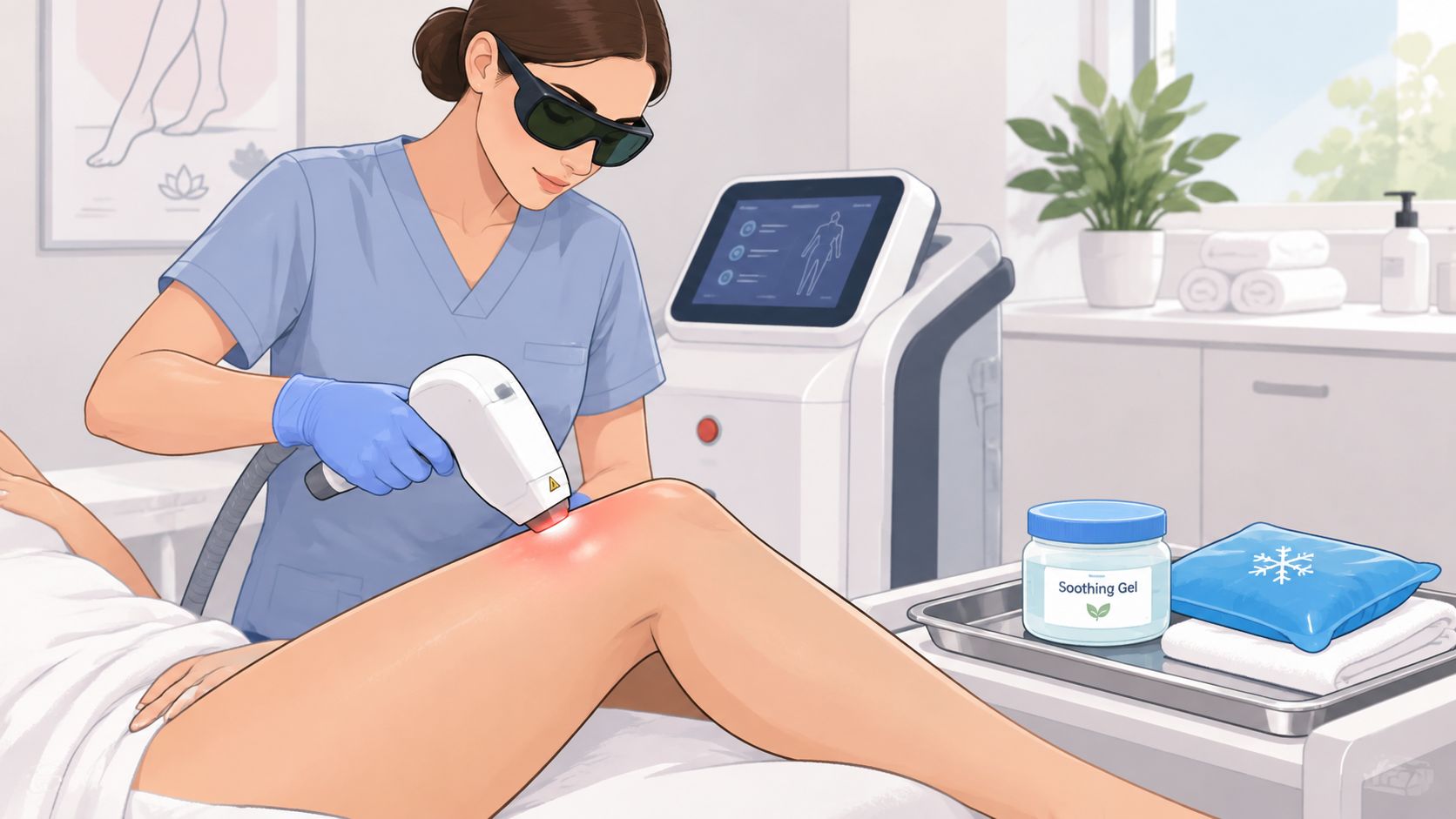
Pigmentary change accounted for 81.4% of reported laser hair removal complications in South Africa, enquanto 25.6% involved scarring e 14% involved textural changes (South African-focused review). Those figures change the safety conversation. Redness and swelling may be expected, but clinics also need systems for preventing burns, pigment alteration, blistering, scarring and eye injury, particularly across a population with varied skin tones and frequent sun exposure.
This guide approaches laser hair removal side effects as a clinical workflow rather than a list of warnings. It explains how laser energy interacts with skin, how side effects differ by Fitzpatrick skin type and wavelength, and how staff can screen, treat, document, monitor and escalate concerns. For broader safety thinking around energy-based treatments, EradiTatt's safety guide offers useful additional context.
Índice
- Introduction to Side Effects
- Understanding Key Concepts
- Types of Side Effects
- Causes and Risk Factors
- Prevention and Aftercare Protocols
- When to Seek Medical Attention
- Clinical Governance Best Practices
- Conclusion and Next Steps
Introduction to Side Effects
A safe treatment starts with a correct classification of what the client is experiencing. Perifollicular redness and swelling can reflect a normal inflammatory response, while escalating pain, blistering or progressive colour change may indicate excessive thermal injury. Treating both situations as “normal redness” creates avoidable risk for the client and the clinic.
South African evidence makes pigment management especially important. The reported complication profile above shows that side effects aren't limited to short-lived irritation. Pigmentary outcomes and scarring can affect appearance long after the appointment, influence client confidence and create complaints that a clinic must handle carefully.
A practical safety approach has four stages:
- Understand the mechanism. Know how wavelength, fluence, pulse duration, spot size and cooling alter heat distribution.
- Stratify risk. Assess skin type, tanning, medication, treatment area and hair characteristics before choosing settings.
- Control the workflow. Use consultation records, test spots, documented parameters, protective equipment and structured aftercare.
- Escalate early. Identify symptoms that need clinical review instead of waiting for deterioration.
The aim isn't to eliminate every visible response. It's to distinguish an expected response from a preventable injury, then give staff a consistent process for both.
Understanding Key Concepts
Laser hair removal uses fototermólise selectiva. The device emits light at a selected wavelength, and melanin in the hair absorbs that energy. The resulting heat travels through the hair structure towards the follicle, damaging the follicle while aiming to limit injury to nearby skin.
A useful analogy is a metalworker's forge. A controlled flame heats a specific section of metal for a defined purpose. If the heat is excessive, applied for too long or directed incorrectly, the metal can deform or burn. Laser treatment works similarly. The follicle is the intended target, but the epidermis also contains melanin. If the operator chooses unsuitable parameters, the surrounding skin can absorb too much heat. Side effects often arise when incorrect parameter selection during photothermolysis causes overheating of epidermal melanin and hair follicle structures (operator-training literature).

The settings staff must understand
Comprimento de onda describes the colour of light emitted by the device and influences how far energy travels and how strongly melanin absorbs it. Longer wavelengths are often selected for darker skin because they can reduce competition between epidermal melanin and the follicle, although the full parameter choice still depends on the individual and device.
Fluência is the energy delivered over a defined area. Raising fluence increases the available thermal effect, but more energy isn't automatically safer or more effective. The operator must balance follicular heating against epidermal tolerance.
Duração do impulso controls how quickly energy is delivered. The hair and skin respond differently according to their thermal characteristics, so pulse selection affects whether heat remains concentrated in the follicle or spreads into adjacent tissue.
Tamanho do ponto describes the area covered by each pulse. It affects penetration, coverage and the total treatment pattern. Staff should record it with the other parameters rather than treating it as a secondary detail.
Arrefecimento protects the epidermis by reducing surface heat and improving comfort. Cooling doesn't correct an unsuitable wavelength or excessive fluence, but it can support safer delivery when the rest of the protocol is appropriate.
Regra prática: Treat every parameter as part of a connected system. Changing one setting can alter the safety margin created by the others.
Types of Side Effects
A reaction should be classified by what it looks like, when it appears and whether it improves. That sequence works like a clinical traffic light. Mild redness and follicular swelling often settle. Worsening pain, spreading inflammation, broken skin, or lasting colour and texture changes require the operator to pause routine follow-up and assess the client.
Immediate reactions
Erythema, or redness, commonly develops during or soon after treatment. It reflects heat and inflammation in the treated area. Perifollicular oedema, visible as small raised bumps around individual follicles, can also indicate a local follicular response.
Mild warmth, tingling and tenderness may accompany these findings. The client's description still matters. Warmth that remains mild is different from sharp, escalating or burning pain. Record both the visible appearance and the reported sensation, including the treatment area and time of review. This creates a baseline against which later changes can be judged.
Short-term reactions
A retrospective study of 900 sequential laser-assisted hair removal treatments recorded discomfort, erythema, swelling, hypopigmentation, hyperpigmentation, blistering, crusting, purpura and folliculitis (retrospective treatment study). The reported adverse tissue reactions occurred mainly in tanned skin or in Fitzpatrick skin types III and above.
The appearance of a reaction helps determine the next step. Mild perifollicular oedema can be monitored, while blistering, crusting or marked swelling call for a more cautious response and documented review. Hyperpigmentation may follow inflammation, particularly after ultraviolet exposure or excessive heat in the epidermis. Hypopigmentation is a loss of colour rather than an increase, and either change can outlast the initial inflammatory period.
Folliculitis may appear as inflamed bumps centred on follicles. It does not automatically indicate infection. Assess whether the area is becoming more painful, spreading, worsening or producing discharge, then record the findings and escalate according to the clinic's protocol.
Long-term concerns
Cicatrizes and persistent textural change carry greater clinical impact because they may remain after the original inflammation settles. Paradoxical hypertrichosis, in which hair growth increases within or beside the treated area, is another recognised complication. Governance should link the event to the treatment record, baseline and follow-up photographs, and an appropriate clinical assessment. An unexpected result should be investigated, not dismissed.
| Side Effect | Início | Duração | Frequency (%) |
|---|---|---|---|
| Erythema | During or shortly after treatment | Usually short-lived, monitor if it persists or worsens | Not specified |
| Perifollicular oedema | Shortly after treatment | Usually short-term | Not specified |
| Blistering or crusting | After treatment as thermal injury develops | Until the affected skin heals | Not specified |
| Hyperpigmentation or hypopigmentation | After inflammation or excessive thermal exposure | May persist beyond the initial reaction | Not specified |
| Scarring or textural change | During healing after deeper injury | Potentially persistent | Cicatrizes 25.6%, textural change 14% in reported South African complications (South African-focused review) |
| Petechiae, purpura or ecchymosis | Shortly after vascular injury | Depends on the extent of the reaction | 31.66% in a 2024 complications study (complications study) |
| Pigmentation change | After treatment | May require prolonged observation | 20.0% in the same 2024 study |
The table's frequency column needs careful interpretation. These figures describe reported complications in particular reviews or studies, not the likelihood for every treated client. Explain that difference during consent and document the source and context used in the clinic's patient information.
Causes and Risk Factors
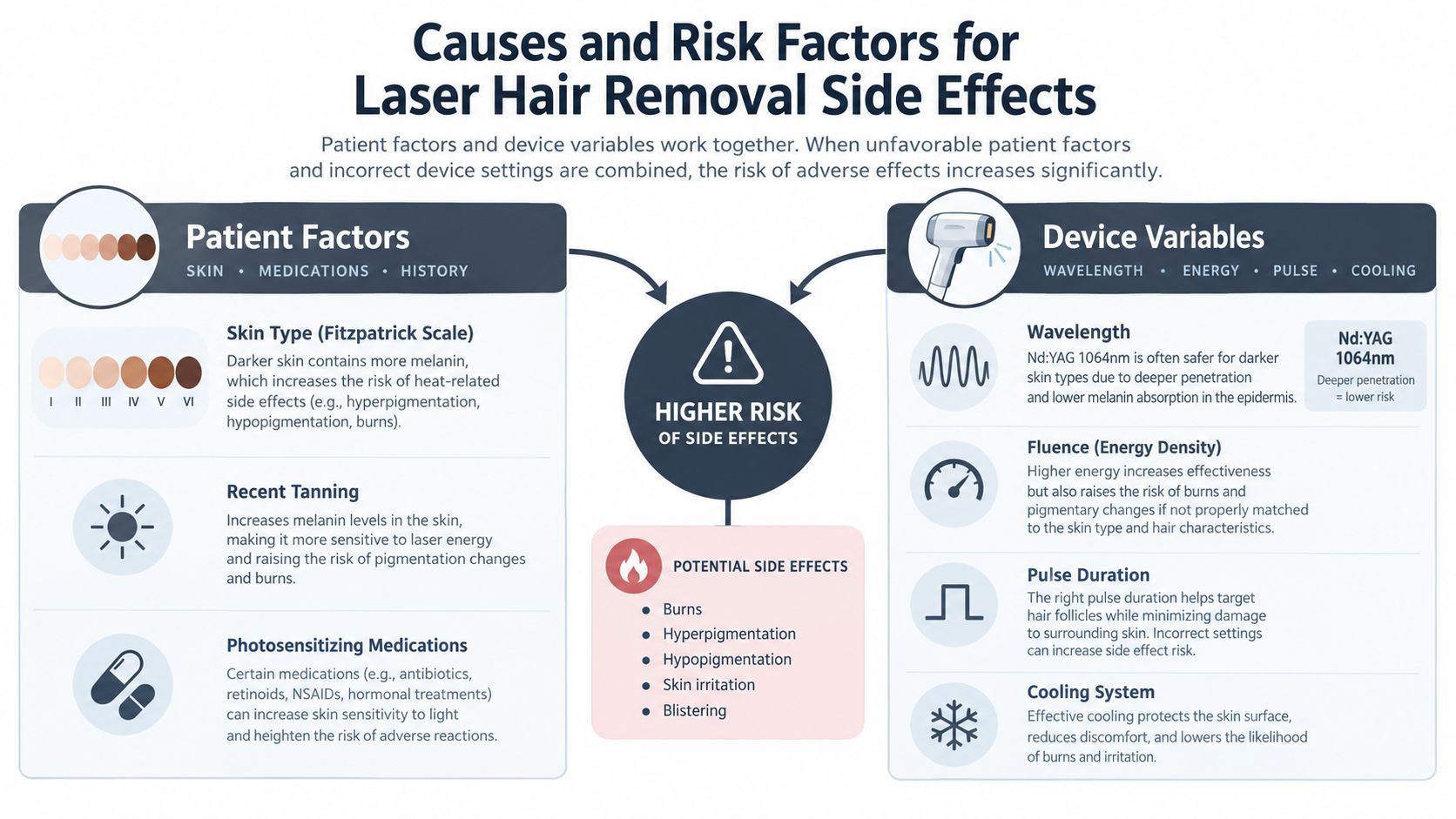
Risk rises when patient factors and device settings point in the same unsafe direction. Recently tanned skin may contain more epidermal melanin. An unsuitable wavelength, excessive fluence or weak cooling can then add heat to that same tissue. Assess the combination, not one variable in isolation.
Skin type and tanning
Fitzpatrick types I and II generally have less baseline epidermal melanin than types V and VI. Types III and IV fall between these groups, although the numerical label cannot replace visual assessment. Recent tanning can temporarily increase melanin activity, so the client's current risk may differ from their usual classification.
A retrospective study of 900 treatments found that most adverse tissue reactions occurred in tanned skin or Fitzpatrick types III and above (retrospective treatment study). South African clinics should ask about beach exposure, outdoor work, sport, holidays and artificial tanning. A form that only asks whether someone “gets sun” does not show the full exposure pattern.
Escolha do comprimento de onda
Shorter-wavelength systems can be absorbed more strongly by epidermal melanin. In darker skin types, pigmentary alterations occurred in up to 19% with shorter-wavelength lasers, em comparação com 2–3% with Nd:YAG in the cited South African safety discussion (South African safety discussion). This supports considering Nd:YAG for suitable darker-skin patients, while alexandrite systems require disciplined selection and parameter control.
Wavelength selection works like choosing a tool for a particular material. Skin tone matters, but hair colour, hair diameter, treatment site, tanning status, cooling performance and operator training also affect the decision. A darker skin type does not automatically determine one setting or one device.
Medication and operator variables
Medication review should identify photosensitising medicines and conditions that may alter healing or inflammation. Record the medication, clarify prescriber advice where needed and postpone treatment if the risk cannot be assessed confidently.
Operator inexperience can lead to poor skin typing, unsuitable wavelength or fluence, inadequate patch testing and inconsistent cooling. South Africa's limited regulation of who may perform laser treatments, and of the qualifications required, makes documented competence a practical safety control. Clinics should retain training records, treatment parameters, patch-test results, incident reviews and escalation decisions so governance does not depend on memory (South African-focused review).
Prevention and Aftercare Protocols
Prevention starts before the handpiece reaches the skin. A clinic should treat screening, parameter selection, cooling, aftercare and follow-up as one continuous chain. A weak link in any stage can undermine careful work elsewhere.
Before treatment
Use a structured consultation rather than informal questioning:
- Record medical history: Note relevant skin conditions, healing problems, previous laser reactions and current treatments.
- Review medication: Ask specifically about photosensitising medicines and document the outcome of that review.
- Assess recent exposure: Record tanning, outdoor exposure and whether the skin has returned to its baseline colour.
- Classify the skin: Use the Fitzpatrick scale as a guide, then assess the actual treatment area under suitable lighting.
- Photograph the baseline: Capture consistent images of the area, including existing pigmentation, scars and texture.
- Explain expectations: Discuss hair reduction, the possibility of temporary reactions and the need for multiple properly spaced sessions without promising a guaranteed result.
Avoid treating visibly tanned or compromised skin until the operator has reassessed the risk. If the client's baseline is uncertain, postponement is safer than trying to compensate with guesswork.
Durante o tratamento
Perform a patch test where indicated by the clinic's protocol, especially when the patient's skin type, tanning status or treatment history creates uncertainty. Begin with a conservative approach, observe the tissue response and document the settings, device, wavelength, spot size, pulse duration, fluence and cooling method.
Cooling should be continuous and appropriate to the system. Staff should monitor the skin, ask about discomfort and stop if the response becomes inconsistent with the expected endpoint. Eye protection is mandatory for the client and staff according to the device and treatment area. A South African consent form warns of accidental eye injury if the laser beam strikes the eye and states that complete eye protection is worn to reduce the risk (South African laser consent information).
For a patient-friendly explanation of the appointment sequence, clinics can also direct clients to what to expect during laser hair removal. Staff should pair that general explanation with the clinic's own written instructions and contraindication checks.
After treatment
Give written aftercare, not only verbal advice. Recommend gentle skin care, cool compresses for comfort and careful sun avoidance, particularly while the treated area remains sensitive. Clients should report blistering, increasing pain, spreading redness, discharge, fever or unexpected colour change.
Keep the aftercare product list simple and compatible with a recently treated skin barrier. Clinics developing a recovery protocol may review produtos para a reparação da barreira cutânea as part of their product-selection process. Staff should avoid suggesting prescription-strength treatment without appropriate clinical authority.

When to Seek Medical Attention
A client who reports mild redness that is already fading may usually be monitored through the clinic's aftercare pathway. Escalate when pain increases, blistering develops, or redness spreads beyond the treated follicles. These signs can indicate a deeper thermal injury that may progress to crusting, infection, pigmentary change or scarring.
Recognised adverse events include burns, blistering, scarring, herpes reactivation, ocular injury and paradoxical hypertrichosis. A 2024 complications study reported petechiae, purpura or ecchymosis in 31.66% of cases and pigmentation changes in 20.0% (2024 complications study). The figures do not replace assessment. They show why an unexpected response needs investigation, particularly when wavelength choice and skin type may alter the risk profile.
Red flags for escalation
- Pain that increases: Worsening or burning pain requires more attention than mild tenderness that settles.
- Blistering or open skin: Do not puncture blisters or recommend exfoliation. Arrange clinical review.
- Progressive redness: Spreading, hotter redness or discharge needs prompt assessment.
- Systemic symptoms: Fever or feeling generally unwell warrants medical attention.
- Eye symptoms: Visual change, significant eye pain or suspected beam exposure should be treated as urgent.
- Persistent colour or texture change: Photograph the area and arrange dermatological review if it does not improve.
The clinic should appoint a responsible clinician or referral contact before a complication occurs. Staff should explain the observed signs, the next action and the expected follow-up time. A clear adverse event reporting process should record the client's account, clinical findings, skin type, device wavelength, treatment parameters, photographs, advice, referrals and outcome. This record supports safer decisions across South African patient groups and helps the team identify patterns linked to settings or technique.
Clinical Governance Best Practices
In South Africa, clinics must make operator competence visible because formal requirements for performing laser treatments and holding specific qualifications have not consistently governed practice. Training records, supervised practice, written protocols and regular competency reviews provide the framework. Skin type and device wavelength should appear in that framework, since the same settings can produce different risks across South African skin tones.
Consent checklist
Consent should confirm that the client has received and understood:
- Treatment purpose: Hair reduction, without promising permanent removal.
- Expected responses: Redness, warmth, tenderness, perifollicular swelling and temporary sensitivity.
- Material risks: Pigmentary change, burns, blistering, scarring, textural change, folliculitis, paradoxical hypertrichosis and ocular injury.
- Eye protection: The client and relevant staff will use protection suited to the device and treatment area.
- Sun and tanning risk: Recent tanning can change the safety profile.
- Revisão da medicação: The client must disclose photosensitising medicines and relevant health information.
- Alternatives and aftercare: The client understands other hair-removal options and recovery instructions.
- Follow-up access: The client knows whom to contact if symptoms worsen or follow an unexpected pattern.
Consent works like a checkpoint, not a signature alone. The record should show what was discussed, what the client understood and which concerns required a modified plan or postponement.
Incident documentation
An adverse-event report should capture the date, treatment area, skin assessment, recent exposure, medication review, device and wavelength, fluence, pulse duration, spot size, cooling, endpoint, photographs, symptoms, first aid, referral and follow-up dates. Separate observed facts from interpretation. “Client reports increasing pain” is more useful than an unsupported conclusion that the client “tolerated treatment poorly”.
Utilização laser safety protocols to support a written SOP covering access control, eye protection, device checks, treatment records, emergency response and staff responsibilities. Review incidents without blame. Identify whether the issue arose during screening, wavelength or settings selection, cooling, communication or follow-up, then update the SOP and training.
Schedule internal audits of consent completeness, parameter records, patch-test decisions, photographs and adverse-event closure. Manufacturer support, equipment servicing and warranty processes belong in the safety file, alongside clinical governance rather than in a separate administrative folder.
Conclusion and Next Steps
Safe laser hair removal depends on more than selecting a device and treating the requested area. The operator must understand selective photothermolysis, assess the client's current skin condition, choose wavelength and settings carefully, protect the epidermis with appropriate cooling, provide clear aftercare and respond quickly when the reaction doesn't improve.
South African practice makes this discipline especially important. Pigmentary change is a significant reported complication, darker and recently tanned skin needs careful risk stratification, and governance must compensate for gaps in formal operator regulation. A consistent system protects clients while helping clinics build trust through transparent communication and reliable follow-up.
Start with a practical implementation meeting. Review the consent form, create a medication and tanning screen, standardise baseline photography, audit parameter records, confirm eye-protection procedures and run a staff exercise on blistering, spreading redness and suspected ocular injury. Then set a recurring review cycle for incidents, equipment checks and competency assessments so safety improvements remain active rather than becoming paperwork.
Omega Lasers supplies medical-aesthetic laser and multi-technology platforms, with device training, technical support and clinic enablement for aesthetic professionals. Visit Lasers Omega to explore laser hair removal systems and training resources that can support safer treatment workflows, consistent documentation and stronger clinic governance.