



The most popular advice on pain free laser hair removal is also the least helpful: “choose a painless machine”. That sounds simple, but it hides the clinical question. Hair removal works by heating the follicle, and heat is what creates both results and sensation.
For clinic owners, the honest frame is better. Pain free laser hair removal isn't a yes-or-no promise. It's a comfort spectrum shaped by wavelength choice, pulse design, cooling, operator judgement, and the client's skin type. In South Africa, that matters even more because one local review notes there is no mandatory national regulation governing who may perform laser treatments or what qualifications are required, which makes operator training a basic safety issue rather than a nice extra (South African review of laser hair removal practice).
If you market “pain free” as zero sensation, you set your team up for complaints. If you explain comfort properly, and especially if you address darker-skin safety directly, you build trust that lasts longer than any headline claim.
Table of Contents
- What Pain Free Laser Hair Removal Actually Means
- How Cooling Systems and Pulse Design Remove the Sting
- Wavelengths and Skin Types That Make Comfort Possible
- The Safety Question Most Pain-Free Pages Skip Over
- What a Real Treatment Session Feels Like
- Choosing the Right Device and Protocol for Your Clinic
- Building Client Trust Through Honest Marketing
- Frequently Asked Questions About Pain Free Laser Hair Removal
- Does pain free really mean zero sensation
- What does it actually feel like
- Why do some clients want numbing cream and others don't
- Which skin tones can be treated safely
- How many sessions should clients expect
- Are side effects possible
- Who shouldn't be treated right away
- When will clients notice reduction
- What are the red flags in a consultation
What Pain Free Laser Hair Removal Actually Means
“Pain free” is marketing language. In clinic reality, it usually means low discomfort that stays well within a tolerable range when the right device and protocol are used.
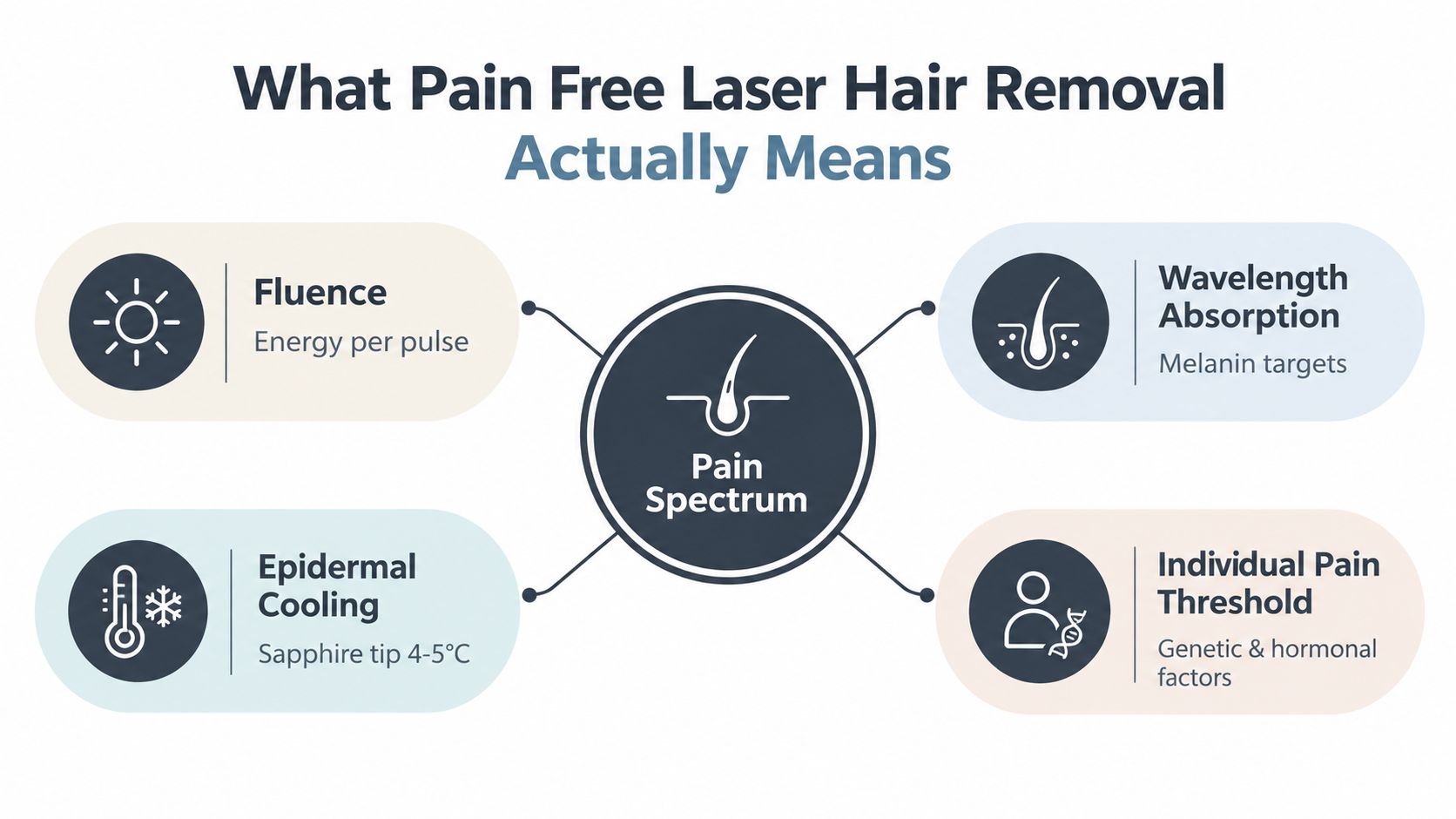
The four factors that shape sensation
A client's experience during treatment depends on four moving parts working together:
- Fluence: This is the energy delivered into the skin. Higher energy can improve follicle heating, but it can also increase sting if cooling and timing aren't well managed.
- Wavelength absorption: Different wavelengths interact with melanin differently. The better the match to skin type and hair depth, the less wasted heat ends up where you don't want it.
- Epidermal cooling: Good cooling protects the surface while the follicle is targeted below. Poor cooling turns a tolerable pulse into a sharp, memorable one.
- Individual pain threshold: Hormones, anxiety, sleep, treatment area, and personal sensitivity all change how the same settings feel.
A better clinical definition
For practical use, I teach teams to think in three bands:
Near-painless treatment
Usually lower-fluence plans, often with multiple passes and strong surface cooling. Comfort is high, but treatment efficiency may depend heavily on protocol discipline.Tolerable therapeutic treatment
Many good treatments sit here. The client feels snaps, warmth, or brief sting, but the session remains manageable.Branded “pain-free” treatment at therapeutic settings
Confusion starts. A device can be sold as pain free and still sting when you use clinically meaningful settings on dense hair or sensitive areas.
Practical rule: If a clinic promises zero sensation for every skin type, body area, and hair thickness, the claim is stronger than the physics.
Why honest wording works better
Clients understand a 0 to 10 comfort scale more easily than vague promises. Saying “this is described as mild to moderate, and we adjust if needed” is stronger than saying “you won't feel a thing”.
That approach also fits South African patient feedback. In one South African review, 69 of 72 patients (95.8%) reported very low to no discomfort, 1 patient (0.72%) reported high discomfort, and 58 patients (82%) rated treatment as excellent overall (patient comfort findings in South African laser practice). That's impressive. It still isn't the same as a universal zero-sensation guarantee.
How Cooling Systems and Pulse Design Remove the Sting
Cooling is where comfort stops being a slogan and becomes engineering. If pain in laser hair removal comes from selective photothermal heating of the follicle, then discomfort drops when your system removes epidermal heat fast enough to prevent thermal build-up.
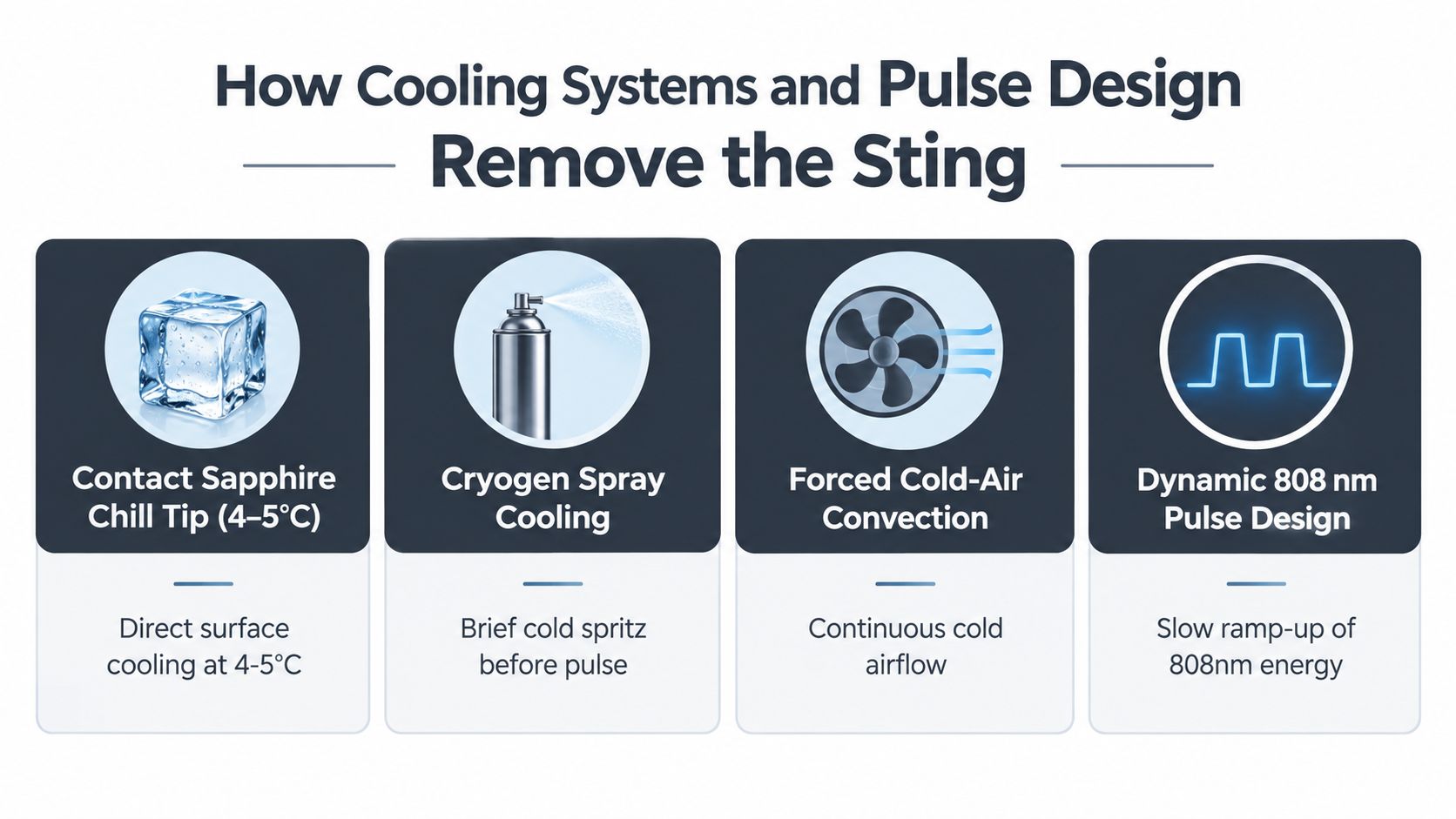
Four cooling approaches clinics should understand
Modern platforms usually rely on one or more of these:
- Contact sapphire chill tips keep the skin surface cold while the handpiece stays in direct contact. This often improves consistency because cooling is tied to pulse delivery.
- Cryogen spray cooling delivers a brief pre-pulse burst that cools the surface just before the laser fires.
- Forced cold-air convection blows continuous cold air over the area. It's useful for larger zones and for clients who find contact tips uncomfortable.
- Wavelength blending with controlled delivery can reduce how aggressively epidermal melanin absorbs heat when settings are designed carefully.
Pulse design matters just as much. A long single pulse spreads heat differently from shorter sub-pulses. In practice, a 20 ms single pulse can feel sharper than 3 × 7 ms sub-pulses on the same skin type when the operator is trying to deliver similar thermal effect more gradually. The total treatment intent may be similar, but the sensation profile can be very different.
What the evidence says about pain reduction
One paired clinical study found that pneumatic skin flattening reduced pain in 95% of subjects versus conventional cryogen dynamic cooling, with mean pain scores of 2.8/10 for PSF versus 5.4/10 for DCD (paired clinical pain comparison). The useful lesson isn't that one named feature solves everything. It's that better skin contact and better heat control change what the client feels.
A separate controlled study comparing cooling methods found that air-cooling and contact-cooling both kept pain in the mild-to-moderate range in static mode and the mild range in dynamic mode, with no statistically significant difference between them. That same single session still achieved 43.4% hair reduction with no reported side effects (cooling and efficacy study). In other words, well-tuned cooling can reduce sting without automatically sacrificing efficacy.
How to apply this in a clinic
For underarms and Brazilian areas, teams usually get the best comfort when they combine:
- Strong cooling before and during pulses
- Longer pulse durations or segmented delivery
- Smaller parameter jumps between passes
- Constant observation of perifollicular response rather than chasing aggressive sensation
A platform built around in-motion delivery and integrated cooling can support that style of treatment when used correctly, such as systems in the SHR hair removal laser category. The machine helps, but protocol still decides whether treatment feels smooth or harsh.
Good comfort comes from controlled heat, not weak treatment.
Wavelengths and Skin Types That Make Comfort Possible
Comfort improves sharply when wavelength and skin type are matched properly. When they aren't, the client often feels two problems at once. More sting, and more risk.
The practical matching rule
For lighter skin, shorter wavelengths can work efficiently because there's less competing epidermal melanin. For darker skin, that same melanin becomes the issue. The device isn't just “seeing hair”. It's also interacting with pigment in the skin.
Independent literature notes that African ancestry and Fitzpatrick IV to VI skin have higher risk of epidermal adverse events such as dyspigmentation, blistering, crusting, oedema, and scarring, and that the long-pulsed 1064 nm Nd:YAG is the preferred wavelength for darker skin because it has the lowest incidence of adverse events (review of laser treatment safety in darker skin).
Wavelength-to-Skin-Type Comfort Matrix
| Skin Type | Best Wavelength | Pulse Duration (ms) | Starting Fluence (J/cm²) | Comfort Expectation |
|---|---|---|---|---|
| I to II | 755 nm alexandrite | Longer pulses often improve tolerability on sensitive areas | Conservative starting point based on hair thickness and area | Can be very comfortable when cooling is strong and hair is dark |
| III to IV | 808 nm diode | Moderate to longer pulses often balance comfort and efficacy well | Start conservatively and titrate by response | Often gives the most balanced comfort profile for mixed indications |
| V to VI | 1064 nm Nd:YAG | Long pulse approaches are commonly used for safety | Start low and increase cautiously after response is confirmed | Usually more tolerable when matched correctly, but clients may still feel each pulse |
The numbers in the pulse and fluence columns are intentionally qualitative here. Exact starting points depend on the device, spot size, hair calibre, tanning history, cooling strength, and test patch response. A fixed chart with hard settings is less safe than a structured assessment.
What clinic owners should tell clients
Don't sell wavelength as a brand feature. Explain it as a skin-safety decision. If you treat a broad range of South African skin tones, darker-skin suitability should be visible in your consultation process, consent wording, and treatment plan. A useful reference point for teams serving melanin-rich skin is this guide to laser hair removal for dark skin.
The Safety Question Most Pain-Free Pages Skip Over
The biggest problem with the phrase pain free laser hair removal is that it can distract clients from the more important question. Is this protocol safe for my skin type?
Comfort is not the same as safety
A treatment can feel acceptable and still be poorly chosen. A client with Fitzpatrick IV to VI skin may tolerate the session, then develop pigment change or a longer recovery because the device or settings were too aggressive for epidermal melanin.
That's why clinics shouldn't blur “comfortable” into “risk free”. For darker skin, the priorities are different:
- Protect the epidermis first
- Use conservative starting fluence
- Patch test before full treatment
- Increase only after the skin proves it can handle the plan
- Keep the client sun-free before treatment
The complications clients rarely hear about
When melanin-rich skin absorbs too much energy near the surface, you can see:
| Fitzpatrick Type | Safe Wavelengths (nm) | Use With Caution | Avoid | Key Protocol Note |
|---|---|---|---|---|
| I to III | 755, 808, 1064 | Higher fluence on recently sensitised skin | None by default, but poor cooling still creates risk | Match settings to hair calibre and body area |
| IV | 808, 1064 | 755 only with careful selection and conservative parameters | Aggressive short-pulse approaches | Test patch and review pigment response before escalation |
| V to VI | 1064, selected long-pulse diode protocols | 808 only when device design and cooling support safe treatment | 755 in most routine scenarios | Extend intervals when needed and prioritise skin response over speed |
The avoid and caution columns aren't there to simplify treatment into absolutes. They're there to remind the operator that “works on hair” isn't the same as “safe on this skin”.
A 2023 dermatology report on skin types V and VI found the long-pulse Nd:YAG was safe and effective, but pain during the laser session was still reported in all patients. That's a much more truthful message than promising a fully pain-free result, especially in darker skin (report discussing realistic comfort in skin types V and VI).
Ask a simple question during consultation: “What wavelength will you use on my skin type, and why?” If the answer is vague, the risk discussion probably is too.
Liability starts where protocol gets lazy
Patch testing, interval spacing, sun avoidance, and careful documentation are not administrative chores. They are what separates an evidence-based service from a complaint waiting to happen. If your team needs a consumer-facing explanation of adverse events to support consent conversations, this overview of laser hair removal side effects is the kind of topic your front desk and clinicians should be able to discuss clearly.
What a Real Treatment Session Feels Like
Clients calm down when the process is explained plainly. Most anxiety comes from uncertainty, not from the pulse itself.
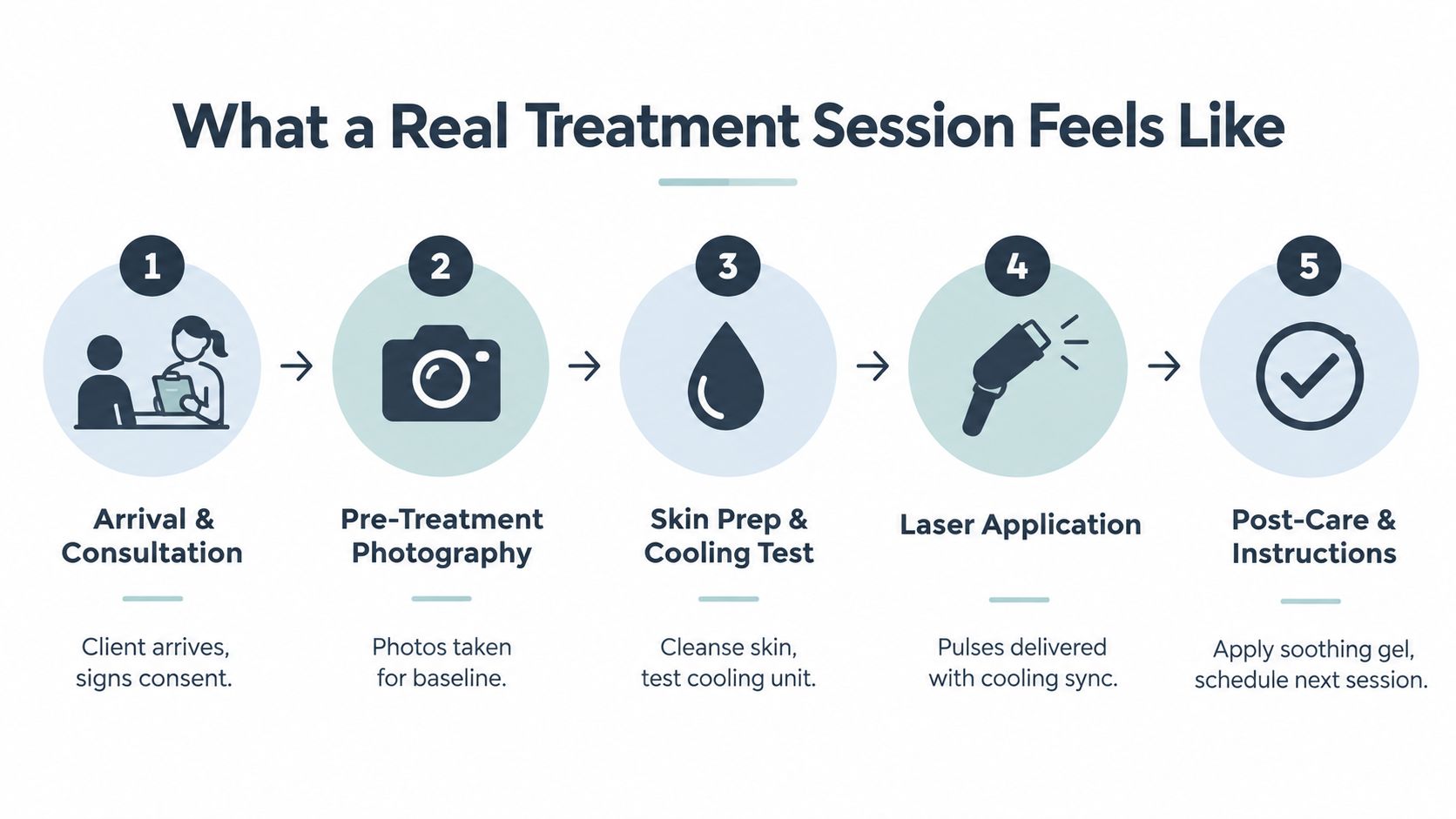
Before the first pulse
A well-run appointment starts with consent, review of medical history, skin assessment under consistent lighting, and photographs for baseline tracking. The treatment area is checked for recent sun exposure, irritation, active breakouts, or anything else that could change the plan.
Then comes the test spot. This is one of the most underused trust-builders in practice. The client gets to feel the pulse, the operator gets to assess immediate skin response, and both sides can decide whether the chosen settings make sense.
What the sensation is usually like
Most clients describe a sequence rather than one single feeling:
- First contact: A cold tip, cold air, or a brief cooling burst.
- During the pulse: A quick snap, flick, or pinprick warmth.
- Across a larger area: Heat can build gradually and feel more like mild sun-warmth than a sharp sting.
- After a pass: Cooling returns, and the skin often settles quickly if the protocol is controlled.
In a South African study comparing professional and home-use treatment, 66.7% of participants in the professional-laser group experienced pain ranging from mild to moderate. The same study reported that all side effects subsided within minutes, which is useful for setting realistic comfort expectations without overselling the experience.
What the operator is doing while the client feels all this
Good operators are not just “moving the handpiece around”. They're watching for skin endpoints, adjusting overlap, pausing to cool, and changing parameters when the area behaves differently from the test spot.
A smooth session often looks uneventful from the bed. That's because the operator is making dozens of small decisions before the client ever needs to complain.
What happens after treatment
The skin may look pink and slightly raised around follicles for a short period. That reaction often reassures an experienced operator that the follicle was engaged without overcooking the surface.
Aftercare is straightforward:
- Keep heat exposure low for the rest of the day.
- Avoid sun exposure and follow clinic sunscreen guidance.
- Use bland skincare if the area feels warm or sensitive.
- Report anything unusual early, especially persistent pigment change, blistering, or unexpected tenderness.
Choosing the Right Device and Protocol for Your Clinic
Clinic buyers often ask the wrong first question. They ask what machine is cheapest to buy, or which system has the highest stated power. Those aren't the numbers that determine client comfort, safety, or retention.
The four specifications that actually matter
Start with these instead:
Wavelength availability
Your patient mix decides whether a single-wavelength platform is enough. If you regularly treat varied skin tones and body areas, flexibility matters.Spot size range
Spot size changes speed, coverage, and how practical the machine feels in real scheduling conditions. A technically capable machine can still bottleneck your day if it's slow on large zones.Fluence delivery under real use
Peak power on a brochure doesn't tell you whether the system delivers stable clinical output across different pulse modes and treatment tempos.Integrated cooling architecture
Comfort claims are weak unless cooling is reliable, consistent, and usable by staff without awkward workarounds.
Hair Removal Device Comparison for Clinic Buyers
| Device Class | Best For | Capex Range (USD) | Throughput (sessions/hr) | Maintenance Notes |
|---|---|---|---|---|
| Diode | Broad clinic use across common hair-removal indications | Varies by build, wavelength mix, and cooling system | Depends on spot size, pulse mode, and operator flow | Check cooling reliability and handpiece wear patterns |
| Nd:YAG | Practices treating more darker skin types or higher-risk pigmentation profiles | Varies by medical-grade configuration | Often efficient on suitable indications, but protocol pace matters | Review servicing support and calibration standards |
| Alexandrite | Clinics focused mainly on lighter skin indications | Varies widely | Can be efficient on the right patient group | Requires careful patient selection |
| IPL-class platforms | Entry-level or multi-service environments where true laser specificity is not the only goal | Broadly variable | Throughput varies with protocol complexity | Clarify lamp replacement, output consistency, and indication limits |
I've left the capex and throughput cells qualitative on purpose. Real cost and speed vary too much by configuration, local service support, handpiece life, and treatment mix to be reduced to one universal number here.
Where protocol affects profitability
The most profitable hair-removal service is rarely the most aggressive one. It's the one that stays safe, repeatable, and review-proof.
A 20-minute session window only works when the machine, room setup, consultation process, consent documents, skin assessment, and aftercare instructions are all organised around that pace. If your team spends too long adjusting around weak cooling or inconsistent output, your margins disappear into overtime and rework.
Training matters just as much as hardware. In South Africa, where operator regulation remains limited in practice, clinics should create their own internal standard:
- Supervised onboarding before solo treatment
- Manufacturer training with documented sign-off
- Regular competency review
- Adverse-event documentation and escalation pathways
- Clear photo standards and consent notes
One example of a multi-wavelength option used in this category is Omega Lasers' Tetra Cool platform, which is positioned for hair-removal treatments across different skin types with integrated cooling. That matters only if the clinic also builds disciplined protocols around it.
Building Client Trust Through Honest Marketing
A clinic owner once showed me a landing page that promised “painless permanent hair removal for every skin tone”. The problem wasn't the enthusiasm. It was that every phrase in that sentence could create a complaint.
Replace absolutes with language you can defend
Try this instead:
- Swap “painless” for “designed for minimal discomfort” when strong cooling and cautious protocols are part of the service.
- Swap “permanent” for “long-term hair reduction” unless your consent process clearly explains maintenance.
- Swap “all skin types” for “treated according to skin assessment and wavelength suitability” so darker-skin safety is explicit.
That kind of wording feels less flashy on a banner. It performs better in real consultations because it matches what clinicians can deliver.
Show the details clients are already looking for
Publish what serious clients ask about anyway:
- Device information: Wavelength, cooling method, and the kinds of skin tones the clinic routinely treats.
- Provider credentials: Who performs the treatment, how they were trained, and who supervises complex cases.
- Comfort expectations: Explain that some areas feel easier than others, and that tolerance varies.
- Aftercare and downtime: Keep this plain, not buried in fine print.
The fastest way to lose trust is to hide behind branding when a client is asking for technical clarity.
Darker-skin transparency builds credibility
Many pages still answer only “does it hurt?” The better clinics also answer “is this safe for my skin tone?” If you address that directly, especially in the South African market, clients notice. So do referring professionals.
Frequently Asked Questions About Pain Free Laser Hair Removal
Does pain free really mean zero sensation
Usually, no. It means the treatment is designed to keep sensation low and manageable. Many clients still feel snapping, warmth, or brief sting, especially on dense hair or sensitive areas.
What does it actually feel like
The cooling sensation is noticed first, then a quick pulse. Small areas may feel sharp but brief. Larger areas often feel warmer over time rather than intensely painful all at once.
Why do some clients want numbing cream and others don't
Pain threshold differs from person to person. So do anxiety levels, hormone patterns, treatment areas, and previous hair-removal experiences. Some clinics prefer to rely on cooling and careful settings first, then decide whether extra comfort measures are needed.
Which skin tones can be treated safely
A wide range of skin tones can be treated, but not with the same wavelength and protocol. Darker skin needs stronger emphasis on epidermal protection, conservative settings, and proper device selection.
How many sessions should clients expect
Hair removal is a course, not a one-off event. Session count and maintenance depend on hair cycle, hormonal factors, body area, and how consistently the treatment plan is followed.
Are side effects possible
Yes. Potential risks include burns, pigment change, irritation, and in some cases unexpected hair stimulation in poorly selected scenarios. Prevention depends on assessment, patch testing, correct wavelength choice, and operator training.
Who shouldn't be treated right away
Clients may need postponement or medical review if they have recent tanning, active skin irritation, certain medications, active infections, or other contraindications identified during consultation. Pregnancy policies vary by clinic and medical oversight model, so that discussion should be documented carefully.
When will clients notice reduction
Visible reduction usually appears over the course of treatment rather than immediately after one pulse. Shedding patterns, regrowth rate, and density change vary by area and by the client's hair cycle.
What are the red flags in a consultation
Walk away if a provider can't explain the wavelength, doesn't assess skin type carefully, dismisses darker-skin risk, skips patch testing when it's indicated, or promises the same experience for every client.
Omega Lasers supplies medical-aesthetic platforms for clinics that need hair-removal technology with a strong focus on comfort, skin-type versatility, and operator support. If you're reviewing your current protocol or planning a new service, visit Omega Lasers to explore device options, training, and clinic-focused guidance built around safer, more honest treatment delivery.