



You're often making the biggest decision in the room long before your clients ever see the machine. The demo goes well. The treatment results look strong. The revenue model seems sensible. Then the real question arrives after the paperwork is signed: who keeps that device working when your diary is full, your staff is ready, and a fault appears on a treatment day?
That's where many clinics discover that the machine wasn't the full investment. The operating system around it was. In aesthetic medicine and advanced beauty, after sales service isn't a soft add-on. It's the difference between protected revenue and cancelled bookings, between calm staff and front-desk panic, between a supplier and a real long-term partner.
Índice
- Beyond the Sale Why After Sales Service is Your Clinic's Safety Net
- The Six Pillars of Comprehensive Device Support
- Calculating the ROI of Excellent After Sales Service
- Your Vendor Evaluation Checklist Key Questions to Ask
- Decoding Your Service Level Agreement
- A Tale of Two Clinics The Real Cost of Service
- Your Questions on After Sales Service Answered
- Is after sales service really part of the buying decision, or something to sort out later
- What matters more, warranty length or support quality
- Should smaller clinics care as much about service as larger clinics
- How do I know if a supplier takes service seriously
- Is training part of after sales service
- What's the biggest mistake clinics make
Beyond the Sale Why After Sales Service is Your Clinic's Safety Net
A new device arrives with a lot of optimism attached to it. You've planned launch offers, trained the team, updated treatment menus, and started counting on that platform to carry part of your monthly revenue. Then an error code appears mid-week, with a fully booked list and clients already on their way.
That moment tells you what you bought.

A clinic doesn't experience equipment failure as a technical inconvenience. It experiences it as disrupted cash flow, stressed staff, unhappy clients, and reputational risk. In this market, the post-sale relationship matters as much as the machine specification sheet.
Customer experience data shows that 32% of customers stop buying after one negative experience, while 72% share positive experiences with six or more people de acordo com customer experience statistics. In aesthetics, that doesn't stay confined to one faulty appointment. It travels through reviews, referrals, WhatsApp groups, and word of mouth.
What clinics often get wrong
Many buyers still compare devices as if the decision ends at installation. That's a mistake. A lower purchase price can become expensive very quickly if support is slow, warranty terms are vague, or parts have to move through a weak service chain.
The stronger approach is to assess the supplier's support model before you assess the sales pitch. Ask how faults are logged, how training follow-up works, who handles spare parts, and what happens when the issue needs escalation. If your team is building tighter follow-up systems, a practical way to boost sales through feedback is to treat service feedback as operational data, not just a satisfaction form.
Good after sales service protects your treatment book before it protects your brand image.
Clinics that document support interactions well also make better commercial decisions later. A simple framework for capturing service patterns, recurring issues, and team feedback can sit alongside broader métodos de recolha de dados para o funcionamento das clínicas, especially when you're comparing device performance over time.
The Six Pillars of Comprehensive Device Support
A proper support model isn't one helpdesk number and a warranty PDF. It's a connected system that keeps the device safe, usable, compliant, and commercially productive.
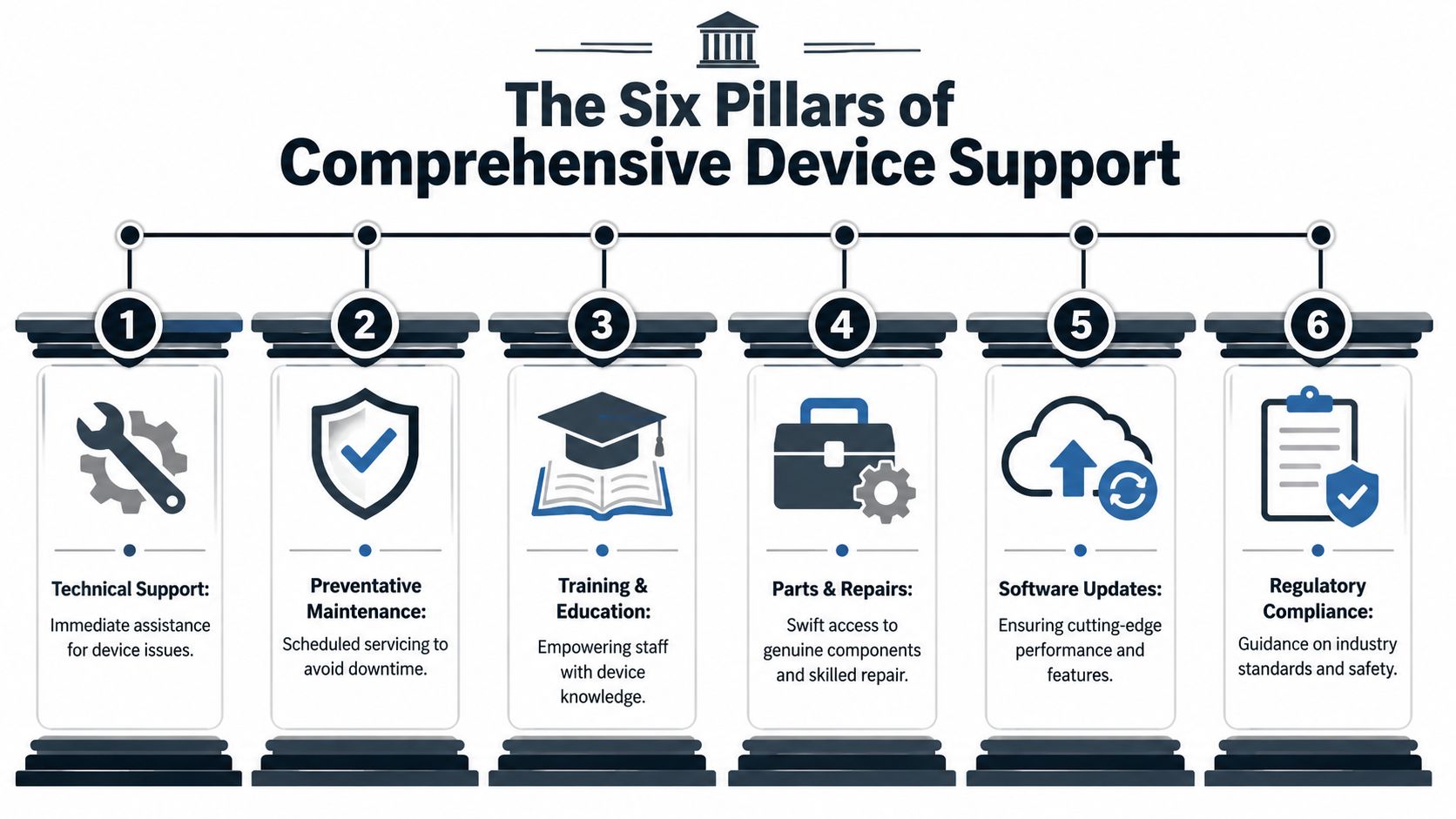
Academic analysis of after-sales systems identifies field technical assistance, spare-parts distribution, and customer care as the major drivers of successful after-sales performance, as outlined in this manufacturing after-sales service study. For clinics using high-throughput devices, that combination matters because repair speed and parts access directly affect treatment continuity.
Warranty is only the starting point
A warranty matters, but buyers often overestimate what the word itself guarantees. The useful question isn't whether a machine has a warranty. It's what the warranty covers in day-to-day practice.
Look closely at these points:
- Parts coverage: Does it cover major components only, or smaller high-failure items too?
- Labour inclusion: Will the clinic pay separately for technician time or call-out costs?
- Travel terms: If your clinic is outside a major metro, are travel and logistics covered?
- Exclusions: Are there conditions that make the warranty easy to void?
- Process clarity: Is the claim route simple, or does it require multiple approvals and delays?
A strong warranty reduces uncertainty. A weak warranty creates arguments when you need action.
The full support system around the machine
The best after sales service rests on six practical pillars.
Apoio técnico
Fast remote triage should come first. Many issues can be narrowed down before a site visit if the support team knows the device well and has a clear fault-reporting process.Manutenção preventiva
Waiting for failure is poor clinic management. Planned servicing helps catch wear, calibration drift, and developing faults before they interrupt patient flow.Spare parts and repairs
Many service promises collapse in this area. If parts aren't available locally or there's no disciplined logistics process, even a simple repair can drag on.Training and re-training
Staff turnover happens. So does skill drift. Ongoing training protects treatment quality and reduces operator-related issues that later get mislabelled as machine faults.Software updates
Devices increasingly rely on software for usability, safety checks, presets, and performance improvements. Updates need a process, not an afterthought.Regulatory and documentation support
Clinics need clean records, clear operating guidance, and confidence that the platform sits properly within regulated practice.
Regra prática: If a supplier can explain the machine in detail but can't explain their service workflow in detail, the risk sits with you.
These pillars work together. If one is weak, the whole support structure feels weaker than the sales conversation suggested.
Calculating the ROI of Excellent After Sales Service
Clinic owners sometimes talk about after sales service as peace of mind. That's true, but it's incomplete. Peace of mind only matters because it protects income.
The first financial lens is simple. Every hour of downtime affects booked treatments, room utilisation, staff productivity, and client confidence. A machine that's unavailable doesn't just stop one service. It can interrupt package plans, follow-up schedules, retail conversion, and referral momentum.
Start with the cost of downtime
When you assess service ROI, don't start with the support package fee. Start with the value of a working machine on a normal operating day.
Ask:
- How many appointments depend on this device each week?
- Which treatments have to be cancelled, moved, or refunded if it fails?
- What happens to therapist or clinician time during the outage?
- How many clients lose confidence when their booking is changed at short notice?
- How much future revenue is tied to those interrupted treatment plans?
This is why cheap support often turns out to be expensive. A lower upfront deal can look sensible until the first unresolved fault.
There's a useful mental model here. Software teams often use structured templates to calculate SaaS project ROI, and the same discipline helps in clinics. You don't need software-specific inputs. You need a consistent way to compare cost, risk, and ongoing return.
For aesthetic devices, that means mapping support quality against machine utilisation. If better service shortens downtime, preserves appointments, and keeps treatment plans on schedule, the return is operational as much as financial.
Then measure retention and repeat purchase value
Service quality also affects what happens after the immediate problem is solved. Buyers are more likely to stay with suppliers who respond well under pressure, and clinics are more likely to retain clients when disruption is handled properly.
Global customer experience data shows 88% of buyers are more likely to purchase again after a great service experiencee a 5% increase in retention can lift profits by 25% to 95%, according to these customer experience findings. That matters in two directions. It matters for your relationship with your supplier, and it matters for your clients' relationship with your clinic.
If your device partner supports you well, your team stays confident. If your team stays confident, treatments stay consistent. If treatments stay consistent, clients are more likely to complete plans and come back.
A practical ROI view should include:
- Revenue protected: Bookings that stay on the diary because faults are handled quickly.
- Reputation protected: Fewer service failures that trigger negative reviews or lost trust.
- Staff confidence: Operators work better when they know support is available and responsive.
- Repeat purchase potential: Strong supplier service reduces friction when you expand your treatment offering.
- Referral value: Reliable treatment delivery gives clients fewer reasons to hesitate when recommending your clinic.
One practical example is a supplier that combines training, technical support, business guidance, and warranty support into the device relationship. Omega Lasers' diode laser ROI breakdown for South African professionals reflects the same commercial reality many clinics face. The machine only performs financially when uptime, treatment flow, and operator confidence all hold together.
Service ROI is rarely hidden. Clinics usually see it in the diary first.
Your Vendor Evaluation Checklist Key Questions to Ask
Most brochures make support sound smooth. That's why you need questions that expose the underlying operating model behind the promise.
The strongest vendors can answer practical questions without hesitation. The weaker ones stay vague, shift to marketing language, or rely on broad assurances instead of process detail.
What to ask before you sign
Support quality should be measured. The key after-sales KPIs include CSAT, ticket resolution rate, and service-level attainment, with standard formulas used to track whether support is resolving issues effectively, as described in this guide to after-sales service KPIs.
That gives you a useful starting point for vendor conversations.
Ask direct questions such as:
- Support access: How do we log a fault, and who answers first?
- Response process: What happens in the first hour after a device issue is reported?
- Technician coverage: Do you have local or regional technical capacity where my clinic operates?
- Parts handling: Which parts are kept in-country, and which are ordered only after diagnosis?
- Training continuity: What happens when a trained staff member leaves and a new operator joins?
- Maintenance planning: Do you offer scheduled servicing, and how is it booked?
- Escalation route: If first-line support can't solve the issue, who takes over next?
- Measurement: Which service KPIs do you track internally, and how often do you review them?
Ask for operating detail, not reassurance. Reassurance is cheap. Service capacity is not.
If you're buying a high-use platform such as a professional laser system, the machine category itself should shape your questions. A high-throughput treatment device needs a more robust support model than a low-frequency add-on treatment. Buyers comparing máquinas profissionais de depilação a laser should evaluate the service burden alongside the clinical features.
Vendor After Sales Service Evaluation Checklist
| Área de Avaliação | Questões-chave a colocar | What to Look For (Green Flags) |
|---|---|---|
| Apoio técnico | How do you diagnose faults remotely? What is the escalation path? | Clear fault-logging process, technical language, defined escalation steps |
| Field service | Who performs on-site repairs, and where are they based? | Named local or regional technician coverage, not vague outsourced support |
| Spare parts | Which parts are stocked locally? How are urgent parts prioritised? | Transparent parts process, realistic logistics expectations |
| Garantia | What is covered, what is excluded, and what costs sit with the clinic? | Written clarity, limited ambiguity, fair treatment of travel and labour |
| Formação | Is training once-off or ongoing? How do you support new staff? | Refresher training, structured onboarding, practical operator support |
| Manutenção | Do you schedule preventative servicing? | Planned maintenance rather than purely reactive repair |
| Reporting | Which KPIs do you track for service performance? | CSAT, ticket resolution tracking, service-level measurement |
| Communication | Who updates us during an open issue? | Single point of contact or clear ownership of updates |
A vendor that answers these questions well usually runs a better service operation. A vendor that avoids them usually creates work for the clinic later.
Decoding Your Service Level Agreement
A Service Level Agreement is where sales language becomes obligation. If the wording is loose, your clinic carries more risk than you think.
The most common problem is that buyers look for the presence of an SLA, not the quality of it. A short, vague agreement can sound reassuring while leaving major gaps around response, travel, parts, and exclusions.
The clauses that matter in real clinic operations
Read the agreement as if your device has already failed.
Focus on these terms:
- Response time: How quickly the supplier acknowledges and starts handling the issue.
- Resolution time: How long the supplier expects the full fix to take.
- Business hours: Whether support operates only in standard office hours or includes urgent treatment-day support.
- On-site attendance: When a technician visit is triggered, and what conditions apply.
- Escalation procedure: Who becomes responsible if the first support level doesn't resolve the problem.
- Exclusions: What situations are not covered, especially around consumables, misuse claims, or travel.
A fast response with no meaningful route to resolution isn't enough. Clinics need both acknowledgement and action.
Read every SLA clause against one practical question: what happens if my machine stops working on a full treatment day?
South African realities your SLA must reflect
In South Africa, after-sales performance is shaped heavily by logistics, technician travel, and parts movement across provinces. A vendor's ability to manage spare parts logistics, technician travel, and on-site repairs, especially outside major metros, directly affects device uptime and revenue, as discussed in this analysis of after-sales service and supply chain realities.
That means your SLA should state more than generic service intentions.
Look for wording that clarifies:
- Provincial coverage: What support looks like if you're not in a major urban centre.
- Travel responsibility: Who pays for technician travel and under what conditions.
- Parts delay handling: What happens if a fault requires a component that isn't immediately available.
- Temporary workarounds: Whether remote support or interim measures are offered while waiting for a visit.
- Communication frequency: How often you'll receive updates during an unresolved issue.
If those details are missing, the agreement leaves too much open to interpretation. And interpretation usually favours the party with less urgency than your clinic.
A Tale of Two Clinics The Real Cost of Service
Two clinics buy similar high-value equipment.
The first clinic chooses mainly on price. The machine performs well at the start, but months later a fault interrupts a busy treatment day. The team logs the issue through a generic support channel, waits for a response, then learns the diagnosis needs another review. A site visit isn't immediate. The needed part isn't nearby. Appointments are moved, clients get frustrated, and the front desk spends the day managing fallout instead of revenue.
The second clinic chooses with after sales service in mind. When a fault appears, support starts with remote checks, the issue is narrowed down quickly, and the clinic gets clear updates on next steps. If an on-site repair is needed, the process is already defined. Staff know who to call. Management knows what to expect. Clients experience a disruption, if any, that feels controlled rather than chaotic.

The difference isn't just technical competence. It's operating discipline.
One clinic bought a machine. The other bought a machine plus a service system. Over time, that gap shows up in cancelled bookings, team stress, treatment consistency, and client trust. The visible cost is downtime. The hidden cost is confidence. Once staff stop trusting that support will arrive when it's needed, they start treating every small issue like a future crisis.
That's why after sales service deserves boardroom-level attention, even in a small clinic. It's revenue protection wearing a technical uniform.
Your Questions on After Sales Service Answered
Is after sales service really part of the buying decision, or something to sort out later
It should be part of the buying decision from day one. Once the machine is installed, your influence typically drops. Support terms are easiest to clarify before signature, not after the first fault.
What matters more, warranty length or support quality
Support quality. A long warranty with weak execution can still leave your clinic exposed. Clear processes, available technicians, realistic parts handling, and proper training matter more in daily operations.
Should smaller clinics care as much about service as larger clinics
Yes. Smaller clinics often feel downtime more sharply because they have fewer rooms, fewer backup devices, and less schedule flexibility. One unavailable machine can affect a meaningful share of the week's revenue.
How do I know if a supplier takes service seriously
Look for specifics. Ask how faults are logged, who handles escalation, how maintenance is planned, how new staff are trained, and what service metrics are reviewed internally. Serious suppliers answer operationally, not emotionally.
Is training part of after sales service
Absolutely. Many support issues begin as usage issues, confidence gaps, or inconsistent operating practice. Ongoing training protects safety, consistency, and machine performance.
What's the biggest mistake clinics make
They buy on features and price, then treat service as an administrative detail. In capital equipment, service isn't an accessory. It's part of the asset.
If you're assessing a new aesthetic device and want to look at the full commercial picture, not just the machine specification, Lasers Omega provides information on device training, technical support, warranty coverage, and business support that can help you evaluate what dependable after sales service should look like in practice.