



A patient finishes a skin rejuvenation consult, pauses at the door, and asks whether your clinic removes tattoos. A week later, someone else asks for partial fading before a cover-up. Then a corporate client wants a visible tattoo lightened before starting a new role. When that question starts appearing across different patient types, it deserves attention in your capital plan.
Recurring demand is a stronger signal than vendor hype. If patients are asking before you advertise the service, there is usually a real revenue opportunity behind it.
In South Africa, tattoo removal has shifted from an occasional add-on to a service line that can justify dedicated equipment, trained operators, and formal treatment protocols. The opportunity is real, but so is the failure rate. I have seen clinics buy on headline specs, then struggle with poor treatment endpoints, inconsistent results on darker skin types, weak consent processes, or pricing that never recovers the machine cost.
The clinics that perform well in this category treat tattoo removal as a business unit, not a gadget purchase. They assess whether the technology suits their patient mix, whether the supplier can support training and service locally, whether the device documentation aligns with SAHPRA requirements, and whether session pricing will produce a sensible payback period in rand, not in vendor spreadsheets.
That is the lens for this article.
The goal is not only to explain how tattoo removal machines work. It is to help a South African clinic owner decide whether to invest, which platform class fits the practice, how to handle compliance and training properly, and how to build a business case that protects both patient safety and margin.
The Growing Demand for Tattoo Removal in South Africa
A clinic owner in Johannesburg sees the pattern before the spreadsheets catch up. One patient wants an old forearm tattoo faded before a corporate job change. Another needs enough clearance for a cover-up artist to work cleanly. A third asks about removing a name tattoo after years of putting it off. When those enquiries start coming from different age groups and different suburbs, demand is no longer incidental. It is a service line worth modelling properly.
In South Africa, tattoo removal demand is being driven by a mix of social change, workplace expectations, maturing aesthetic medicine, and better patient awareness of laser-based options. Clients are also arriving better informed about pain, downtime, and likely session counts, which means consultations need to be tighter and more commercially disciplined. Clinics that prepare properly can convert that interest into recurring revenue. Clinics that buy the wrong platform usually discover the gap between enquiry volume and profitable treatment delivery very quickly.
Why clients are asking now
The patient profile is wider than it was a few years ago. Full-removal cases still exist, but they are only part of the market. A profitable clinic will also see cover-up preparation, selective fading, and clean-up of poorly executed older work.
Commercially, this trend creates multiple treatment intents:
- Full removal cases with higher lifetime value because they usually require a longer treatment plan
- Fade-for-cover-up cases that often convert faster because the client already has a clear end goal
- Selective correction work for names, outlines, or uneven pigment
- Multi-tattoo patients who start with one area, then return for additional sites if the first result and experience are good
This mix matters operationally. It affects consultation scripting, package design, room utilisation, and cash flow. A clinic that prices every case as if it were a full removal leaves money on the table in some consultations and underestimates treatment complexity in others. Good operators segment demand early.
Pain management also affects conversion more than many owners expect. Patients who ask practical questions about discomfort are often close to booking, not merely browsing. Offering clear pre-treatment guidance, including options such as topical numbing support for laser procedures, can improve show-up rates and reduce drop-off between consultation and first session.
Why demand now supports a real business case
The service category has matured. Patients increasingly expect a medical-aesthetic standard of care, documented consent, visible hygiene protocols, and equipment that looks credible in a clinical setting. That expectation favours established clinics over informal operators, but only if the clinic can match the promise with the right technology, trained staff, and realistic treatment planning.
From a business perspective, tattoo removal works best as repeat revenue with controlled consumable costs. The attraction is not one high-ticket session. It is a sequence of treatments that fills appointment slots, creates review points for package upgrades, and can cross-refer into adjacent services such as scar management or pigment correction where appropriate. The risk is buying a machine that underperforms on darker skin types, struggles with common ink colours, or lacks dependable local service support. In South Africa, those mistakes are expensive because replacement timelines, service delays, and compliance gaps can erode margin fast.
Tattoo removal is now established enough to justify board-level scrutiny inside a clinic. The right investment can add a durable revenue stream. The wrong one creates complaints, idle capital, and a long payback period.
How Laser Tattoo Removal Machines Work
A patient arrives with a dense black forearm tattoo, realistic expectations, and Fitzpatrick IV skin. The machine you bought has one chance to justify its place on your floor. If the wavelength is wrong, the pulse delivery is unstable, or the operator does not understand the endpoint, the result is not just a poor session. It is a complaint, a refund discussion, and a slower return on a large capital purchase.
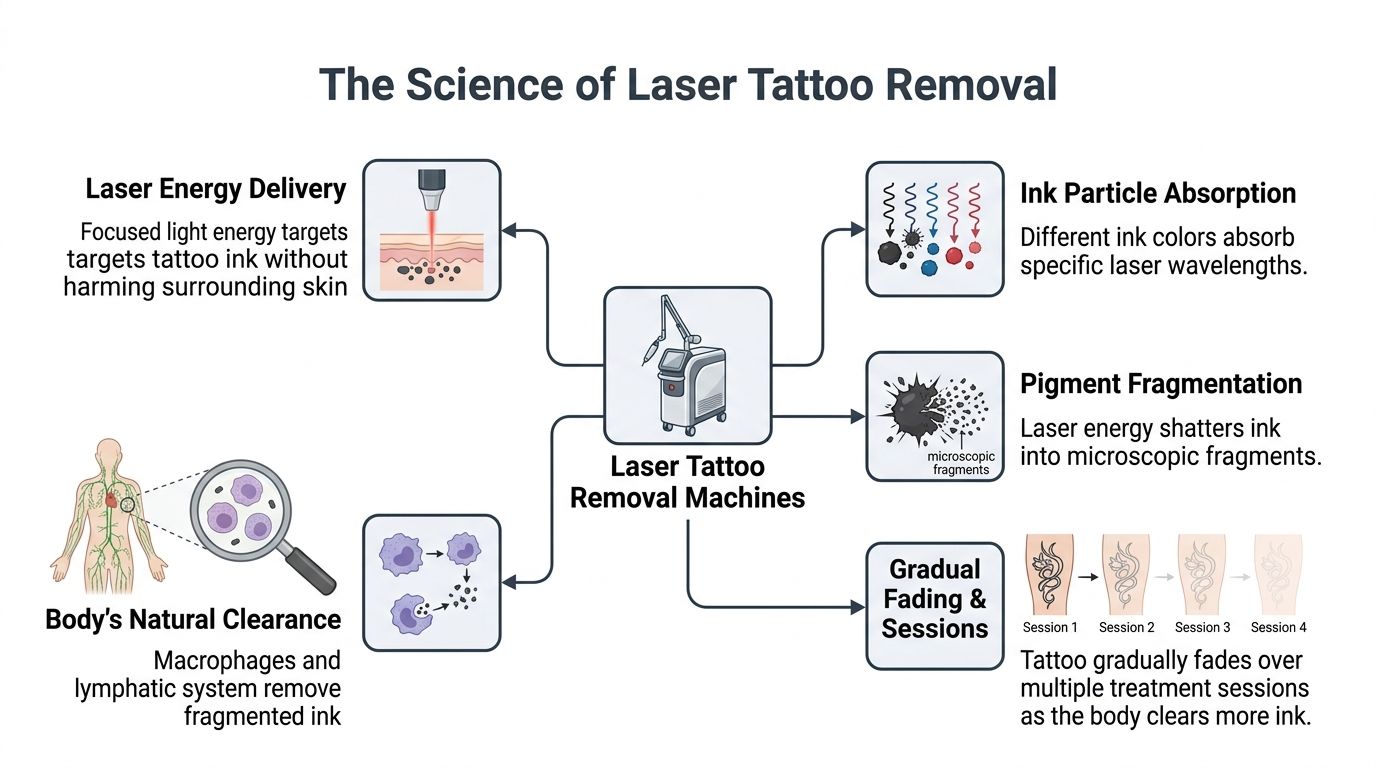
Tattoo removal depends on selective photothermolysis and a strong photoacoustic effect. The laser delivers extremely short pulses into the pigment, the ink absorbs that energy, and the larger pigment particles fracture into smaller fragments. Those fragments are then cleared gradually by the body over the following weeks.
That biological clearance window is why tattoo removal is sold as a treatment course, not a once-off procedure. Your machine starts the process. The patient’s immune response finishes it between sessions.
The core mechanism
The laser does not remove the tattoo directly. It breaks large pigment particles into smaller fragments that the body can clear over time. For a clinic owner, that distinction matters because good outcomes depend on the interaction between wavelength, pulse duration, fluence, spot size, cooling, and operator judgment. A machine with poor beam stability or inconsistent output can look acceptable on paper and still produce weak clinical progress.
Visible frosting, tissue whitening, pinpoint bleeding, and patient discomfort all need to be interpreted correctly in context. Operators who chase aggressive endpoints to impress patients usually create more downtime, more inflammation, and more risk without improving clearance. The better commercial model is controlled, repeatable progress with documented photography and honest session planning.
Why wavelength matters
Wavelength determines which ink absorbs the energy and how far that energy penetrates. In practice, your platform has to cover the colours you are likely to treat in South Africa, not just the colours shown in a sales brochure.
As noted in the Titan 3 technical manual, Q-switched Nd:YAG systems commonly use 1064nm and 532nm wavelengths. In clinic terms, 1064nm is typically used for black and dark blue ink and is generally the safer workhorse wavelength for darker skin types because of its deeper penetration and lower epidermal melanin absorption. The 532nm setting is used for more superficial red and orange pigment, but it demands more caution because epidermal interaction is higher.
This is one of the easiest places to spot a weak vendor. If the supplier cannot explain, clearly and without jargon, which wavelength is suited to which ink family and skin type, do not assume the training will improve after the invoice is paid.
Why pulse delivery and peak power affect results
Pulse energy alone is not enough. What matters is how that energy is delivered. Shorter, high-intensity pulses create a stronger mechanical effect on the pigment, which is why machines with stable high peak power and consistent beam quality usually clear tattoos more efficiently than low-cost systems with inflated specifications.
From a business perspective, efficient fragmentation improves the early visual response. That improves patient confidence, makes package sales easier to defend, and reduces the number of clients who abandon treatment after one or two sessions because they think nothing is happening.
Better technology does not eliminate the biology. It reduces wasted sessions.
What patients feel and what operators need to control
Tattoo removal is tolerable for many patients, but it is not a comfort treatment. Pain management, epidermal cooling, interval planning, and aftercare instructions all influence retention and satisfaction. Clinics that standardise pre-treatment steps usually run smoother treatment days and see fewer interruptions once the handpiece is in use.
For suitable cases, many clinics combine cooling with a topical anaesthetic protocol and keep a product such as topical numbing support for laser procedures available as part of that workflow.
Practical rule: Buy a machine your team can explain, calibrate, and defend clinically. If the operator does not understand how the laser interacts with pigment, skin, and healing time, the clinic will struggle to deliver safe results at a profit.
Q-Switched vs Picosecond Lasers A Head-to-Head Comparison
A clinic owner in Johannesburg or Cape Town can lose money with either platform if the buying decision is based on headline specs instead of treatment mix, pricing power, and operator discipline. This comparison matters because it affects three numbers that decide whether the service line works: how many sessions you can realistically sell, how much downtime and risk you carry, and how quickly the machine pays itself off.
Q-switched technology is the older commercial workhorse. Picosecond technology usually gives faster clearance in harder cases and supports stronger premium pricing. The purchase decision is not about novelty. It is about whether your clinic needs a dependable entry-level revenue stream or a higher-yield platform that can justify a larger capital outlay.
The technical difference that affects revenue
The main separation is pulse duration. Q-switched systems fire in nanoseconds. Picosecond systems fire in shorter pulses, which increases the photoacoustic effect and shifts more of the work toward pigment fragmentation rather than heat spread. In practical terms, that often translates into better response in resistant ink, more convincing progress photos early in the treatment plan, and fewer borderline cases that drag on and damage patient confidence.
A single source cited earlier reports picosecond pulse durations in the 450 to 750 picosecond range versus 5 to 20 nanoseconds for nanosecond systems, with higher peak power, shorter treatment courses in the cited comparison, and lower thermal burden in some cases, including lower concern around post-inflammatory hyperpigmentation than older nanosecond approaches in higher-risk patients (Removery laser tattoo removal machine comparison).
That does not mean every picosecond machine outperforms every Q-switched unit. Build quality, true fluence delivery, beam profile, spot sizes, cooling, and service support still decide what happens in a treatment room.
What changes clinically and commercially
For black amateur tattoos and basic fading for cover-up work, a good Q-switched platform can still be a sensible business purchase. The machine cost is usually lower. The treatment logic is familiar. If your clinic wants to test demand before committing to a premium platform, Q-switched can be the right first step.
The trade-off is throughput and case range. More sessions can mean more total billings per patient, but that only helps if patients stay the course. In real clinics, long treatment plans increase dropout risk, especially when visible change is slow. That hurts package completion, review quality, and referral momentum.
Picosecond systems usually make more sense where the clinic sees professional tattoos, layered cover-ups, colour work, or patients who are comparing providers online and asking specific technology questions before they book. They also tend to support higher consultation-to-treatment conversion because the value proposition is easier to explain: fewer sessions in suitable cases, better response in stubborn ink, and a lower heat profile.
Q-Switched vs. Picosecond Laser Technology Comparison
| Feature | Q-Switched (Nanosecond) Laser | Picosecond Laser |
|---|---|---|
| Pulse duration | Nanosecond pulse duration | Shorter picosecond pulse duration |
| Energy effect | Established pigment fragmentation with greater thermal contribution | Stronger photoacoustic fragmentation with less reliance on heat |
| Peak power | Lower relative peak power | Higher relative peak power |
| Typical treatment course | Often longer, especially for dense professional tattoos | Often shorter in suitable cases |
| Best fit | Black ink, cover-up fading, lower-cost market entry | Resistant tattoos, colour work, premium service positioning |
| Thermal damage profile | More heat management required | Lower thermal burden in many cases |
| Commercial impact | Lower capital cost, broader entry access | Higher ticket potential, stronger premium differentiation |
Which purchase fits which clinic model
Choose Q-switched if the business plan is conservative and tightly controlled. That usually means one or more of the following:
- You are launching tattoo removal as a secondary service, not a flagship category
- Your local demand is mostly black ink and pre-cover-up lightening
- Capital budget is limited and payback speed depends on a lower monthly finance burden
- Your team is early in its laser learning curve and needs a simpler operating model
Choose picosecond if tattoo removal is expected to be a visible profit centre. That usually applies when:
- Your clinic competes in metro markets where patients compare devices before booking
- You expect a meaningful share of professional, older, layered, or multi-session failures from other providers
- Your patient base includes a significant proportion of darker skin types, where heat management and conservative risk reduction matter more
- You want stronger pricing power and a better story for package sales
For most South African clinics, the right answer comes from the spreadsheet, not the brochure. If the local market will only support budget pricing, a premium picosecond platform can become an expensive underused asset. If your catchment includes higher-income patients, referral doctors, cosmetic injectables clients, and strong demand for correction work, buying only on entry price can cap revenue for years.
Ask a harder question before signing any quote: will this platform let the clinic profitably treat the tattoos that actually present in your rooms, at prices your market will accept, under safety standards your operators can maintain consistently?
Matching Technology to Skin Type and Ink Colour
Tattoo removal only looks simple when someone is treating the easiest possible case. Real practice means mixed pigments, cover-up layers, sun exposure, old scarring, and patients across the Fitzpatrick scale. That’s where machine choice and operator judgement start to separate strong clinics from risky ones.
A device that handles black ink acceptably on lighter skin may still be the wrong purchase for a South African clinic treating a broad, real-world patient mix.

Start with skin, not with the tattoo
Operators often make the mistake of fixating on the ink first. Safe practice starts with skin type. The reason is straightforward. Melanin competes for energy absorption, and that changes how aggressively you can treat.
For darker skin, conservative parameter selection, stronger cooling, disciplined test-spotting, and longer respect for tissue response become more important. You don’t win by chasing dramatic endpoints in one session. You win by avoiding preventable injury while keeping the patient on a successful treatment path.
Then match the wavelength to the pigment
Colour strategy should be built around what the platform can deliver. In general clinical practice:
- Black and dark blue inks are usually the most straightforward to target with 1064nm platforms.
- Red and orange pigments respond better when 532nm capability is available.
- Green, blue-green, and other resistant colours are where some clinics outgrow basic systems and start needing broader wavelength options or picosecond capability.
That’s why “multi-colour treatment” should never be accepted as a brochure phrase on its own. Ask which wavelengths are included, which handpieces are standard, and which colour groups the vendor expects you to treat well versus merely attempt.
Practical treatment planning in a ZA clinic
A useful intake process usually includes these checks:
- Skin assessment first. Record Fitzpatrick type, tanning status, and any history of pigment change.
- Tattoo history next. Ask whether the tattoo is professional, amateur, layered, or partially removed before.
- Colour mapping. Don’t price or forecast sessions before identifying the actual pigment mix.
- Patch strategy. Test when the risk profile or colour response is uncertain.
- Photographic discipline. Consistent images are essential for tracking progress and protecting your consultations.
What works and what doesn’t
What works is conservative consistency. Good settings, repeatable protocols, clear aftercare, and patience.
What doesn’t work is aggressive fluence chosen to impress the patient on day one. That approach often leads to extended downtime, poor healing, avoidable pigment change, and unhappy follow-up visits.
In darker skin, the best operators don’t chase dramatic reaction. They chase safe progression.
The clinics that earn trust in tattoo removal machines are usually the clinics that know when to say no, when to delay, and when a partial fade plan is smarter than promising complete clearance too early.
Navigating Safety SAHPRA Compliance and Training
Many clinics lose confidence, not because regulation makes tattoo removal impossible, but because the available guidance is fragmented and often irrelevant to South African practice.
That gap is real. According to this review of the compliance content gap, there is virtually no accessible guidance for aesthetic professionals on regional compliance frameworks, and ZA practitioners are especially underserved because most available content focuses on the U.S. market rather than SAHPRA, operator certification, and local compliance pathways.
Why compliance is a business asset
Too many buyers treat compliance as a paperwork nuisance. In reality, it protects revenue.
When a clinic can show that its tattoo removal machines are SAHPRA-licensed and that staff are properly trained, several things improve at once:
- patient trust rises
- insurer conversations become easier
- staff confidence improves
- adverse-event risk is easier to control
- the clinic has a clearer defence if something goes wrong
That’s not abstract governance. It’s part of your positioning.
What clinics should verify before launch
You need a practical compliance file, not a verbal assurance from a salesperson. Before treating a single patient, verify:
- Device status. Confirm SAHPRA licensing for the actual machine being sold, not a similar model.
- Training scope. Ensure training covers consultation, contraindications, settings, test spots, and adverse-event response.
- Operator competency. Don’t assume a therapist experienced in another laser category can safely move into tattoo removal without specific education.
- Clinical documentation. Build consent forms, photography standards, patch-test records, and aftercare instructions before launch.
- Service and maintenance pathway. If a fault occurs, know who handles it, how quickly, and whether treatment continuity is realistic.
Training that actually prepares a team
A short handover isn’t enough. Tattoo removal requires judgement. The operator must know when to reduce settings, defer treatment, or stop entirely.
That’s why a serious clinic should look for structured education rather than basic onboarding. Programmes such as laser hair removal training are a useful example of the kind of formal device education mindset clinic owners should expect from any advanced aesthetic equipment partner, even when the treatment category differs.
Buying a compliant machine without training is like buying a theatre without a surgeon. The asset exists, but the service doesn’t.
What poor compliance usually looks like
In practice, the warning signs are familiar. The supplier can’t explain licensing clearly. The training is product-demo level only. No one discusses contraindications in darker skin. The clinic launches with pricing but no protocols.
That combination creates the worst possible outcome. A high-ticket capital investment that staff use cautiously, inconsistently, or not at all.
Building Your Business Case Calculating ROI
A clinic owner signs for a laser on Friday, launches a promotion on Monday, and realises by month three that bookings are too thin to cover finance, room time, and staff hours. That mistake is common because too many buying decisions start with the machine and only later reach the spreadsheet.
Tattoo removal can be profitable in South Africa, but only when the business case is built around local pricing, realistic utilisation, and the cost of keeping the device working. International articles can still help with benchmarking. For example, this international overview of tattoo removal profitability and leasing ranges gives a general reference point for monthly lease costs, but it should be treated as a non-SA benchmark rather than a South African planning figure.

The ROI model that matters
Use a four-part model:
- Capital and setup cost
- Monthly operating cost
- Revenue per patient plan
- Payback period
This sounds simple. In practice, clinics usually undercount the second category and overestimate the third.
Capital and operating costs
The machine price is only the start. A serious ROI model should include every cost attached to delivering the treatment safely and consistently.
Include:
- Purchase, lease, or finance cost
- Initial training and follow-up training
- Room use, because every tattoo removal session displaces another billable treatment
- Operator time, including consultation, photography, patch testing where needed, treatment, and aftercare discussion
- Consumables and aftercare products
- Service contract and repairs
- Marketing and launch spend
- Downtime risk, especially if parts or engineering support are not locally available
I advise clinic owners to build this in a monthly format first, then annualise it. That exposes pressure points quickly. If a device needs strong patient flow just to break even, the risk is higher than many sales proposals suggest.
For clinics comparing finance options across aesthetic equipment, this laser hair removal machine cost guide for clinic owners is useful as a budgeting reference because the same capital planning logic applies.
Revenue per patient plan
Revenue planning should be based on full treatment plans, not single sessions. Tattoo removal is a repeat-visit service. That is why conversion, retention, and rebooking discipline matter as much as headline pricing.
One source often referenced for market context, this overview of the South African market, is better used as broad background than as a pricing authority. For actual budgeting, each clinic should work from its own local fee structure, expected case mix, and the treatment depth it intends to offer.
The commercial variables that matter most are usually:
- Tattoo size and complexity
- Black ink versus multicolour work
- Fade for cover-up versus full clearance
- Consultation-to-treatment conversion rate
- Average number of completed sessions per patient
- Rebooking discipline between sessions
A small amateur black tattoo and a dense professional multicolour sleeve do not belong in the same revenue model. Too many clinics blend them together, then wonder why payback slips.
A practical payback model
Build three scenarios. Conservative, base case, and stretch case.
For each one, answer these questions:
- How many qualified consultations can the clinic generate each month?
- How many of those patients are suitable and willing to start?
- What is the average package value or expected session count per accepted patient?
- What gross margin remains after staffing, finance, marketing, consumables, and servicing?
- How many months does it take to recover setup cost?
Experience proves invaluable. A machine with higher fluence, stronger versatility across ink colours, or faster treatment times may cost more upfront but still produce a better return if it improves throughput and broadens the case mix you can treat confidently.
Where clinics misread ROI
The biggest error is treating tattoo removal as session revenue only.
The better model also asks what the service does for the rest of the clinic. Tattoo removal often brings in first-time patients who later book skin treatments. Good before-and-after progress improves referrals. A clinic that can manage difficult cases in darker skin types safely can also build a stronger reputation than competitors using underpowered systems.
Those gains are real, but they should sit outside the core payback model. Build the investment case so it still works without counting on cross-sales.
Practical rule: Buy the machine only if the numbers work with conservative utilisation, your current team, and your actual local demand.
Vendor ROI projections are sales tools. Your spreadsheet should be stricter. If bookings need to be near full capacity from month one for the investment to make sense, the clinic is buying too early, overbuying on technology, or relying on demand it has not yet proved.
A Clinic Owner's Vendor Selection Checklist
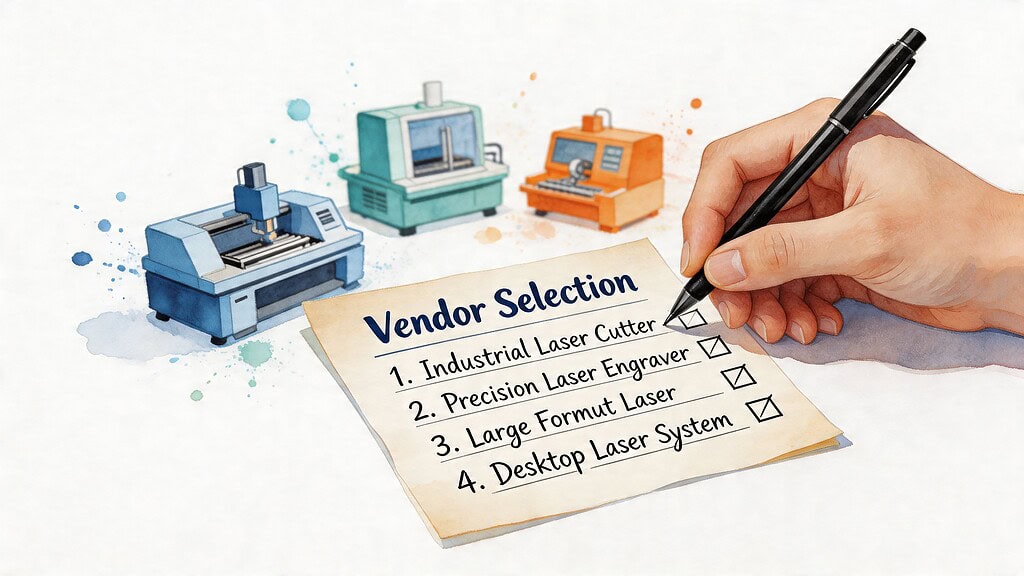
Most machine buying mistakes happen after the demo, when excitement overrides diligence. Use a written checklist and score every vendor the same way.
A supplier isn’t only selling hardware. They’re selling your future uptime, your team’s confidence, and your clinic’s ability to deliver repeatable results.
The shortlist criteria
- Regulatory proof. Ask for documentation that the specific device is SAHPRA-licensed. Don’t accept a generic compliance claim.
- Clinical fit. Match the machine to your likely tattoos, skin types, and treatment goals. Don’t buy a premium system for cases your clinic won’t see, or a basic system for cases it can’t handle.
- Training depth. Ask what the team will learn beyond button operation. Consultation, contraindications, test spots, and managing complications must be included.
- Warranty terms. Check length, exclusions, and who performs service work.
- After-sales support. Ask how faults are logged, how fast support responds, and whether parts are locally accessible.
- Consumables and maintenance. Understand recurring ownership obligations before signing.
- Commercial support. Ask whether the vendor helps with launch strategy, treatment menus, or patient education assets.
- Reputation in your market. Speak to clinics already using the platform in a comparable setting.
Questions worth asking in the room
Ask the vendor to explain one difficult case, one darker-skin case, and one multi-colour case. Then ask what the machine does well, and what it doesn’t.
If the answers sound perfect, be cautious. Credible suppliers know the limits of their own platform.
Frequently Asked Questions for Clinic Owners
Can my existing aesthetic therapists perform tattoo removal?
Possibly, but only if they receive treatment-specific training and your clinic has clear protocols. Experience in other energy-based treatments helps, but tattoo removal introduces different judgement calls around pigment response, skin type, and adverse-event prevention.
Should I start with Q-switched or go straight to picosecond?
That depends on your patient mix and business model. If your demand is likely to centre on black ink and straightforward fade work, a Q-switched platform may be a sensible launch point. If your clinic expects more professional tattoos, resistant colours, and a broader urban case mix, picosecond usually makes more strategic sense.
What’s the most expensive mistake after purchase?
Underutilisation. Clinics often buy capable tattoo removal machines, then fail to train properly, market consults consistently, or build treatment pathways their team can explain with confidence.
How should I market tattoo removal without sounding cheap?
Lead with trust, not discounts. Show consultations, explain realistic outcomes, discuss safety, and use strong photography. Patients choosing tattoo removal are often cautious. They respond better to authority and clarity than to price-led messaging.
What should I watch during a demo?
Watch whether the supplier can explain treatment logic, not only interface features. Ask about wavelength use, skin type strategy, aftercare, service support, and what cases they would decline.
Is tattoo removal better as a core service or an add-on?
Either model can work. As an add-on, it can monetise your existing client base. As a core service, it can differentiate the clinic more sharply. The correct answer depends on whether you have the team, demand, and clinical discipline to support it properly.
If you're evaluating tattoo removal machines and want a partner that understands both clinical performance and the commercial realities of South African aesthetic practice, Omega Lasers is worth a serious look. Their portfolio, training support, technical backup, and SAHPRA-focused approach are aligned with what clinic owners need when adding a high-stakes treatment category.