




You're staring at a clinic invoice that doesn't line up with the quote you were given. The supplier said one thing on the phone, the monthly spend says another, and the gaps usually sit in delivery charges, tank rental, and boil-off you never see in the headline price. That's why the liquid nitrogen price you should care about is the delivered, usable cost, not the number scribbled next to a per-litre quote.
Table of Contents
- Why Your Liquid Nitrogen Invoice Never Matches the Quote
- Current Liquid Nitrogen Price Ranges and Benchmarks
- Factors That Drive Your Delivered Cost Up or Down
- Real Usage Rates for Common Aesthetic Treatments
- Procurement Strategies That Actually Reduce Your Spend
- Safety and Regulatory Requirements for Clinic Storage
- Your Liquid Nitrogen Procurement Checklist
Why Your Liquid Nitrogen Invoice Never Matches the Quote
A clinic manager can look at the invoice and think the supplier changed the price after the fact. Usually, that is not what happened. The quote often covers only the cryogen itself, while the bill picks up the rest of the chain, transport, handling, tank hire, and losses between fills.
The headline number is only the starting point
Liquid nitrogen is sold as a product, but your monthly spend is a service bundle. That matters because cryogenic gas pricing depends on storage and delivery conditions, not just chemistry. For ZA buyers, the public market signal that best tracks this environment is the U.S. Producer Price Index for industrial gas manufacturing, nitrogen, which sat at 264.231 in June 2026, after 264.256 in May and 261.590 in April, with the longer path moving from 205.20 in 2020 to 251.10 in 2025 via a peak of 281.63 in 2023 (FRED series PCU3251203251207).
That history is what procurement teams should watch. It shows the nitrogen cost environment has shifted materially over time, even when month-to-month changes look small. If you only chase the phone quote, you miss the bigger budget reality.
Practical rule: compare delivered usable litres, not the number before transport, handling, and storage are added.
Boil-off is the hidden budget leak
Every dewar loses product if it sits too long between uses. The assumption in many clinics is that “we bought the gas, so the gas is ours”, but cryogenic liquid does not sit still. For intermittent users, the effective cost per usable litre rises because some of the supply leaves as vapour before it ever supports a treatment.
That is why a price sheet can look competitive and still produce a bad invoice. If the tank is too small, the top-ups are too frequent, or the storage vessel is poorly insulated, the quote on paper stops mattering quickly. The right comparison point is the total cost of ownership, not the opening number, and that logic is laid out clearly in Omega Lasers' total cost of ownership guide.
Delivery frequency also changes the bill in ways a per-litre quote hides. Short runs, urgent drops, and awkward access all push the delivered cost up, and the pattern is familiar in other logistics-heavy sectors too, including the Haulier.AI cost guide for Felixstowe. Clinics that order in small, irregular batches usually pay more once transport and handling are spread across fewer usable litres.
If you want to read the invoice correctly, break it into four parts. The first is the product price. The second is getting it to site. The third is storage-related loss. The fourth is the fixed charge for having the system there at all. That is the number that matters when you are deciding whether a supplier quote is competitive.
Current Liquid Nitrogen Price Ranges and Benchmarks
A supplier quote only makes sense if you know which supply model it belongs to. Bulk delivered nitrogen, small packaged supply, and on-site production sit in different price bands, and clinics often compare them as if they were the same product.
What the market ranges specifically say
Independent pricing references show that LN2 can run from about $0.30 to $1.50 per litre in general markets, with remote delivery and small packaged supply pushing the effective price higher (Hypertextbook liquid nitrogen facts). A U.S. industry price summary reports on-site liquid nitrogen as low as $0.13 per litre, bulk quoted prices from $0.50 to $1.78 per litre, and an all-in delivered cost of $2.00 to $5.00 per litre once storage and delivery are included (Rutherford Titan liquid nitrogen price guide).
For clinic procurement, the takeaway is blunt. Fragmented supply costs more per usable litre. A small intermittent user can end up paying far more than a larger site with stable demand and a storage setup that holds product instead of wasting it.
| Supply Type | Price Range (per liter) | Typical Use Case |
|---|---|---|
| On-site production | $0.13 at the low end | High-usage operations with dedicated generation |
| Bulk supplier delivery | $0.50 to $1.78 | Clinics and facilities with regular refill needs |
| General market supply | $0.30 to $1.50 | Broad reference range for delivered supply |
| Delivered all-in cost | $2.00 to $5.00 | Real-world total once storage and delivery are counted |
How to read the trend line
The U.S. producer index for nitrogen gives you a useful trend marker when local retail series are not published. It moved from 205.20 in 2020 to 248.02 in 2021, 276.14 in 2022, and 281.63 in 2023, before easing to 239.64 in 2024 and 251.10 in 2025. That is the kind of background movement buyers should expect to feel in contract renewals and spot pricing.
Quarterly market trackers show the same pattern. In Q2 2026, one report said the U.S. Nitrogen Price Index rose 4.31% quarter-over-quarter to an average of about USD 274.00/MT, while the Congo Nitrogen Price Index rose 7.74% quarter-over-quarter, and Europe declined in the same period (ChemAnalyst nitrogen pricing data). For South African buyers, that is the warning sign. Your supplier's price is tied to the same freight, energy, and supply tightness that move international benchmarks.
Factors That Drive Your Delivered Cost Up or Down
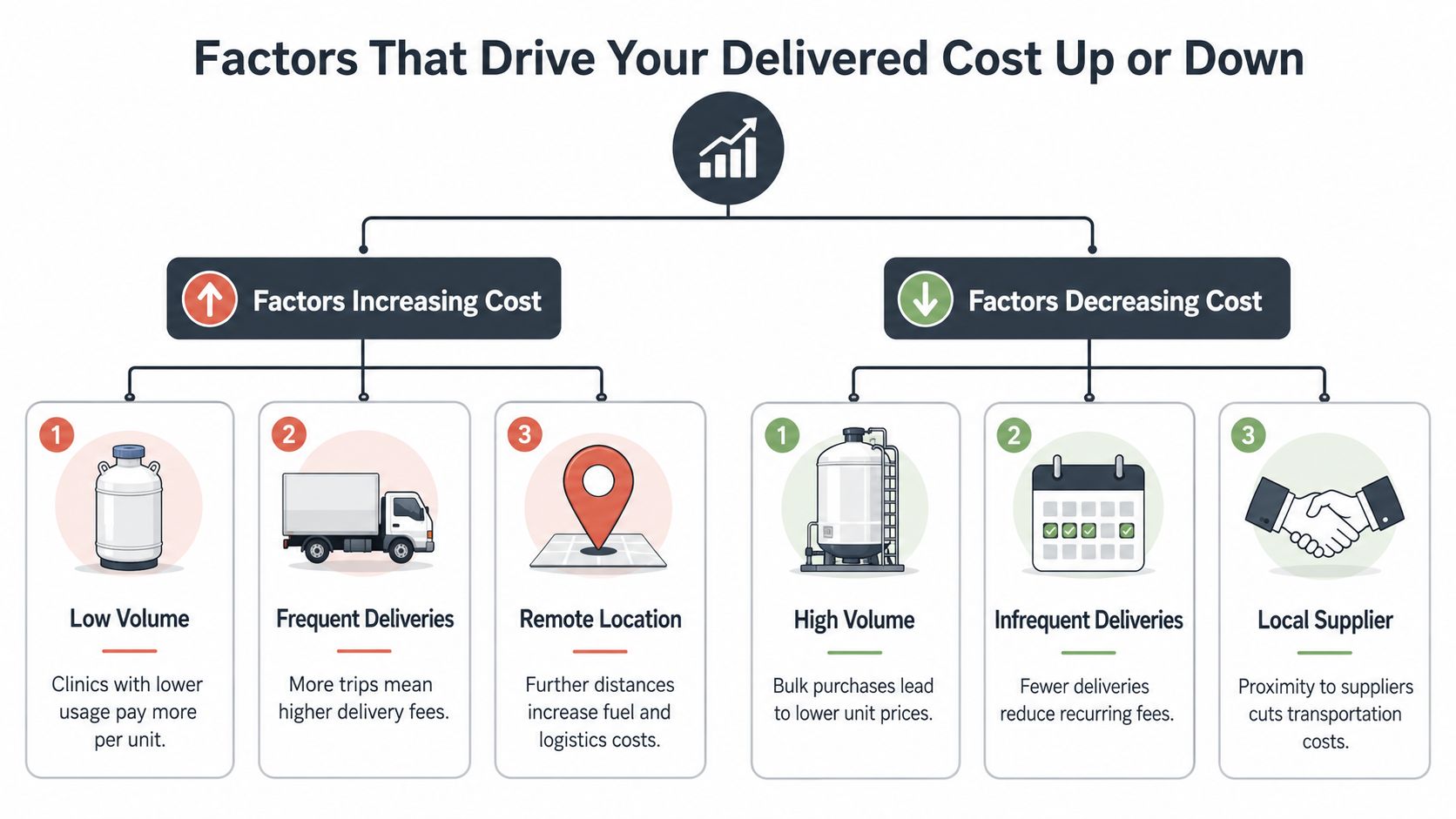
The clinic that pays the least per usable litre usually does three things well. It buys in sensible volume, keeps deliveries efficient, and stores product in a vessel that doesn't waste what it has already paid for.
Volume and location decide a lot of the bill
The first lever is simple. Low volume users pay more per unit because the delivery cost gets spread across fewer usable litres. That's especially true outside major industrial hubs, where fuel, travel time, and coordination costs all rise.
A remote location does the same damage. Cryogenic gases must move in insulated vessels, and the farther they travel, the more expensive the logistics become. If your site is outside a dense supply corridor, assume your delivered quote will be higher and your refill cadence will matter more than the sticker price.
Delivery frequency and tank management are where money leaks
Frequent deliveries are expensive because each trip brings admin, handling, and transport overhead. A clinic that orders too often because the tank is undersized ends up paying for urgency, not just gas. That's why infrequent, well-planned deliveries usually beat a stream of small emergency refills.
Tank rental versus ownership also shifts the economics. Rental can look painless at signup, then show up as an ongoing overhead that inflates the monthly figure. Ownership can reduce that burden, but only if the vessel is properly sized and maintained.
If a supplier won't separate product cost, delivery fee, and tank charges, the quote isn't transparent enough to benchmark.
Storage quality affects usable cost, not just safety
The actual product specification matters too. Industrial tenders in the region can call for electronics-grade LN2 at ≥99.998% purity, oxygen ≤1 ppm, water ≤1 ppm, and a -196°C boiling point, which tells you high-spec supply is tightly controlled (IISC LN2 rate contract tender). That doesn't mean every clinic needs that grade, but it does mean specification can move price.
The business point is sharper. Every extra day a cryogenic vessel sits between treatments increases evaporative loss. So if your clinic uses LN2 intermittently, your true cost per usable litre is usually worse than the invoice suggests.
Real Usage Rates for Common Aesthetic Treatments
Consumption only makes sense once you tie it to actual service flow. A clinic that uses LN2 occasionally for spot cooling will spend very differently from a site running cryotherapy sessions or a high-throughput dermatology list.
The workload pattern matters more than the treatment label
Laser hair removal systems that rely on cryogenic cooling, cryotherapy chambers, and dermatological applications all create different draw patterns. The point isn't the name of the treatment, it's how often the vessel is opened and how quickly the product cycles out of storage.
If your team has a mixed menu, map LN2 use by session block, not by month-end guesswork. A busy week can empty a small dewar far faster than managers expect, while a quiet week still racks up boil-off. Clinics that don't track that pattern end up buying emergency top-ups at the worst possible price.
Budgeting should follow usage, not habit
Here's the clean way to understand it:
- Low-volume aesthetic use: intermittent cooling or spot applications can look cheap on paper, but small refills usually carry a worse delivered cost.
- Moderate-volume cryotherapy use: regular patient flow supports better ordering discipline, so the spend is more stable.
- High-turnover clinical use: if LN2 is a core utility, storage capacity and delivery planning matter more than chasing the lowest per-litre quote.
The best budgeting model is simple. Estimate your monthly use, then add the logistics layer. If you only price the liquid itself, you'll understate spend and overpromise margins.
The clinic that treats LN2 like an inventory item usually spends less than the clinic that treats it like an emergency purchase.
Procurement Strategies That Actually Reduce Your Spend
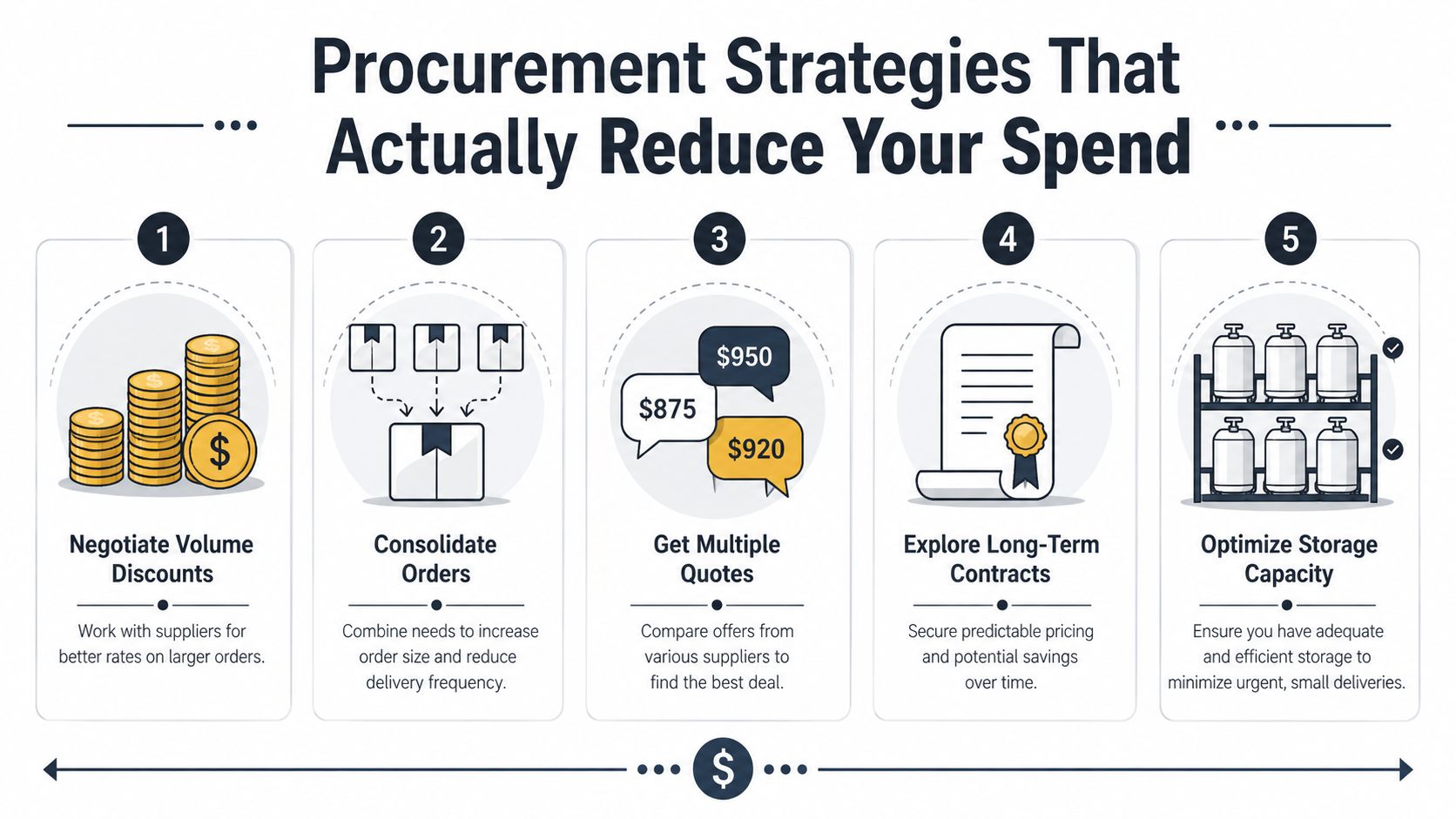
Most clinics leave money on the table when they negotiate the liter price, then accept whatever happens to delivery, storage, and refill timing. That's backwards.
Negotiate the delivered unit, not the headline quote
You want a contract that prices delivered volume into your storage vessel. That's the number that reflects what lands in the clinic. Ask for separate line items for product, transport, tank rental, handling, and refill cadence so you can see where the money is going.
Use internal demand planning to consolidate orders where possible. Fewer deliveries usually means fewer transport charges, but don't over-consolidate if boil-off risk is high. The sweet spot is enough volume to reduce trip frequency without letting product sit long enough to evaporate away.
Lock in structure where volatility hurts most
Quarterly swings are real in industrial nitrogen markets, so pure spot buying is a weak plan for recurring clinic use. Fixed pricing can make sense when your usage is steady and the supplier is credible. If demand shifts a lot, use a shorter pricing window with clear review dates rather than open-ended exposure.
The supplier relationship should also include a realistic tank plan. If the vessel is too small, you'll pay for extra trips. If it's too large for your actual usage, you'll pay through avoidable boil-off. That's a storage decision, not just a procurement decision.
For clinics that want a broader operational view of supply planning, Omega Lasers' supply chain optimisation guide is a useful companion because the same logic applies across consumables and service scheduling.
Safety and Regulatory Requirements for Clinic Storage
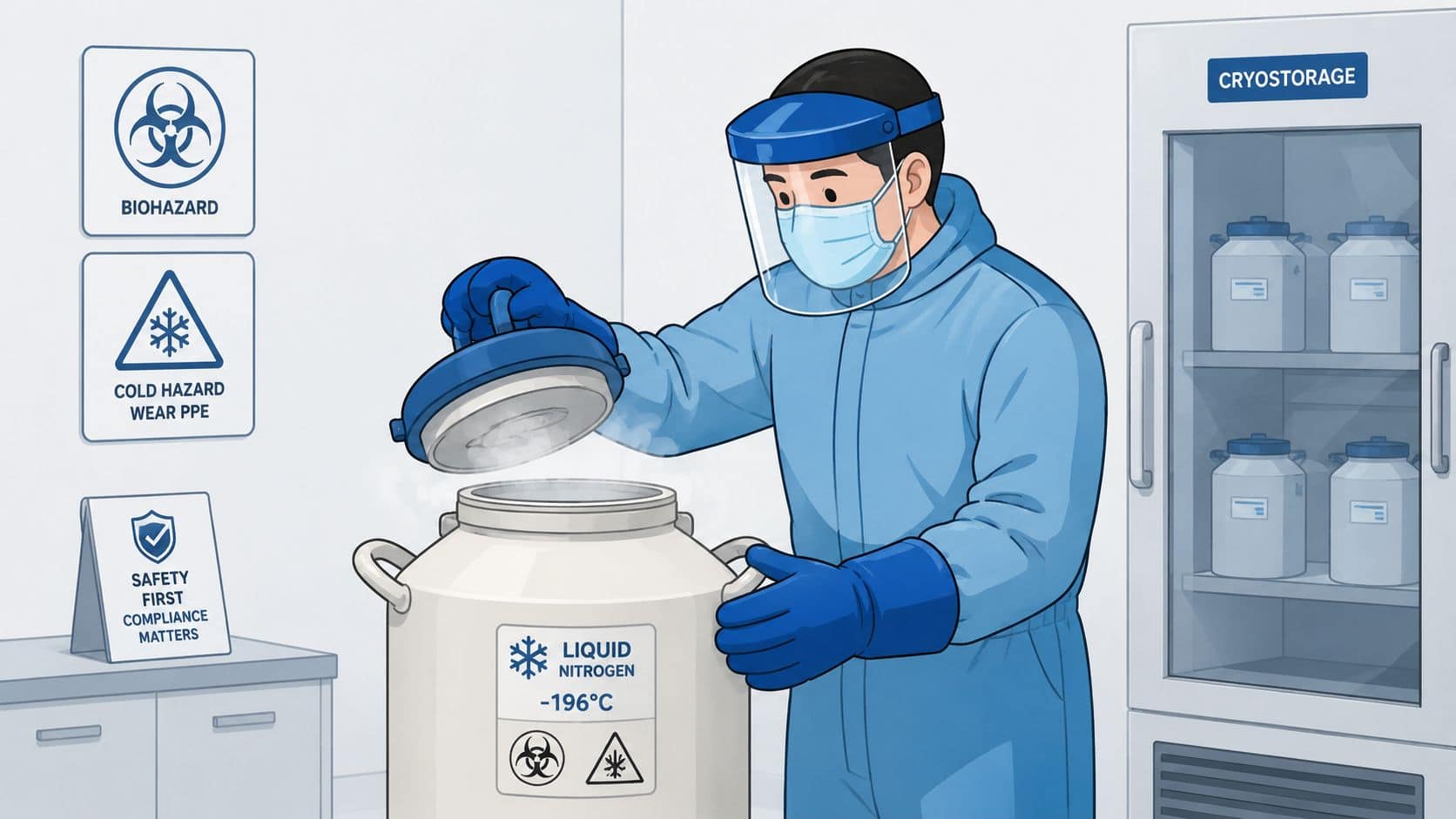
LN2 is a cost line, but it's also a hazard. Treat it like a routine consumable and you'll create a safety problem that can become a financial problem fast.
Storage needs ventilation and monitoring
Liquid nitrogen becomes a gas very quickly, and that gas displaces oxygen. The research background notes that oxygen deficiency monitoring is critical because LN2 has no warning signs like smell or colour, and oxygen levels below the safe threshold create serious risk. Clinics should use well-ventilated spaces, proper cryogenic containers, and oxygen monitoring where LN2 is stored or used.
The storage setup should be boring, reliable, and easy to inspect. Secure the vessel upright, keep it away from direct heat, and train staff to handle transfers without rushing. The more orderly the storage area, the less product you lose and the less likely you are to deal with an avoidable incident.
Safety spending is part of cost control
Good storage hardware isn't just a compliance item. Better insulation reduces boil-off, and less boil-off means lower monthly spend. That's why the cheapest vessel on day one can become the most expensive option over time.
A practical operational detail also matters. When liquid needs to move around a facility, use proper carts and transport equipment built for medical gas handling. For a useful example of that category, see the hospital cylinder cart options resource. The point is simple, safe movement protects staff and protects the inventory you've already paid for.
Your Liquid Nitrogen Procurement Checklist
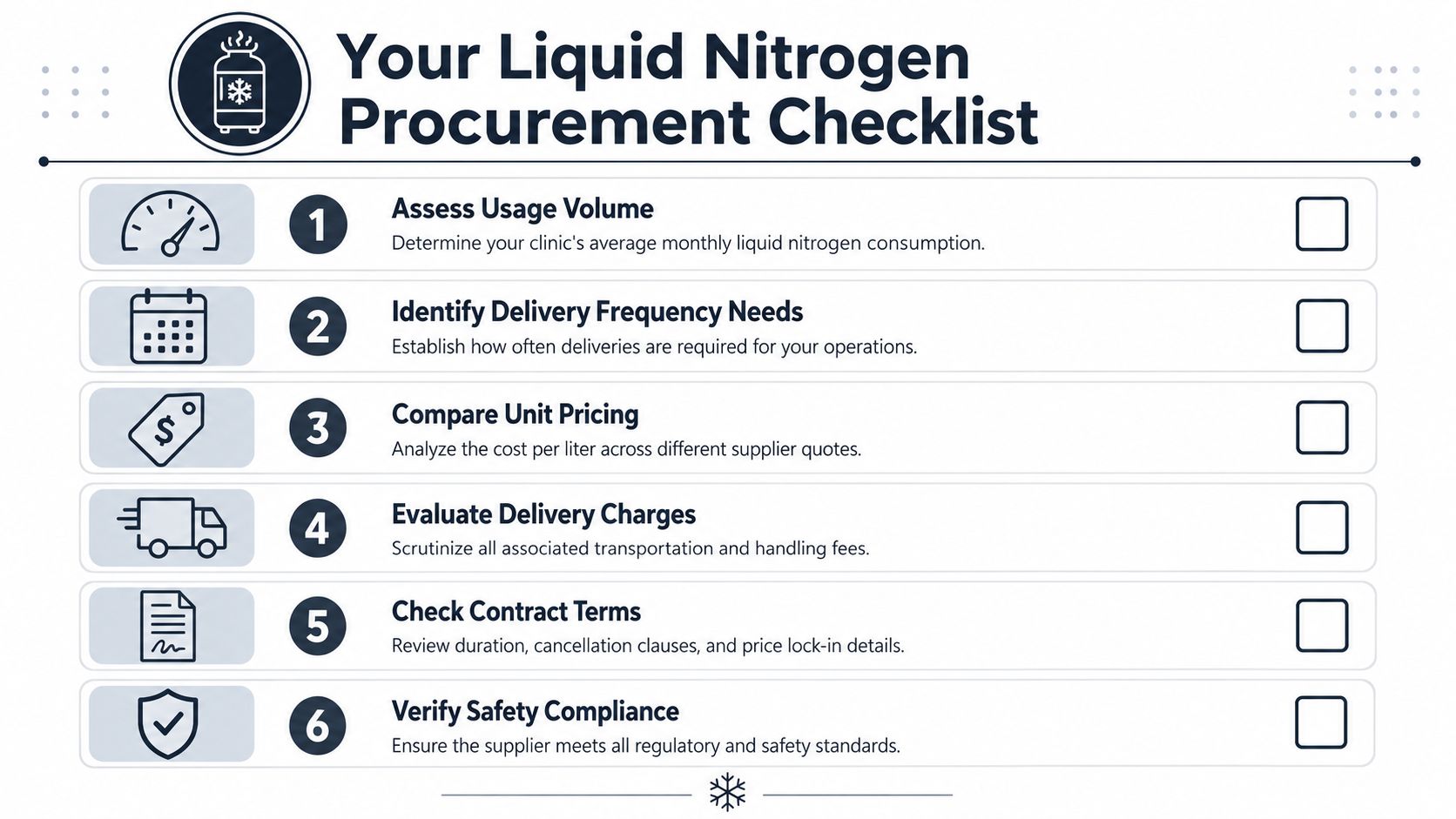
Good procurement starts with the right questions. If you can't answer them clearly, you're not ready to sign.
Use this checklist before you accept a quote
- Assess usage volume. Know how much LN2 the clinic consumes in a normal month.
- Identify delivery frequency needs. Match refill timing to real operations, not guesswork.
- Compare unit pricing. Check the cost per litre across quotes, but don't stop there.
- Evaluate delivery charges. Separate transport, handling, and any minimum order rules.
- Check contract terms. Review duration, cancellation terms, and price lock-in language.
- Verify safety compliance. Confirm the supplier's handling, storage, and delivery standards.
If you want cleaner stock control across recurring consumables, the same discipline applies to the rest of your clinic. Omega Lasers' inventory management guide fits neatly with this approach because buying well only works when inventory is tracked properly.
The habit that saves money is consistency. Review every quote on an all-in basis, challenge vague delivery language, and make suppliers explain the storage and refill assumptions behind their pricing. That's how you stop overpaying for nitrogen you never use.
If you want a more disciplined view of clinic operating costs, Omega Lasers can help you think beyond device pricing and into the supply and workflow choices that shape margin. Visit Omega Lasers to explore equipment, training, and clinic support built for practices that want tighter operations and better returns.