




A clinic owner can spend days comparing treatment modes, cooling systems and training packages, then reach the final decision with a quote open on the desk and a pen hovering over the signature line. The uncomfortable question isn't whether the laser can produce revenue. It's whether the clinic can recover the cash tied up in the purchase before utilisation, staffing, maintenance or financing costs turn the investment into a long-running drain.
Payback period calculations answer one narrow but important question: how long it takes for an investment to recover its original cost from net cash inflows. That makes payback a useful first screen for an aesthetic laser purchase, particularly where liquidity matters. It doesn't tell you whether the platform is the most profitable choice over its useful life, and it doesn't replace a full investment appraisal.
The practical approach is to calculate one payback figure, then challenge every input behind it. Treatment volume, pricing, consumables, therapist time, finance charges, maintenance, downtime and patient demand all deserve their own line. A defensible range is more useful than an impressive single number.
Table of Contents
- Why Payback Period Matters When Buying a Laser
- The Core Payback Period Formula and Shortcut
- Building the Revenue Side of the Calculation
- Accounting for Total Ownership Costs
- Sensitivity Scenarios and Worked Examples
- Where Payback Period Misleads and What to Use Instead
- Decision Checklist Before You Sign the Order
Why Payback Period Matters When Buying a Laser
A laser purchase can look safe when viewed through a monthly instalment, yet feel very different when expressed as the number of treatment months required to recover the full investment. That distinction matters to the owner funding the deposit, the practice manager responsible for cash flow and the finance partner assessing repayment risk.
In South African capital budgeting practice, payback has been used as a screening method for decades. Literature cited in a South African study records 63% of 48 companies using payback in Lambrechts' 1976 findings, followed later by 69% of 132 firms in Andrews and Butler's 1986 research, as reported in this South African payback calculation reference. Those historical figures don't prove that payback is sufficient. They show why the method remains familiar to local owners and finance teams.
Recovery time is not profit
Payback measures the point at which cumulative net cash inflows equal the initial outlay. If a machine costs R1.8 million, the calculation asks how many months of net treatment contribution are needed to recover R1.8 million. It doesn't measure the value of treatments delivered after that point, the cost of capital, tax, or the residual value of the equipment.
That narrow focus is also its strength. Owners often need a conservative liquidity check before debating longer-term returns. A platform that recovers capital quickly may reduce the period during which the clinic is exposed to weak demand, provided the forecast is credible.
Practical rule: Treat payback as a screening gate, not as permission to sign a quotation.
Why a single number creates false confidence
A supplier proposal may present a neat payback result based on assumed sessions, pricing and costs. The arithmetic can be correct while the forecast remains unrealistic. If the clinic can't fill the appointment book, the machine's technical capability won't rescue the cash model.
The rest of the calculation should therefore separate the purchase price from the revenue engine and the operating cost base. Build the formula, show the cash flows, then test what happens when bookings ramp slowly, a therapist leaves, consumables cost more or the machine sits idle during service.
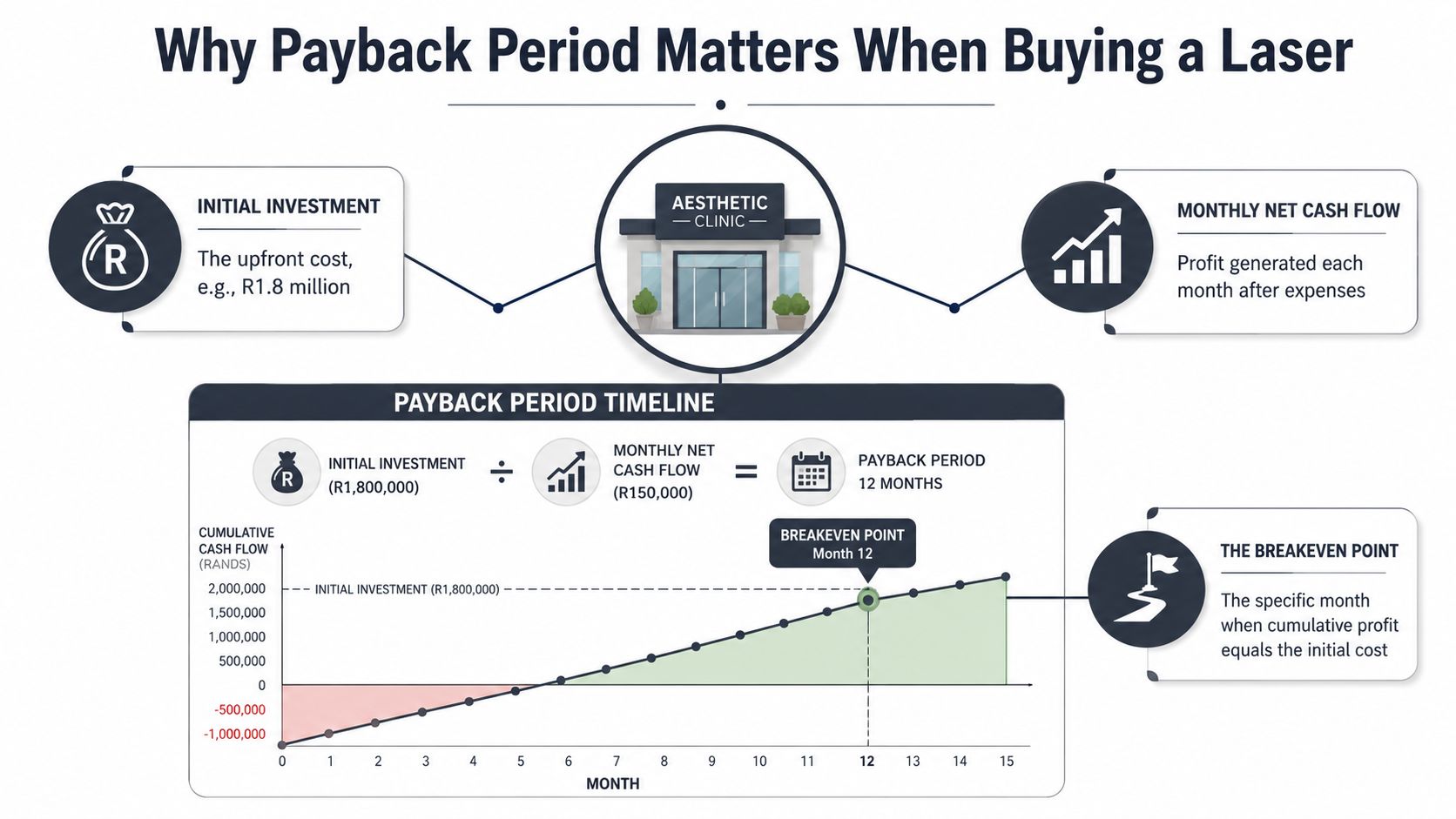
The Core Payback Period Formula and Shortcut
The basic formula is straightforward:
Payback period = total initial investment ÷ net annual cash inflow
Suppose an Omega diode platform has a total initial investment of R1.2 million, and the clinic forecasts net annual cash flow of R360,000 after directly attributable operating costs. The calculation is:
R1,200,000 ÷ R360,000 = 3.33 years
To express the fractional year in months, multiply 0.33 by 12, producing approximately four months. The estimated payback is therefore about three years and four months, subject to the forecast remaining stable.
The shortcut works only when annual net cash inflows are reasonably constant. South African capital budgeting guidance describes the same principle, using initial outlay divided by annual net cash flow where inflows are constant, while recommending cumulative cash flows and interpolation where they vary, as explained in this investment appraisal reference.
Uneven cash flows need cumulative tracking
Clinics rarely start at mature utilisation. A new platform may have a slower first year, stronger demand after marketing and referral activity, then interruptions caused by staff changes or servicing. In that situation, add each year's net cash flow to the running balance until the initial investment is recovered.
| Year | Net Cash Flow (R) | Constant Method | Cumulative (R) | Cumulative Method |
|---|---|---|---|---|
| 1 | 180,000 | 1.00 | -1,020,000 | Not recovered |
| 2 | 240,000 | 2.00 | -780,000 | Not recovered |
| 3 | 300,000 | 3.00 | -480,000 | Not recovered |
| 4 | 380,000 | 4.00 | -100,000 | Not recovered |
| 5 | 420,000 | 5.00 | 320,000 | Recovered during Year 5 |
The unrecovered balance at the end of Year 4 is R100,000. Divide that by the Year 5 cash flow of R420,000, giving about 0.24 of a year, or roughly three months. The uneven-cash-flow payback is therefore approximately 4.24 years, not the headline result produced by averaging the series.
Read the proposal carefully
Both methods may appear on equipment schedules or finance proposals because each answers a different forecasting problem. The constant method is quick and transparent. The cumulative method is more appropriate when a clinic expects a ramp-up, seasonal demand or uneven service interruptions.
Building the Revenue Side of the Calculation
Revenue assumptions usually move the payback result more aggressively than small changes to the purchase price. A clinic can negotiate a modest discount once, but it can lose months of recovery time if its treatment diary runs below forecast for a sustained period.
For a diode hair-removal platform, start with the treatment menu. A South African clinic may charge R800 to R1,500 per session for small areas, with full-leg treatment reaching up to R3,500, according to this regional diode laser ROI illustration. Those prices shouldn't be copied into a forecast without checking the clinic's location, positioning, treatment duration and local demand.
Build the model from appointments
The first calculation is gross treatment revenue:
Treatments per week × treatment price × operating weeks = annual treatment revenue
Then remove the costs that increase when treatment volume increases. These may include therapist time, consumables per session, payment costs, treatment-room allocation and the marketing spend required to keep the diary active. Depreciation doesn't belong in a cash payback calculation because it isn't a cash outflow, as explained in this cash-flow treatment guide.
Use a booking forecast rather than a hopeful capacity figure. A new aesthetic laser may run at 8 to 15 treatments per week in its first year, with utilisation potentially rising to 20 or more treatments per week once the patient base develops, as outlined in the regional commercial laser guidance linked above. Treat these as planning assumptions to test, not guaranteed outcomes.
| Line Item | Conservative | Base Case | Optimistic |
|---|---|---|---|
| Treatments per week | 8 | 15 | 20+ |
| Average treatment price | R800 | R1,200 | R1,500 |
| Operating weeks | Clinic assumption | Clinic assumption | Clinic assumption |
| Gross treatment revenue | Formula input | Formula input | Formula input |
| Therapist and room cost | Higher allowance | Normal allowance | Lower per-treatment allocation |
| Consumables | Verified supplier cost | Verified supplier cost | Verified supplier cost |
| Marketing allowance | Higher during ramp-up | Planned allowance | Lower after demand builds |
| Net contribution | Gross revenue less listed costs | Gross revenue less listed costs | Gross revenue less listed costs |
Avoid mixing revenue with cash contribution
A R1,200 booking isn't R1,200 available for repayment. The clinic must calculate the contribution left after direct delivery costs. If a treatment requires more therapist time than expected, the opportunity cost of that appointment can materially reduce the amount available to recover the machine.
The cleanest spreadsheet has one row for each assumption and allows the owner to change treatment price, sessions and cost per session independently. That makes it obvious whether the payback depends on premium pricing, high volume or unusually low operating costs.
Accounting for Total Ownership Costs
A clinic can buy an Omega Diode 808 for R650,000 and still underestimate the cash required to reach payback. Financing may add a deposit, interest, a residual or balloon amount, insurance, installation and training. The repayment structure changes the monthly cash burden even when the equipment price remains unchanged.
Use the specified South African planning case of R110,000 in first-year financing charges. Include that amount as a first-year cash outflow, rather than burying it inside a payback calculation based on gross treatment revenue. For a wider view of financing and ownership costs, review these hyperbaric ROI and financing insights.
Separate fixed and variable costs
Fixed costs continue whether the machine delivers one treatment or fills the diary. Variable costs increase with each appointment. Maintenance can contain both elements, depending on the contract and usage terms.
| Cost Category | Annual Amount (ZAR) | Payback Impact |
|---|---|---|
| Financing charges | R110,000 in the specified first-year scenario | Reduces cash available for recovery |
| Consumables | Verify from the supplier and treatment protocol | Increases with each session |
| Scheduled maintenance | Quote-specific | Creates a fixed or planned annual outflow |
| Insurance | Quote-specific | Adds to the fixed operating base |
| Training time | Quote-specific | Reduces productive clinic hours during onboarding |
| Installation downtime | Quote-specific | Removes available treatment capacity |
| Handpiece or component replacement | Contract-specific | Can create a material irregular cash outflow |
The brief's cost scenario places consumables and scheduled maintenance at 15% to 20% of true annual cost. Model that exposure as a range, not a token allowance. It can shift payback by months, especially when bookings are close to the clinic's minimum viable level.
Build the spreadsheet so each assumption can change independently. Treatment volume, consumable cost, financing, maintenance and downtime should each have their own input. That setup shows whether a purchase depends on sustained utilisation or survives a weaker ramp-up.
Read the warranty as an operating document
A warranty may cover defined faults while excluding wear items, misuse, consumables or damage linked to operating conditions. Confirm responsibility for travel, labour, replacement components and downtime during a covered issue. A short service response protects revenue, whereas unclear warranty exclusions can leave the owner funding urgent repairs independently.
Ask for written answers before signing:
- Which components are covered?
- Which parts count as wear items?
- Who pays labour and travel?
- What happens to scheduled treatments during repair?
- Does usage affect maintenance or warranty terms?
These answers belong in the ownership model. The total cost of ownership framework provides a useful structure for assigning each item to fixed cost, variable cost, financing or operational risk. A quote that looks affordable on equipment price alone may produce a much longer payback once those cash demands and capacity losses are included.
Sensitivity Scenarios and Worked Examples
A payback forecast should survive unfavourable assumptions. Start with the revenue model, duplicate it into best, base and worst cases, then change only the inputs that management can explain. A scenario isn't a prediction. It's a controlled way to show how utilisation, pricing, delivery costs and interruptions affect the recovery period.
The requested base case uses 35% utilisation and an R850 treatment price, with normal consumables. The best case assumes high utilisation, no downtime and stronger pricing. The worst case assumes a slow ramp-up, two technician changes and warranty exclusions that create additional exposure.
| Scenario | Treatments / Month | Net Contribution / Month | Payback (Months) |
|---|---|---|---|
| Best case | High utilisation assumption | High contribution after direct costs | Roughly 14 |
| Base case | Volume derived from 35% utilisation | Based on R850 treatment price and normal consumables | Calculate from the quote |
| Worst case | Slow ramp-up | Reduced by staff disruption and excluded costs | Over 40 |
The best-case and worst-case boundaries in this grid are planning ranges, not guaranteed market outcomes. The base case should be built from signed-off bookings, historical room utilisation and prices the clinic can defend locally. If the base case only works when every appointment is charged at the top of the menu, it's already too optimistic.
Test a different platform logic
A higher-ticket Q-switched or fractional platform can produce a different cash pattern from diode hair removal. The treatment price may be higher, but so may consumables, practitioner time, consultation requirements and patient acquisition effort. The formula doesn't change. The inputs do.
For that model, create separate rows for average price, sessions per month, consumable cost, practitioner contribution, downtime and maintenance. Don't transfer a diode platform's utilisation assumption into a resurfacing model just because both are lasers. The clinical pathway, repeat cadence and patient decision process can produce very different booking behaviour.
Create a reusable template
A practical worksheet should include:
- Investment: purchase price, delivery, installation, training and financing charges.
- Volume: treatments by month, with a ramp-up rather than a flat line.
- Price: average realised price after packages, promotions and discounts.
- Contribution: treatment revenue less therapist time, consumables and variable marketing.
- Interruptions: planned servicing, installation downtime and staff changes.
- Output: monthly net cash flow, cumulative recovery and the first month in which the balance reaches zero.
Use the laser break-even analysis resource to structure the worksheet, then run the result with assumptions that the owner, clinical lead and finance partner have each approved.
Where Payback Period Misleads and What to Use Instead
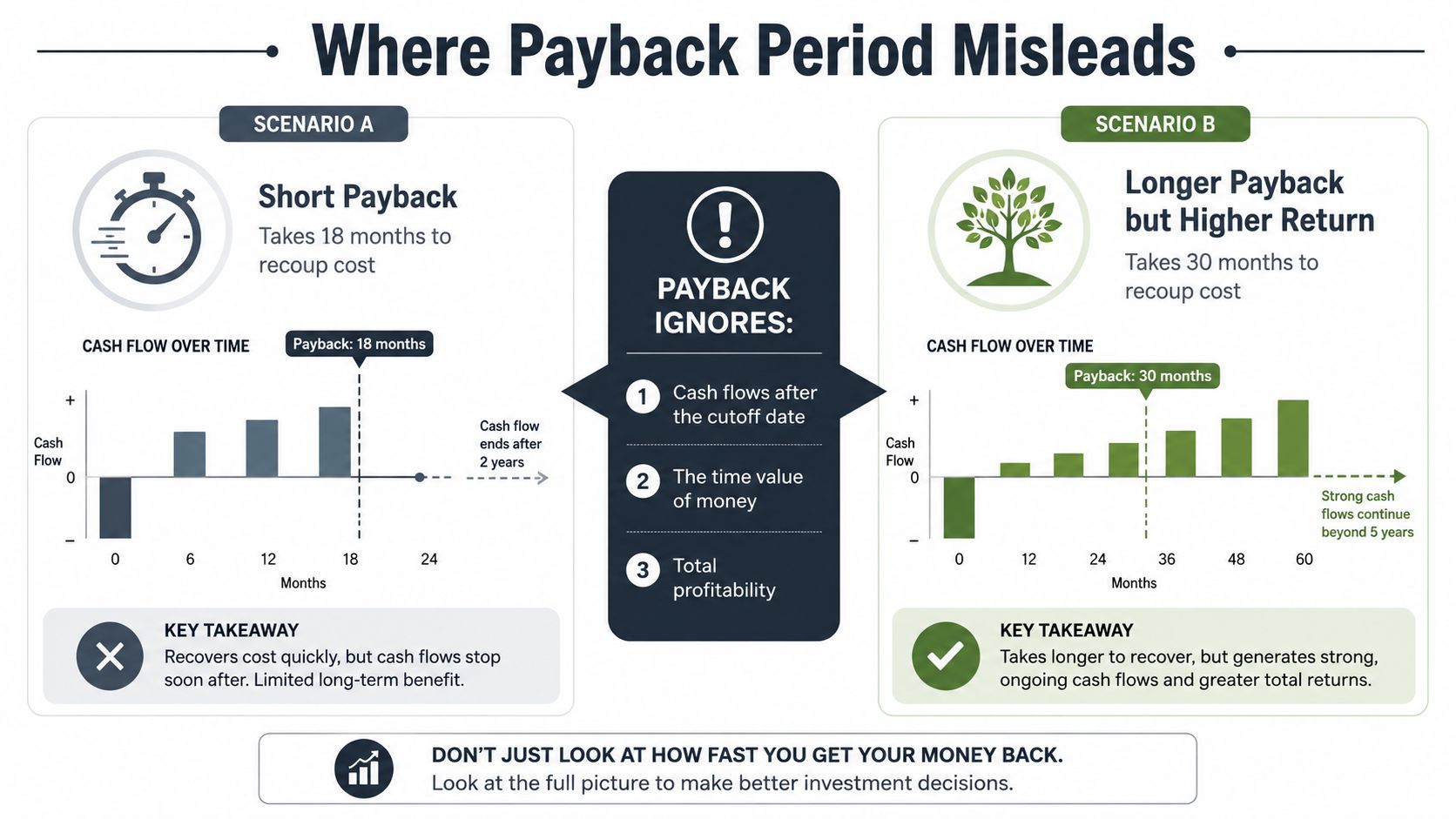
A short payback doesn't automatically make a laser a good investment. Simple payback ignores the time value of money, excludes cash flows after the recovery point and can favour a project that produces early cash but weak long-term value. South African finance teaching materials specifically warn that the method omits both discounted value and post-payback cash flows, and that an acceptable payback threshold is generally an internal policy choice rather than an economically grounded rule, as discussed in this capital budgeting source.
Consider two platforms that both recover their initial cost in 24 months. One may produce R2.1 million over five years, while the other produces R4 million over five years, as a worked comparison. Payback treats them as equal at the point of recovery. The owner shouldn't.
Add three decision tests
ROI measures return relative to the investment over a defined period. It helps compare total profitability, although the calculation must state whether it uses accounting profit or cash contribution.
NPV discounts future cash flows and subtracts the initial investment. A South African clinic may test a 12% to 15% discount rate when reflecting its capital costs, financing conditions and opportunity cost, but the chosen rate should be documented rather than inserted casually.
Demand sanity checking asks whether the forecast volume fits the catchment, current referrals, treatment-room hours, therapist availability and local price sensitivity. A spreadsheet can calculate any volume. It can't create patients.
A payback result is only as credible as the diary behind it.
Use the return on investment calculation guide alongside payback. The sensible order is to use payback as a liquidity filter, then approve the purchase only when ROI, NPV, operational capacity and downside exposure also make sense.
Decision Checklist Before You Sign the Order
The final review happens when the purchase order is ready. That moment rewards discipline, not enthusiasm. A laser can become a productive treatment asset, but only if the clinic has tested the commercial assumptions and understands the cash obligations after delivery.
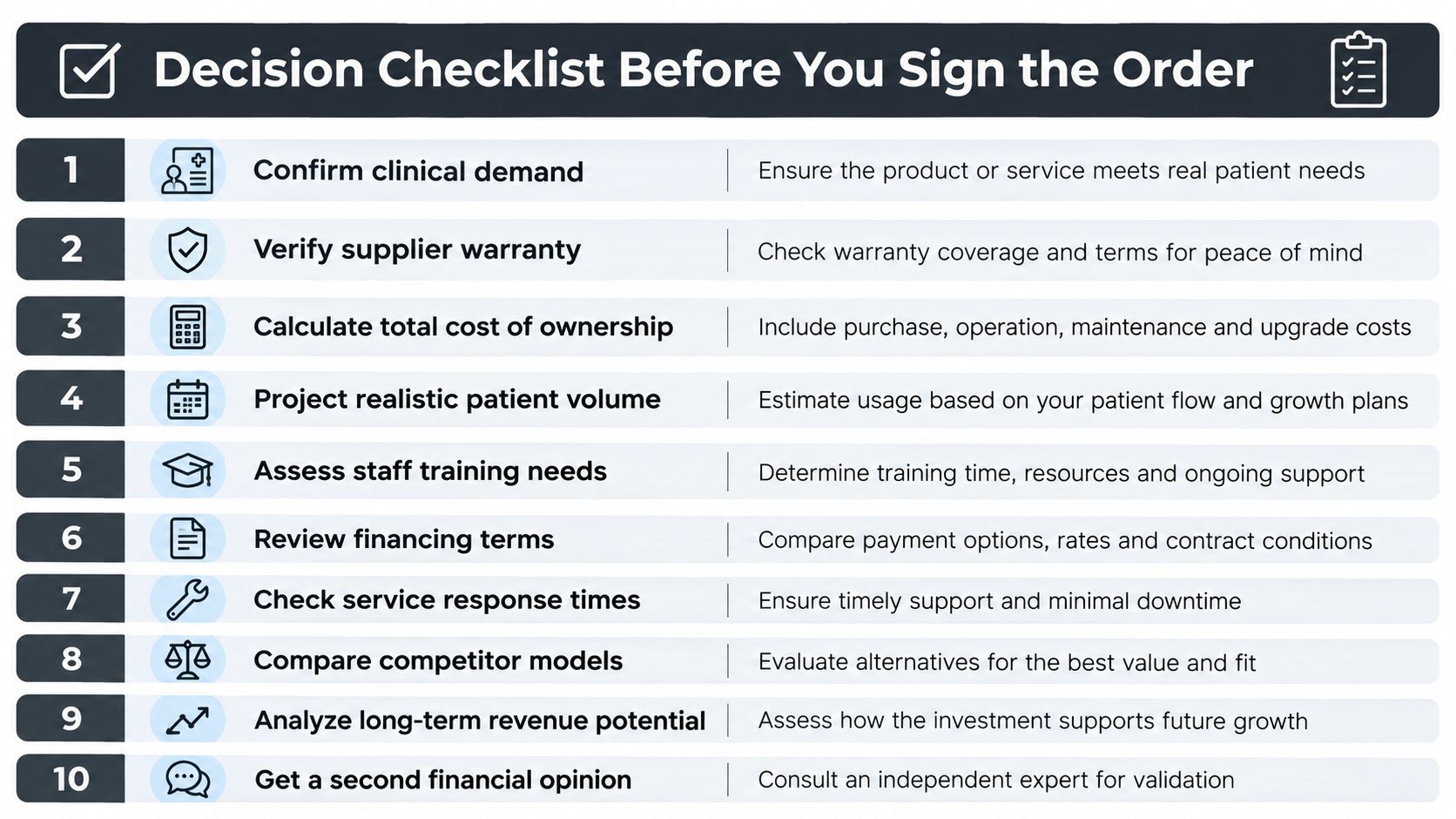
Use this ten-point sign-off:
- Demand: Confirm clinical demand with a signed-off booking forecast.
- Pricing: Check realised treatment pricing against three local competitors.
- Total cost: Include consumables, maintenance, insurance, finance charges, training and downtime.
- Volume: Project realistic patient numbers by month, including the ramp-up period.
- Training: Cost therapist training time and schedule it without pretending those hours are free.
- Finance: Review the deposit, interest, repayment schedule and residual or balloon amount.
- Service: Confirm response times, escalation routes and the practical effect of downtime.
- Warranty: Map exclusions against expected treatment hours, wear items and replacement parts.
- Strategy: Confirm an exit, resale, replacement or upgrade path.
- Approval: Obtain written go or no-go sign-off from the owner and finance partner.
Make the checklist auditable
Put the ten points on one page. Add the quote reference, model, date, assumptions, responsible person and final decision. Attach the booking forecast and the best, base and worst-case calculations. If an assumption changes, date the revision rather than overwriting the original.
The owner-defined maximum payback should be explicit. South African franchise and investment guidance often uses three to five years as a rough benchmark, while local commentary places an ideal ROI period closer to three to four years after drawing a market-related salary, as outlined in this South African franchise ROI discussion. Those figures are reference points, not universal approval rules. A clinic may choose a tighter limit because its debt capacity or cash reserves are constrained.
This isn't bureaucracy. It's the barrier between a calculated payback and a regret. Complete the page, photocopy it for future acquisitions, and date-stamp the version used for each purchase.
Omega Lasers supplies medical-aesthetic platforms and supports clinics with device training, technical assistance, marketing support, business development guidance and after-sales service. Build your own payback range from a fully loaded quote, then visit Omega Lasers to discuss the platform, financing and operational support that fit your clinic's numbers.