



You’re probably weighing the same question most clinic owners eventually face. Do you add another facial device, or do you invest in a treatment category that can book repeat visits, attract a broader client base, and become part of the clinic’s core revenue?
For many South African practices, hair removal laser machines sit in that second category. They aren’t impulse purchases. They shape who you can treat, how safely you can treat them, how fast your team can work, and how confidently you can market the service.
The South African market context matters. Generic buying guides written for the US or Europe often assume lighter skin populations, different regulatory standards, and a very different operating environment. Here, device choice has to reflect diverse Fitzpatrick skin types, SAHPRA compliance, treatment speed, support, and downtime risk. A machine that looks good on a brochure can become a poor business decision if it struggles on darker skin, slows your diary, or creates compliance exposure.
The Modern Clinic’s Guide to Investing in Laser Hair Removal
A clinic owner in Johannesburg or Cape Town usually reaches this decision after a familiar month. The diary is full of injectables and facials, retail sales are steady, but revenue still depends too heavily on short-cycle services. Then clients start asking the same question at consults: do you offer laser hair removal?
That question matters because laser hair removal can become a repeat-treatment service line with predictable demand, provided the machine fits your market. In South Africa, that means more than buying a popular platform or chasing a low import price. It means choosing a system that can treat a broad mix of skin types safely, hold up under daily use, and meet local compliance requirements.
If your team needs a plain-language refresher before comparing platforms, this overview of how laser hair removal works in clinical practice is a useful starting point.
Why this category changes a clinic’s economics
Hair removal behaves differently from many aesthetic treatments because it is rarely a once-off purchase from the client. A well-run service usually includes consultation, patch testing where appropriate, a course of sessions, and occasional maintenance. That creates recurring bookings and gives the front desk something every clinic values: future appointments already linked to today’s treatment.
The commercial upside is straightforward, but only if throughput and outcomes are good enough. A slow machine can turn a high-demand service into an operational bottleneck. An underpowered machine can fill the book for three months and still damage retention if results are inconsistent. Good economics in this category come from the combination of treatment speed, safe parameters, low consumable burden, and client confidence.
A profitable platform should help you build:
- Repeat treatment revenue: Clients usually commit to a series rather than a single visit.
- Better retention: Clients who return every few weeks are easier to keep engaged with the clinic.
- Cross-referral into other services: Hair removal clients often ask about pigmentation, vascular work, acne, or rejuvenation once trust is established.
- Stronger use of staff time: Fast, predictable protocols make delegation and scheduling easier.
The South African lens matters
South African clinics cannot rely on buying advice written for lighter-skinned populations and assume it will translate cleanly into local practice. In many clinics, a large share of patients sit in Fitzpatrick IV to VI. That changes wavelength choice, cooling expectations, test patch discipline, operator training, and risk management.
Regulation also matters more than many buyers expect. A machine is more than a cosmetic purchase. It is a medical-aesthetic device that has to be evaluated in terms of safety, documentation, service support, and whether its regulatory position in South Africa is clear enough to protect the business.
Before approving any quote, ask three practical questions:
| Business question | What the machine must prove |
|---|---|
| Can it treat the clients who already come to my clinic? | Safe and effective performance across your actual skin-type mix, especially darker skin types |
| Can it keep pace with the appointment book? | Practical spot size, repetition rate, cooling, and workflow that support real clinic throughput |
| Can I operate it with confidence? | Clear South African regulatory documentation, training, service backup, and traceable support |
A brochure can hide poor fit. Daily use exposes it quickly.
The clinics that buy well usually reverse the wrong decision sequence. They do not start with price. They start with patient profile, operator skill, compliance exposure, maintenance support, and revenue per treatment hour. Price only makes sense after that.
How Laser Hair Removal Actually Works
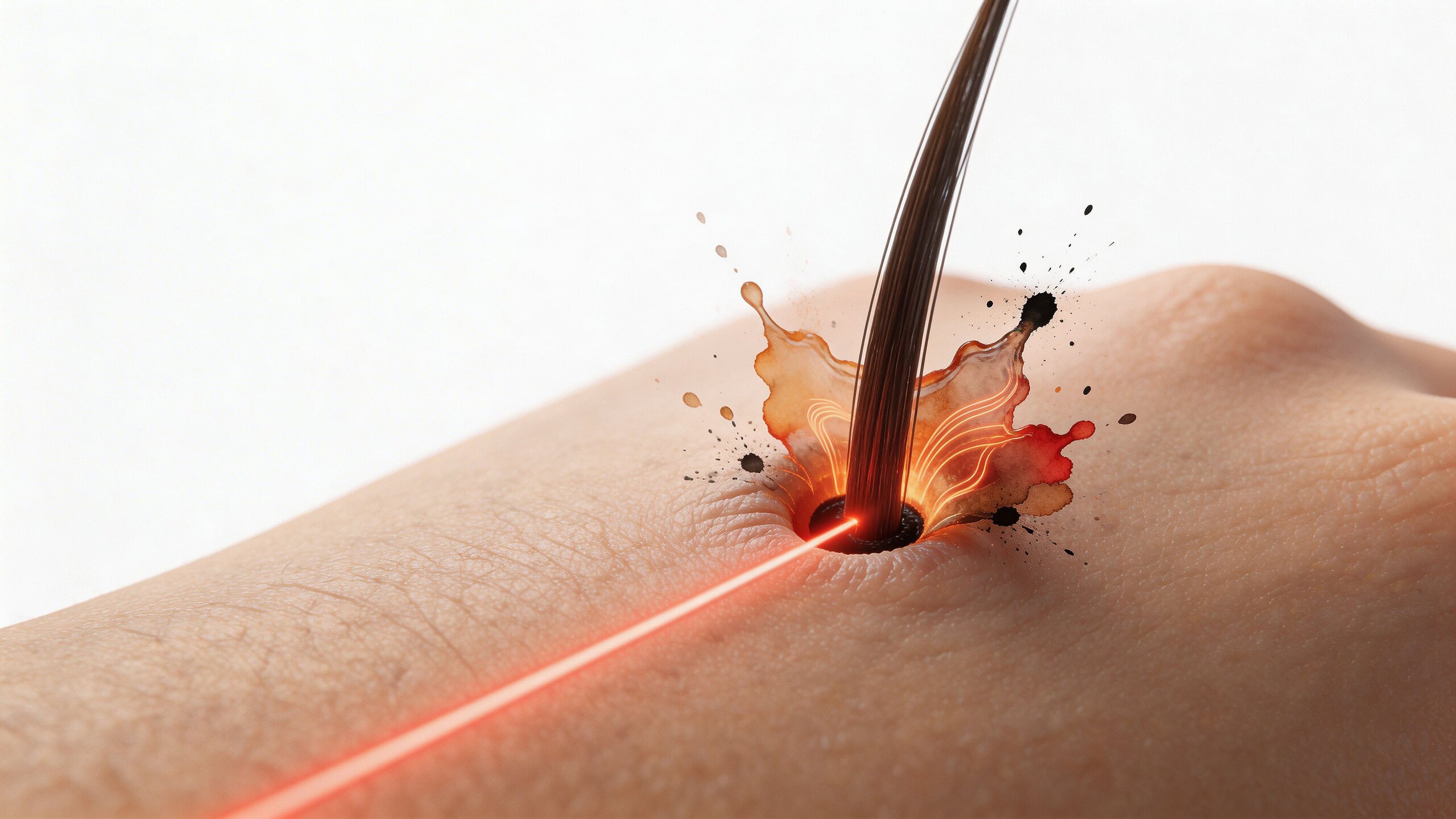
Laser hair removal works because the machine targets melanin in the hair shaft and follicle. Light energy is absorbed, converted to heat, and delivered where you want the damage to happen. The goal isn’t to heat the whole skin surface. The goal is to heat the follicle selectively enough to disrupt regrowth while keeping surrounding tissue protected.
A useful way to explain it to staff is this. The laser acts like a colour-seeking heat delivery system. It looks for pigment in the hair, not for the skin around it.
If you want a plain-language overview of treatment mechanics, this explanation of how laser hair removal works is a useful starting point for clinic teams.
Why timing matters as much as power
A common buying mistake is to focus only on wattage or energy output. Power matters, but timing matters just as much.
The follicle has a thermal relaxation time (TRT) of 40–100 ms, and effective treatment depends on damaging the follicle within a controlled thermal window while protecting the epidermis. The same technical guidance notes a thermal damage time (TDT) of 10–30 ms, with sapphire contact cooling at 0–5°C used to protect the skin while 20–30 J/cm² fluence disables the follicle, achieving up to 90% hair reduction according to Nubway’s technical guide.
In practical terms, think of TRT and TDT as cooking control. Too little heat, and nothing useful happens. Too much heat in the wrong place, and you scorch the surface before the target underneath is properly treated.
Cooling isn’t a comfort extra
Cooling is often marketed as a comfort feature. In clinic reality, it is a safety and consistency feature first.
A machine with proper contact cooling lets the operator work with confidence because the epidermis is being protected while follicular heating takes place. That matters especially when treating darker skin, where excess epidermal heating creates unnecessary risk.
Three things have to work together:
- Wavelength choice: Determines how the light behaves in skin and how strongly melanin absorbs it.
- Pulse duration: Controls how long the tissue is exposed to energy.
- Cooling system: Protects the skin surface so treatment stays tolerable and safer.
The machine doesn’t create good outcomes on its own. Good outcomes happen when wavelength, pulse duration, fluence, and cooling are matched correctly to skin and hair.
Why professional systems outperform consumer devices
At-home devices usually rely on lower-energy light-based approaches and broad safety limits. Professional laser systems give the practitioner more control over settings and delivery.
That control is the difference between a treatment that merely warms the area and one that creates clinically meaningful follicular damage. It’s also why operator training matters so much. A high-grade platform in untrained hands can still be poorly used. A trained operator with a capable machine can produce repeatable, defensible results.
Choosing the Right Wavelength for Your Clientele
Selecting the optimal laser wavelength is essential for maximizing efficacy and ensuring client safety across diverse skin and hair types.
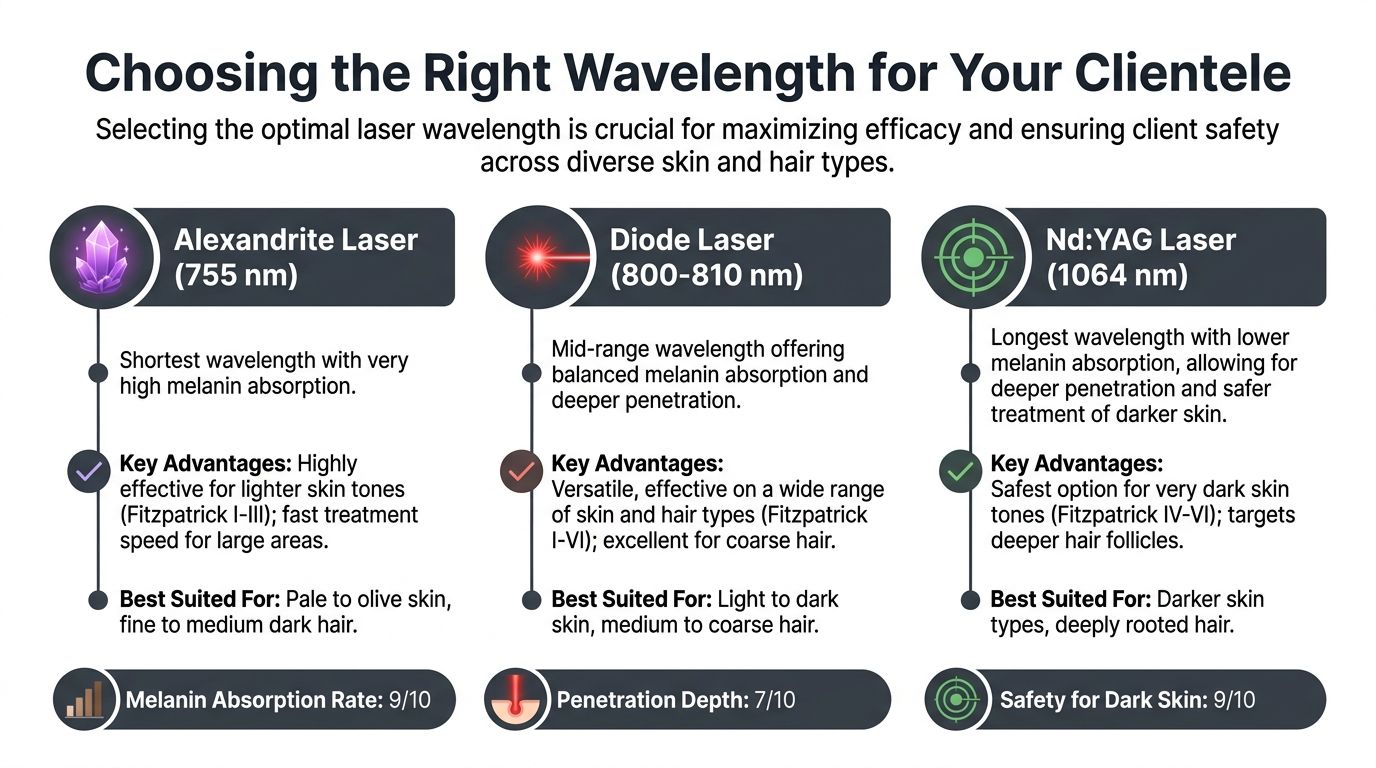
If you only remember one technical point from this guide, make it this one. Wavelength choice determines who you can treat well. In South Africa, that isn’t a minor technical detail. It defines the size of your addressable market.
A helpful reference when comparing light-based options is this overview of IPL and laser hair removal. The key clinic decision, though, usually sits inside professional laser categories rather than consumer-style comparisons.
What each wavelength actually does in practice
No wavelength is universally perfect. Each has strengths, limits, and a clinical context.
Alexandrite
755 nm Alexandrite is known for strong melanin absorption. That makes it effective, but also means it requires care on darker skin tones.
Clinically, it’s often attractive for lighter skin and finer to medium dark hair because it targets pigment aggressively. The trade-off is reduced margin for error where epidermal melanin is higher.
Diode
810 nm diode sits in the middle and is often treated as the clinic workhorse. It offers a balance between melanin absorption and penetration depth.
That balance is why diode systems are widely used across varied treatment areas and hair types. For many clinics, diode remains the practical centre of the service menu because it can handle a broad day-to-day caseload.
Nd:YAG
1064 nm Nd:YAG penetrates deeper and has lower melanin absorption in the epidermis. That’s why it’s widely considered the safer option for darker skin types.
In a South African setting, that matters immediately. A machine that can’t treat deeper phototypes with confidence limits your bookings, your referrals, and your reputation.
Single wavelength versus multi-wavelength systems
Consequently, many buying decisions become either smart or expensive. A single-wavelength machine can perform very well in a narrower lane. A multi-wavelength platform can widen that lane substantially.
In South Africa, where 78% of the population has Fitzpatrick skin types IV-VI, four-wavelength systems (755/808/940/1064nm) have been shown to outperform dual-wavelength lasers by 50% in coarse African hair reduction, and standard lasers can have a 30% failure rate on tanned or keratin-rich hair compared with 8% for multi-wave platforms, according to Women’s Health’s cited market summary.
That changes the buying logic. A machine that performs acceptably on some clients but struggles on coarse, firmly rooted, or heavily keratinised hair may still look affordable on day one. Over time, it can cost you in refunds, incomplete courses, poor word of mouth, and underused appointment slots.
Here is the simplest comparison.
| Wavelength | Laser Type | Primary Target | Best for Fitzpatrick Skin Types | Key Advantage |
|---|---|---|---|---|
| 755 nm | Alexandrite | High melanin absorption in hair | Generally lighter skin types | Fast, efficient pigment targeting |
| 810 nm | Diode | Balanced follicle targeting | Broad clinical range | Versatility across many routine cases |
| 1064 nm | Nd:YAG | Deeper follicle targeting with lower epidermal melanin absorption | Darker skin types | Safer profile on pigmented skin |
| 755/808/940/1064 nm | Multi-wavelength platform | Mixed hair depth and skin tone demands | Broadest practical range | Greater flexibility for diverse caseloads |
What works in South African clinics
In a mixed-population market, versatility is revenue protection. A clinic that treats lighter, medium, and darker skin confidently can market more openly, convert more consultations, and reduce the number of clients turned away because the device is the wrong fit.
A platform such as Omega Lasers’ Tetra Cool, which uses four wavelengths, fits a practical clinic model. The relevance isn’t branding. It’s that a four-wavelength setup matches the reality of treating different skin tones and different hair structures in one diary.
Don’t judge a wavelength by how it performs on an ideal candidate. Judge it by how it performs across the people your reception desk actually books.
What does not work well
Some patterns show up repeatedly in underperforming clinics:
- Buying only for lighter skin protocols: This narrows your market in a country that demands broader capability.
- Assuming diode alone solves every case equally well: Diode is strong, but not every hair and skin combination behaves the same.
- Treating wavelength as a marketing term: It’s a treatment decision, not a sales line.
- Ignoring coarse African hair behaviour: Machines that look competent elsewhere may underperform where hair structure is denser or more resistant.
When clinic owners ask which wavelength is “best”, the better question is, best for whom? In South Africa, the safest answer is usually the platform that gives you the widest safe treatment range.
Navigating Safety and Regulatory Requirements in South Africa
A device can be technically capable and still be the wrong purchase if it creates legal exposure. That’s the part many overseas buying guides miss.
In South Africa, SAHPRA licensing is not paperwork to sort out later. It sits at the centre of lawful operation, risk control, and patient trust. FDA and CE approvals may indicate broader manufacturing and safety standards, but they don’t replace local requirements.
Why SAHPRA changes the buying decision
As of 2025, only an estimated 20% of imported aesthetic lasers in South Africa were fully SAHPRA licensed. The same compliance summary states that using non-compliant devices carries risks of fines up to R100,000 and 6-12 month import delays, while compliant clinics report 25% higher client retention due to trust in regulated safety, according to the SA-focused compliance overview published here.
That creates a sharp divide between a cheap machine and a sensible machine.
A non-compliant device can cause problems long before treatment begins:
- Import friction: Delays can stall launch plans and cash-flow assumptions.
- Operational risk: If the device’s status is challenged, your service line can stop abruptly.
- Insurance and liability concerns: Regulatory gaps complicate how you defend your clinic if something goes wrong.
- Trust damage: Clients may not know every technical detail, but they do respond to visible professionalism.
Compliance is part of your brand
Clients usually don’t walk in asking to inspect a licensing file. They do, however, judge whether your clinic feels credible, medical, organised, and safe.
That perception comes from details:
| Compliance area | Why it matters to the clinic |
|---|---|
| SAHPRA licensing | Supports lawful local operation |
| Documented training | Shows that staff are competent, not guessing |
| Treatment protocols | Reduces inconsistency between operators |
| Service support | Helps maintain uptime and safe function |
A regulated device doesn’t guarantee good treatment. But a non-regulated device can undermine good treatment before you even start.
What to ask the supplier before signing
A serious supplier should answer direct compliance questions clearly.
Ask for:
- Proof of SAHPRA licensing
- The exact device model listed for South Africa
- Training scope for operators
- Local service and technical support arrangements
- Written warranty terms
- Any documentation required for inspections or audits
If the answers are vague, delayed, or framed around foreign approvals only, pause the deal. In this category, uncertainty is a warning sign.
Optimising Your Clinic for High Throughput and Client Comfort
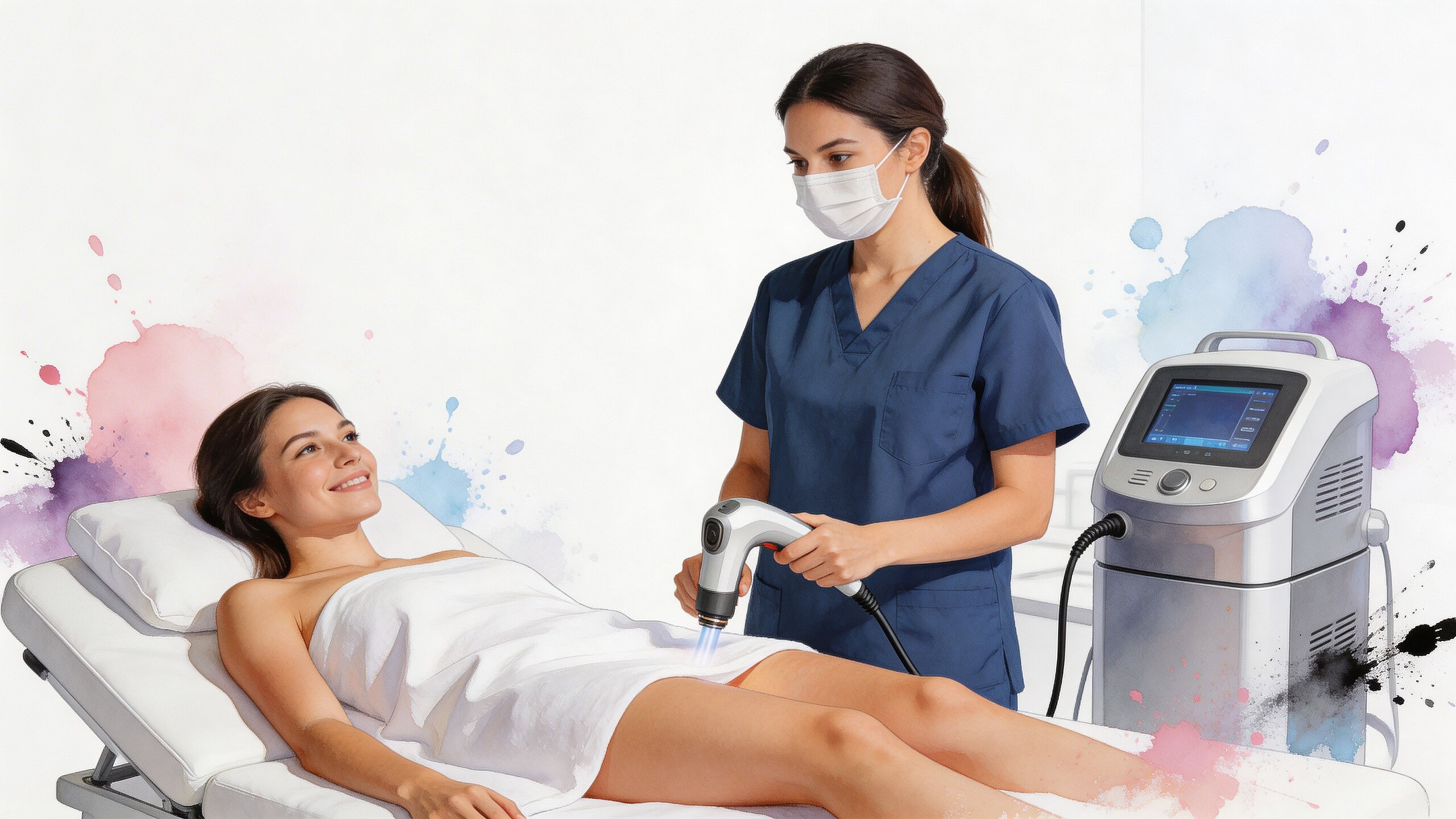
A laser only becomes profitable when it works under normal clinic pressure. That means back-to-back bookings, different treatment areas, varying pain tolerance, different operators, and no appetite for frequent downtime.
The machine might look excellent in a demo room. What matters is whether it still performs at 10:30 on a busy Saturday when you’re running late and moving from underarms to full legs to bikini.
Speed affects profitability more than most owners expect
Treatment speed doesn’t just change convenience. It affects your room utilisation, staffing pressure, and how many sessions fit into a day.
According to Liton Laser’s equipment analysis, professional machines with SHR modes operating at 10 Hz can cut treatment times for large areas by 40%, boosting daily treatment capacity from 8 to 15. The same analysis reports that crystal freeze contact cooling maintains skin at 5–10°C, reducing pain by 70% and contributing to 90% client retention rates due to enhanced comfort.
That makes two operational points very clear. First, speed raises capacity. Second, comfort helps keep the diary full.
Features that matter in day-to-day use
Not every technical feature has equal business value. These ones usually do.
- Large spot sizes: These reduce time on big zones like legs and backs.
- Stable repetition rates: Fast delivery is useful only if the handpiece stays consistent.
- Reliable cooling: Comfort improves compliance, especially on sensitive areas.
- Preset protocols: These help less experienced operators work more consistently.
- Memory functions: Useful in repeat-visit treatment plans where consistency matters.
What good workflow looks like
The most efficient clinics don’t rely on a powerful machine alone. They build a treatment system around it.
Start with consultation discipline
A quick but proper consultation reduces errors later. Skin type, recent sun exposure, hair thickness, medication history, and treatment goals all affect settings and timing.
Match handpiece and area correctly
Large areas should not be treated with a tiny handpiece unless there’s no other option. That slows the session, tires the operator, and reduces daily capacity.
Standardise aftercare language
Clients who understand heat response, shaving intervals, and expected shedding are easier to manage and less likely to panic over normal treatment responses.
Smooth workflow comes from small repeated decisions. Correct room setup, clear consent, clean protocols, and a machine that doesn’t fight the operator.
What to avoid
A few mistakes erode margins:
- Buying a slow machine because it was cheaper upfront
- Underestimating operator fatigue on large-area work
- Skipping formal protocol training
- Treating comfort as optional instead of retention-related
- Ignoring warranty response times and local service access
The practical winner is usually the machine that staff can use confidently, clients can tolerate comfortably, and your diary can absorb efficiently.
Building Your Business Case Calculating ROI and Marketing
A clinic in Johannesburg can buy a capable laser, train the team, launch on social media, and still miss its numbers six months later. The usual reason is simple. The owner priced from overseas examples, underestimated how many Fitzpatrick IV to VI clients needed longer consultations and careful test patching, and overestimated how quickly the diary would fill with full-course bookings.
The business case has to reflect South African conditions from day one. That means local pricing, realistic completion rates, SAHPRA-aware positioning, and a machine that can safely serve the skin types already sitting in your database.
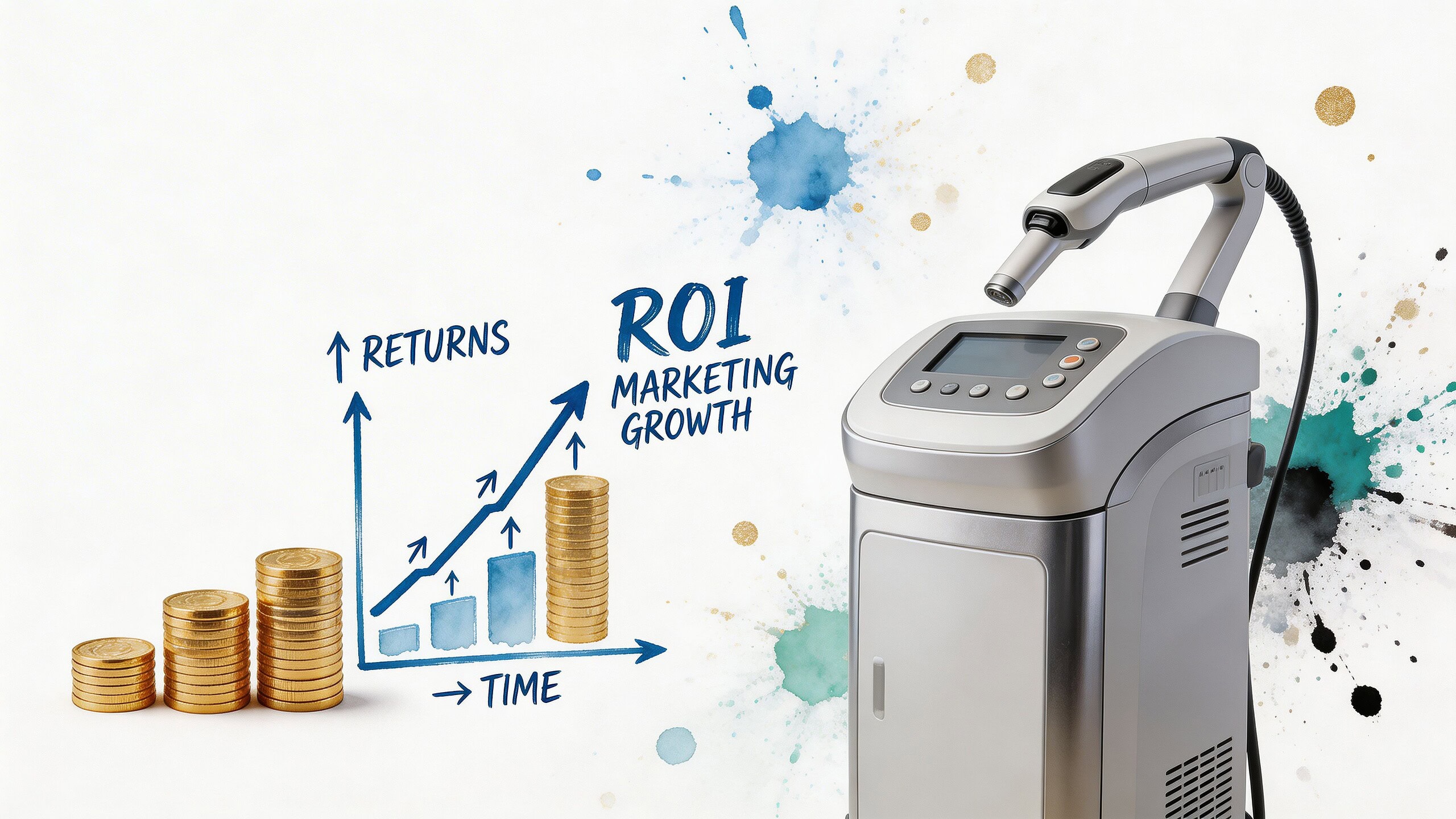
A practical starting point is this ROI breakdown for South African aesthetic professionals.
Start with your own numbers
Revenue comes from four inputs. Session price, number of sessions per client, available treatment slots, and course completion.
Profit is narrower than revenue. Finance repayments, service support, consumables, operator time, patch testing, cancellations, and downtime all sit in the gap between the two.
Imported assumptions often distort the model. South African clinics deal with different disposable income patterns, seasonal sun exposure, load-shedding planning, and a broader mix of darker skin types than many US or European buying guides account for. A machine that looks profitable on paper can become expensive if it treats only a narrow slice of your market confidently.
A basic ROI worksheet
Use this structure:
| ROI input | What to enter |
|---|---|
| Average session fee | Your planned price for each treatment area |
| Sessions per client | Your actual protocol by area and hair type |
| Daily treatment capacity | Based on real appointment length, not ideal speed claims |
| Weekly operating days | Your normal diary pattern |
| Expected completion rate | A conservative estimate from your client profile |
| Monthly finance or capital cost | The machine cost per month |
| Maintenance and support cost | Service cover, parts, and probable downtime |
| Launch marketing budget | What you will spend to fill consultations in the first 3 to 6 months |
Build the model on an ordinary month.
Throughput and completion drive return
Headline pricing matters less than clinic owners expect. Throughput and completion usually decide whether the machine becomes a profit centre or an underused asset.
A fast system increases daily capacity, but speed alone does not protect margin. If treatments are uncomfortable, if darker skin types require frequent rescheduling because the platform lacks flexibility, or if settings feel inconsistent between operators, package completion drops. The machine then spends too many hours idle between first consultations and abandoned follow-ups.
Three business realities matter here:
- Speed affects room economics: More completed appointments per room per day lowers the cost of each treatment slot.
- Comfort affects package retention: Clients who can tolerate repeat visits are easier to convert into full courses and maintenance plans.
- Skin type versatility affects market size: In South Africa, a system that safely handles Fitzpatrick IV to VI is not a niche benefit. It is often the difference between broad demand and a very limited target market.
Marketing the service without creating refund problems
Good laser marketing should sound clinical, not theatrical. Promises that are too aggressive may win a booking, but they create complaints, refund pressure, and reputational damage later.
Start with suitability. State clearly that treatment depends on hair colour, hair thickness, medical history, recent sun exposure, and skin type. That protects the clinic and filters out poor candidates before they absorb chair time.
Package design also matters. Single sessions are easy to advertise, but full-course plans usually produce better outcomes and stronger cash flow. The client sees a treatment plan. The clinic sees a clearer revenue path and fewer stop-start bookings.
For South African buyers, trust signals carry real weight:
Clear compliance language
Use accurate wording about practitioner training, consultation protocols, consent, patch testing where indicated, and SAHPRA-aligned device procurement. Clients may not know the regulations in detail, but they recognise a clinic that takes safety seriously.
Before-and-after education
Use real clinic imagery only where consent allows and results are typical. Show reduction, spacing of sessions, and expected shedding patterns. Do not market fantasy timelines.
Database-led promotion
Your best early laser clients are often already in the practice. Existing injectables, skin, and waxing clients convert well because trust already exists. Start there before spending heavily on cold traffic.
Strong laser marketing shows that your clinic can assess properly, treat safely across local skin types, and deliver repeatable results that justify the fee.
A practical stress test before you sign
Write the answers down. If the answers are vague, the purchase is still premature.
- How many laser appointments can you fill each week within 90 days of launch?
- What proportion of your current database falls into Fitzpatrick IV to VI?
- Can this platform treat that group confidently within safe parameters?
- How much operator time is needed before settings become consistent across the team?
- What is the financial cost of three to five days without the machine if service is delayed?
- What is your plan for consultation follow-up, package conversion, and missed-visit recovery?
Clinic owners sometimes focus on the purchase price because it feels concrete. In practice, the bigger profit question is whether the machine fits your local clientele, keeps clients on protocol, and stays working with dependable support. That is the business case.
FAQs and Your Implementation Checklist
Clinic owners usually ask the same sensible questions before they commit. The answers often determine whether the purchase becomes a growth asset or a source of frustration.
FAQs owners ask before buying
Is professional laser the same as at-home IPL
No. They sit in different categories.
Professional laser systems are built for controlled clinical use, deeper treatment capability, and operator-led parameter selection. At-home IPL devices are designed around broad safety limits and convenience. They may have a place in consumer maintenance, but they don’t replace professional treatment results or clinic workflow.
Can one machine treat every skin tone equally well
Not equally well. That’s the point.
Some systems are far more versatile than others, but no responsible practitioner should pretend every wavelength behaves the same on every client. In South Africa, the safer commercial decision is usually a platform that gives you broad flexibility across different skin types and hair structures.
What should I tell clients about “permanent” hair removal
Use careful language. Promise reduction, not fantasy.
Clients should understand that laser hair removal targets active follicles over a course of visits. Many achieve major, long-lasting reduction, finer regrowth, and much easier maintenance, but results vary by hair biology, hormones, area, and compliance with the treatment plan.
Is this suitable for mobile therapists
It depends on the device, the support model, and your operating setup.
Mobile use raises extra questions around transport safety, power stability, cooling efficiency, insurance, treatment environment, and record keeping. If you’re mobile, supplier training and technical support matter even more because you don’t have the same infrastructure as a fixed clinic.
How important is training if the machine has presets
Very important.
Presets help, but they don’t replace judgment. Your operator still needs to assess skin, recognise when not to treat, explain aftercare, adjust for hair characteristics, and identify responses that need caution.
Implementation checklist for buying hair removal laser machines
Use this as your pre-purchase and launch checklist.
1. Define the clinic case
- Review your client mix: Note the skin tones and hair types you see most often.
- List target treatment areas: Face, underarms, bikini, legs, chest, and back all affect workflow differently.
- Set service goals: Decide whether the device must be a core revenue service or an add-on.
2. Verify regulatory standing
- Request SAHPRA proof: Ask for exact model documentation, not generic assurances.
- Check local support: Confirm who services the machine inside South Africa.
- Read warranty terms: Make sure response time and practical coverage are clear.
3. Evaluate treatment fit
- Check wavelength strategy: Single-wavelength devices may limit your usable market.
- Assess cooling seriously: Comfort influences repeat bookings and operator confidence.
- Review handpiece practicality: Spot size matters for both speed and fatigue.
4. Test operational value
- Map treatment flow: Consultation, patch test, treatment, rebooking, and aftercare should feel efficient.
- Ask staff for input: The operator often spots usability issues before management does.
- Plan maintenance windows: Don’t assume perfect uptime forever.
5. Build the financial model
- Use realistic session pricing: Base it on your location and positioning.
- Model a normal booking pattern: Avoid optimistic assumptions.
- Include indirect costs: Training time, launch marketing, consumables, and support all count.
6. Prepare the launch properly
- Train the whole team: Front desk, therapists, and managers should all understand the service.
- Create consultation scripts: Consistent explanations improve conversion and expectation management.
- Prepare aftercare material: Written instructions reduce confusion and unnecessary callbacks.
7. Protect the reputation of the service
- Document everything: Consent, settings, responses, and aftercare advice.
- Take standardised photos where appropriate: Consistency matters more than flashy before-and-afters.
- Review outcomes regularly: Good clinics refine protocols instead of assuming the machine will solve everything.
Buy the machine only when the clinic is ready to deliver the treatment properly. A laser installed without systems around it is just expensive hardware.
A final practical test is this. If a supplier disappeared the day after installation, would your team still know how to operate safely, explain treatment clearly, maintain records, and protect the client journey? If the answer is no, the deal isn’t complete yet.
If you’re comparing hair removal laser machines for a South African clinic, Omega Lasers is one supplier to review for SAHPRA-licensed aesthetic platforms, training, technical support, and clinic-focused implementation. The useful next step isn’t asking which machine is cheapest. It’s asking which system fits your client mix, compliance needs, and treatment model without creating avoidable risk.