



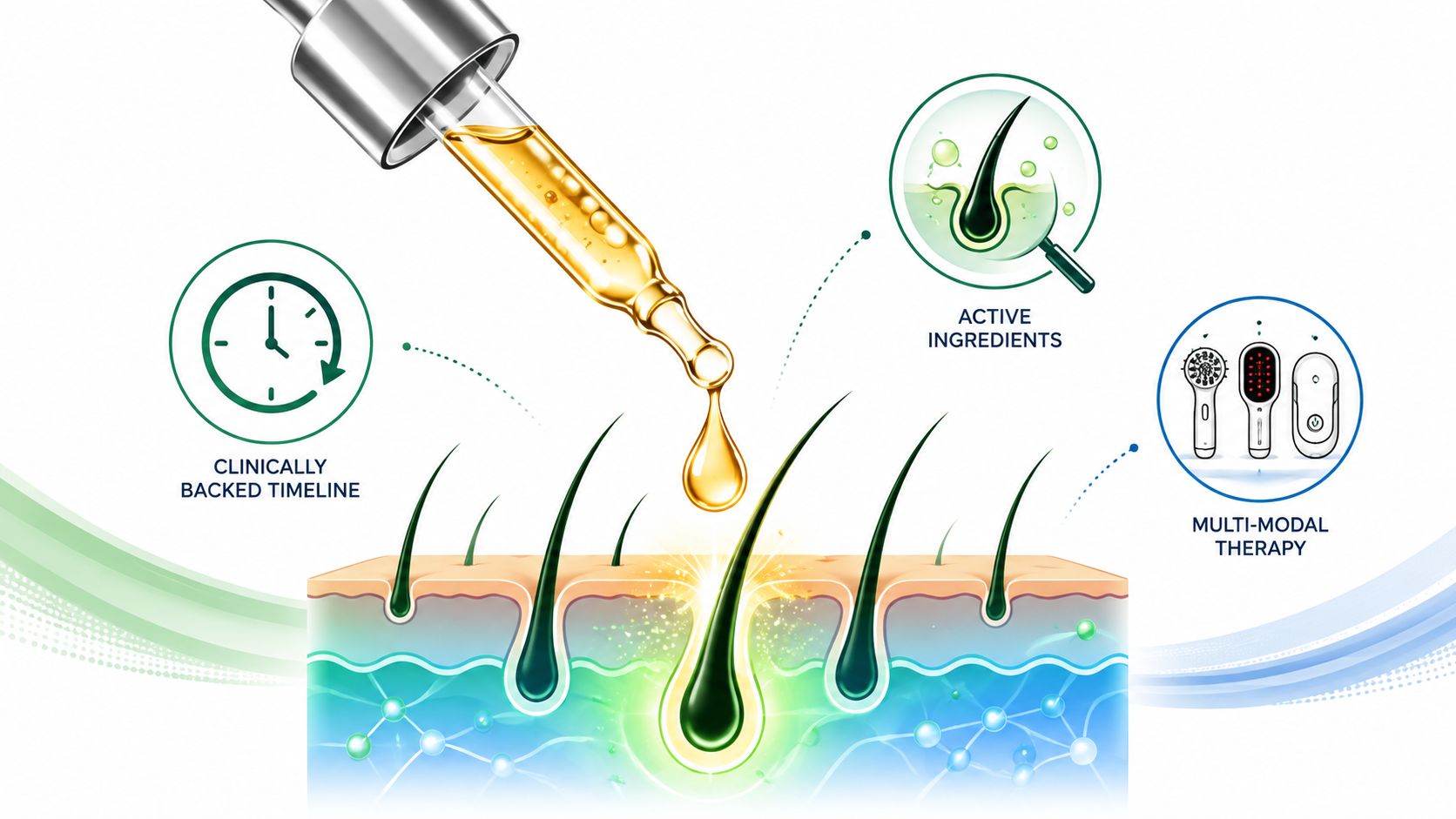
Most people ask the wrong question about a hair growth serum. They want to know which bottle “creates new hair,” when the more useful clinical question is whether the product can reduce shedding, support density, and improve the scalp environment enough to justify consistent use. In practice, that distinction matters, because a serum that changes the way existing follicles behave is not the same thing as one that can reverse scarring loss or traction damage.
For aesthetic teams, the safest position is simple. A serum can be a useful adjunct for thinning, shedding, and scalp support, but it should never be sold as follicle replacement. That framing protects outcomes, keeps consultations honest, and helps clients understand why treatment plans often need more than one modality.
Table of Contents
- What Hair Growth Serum Actually Does for Clients
- Types of Hair Growth Serums and How They Work
- Clinical Evidence and Realistic Timelines
- In-Clinic Protocols and Multi-Modality Integration
- Client Selection and Contraindications
- Pricing, Uptake, and Marketing Strategies for Clinics
- Common Questions and Misconceptions About Hair Growth Serums
What Hair Growth Serum Actually Does for Clients
A hair growth serum is often marketed like a miniature transplant in a bottle, but that's the wrong mental model. The better model is support, not replacement. In peer-reviewed cosmetic hair research, topical serums have been associated with measurable changes in hair density, hair growth rate, hair thickness, and reduced hair fall over defined treatment periods, which is useful in the consultation room because clients can understand that the visible outcome is usually better coverage, less shedding, and improved strand quality, not brand-new follicles.
What clients can realistically expect
In day-to-day practice, the most common wins are modest and cumulative. Some clients notice less hair on the pillow or in the shower first, others see better scalp coverage before they see any obvious regrowth. That sequence matters, because the first sign that a serum is doing something is often reduced shedding, not a dramatic change in the hairline.
Practical rule: if a client wants a serum because they expect a bald temple to fill back in on its own, the expectation is already too high.
That's why the underlying cause has to guide the recommendation. A serum can be appropriate for androgen-related thinning, postpartum shedding, or general cosmetic density support, but it's not a solution for every pattern of loss. It also doesn't replace scalp care, styling changes, or medical assessment when the pattern suggests a deeper problem.
Where the limits sit
The key clinical limitation is simple. Serums can support follicles that are still active, but they can't reliably reverse scarring alopecia, and they're not a substitute for correcting repeated traction from tight braids, wigs, weaves, or harsh tension at the edges. The brief on edge loss is especially important in South African consultations, where protective styling is common and clients often hope a product alone will undo ongoing breakage.
If the scalp is inflamed, broken, or under chronic tension, the first intervention is usually to reduce the trigger. A serum may still have a place later, but only as one part of a wider strategy that may include gentler styling, barrier support, or referral. For clinics that want a scalp-support angle, it's also sensible to pair serum conversations with broader care, such as skin barrier repair products, because an irritated scalp rarely responds well to aggressive routines.
Types of Hair Growth Serums and How They Work
Not all serums are trying to do the same job. Some aim to influence follicle cycling, some focus on scalp comfort and barrier support, and some do both. From a clinical perspective, the useful way to read an ingredient list is to ask two questions. Is there an active that can plausibly affect the follicle, and is there an ingredient or system that makes the scalp a better place for that follicle to function?
Follicle-directed formulas
The strongest mechanistic pathways linked to serum performance are TGF-β, β-catenin, JAK/STAT3, ERK signalling, and 5α-reductase inhibition mechanistic review. In plain terms, these pathways matter because they can help move follicles out of a resting state, support dermal papilla activity, and reduce androgen-driven miniaturisation. A formula that touches one of these pathways is more plausible than one built only around cosmetic fragrance and vague botanical language.
Supportive scalp formulas
A second category is the support-first product. These formulas are less about forcing a cycle shift and more about making the scalp less reactive, less dry, and less inflamed. That matters because a stressed scalp environment can make good follicles behave badly. In clinic, those products often have a place for clients who complain of discomfort, flaking, or breakage around the areas they're trying to treat.
Multi-active blends
The most practical serums usually combine a follicle-stimulating active with a supportive scalp active. That combination makes sense because hair growth is not driven by one switch. The follicle has to be stimulated, but the surrounding environment still has to tolerate the formula and support repeated application.
A serum that only looks impressive on a label can still do very little for a client. I'd rather see a plain formula with a clear mechanism than a crowded blend of trendy ingredients with no realistic pathway to effect.

When you assess a product for a client, the question isn't “Does it sound advanced?” It's “Does it combine a plausible growth signal with a scalp environment that can tolerate it?” That is the difference between a formula that may influence hair cycling and one that only makes the hair shaft look better temporarily.
Clinical Evidence and Realistic Timelines
The most useful serum data are the studies that measure change over a defined period instead of leaning on vague before-and-after language. A 90-day clinical study of a topical hair-growth serum reported statistically significant improvements in hair growth rate, hair density, vellus hair density, terminal hair density, and reductions in hair fall and thinning, all with p<0.0001 90-day study. That matters because it gives practitioners a defensible basis for telling clients that measurable change can appear within roughly three months of consistent use.
The timeline clients can understand
A second 60-day human study reported that hair growth rate increased by 10.52% at Day 30 and 31.62% at Day 60, while average hair growth rose to 424.21 μm/day at Day 30 and 487.31 μm/day at Day 60 60-day study. The same study also reported up to 1.5 times improvement after 60 days with no product-related adverse events. Those numbers are useful in consultation because they anchor the conversation in short-term expectation, not vague hope.
How to translate the data into practice
In the treatment room, I'd frame the process like this. If a serum is going to help, the client should expect the first meaningful change only after weeks to months, not days. That doesn't mean nothing is happening early on. It means the visible payoff usually lags behind the application habit.

A practical consultation script is straightforward. Start with the client's baseline, explain that the first month is about consistency and tolerance, then review density, shedding, and coverage at the next checkpoint. If they want immediate visual transformation, a serum alone is the wrong tool. If they want incremental, measurable improvement and they'll use it daily, the product has a place.
In-Clinic Protocols and Multi-Modality Integration
A serum works better when the scalp is prepared properly and the treatment sequence is sensible. The standard mistake is to treat serum application like retail add-on aftercare instead of a structured clinical step. That's where poor absorption, irritation, and inconsistent outcomes start.
A repeatable clinic workflow
The cleanest protocol is simple enough to train across a team:
- Cleansing first. Start with a clean scalp so residue, oils, and styling buildup don't block contact with the active.
- Targeted application. Part the hair and place the serum directly on thinning zones instead of coating the whole head.
- Gentle massage. Use light massage to help spread the product without creating friction on fragile edges.
- Aftercare instruction. Give the client a clear home routine so the regimen stays consistent after they leave the clinic.
That sequence matters because scalp treatment is not just about what is used, it's about what it's layered onto. After aggressive resurfacing, heat-based work, or anything that leaves the barrier irritated, I'd delay topical actives rather than push through. A sensitised scalp is more likely to sting, shed, or reject the regimen.
Where device-based care fits
Hair serums can sit alongside scalp-focused device work when the timing is thoughtful. Non-aggressive energy-based approaches and low-trauma scalp therapies can complement topical care, but they should be sequenced so the skin isn't overloaded. For clinics already running microneedling workflows, DermaPen micro needling can be part of a broader scalp protocol when the client is suitable and the skin is intact, but serums should still be chosen for tolerance rather than hype.
The rule I use is straightforward. If the scalp looks angry, inflamed, or freshly treated, hold the serum and let the barrier settle first.
That same logic applies to laser and RF-adjacent menus. Don't stack too many interventions in one visit just because the client wants faster change. Sequencing protects comfort, improves adherence, and reduces the chance that a good product gets blamed for a bad protocol.
Client Selection and Contraindications
The strongest serum outcomes come from the right patient selection. A hair growth serum is most sensible when the problem is visible thinning, mild-to-moderate shedding, or early miniaturisation. It is much less useful when the client is dealing with a condition that requires medical diagnosis or a change in styling behaviour before any topical product has a chance.
Matching the problem to the tool
If the presentation is diffuse shedding with a still-healthy scalp, a serum may support density and reduce visible loss. If the hairline is receding because of chronic tension, the first intervention is usually behavioural, not cosmetic. And if the loss pattern suggests scarring, broken follicles, or patchy autoimmune disease, a topical bottle is the wrong endpoint.
A practical triage framework helps:
- Likely serum-responsive: early thinning, general shedding, cosmetic density concerns.
- Needs broader action: traction-related edge loss, recurrent breakage, styling-related stress.
- Needs medical assessment: scarring patterns, patchy loss, scalp inflammation, persistent unexplained shedding.
Safety and referral thresholds
Patch testing still matters, especially on sensitive scalps or when the client already has a history of irritation. Pregnancy also deserves a conservative stance, because there's no reason to push topical growth claims in a situation where the benefit is uncertain and the tolerance threshold is lower. Scalp infections are another hard stop until the skin barrier is healthy again.
If the scalp disease comes first, the serum comes second. That order saves the clinic from overselling and saves the client from chasing the wrong solution.
The important distinction is between appearance improvement and true regrowth. A serum may make existing hair look fuller, reduce shedding, or support a denser look over time. That is not the same as replacing lost follicles, especially when traction or scarring has already changed the architecture of the scalp.
Pricing, Uptake, and Marketing Strategies for Clinics
Serums sell best when they're positioned as part of a scalp-health programme, not as a standalone miracle. That positioning helps retention, because clients understand they're buying a process, not a promise. It also makes the commercial offer easier to explain when the treatment room already includes device-based scalp care or other aesthetic work.
How to frame the offer
The cleanest structure is to bundle the serum into a maintenance pathway. A client visits for assessment, starts a topical plan, and then comes back for review and documentation. That creates a more durable relationship than a one-off retail handoff, and it gives staff a reason to follow up on adherence instead of waiting for a complaint.
A strong education layer also helps. Clinic content should show clients how to apply, what to expect, and when to escalate if the pattern doesn't improve. For teams building that material, trust-building content for professional firms is a useful model for shaping educational language without sounding salesy.
What to avoid in the sales conversation
Don't promise dramatic hairline reversal. Don't overstate “new growth” when the more likely outcome is reduced shedding and better density. And don't hide the fact that consistent use is what makes topical care worth trying in the first place.
One of the easiest ways to improve uptake is to make the regimen visible. Show where the serum fits in the routine, explain the checkpoints, and document progress with the same camera angle each time. When clients can see structure, they're more willing to stay the course.
For clinics building out their educational funnel, marketing content creation can support that process with scalp-care explainers, treatment guides, and consultation assets that make the offer easier to understand before the appointment.
Common Questions and Misconceptions About Hair Growth Serums
Clients usually ask the same three things, just in different words. Can it bring back edges lost to tight braids? How long until I see something? And why does one serum seem to do nothing while another looks promising? The honest answer is that the result depends on the type of loss, the consistency of use, and whether the scalp is still a viable target.
A useful example is the client with long-standing traction at the temples. If the edges are thin because of repeated tension, a serum may improve the look of surrounding hair and reduce extra shedding, but it won't magically rebuild damaged follicles. That's where styling changes and, if needed, referral matter more than another bottle.
For clients with diffuse thinning, the conversation is different. They often do better when the serum is part of a broader plan and they're willing to wait the full treatment window before judging it. The 60-day and 90-day study data give you the language for that conversation, because the change is measured over time, not overnight.
Another common misconception is that a serum must create new follicles to be worthwhile. It doesn't. If it reduces shedding, supports density, and helps the scalp tolerate ongoing care, that can still be a good clinical outcome. The key is to call it what it is, then match it to the right client.
If you want your clinic to position scalp treatments more intelligently, Omega Lasers can help you build the device side of the pathway with training, treatment platforms, and client-facing support that fit real salon and clinic workflows. Visit Omega Lasers to explore the systems and resources that can sit alongside your serum protocol and make your hair-loss consultations more credible.