




Nearly one in five education verification checks in South Africa, approximately 18%, uncover fraudulent or misrepresented matric certificates and qualifications, according to reporting on the country's growing qualification fraud problem (The Star). For aesthetic clinics, that statistic changes the conversation. Credential verification isn't an admin chore. It's a patient safety control, a compliance control, and a business protection measure.
In aesthetics, the actual risk isn't only whether a person has a diploma. It's whether the person is properly verified for the treatment they perform, on the specific device they use, inside a regulated clinical environment. That's where many clinics get caught. They verify the practitioner in broad terms, but they don't close the gap between the practitioner and the device.
Always ensure the information is accurate and true, as this concerns aesthetic lasers, energy-based devices, and health.
Table of Contents
- The High Stakes of Credential Verification in Aesthetics
- Understanding Practitioner vs Device Verification
- How to Verify Your Practitioners A Step-by-Step Guide
- Ensuring Your Aesthetic Technology Is Compliant
- Common Red Flags in Credential Verification
- Implementing a Verification Policy in Your Clinic
- Frequently Asked Questions on Credential Verification
- An applicant trained overseas has excellent paperwork. Can we let them start while verification is still in progress?
- We bought a new laser. Does our existing team need fresh sign-off if they already have aesthetic training?
- A supplier says the machine is CE or FDA cleared. What does that change for a South African clinic?
- We use a third party to help with verification. Where does the risk still sit?
- What usually forces an urgent re-check outside the normal review cycle?
The High Stakes of Credential Verification in Aesthetics
Qualification fraud is already established as a real hiring risk. In an aesthetic clinic, the exposure is higher because a bad hire does not stay on paper. It reaches the treatment room.
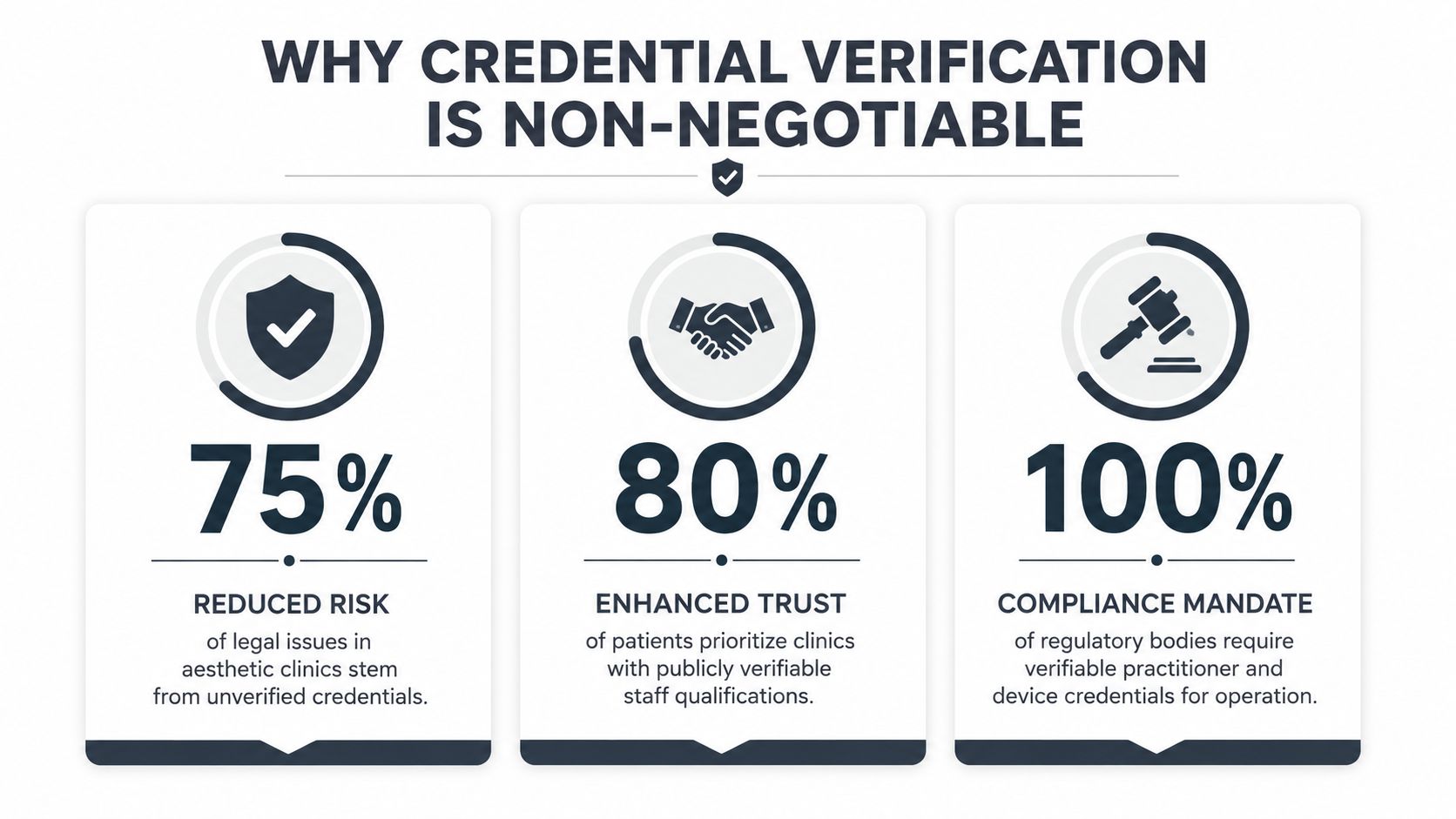
Clinic owners carry legal, financial, and clinical risk at the same time. Staff perform procedures on skin, use energy-based equipment, obtain consent, document outcomes, and manage complications when treatment does not go to plan. If an unverified practitioner treats a patient, the fallout can include a complaint, an insurer dispute, a refund demand, reputational damage, and hard questions about director oversight.
One gap causes repeated problems in South African aesthetic clinics. Owners verify the person in a general sense, then assume that clearance extends to every device in the business. It does not. A therapist may hold a genuine qualification and still lack documented training, scope alignment, or manufacturer sign-off for a specific high-risk platform. That practitioner versus device gap is where many clinics get caught.
What clinic owners often miss
A certificate on file proves very little on its own. It does not confirm identity, authenticity, current standing, scope of practice, or device-specific competence. It also does not show whether the clinic checked any of this before allowing treatments to start.
Identity checks are the foundation. If the person presenting for work is not properly matched to the qualification, every later check is weakened. For a plain-language overview of that first layer, teams can learn about identity verification with HomeProBadge.
Practical rule: If you cannot show who the practitioner is, what qualification was verified, and which devices they were cleared to use, your clinic is relying on assumption.
Verification also matters after hiring. I advise clinics to treat it as part of risk control, not recruitment admin. It supports incident response, insurer queries, internal audits, and decisions about scope expansion when new treatments or machines are introduced. It also affects whether your cover will respond cleanly, which is why clinics should review their professional indemnity requirements alongside credential records and treatment protocols.
Done properly, credential verification gives management something useful. It screens out fraudulent applicants, exposes training gaps before patients are booked, and creates a defensible record when a regulator, insurer, or attorney asks what checks were done and when.
Understanding Practitioner vs Device Verification
Most clinics blend everything into one file called “staff credentials”. That's where errors start. In aesthetics, there are two separate verification tracks. One is the practitioner. The other is the device.

A simple way to think about it is this. A general beauty or health qualification is like a driver's licence. It may show that someone has baseline training. It does not automatically mean they're cleared to fly a plane. In the same way, a general diploma doesn't automatically establish that someone is competent, authorised, and documented to operate a specific regulated laser platform in your clinic.
Practitioner verification
Practitioner verification asks whether the person is who they say they are, whether their qualification is genuine, and whether their scope of practice fits the services they'll perform. That includes identity matching, qualification checks, registration checks where applicable, work history review, and confirmation that their training aligns with the treatments you offer.
Many hiring managers often stop short, collecting only a certificate, an ID copy, and perhaps a reference. That approach misses the operational reality of aesthetic practice.
Device verification
Device verification asks a different set of questions. Is the machine lawfully registered where required? Is it the right class of technology for the advertised use? Is there a documented safety structure around it? Has the clinic identified who may operate it, under what training standard, and with what records?
The machine can be compliant while the operator is not. The operator can be qualified in general terms while the machine setup is non-compliant. Both failures matter.
The most overlooked issue in South African aesthetics is the SAHPRA-device vs practitioner verification gap. Clinics often verify a therapist's general diploma but miss the specific device endorsement, creating a high risk of regulatory non-compliance. Government guidance on qualification verification highlights this broader problem: standard checks don't always catch the documentation gaps that lead to delays and safety issues (Gov.za qualification verification guidance).
Treat them as linked but separate controls
A workable clinic system keeps these records separate, then cross-references them before a person is booked for treatment. That means:
- One file for the person: ID, qualifications, registrations, references, internal competency sign-off.
- One file for the machine: registration status where applicable, supplier documents, service records, safety documents, operating protocols.
- One matrix linking both: which practitioner may use which device, for which treatment, under what supervision.
That third record is the one many clinics never build. It's also the record that usually resolves disputes fastest when a regulator, insurer, or patient asks who was authorised to do what.
How to Verify Your Practitioners A Step-by-Step Guide
A good practitioner verification workflow is repeatable, documented, and slow enough to catch problems before a staff member touches a client. It should start before the contract is signed and continue after the person joins the clinic.

Start with original source documents
Ask for more than a CV and scanned certificates. At minimum, collect identity documents, qualification certificates, transcripts where relevant, registration details where relevant to the role, evidence of treatment training, and written employment history. If the person claims laser training, ask for the exact training record, not a generic statement that they are “laser certified”.
Then inspect originals or properly certified copies according to your clinic policy. Don't treat document collection as the verification itself. It's only the intake stage.
Verify qualifications through SAQA
In South Africa, primary source verification of national qualifications must be conducted via the South African Qualifications Authority, and employers in regulated sectors can't accept self-declared certificates without that validation. The process can take up to 20 working days under the applicable directive, so clinics need to build that waiting period into recruitment and onboarding timelines (DPSA directive on qualification verification).
Under pressure, many clinics make poor hiring decisions. They have a full diary, they need someone urgently, and they let the candidate start before the verification is complete. That's risky. If the role is treatment-facing, the safer position is simple: no independent clinical work until the verification is closed.
Delay the start of unsupervised treatment work, not the verification. When clinics reverse that order, they inherit avoidable risk.
Check professional standing and role fit
After qualification verification, confirm whether the role requires registration with a professional body and whether the person's standing is current. The exact council or body depends on the role. The core question is always the same: is this person legally and professionally in good standing for the work you intend to assign?
For clinic managers who want a clear example of how registration frameworks shape scope and accountability, understanding psychology registration offers a useful comparison point. It's not a South African framework, but it shows why role title, registration status, and permitted practice can't be treated casually.
Cross-check device-specific competence
This is the step that separates generic HR screening from proper aesthetic credential verification. Once the person's base qualification is verified, compare it against the actual devices and treatments in your clinic.
Use a practical checklist:
- Match the person to each treatment category: hair removal, resurfacing, vascular work, pigmentation work, skin rejuvenation, or other service lines.
- List each device they'll operate: don't use broad labels like “laser machine”.
- Request evidence of training for that specific platform or device type: supplier training, internal competency sign-off, safety instruction, and any role-specific documentation.
- Confirm supervision rules: decide whether they may operate independently or only under senior oversight.
- Record the approval internally: date, reviewer, and conditions.
Validate experience with direct conversations
References matter most when they are direct and specific. Ask previous employers what treatments the person performed, which devices they used, whether they worked independently, and whether there were concerns about judgement, record-keeping, or patient communication.
A vague “yes, she worked here” is not a useful reference. A useful reference ties the candidate to real tasks, dates, conduct, and level of responsibility.
Keep the file live
Credential verification isn't finished on day one. Registrations can lapse. Internal competency can drift. Staff can move into new treatments without formal sign-off if management isn't paying attention.
A practical ongoing file should include:
- Expiry tracking: registrations, insurance-related documents where applicable, and any time-bound authorisations.
- Scope tracking: what the practitioner is currently approved to do.
- Training updates: refresher training, new device training, revised protocols.
- Incident-linked review: if there's a complaint or adverse event, review the credential file immediately.
The clinics with the fewest verification problems aren't necessarily the largest. They're the ones with a disciplined process and a clear rule that no one works beyond documented competence.
Ensuring Your Aesthetic Technology Is Compliant
Some clinic owners verify staff carefully, then become surprisingly casual about the machine itself. They rely on a sales invoice, a supplier promise, or a label on the console. That isn't enough. Device compliance needs its own paper trail and its own internal checks.
The first issue is classification. In South Africa, Class 3 and Class 4 laser devices used in a medical-aesthetic setting require registration with SAHPRA and a designated Laser Safety Officer for each machine, although one person may serve as LSO for multiple devices. By contrast, IPL and LED devices are not subject to the same licensing requirements and can be operated more freely (South African laser regulations overview).
What that distinction means in practice
A clinic can't treat all energy-based devices as if the rules are identical. They aren't. A regulated laser environment carries a different compliance burden from an IPL or LED setup. That affects procurement, staffing, room protocols, training, and records.
Here's a practical comparison:
| Device category | Compliance focus inside the clinic |
|---|---|
| Class 3 or 4 laser | Confirm SAHPRA registration requirement is addressed, assign an LSO, keep safety and operational records, and limit use to properly authorised operators |
| IPL or LED | Apply internal training, treatment protocols, consent, and maintenance controls even though the licensing burden is different |
The absence of a licensing requirement for IPL or LED doesn't remove your duty to manage risk. It only changes the regulatory pathway. Patients can still be harmed by poor treatment decisions, weak protocols, or badly maintained equipment.
Documents every clinic should demand
When a device enters the clinic, the owner or manager should collect and organise a core compliance pack. That pack should be reviewed before the machine is marketed, booked, or used.
Include:
- Device identification documents: model details, serial number, and supplier paperwork.
- Registration evidence where required: especially for Class 3 and 4 laser devices.
- Safety documents: operator guidance, risk controls, room safety measures, and LSO records where applicable.
- Service history: commissioning, maintenance, repairs, and calibration-related records where relevant.
- Training records: who trained your staff, on which platform, on what date, and with what internal sign-off.
If a supplier is vague about registration status, operating requirements, or service records, pause the purchase. A compliance problem bought cheaply is still a compliance problem.
A structured procurement review helps here. For owners tightening supplier checks, this guide for compliance and risk management is a useful reference for building better due diligence questions into your purchasing process.
Compliance isn't complete without support records
A machine that starts well can still become a liability if support records fall behind. Clinics need a system for logging faults, servicing, software or component updates where applicable, and operator retraining after repairs or operational changes. Those records matter when a treatment outcome is questioned.
That's also why after-sales support should be part of your compliance assessment, not just your buying decision. If you're reviewing what strong post-purchase documentation should look like, the benchmark is disciplined after-sales service support tied to maintenance, response, and operator continuity.
Common Red Flags in Credential Verification
Most verification failures don't begin with a dramatic confession. They start with small inconsistencies that busy clinics overlook because the candidate interviews well or the equipment deal looks attractive.
The South African discrepancy pattern shows where caution is justified. According to MIE's 2024 data, 7.82% of matric certificates, 8.28% of short course qualifications, and 11% of international credentials contained discrepancies or failed verification (MIE qualification verification data). In an aesthetic clinic, those categories matter because entry-level hires and short-course-led claims are common.

Red flags on the practitioner side
A candidate submits a polished CV and several certificates, but the dates don't line up. One document shows a completion year that conflicts with the employment history. Another uses a different version of the person's name. That's not a small admin issue. It's a cue to stop and verify every record before moving forward.
Another common scenario is reluctance to show originals. The applicant sends scans, says the originals are “in storage”, and keeps postponing inspection. That isn't proof of fraud on its own, but it is a warning sign. In a compliant clinic, unexplained document avoidance means no treatment access until the record is resolved.
Red flags around device claims
The device side has its own pattern. A supplier or reseller offers a laser at an unusually attractive price, but can't clearly show the registration pathway, support documentation, or operator safety structure. The machine may still exist and may still power on. That doesn't make it clinic-ready.
Another warning sign appears when staff say they are “trained on all laser devices”. Competence doesn't work like that. Training should connect to specific platforms, treatment types, and internal sign-off. Broad claims with no matching records usually collapse when you ask basic follow-up questions.
Weak detail is often the first visible sign of a weak credential. Genuine records usually become clearer under scrutiny. Problematic ones become vaguer.
A quick screening table
| Warning sign | Why it matters |
|---|---|
| Inconsistent names or dates | Suggests identity mismatch, altered records, or poor document integrity |
| Only scanned certificates, no originals | Prevents proper inspection and raises authenticity questions |
| Generic “laser certified” claim | Doesn't prove competence on your actual device mix |
| Unclear international documentation | Requires extra caution because international credentials showed the highest discrepancy rate in the cited data |
| Supplier can't produce a clean device paper trail | Increases the risk of operational and regulatory problems later |
The clinics that avoid bad hires and bad purchases don't rely on intuition. They escalate small inconsistencies early, document the concern, and refuse to fill in missing facts with optimism.
Implementing a Verification Policy in Your Clinic
A clinic without a written verification policy usually ends up with inconsistent decisions. One manager asks for originals. Another accepts screenshots. One therapist gets signed off properly. Another starts because the diary is full. That inconsistency becomes a risk pattern.
A practical policy should be short enough to use and strict enough to defend. It doesn't need legal theatre. It needs clear rules, named responsibilities, and records that hold up under scrutiny.
The core policy framework
Build your policy around five operating parts:
- Scope: define which roles, contractors, and devices are covered.
- Required evidence: list the exact documents needed for each role and each device category.
- Verification method: state which checks must be primary source checks, which internal reviews are required, and who signs off.
- Restriction rule: no staff member performs unsupervised treatment until all required checks are complete.
- Review cycle: decide when files are rechecked and what triggers an immediate review.
A useful internal template
Many clinics do well with a simple matrix that includes the person, the treatment category, the device, the proof reviewed, the verifier, and the approval status. That matrix becomes your operating control.
For example:
| Item | Internal requirement |
|---|---|
| Practitioner identity | Verified and filed |
| Qualification | Verified through the required process and filed |
| Role registration where applicable | Checked and current |
| Device-specific training | Evidence reviewed and internally signed off |
| Treatment authorisation | Approved, limited, or declined |
| Reverification date | Scheduled in advance |
Decide what happens when checks fail
The policy also needs a discrepancy process. If a qualification can't be verified, if dates don't match, or if device competence is unclear, the rule should be immediate pause, documented review, and written escalation to the clinic owner or responsible manager.
A strong policy is only useful if records are easy to retrieve. That's why disciplined record-keeping systems matter. A missing file can be just as damaging as a missing verification.
The most reliable clinics make credential verification part of onboarding, rostering, training approval, and incident management. Once it's built into operations, staff stop treating it as paperwork and start treating it as a condition of practice.
Frequently Asked Questions on Credential Verification
One point causes more clinic mistakes than owners expect. They verify the practitioner, but they never verify whether that practitioner is cleared and trained to use the specific device booked into the room.
An applicant trained overseas has excellent paperwork. Can we let them start while verification is still in progress?
That creates avoidable risk. International qualifications often take longer to confirm, and gaps usually show up in scope, clinical terminology, or missing primary-source records. The safer approach is to complete identity checks, confirm the qualification through the issuing body where possible, and restrict the person from higher-risk treatments until the file is closed.
If the role involves laser, IPL, RF microneedling, or other energy-based treatments, hold a separate device authorisation decision. A strong CV does not answer the device question.
We bought a new laser. Does our existing team need fresh sign-off if they already have aesthetic training?
Usually, yes.
General aesthetic training and prior clinic experience may support suitability for the role, but neither proves competence on a newly introduced device. Different platforms have different parameters, contraindications, consumables, cooling systems, treatment endpoints, and shutdown procedures. From a risk perspective, the core issue is not whether the therapist is experienced. It is whether the clinic can show that this person was assessed and approved for that exact system and treatment scope.
A supplier says the machine is CE or FDA cleared. What does that change for a South African clinic?
It may help you assess the equipment, but it does not settle your local compliance position. In practice, clinic owners need to separate two questions. First, is the device acceptable for use in South Africa under the applicable local requirements? Second, is this practitioner authorised by the clinic to operate it?
That SAHPRA-device versus practitioner gap is where many files fail under scrutiny. A device can be properly sourced and still be used by the wrong person. The reverse is also true.
We use a third party to help with verification. Where does the risk still sit?
With the clinic.
External support can help collect records, chase institutions, and flag inconsistencies, but it does not transfer accountability. If a complaint, adverse event, or insurer query lands on your desk, the clinic must show what was checked, who approved the person, and why that approval included the device used on the patient. If the outsourced provider misses something, the operational and legal exposure still sits with the owner or responsible manager.
What usually forces an urgent re-check outside the normal review cycle?
The triggers are usually operational, not administrative. A practitioner starts performing a new treatment category. A complaint suggests treatment outside scope. An incident raises questions about settings, supervision, or consent. A staff member returns after a long break and is rostered back onto high-risk equipment.
Those are the moments to reopen the file immediately, even if the scheduled review date is months away.
If your clinic is upgrading devices or tightening compliance systems, Omega Lasers can help you build around safer procurement, documented training, and support structures that suit a regulated aesthetic environment. The right technology partner doesn't replace credential verification. It makes it easier to run a clinic that takes it seriously.