




The treatment room is ready, the client has arrived, and the clinic's core device has just displayed a critical error. A diode laser or RF microneedling platform that worked perfectly on Friday can become the most expensive object in the building on a fully booked Monday. The repair invoice is only one part of the problem. Cancelled appointments, staff downtime, rushed client communication, compliance questions, and the search for a qualified technician can cost far more.
For aesthetic practices, equipment repair services should be managed as a revenue-protection and patient-safety function, not as an emergency phone call made after something fails. The right process covers safe triage, warranty protection, technician verification, preventive maintenance, service-level agreements, and records that stand up to scrutiny.
Table of Contents
- Why Equipment Downtime Costs More Than the Repair Bill
- Immediate Triage When a Device Fails
- Navigating Warranties and Choosing Certified Technicians
- Weighing Repair Costs Against Revenue Lost to Downtime
- Building a Preventive Maintenance and SLA Strategy
- Documentation and Compliance Recordkeeping for Aesthetic Devices
Why Equipment Downtime Costs More Than the Repair Bill
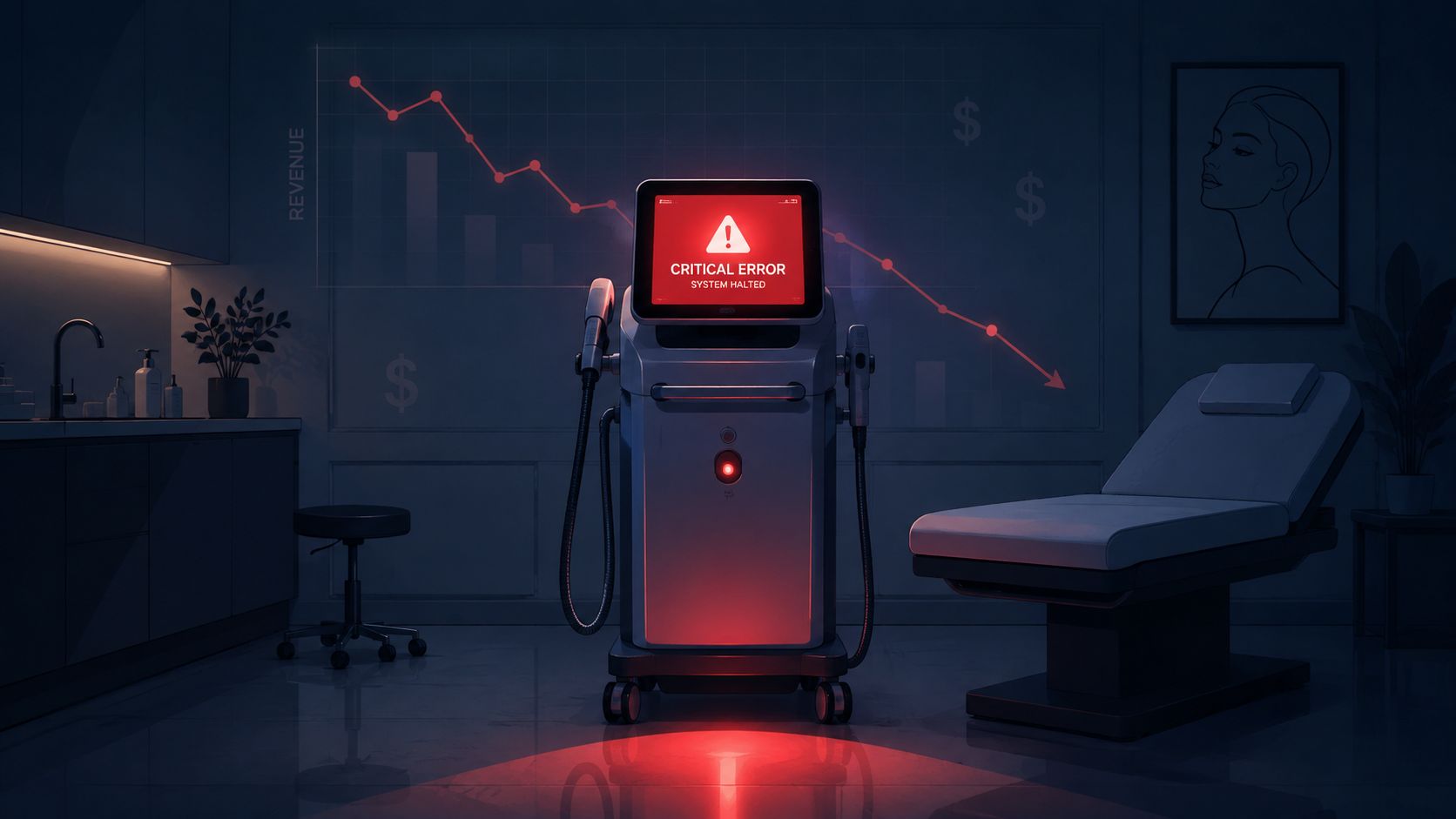
The true cost of a device failure extends far beyond the repair invoice. A laser, radio-frequency platform, or body-contouring unit can remove treatment capacity without warning, leaving the clinic to manage cancelled bookings, idle staff, client complaints, and questions about whether the device can be used safely again.
The first response also affects the eventual repair. Repeated power cycling may worsen an electrical fault. An unauthorised repair can affect warranty coverage. A rushed workaround may leave the clinic unable to show that the device was safe, correctly maintained, or operated within the manufacturer's instructions. Equipment repair services therefore belong in the clinic's operational and compliance planning, not only in an emergency contact list.
The visible and hidden losses
The cancelled appointment is only the obvious loss. Therapist time remains unproductive, reception staff must contact affected clients, and managers may need to arrange couriers, replacement consumables, or an emergency technician. Clients may also have arranged transport or time away from work, so poor communication can damage trust beyond the value of one treatment.
South Africa's repair economy shows that maintenance is a substantial after-sales activity rather than a minor support function. That broader context matters for aesthetic practices because specialised equipment often requires trained technicians, approved parts, and travel to locations outside major centres. Clinics should budget for service access and downtime exposure, not just the purchase price.
A South African industrial maintenance study recorded average downtime of 288 hours per month, a standard deviation of 840 hours, and a maximum of 6,214 hours. The wide spread shows why a single average can conceal serious operational exposure. Clinics need structured fault diagnosis and a priority order for high-criticality devices instead of relying on whoever can arrive first. The study separates downtime from corrective man-hours, so internal reports should record lost operating time separately from technician labour. The underlying findings appear in the industrial maintenance downtime study.
Practical rule: Protect the client, isolate the device, preserve the evidence, and only then discuss the fastest repair route.
South African operating conditions
Load-shedding and unstable power can expose weaknesses in sensitive electronics, particularly where a clinic lacks suitable power protection or a controlled shutdown procedure. Ventilation, dust, heat, and poor handpiece storage can also affect reliability. None of these factors proves the cause of a fault, but the technician should assess and record them during diagnosis.
Compliance adds another layer. A device's FDA or CE documentation does not remove the clinic's responsibility to use it according to approved instructions, while South African practices must also consider applicable SAHPRA requirements and retain evidence of servicing, faults, and corrective action. A repair that restores function but leaves incomplete records can create a separate problem during an audit, incident review, or warranty discussion.
Geography affects the recovery plan. A clinic in a major metro may have access to a certified field technician, while a practice outside the main centres may need to arrange travel, courier a component, or use a temporary treatment plan. Before signing a service agreement, ask who performs the work, which parts are authorised, what response time applies, and what happens if the first visit does not resolve the fault.
A total-cost view of ownership, such as the framework in this equipment ownership guide, helps owners compare purchase price with support, maintenance, downtime exposure, and replacement planning.
The operational question is, “What process returns this device to service safely while protecting compliance, client trust, and future availability?”
Immediate Triage When a Device Fails
The first hour determines whether a failure becomes a controlled service event or a confusing chain of guesses. Staff should follow the same response every time, whether the device is a laser, cooling platform, radio-frequency system, body-contouring unit, or diagnostic accessory.
Start with safety, not troubleshooting
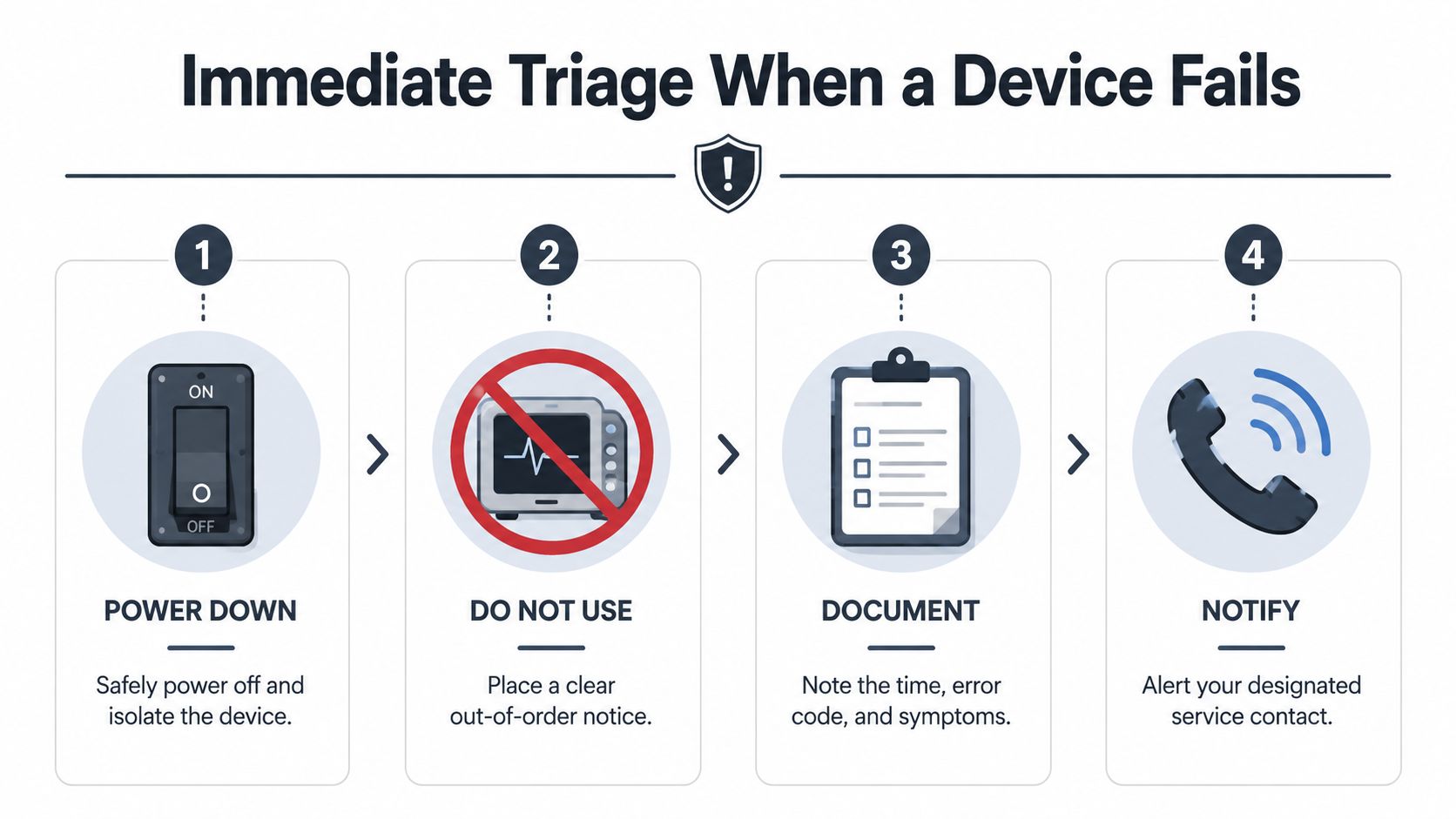
Stop the treatment safely. If a client is connected to the device or a handpiece is in contact with the skin, follow the manufacturer's normal treatment-stop procedure. Don't pull cables, open panels, bypass interlocks, or continue because the device appears to be producing energy.
Power down and isolate the unit. Switch it off using the approved shutdown sequence, disconnect it from use, and isolate it from the treatment area if there's heat, smoke, fluid, unusual noise, burning smell, exposed wiring, or a possible electrical hazard. Staff shouldn't remove covers or attempt component-level repairs.
Mark it clearly. Place an out-of-order notice on the device, remove it from the booking system, and tell every relevant therapist that it must not be used. A verbal warning isn't enough when multiple rooms share equipment.
Check for immediate client harm. Record whether the client experienced unexpected heat, pain, a skin reaction, electrical sensation, eye exposure, or any other adverse event. Follow the clinic's incident procedure and seek appropriate clinical assessment where necessary.
Capture the evidence a technician needs
The service call should include the device model, serial number, location, time of failure, error code, treatment mode, selected parameters, handpiece or applicator in use, and what happened immediately before the fault. Add the last service date, recent consumable changes, unusual power events, temperature changes, liquid exposure, and any recent relocation.
Photographs of the screen, connectors, treatment head, and visible damage can shorten the diagnostic conversation. Keep the original image files and don't erase the error message by repeatedly restarting the unit.
The clinic's internal log should also identify the client record, treatment stage, operator, and any immediate action taken. Store clinical information securely and share only what the technician needs.
Communicate without overpromising
The front desk should contact affected clients promptly, explain that the clinic has taken the device out of service for a safety assessment, and offer realistic alternatives. Don't promise a return-to-service time before the technician has inspected the equipment.
Use the failure to protect trust. Offer a rescheduled slot, explain whether another suitable device or treatment option is available, and ensure the therapist documents any change to the treatment plan. A concise internal troubleshooting guide for common device issues can help staff distinguish user checks from faults that require technical support.
Regulatory escalation depends on the event, the device, the manufacturer's instructions, and the applicable clinic procedures. A simple display fault with no client impact may follow standard repair channels, while an adverse event, suspected safety defect, fire, electrical injury, or repeated malfunction should be escalated through the responsible clinical, quality, manufacturer, and regulatory pathways. When uncertain, preserve the records and ask the authorised service or compliance contact for direction.
Navigating Warranties and Choosing Certified Technicians
A low repair quote can become expensive if it voids the warranty, uses an unsuitable part, or leaves the clinic without calibration evidence. The decision should begin with device status, not price.

Establish the service position first
For an in-warranty device, gather the purchase agreement, warranty certificate, serial number, installation record, service history, fault photographs, error logs, and details of the operator and treatment conditions. Check the warranty language before authorising another party. Unauthorised modifications, unsuitable consumables, missed maintenance, physical damage, or incorrect operating conditions may affect a claim, depending on the contract.
Ask the supplier to confirm in writing:
- Coverage: Which component or failure mode is included?
- Transport: Who pays for collection, travel, or return delivery?
- Turnaround: When will the assessment begin, and what happens if parts are unavailable?
- Loan equipment: Is a temporary unit available, and under what conditions?
- Calibration: What testing and documentation will accompany the repair?
- Future protection: Will the repair preserve the remaining warranty period?
For devices represented as FDA approved, CE certified, or SAHPRA licensed, the clinic should verify the specific device documentation and the service provider's relationship to that device. A technician's general electrical experience isn't the same as training on a particular energy-based platform.
Compare authorised and independent options
An authorised provider may offer direct access to technical bulletins, approved parts, device-specific service records, and warranty support. The trade-off can be a higher service charge or a longer wait if the provider has limited regional coverage.
An independent specialist may provide faster local attendance, broader scheduling flexibility, or a more competitive quotation. That option only works if the technician can demonstrate relevant training, understands energy delivery and safety interlocks, uses traceable parts, and supplies a proper service report. “We've repaired similar equipment” isn't sufficient evidence.
Request copies or confirmation of:
- Device-specific training
- Calibration and electrical safety capability
- Insurance and business registration
- Parts sourcing and traceability
- Repair documentation
- Escalation process for unresolved faults
A repair is complete only when the device has been tested, documented, and released for safe clinical use.
South Africa's right-to-repair discussion adds another layer. The Competition Commission has published draft aftermarket guidelines intended to improve access to parts, repair information, diagnostic tools, and software, while addressing OEM practices that can make repairs uneconomical compared with replacement. The policy context is summarised in this South African aftermarket repair guidance report. Draft guidance doesn't automatically remove warranty conditions or authorise unsafe work, so clinics should still review the contract and device requirements.
The same principle applies to adjacent technical assets. For background on repair workflows and end-of-life handling in another equipment category, the Reworx Recycling telecom guide offers useful context. The key lesson is to separate diagnosis, repair, verification, and responsible disposition.
For an active support relationship, review the scope of Omega Lasers after-sales service alongside any supplier's warranty and service terms. The clinic should know exactly who owns each step when a device fails.
Weighing Repair Costs Against Revenue Lost to Downtime
A repair quote has to be compared with the value of the treatment capacity that has disappeared. Managers often know their session price and booking volume, but they don't always convert those figures into an hourly downtime number that supports a sound decision.
Use your own booked schedule rather than an optimistic capacity estimate. The simple calculation is:
Daily revenue at risk = average treatments per day × average price per session
The table below is a planning template. It intentionally leaves the clinic-specific figures blank because treatment volume and pricing vary by location, practitioner, package structure, and booking mix.
Downtime Cost Calculator for Common Aesthetic Devices
| Device Type | Avg Treatments Per Day | Avg Price Per Session | Daily Revenue at Risk |
|---|---|---|---|
| Diode laser | Clinic figure | Clinic figure | Treatments × price |
| RF microneedling system | Clinic figure | Clinic figure | Treatments × price |
| HIFEM system | Clinic figure | Clinic figure | Treatments × price |
| Skin resurfacing platform | Clinic figure | Clinic figure | Treatments × price |
| Multi-technology facial device | Clinic figure | Clinic figure | Treatments × price |
This calculation measures booked treatment revenue at risk, not profit. It doesn't include therapist wages, consumables, rent, finance costs, client acquisition, or the administrative time spent rescheduling. It also shouldn't be used to justify unsafe treatment on a device that hasn't passed inspection.
Decide how urgently to spend
Same-day attendance can make sense when the device supports a full schedule, the fault is likely diagnosable locally, and the emergency fee is lower than the contribution margin protected by restoring service. It may not make sense when the unit has a serious safety fault, the technician can't verify the repair, or the provider needs to wait for a controlled parts replacement.
A practical decision meeting should answer four questions:
- Capacity: How many booked treatments will be affected?
- Substitution: Can another compliant device or qualified practitioner deliver the service?
- Repair confidence: Has the provider identified a credible diagnostic path?
- Continuity: Is a loaner, temporary relocation, or controlled rescheduling available?
A loaner device can protect continuity, but only if staff are trained on it, the equipment is appropriate for the intended treatment, and the clinic can document its status. Moving a device between rooms or branches also creates installation, transport, and calibration questions.
Replacement deserves attention when failures recur, parts are difficult to source, or the device no longer supports the clinic's clinical and commercial needs. A useful review of the distinction between ageing equipment and equipment that has become operationally obsolete appears in this medical equipment obsolescence guide. The decision should consider remaining serviceability, safety, support access, and the cost of lost availability, not the original purchase price alone.
Client communication is part of the financial calculation. Repeated cancellations can weaken confidence and make future bookings harder, even when the immediate revenue loss appears manageable. A transparent explanation, a prompt alternative, and consistent follow-up usually protect the relationship better than vague promises.
Building a Preventive Maintenance and SLA Strategy
A device can remain operational while becoming a scheduling risk. Build the maintenance plan around every component that can interrupt a treatment, including handpieces, applicators, power supplies, cooling systems, software dependencies, and accessories. The equipment register should show the manufacturer's service interval, calibration requirements, consumable schedule, responsible staff member, and operational consequence of failure.

Build the calendar around risk
A frequently used hair-removal platform needs a different inspection rhythm from equipment used occasionally for skin analysis. Schedule checks before busy booking periods, after relocation, following abnormal power events, and whenever staff notice changes in sound, cooling, output, screen behaviour, or treatment consistency.
Use three maintenance layers:
- Operator checks: Cleaning, visual inspection, correct shutdown, cable checks, and confirmation that safety features work as instructed.
- Planned technical service: Calibration, electrical safety checks, internal inspection, performance verification, and replacement of approved wear components.
- Quality review: Examination of fault history, repeat failures, delayed parts, and the effect of maintenance activity on available treatment capacity.
Staff training protects the plan. It should specify what operators may inspect, what they must never open or bypass, how to record an error, and who may release a device for use. A technician cannot correct damage caused by poor daily handling.
For South African aesthetic practices, the maintenance file should also identify the device's applicable FDA or CE documentation and SAHPRA requirements. The clinic should confirm that servicing, replacement parts, calibration, and post-repair testing remain consistent with the manufacturer's instructions and the device's authorised use.
Negotiate the SLA in operational language
A service-level agreement should define more than “technical support included”. Put these points in writing:
- Response: Time to acknowledge a fault and begin diagnosis.
- Attendance: Whether onsite service changes by region or fault severity.
- Parts: Sourcing process, approval for non-stock components, and communication when availability changes.
- Loaners: Eligibility, delivery, installation, training, and return responsibilities.
- Reporting: Repair report, test results, calibration evidence, and release authorisation.
- Escalation: The person responsible for unresolved or repeat failures.
- Review: How the clinic measures response, restoration, repeat faults, and communication quality.
Ask the provider to separate required maintenance from optional recommendations. Each recommendation should identify the failure mode it addresses, the test or task involved, and the evidence the clinic will receive. Avoid paying for vague preventive work without a device-specific checklist or documented result.
As noted earlier, the repair market is substantial. That context supports treating maintenance as an operating discipline rather than an afterthought, especially where downtime affects bookings, staff utilisation, client confidence, and compliance evidence.
If a manufacturer provides structured technical support and a 2-year manufacturer warranty, record every obligation needed to preserve that protection. For a clinic using Omega Lasers equipment, the service agreement should connect support, staff training, maintenance scheduling, warranty handling, and escalation responsibilities in one written process.
Documentation and Compliance Recordkeeping for Aesthetic Devices
A clinic's equipment file should answer five questions without a frantic search: What is this device? Who supplied it? Who may service it? What has happened to it? Is it safe to use now?
Create one digital folder and one matching register entry for every device. Store the purchase agreement, serial number, warranty certificate, installation record, user training evidence, manufacturer instructions, service contacts, and applicable regulatory documentation. Keep service reports, calibration results, repair invoices, parts information, incident forms, and technician credentials in the same record.
Make the record useful during a failure
A service log should capture the date, device status, symptoms, error code, operator, treatment context, action taken, technician, parts used, test results, and release decision. Don't record only “serviced” or “fixed”. Those words don't help identify recurring faults or demonstrate that the equipment passed a meaningful post-repair check.
Use a simple spreadsheet if the clinic is small. Larger practices can assign equipment owners, automated review dates, and permission-controlled digital storage, but the system must remain easy enough for staff to update immediately after a service visit.
Link records to compliance and business decisions
Records support warranty claims, insurance notifications, internal incident reviews, and responses to questions about device safety. They can also help demonstrate that the clinic uses appropriately trained staff and follows manufacturer instructions for equipment represented as FDA approved, CE certified, or SAHPRA licensed.
The register should flag devices with repeated downtime, incomplete calibration evidence, unavailable parts, or unresolved safety concerns. Over time, that pattern informs the repair-versus-replace decision. A low-cost repair may be sensible when the device is otherwise reliable, while repeated failures and weak support may justify planned replacement before a busy period.
Run a monthly record audit:
- Identity: Serial number and location match the physical device.
- Coverage: Warranty dates and service obligations are current.
- Capability: Staff training and technician credentials are documented.
- Performance: Faults, downtime, and corrective labour are recorded separately.
- Release: Every repaired device has a documented safety and performance check.
- Ownership: One named manager is responsible for follow-up.
A disciplined recordkeeping system turns equipment repair services from a series of emergencies into a repeatable control process. It also gives practice owners evidence when negotiating response times, challenging unexplained charges, or deciding whether a device still earns its space in the treatment room.
Omega Lasers supplies aesthetic laser and multi-technology systems with technical support, training, after-sales assistance, and a 2-year manufacturer warranty, helping clinics manage both device performance and downtime risk. Review the available support and equipment options at Omega Lasers, then speak with the team about a repair, maintenance, or service plan suited to your clinic.