




You're probably dealing with this now. A new device is in the treatment room, a staff member has completed manufacturer training, renewal dates are approaching, and someone in management has asked the uncomfortable question: does any of this count towards registration compliance?
That's where many South African aesthetic clinics get stuck. The problem usually isn't a lack of training. It's a lack of documented, regulator-aligned training. In laser and energy-based practice, that gap matters because poor records, weak supervision, or the wrong type of educational activity can create risk on three fronts at once: practitioner registration, patient safety, and clinic reputation.
Always ensure the information is accurate and true, as this concerns aesthetic lasers, energy-based devices, and health.
Table of Contents
- Why Continuing Education Is Non-Negotiable
- Decoding CEUs vs CPD Points in South Africa
- Requirements for Different Aesthetic Professionals
- Your Step-by-Step Clinic Compliance Checklist
- Finding Accredited Courses and Documenting Training
- How Omega Lasers Training Aligns with Your CE Goals
- FAQs for Clinic Managers on Continuing Education
Why Continuing Education Is Non-Negotiable
Aesthetic clinics often treat continuing education requirements as an admin task until the week they need the paperwork. That's backwards. In practice, continuing education is part of your clinical risk system. If a practitioner performs laser work, uses an energy-based platform, or advises patients on treatment suitability, their training record needs to stand up to scrutiny.

The typical failure pattern is familiar. A clinic books product and device training, staff attend, certificates are emailed, and nobody checks whether the activity fits the practitioner's registration framework. Months later, renewal comes up and the team discovers that attendance alone doesn't solve the compliance question. This is why structured staff training and development planning has to sit inside a documented compliance process, not outside it.
What's really at stake
If your records are weak, you don't just face admin pressure. You expose the clinic to avoidable operational costs. Managers lose time reconstructing attendance logs. Practitioners may need to repeat training. Appointments can be disrupted if scope, supervision, or competency records can't be shown clearly.
Practical rule: If a treatment can injure a patient when used badly, the training record for that treatment should be easy to find, easy to read, and easy to defend.
There's another problem in South Africa. No region-specific data exists on how often South African aesthetic professionals fail registration renewal due to non-compliant CEU activities. This lack of public compliance data for laser-specific aesthetics creates uncertainty for clinic managers, making proactive compliance critical, as noted in the HPCSA rules update discussion.
Compliance protects more than registration
A clinic with current, verified education records is easier to insure, easier to audit internally, and easier to manage when staff change roles. It also helps when a patient complaint turns into a detailed review of protocols, consent, supervision, and competence.
That's why the smartest clinics don't ask, “Did everyone attend training?” They ask, “Can we prove that the right person completed the right training, for the right treatment, within the right compliance framework?”
Decoding CEUs vs CPD Points in South Africa
Most clinic confusion starts with terminology. Teams use CEUs and CPD points as if they mean the same thing. They don't always, and the distinction matters because different councils use different systems.
The annual rhythm under HPCSA
For health practitioners registered with the HPCSA, continuing education is measured in Continuing Education Units (CEUs) which must be accumulated every twelve-month period. Those CEUs remain valid for only 12 months from the activity date, and the framework includes a mandatory portion for ethics, human rights, and health law under the updated HPCSA CPD Guidelines.
In practical terms, this means a clinic can't treat training as something to sort out every few years. If your practitioners fall under the HPCSA system, the training calendar has to move continuously. A course completed too early may not help when the compliance window is reviewed later.
How CPD points differ
Other South African professional structures use point-based systems over longer cycles. That changes how managers should budget, schedule, and track education. A long cycle can create false comfort. Staff think they have time. Then the last year becomes a scramble to patch missing categories, missing certificates, or missing developmental activities.
CEUs are about ongoing, current engagement. CPD point systems often require a longer view and tighter category planning.
A good way to think about it is this:
- CEUs under annual compliance demand regular activity and date awareness.
- CPD point systems over longer cycles demand category balance and long-range record keeping.
- Both systems require evidence. If the clinic can't prove completion, the activity may as well not have happened.
Why clinic managers need a register, not a spreadsheet alone
A simple spreadsheet often fails because it records attendance but not acceptability. A proper internal register should show the practitioner, regulator, registration category, renewal date, activity title, provider, learning format, supporting certificate, and whether the activity appears to meet the relevant category rules.
That last field matters most. A workshop may be excellent clinically and still sit in a grey area for renewal purposes.
Consider the practical difference:
| Term | What it usually signals in practice | Management implication |
|---|---|---|
| CEUs | Time-sensitive continuing education under an annual cycle | Review monthly, not yearly |
| CPD points | Broader professional development tracked over a cycle | Monitor category mix early |
| Ethics component | Mandatory topic area, not an optional extra | Ring-fence budget and dates |
| Proof of completion | Audit evidence | Store centrally and by person |
The clinics that stay calm at renewal time usually do one thing well. They track compliance as a live operating system, not as a filing exercise.
Requirements for Different Aesthetic Professionals
A clinic buys a new laser, books supplier training, and assumes the team is covered. Three months later, a manager tries to prepare for a renewal check or an insurer query and finds a gap. The device training certificate is there, but the practitioner's regulator-specific education record, supervision log, or scope evidence is not. That problem is common in South African aesthetic clinics, especially where laser services sit between formal professional registration and practical in-house training.
One policy will not cover every person in the treatment room. Doctors, therapists, technical staff, and laser operators do not all answer to the same standards, and the grey areas usually show up around devices.
A practical comparison by role
Use a role-based view first, then decide what training counts for each person.
CE Requirements by Aesthetic Profession in South Africa
| Professional Title | Governing Body | Requirement Type | Required Amount & Cycle |
|---|---|---|---|
| Medical doctors and other health practitioners registered with HPCSA | HPCSA | CEUs | CEUs must be accumulated every twelve-month period, with a mandatory portion dedicated to ethics, human rights, and health law, as noted earlier |
| Engineering-linked technical professionals involved in regulated technical practice | ECSA | CPD credits | 25 CPD credits over a mandatory 5-year cycle, with 1 credit equal to 10 notional learning hours, at least 250 hours total, spread across at least two of three categories, at least 3 credits per year across any two categories, and at least 5 credits from Category 1a, under the ECSA renewal framework |
| Aesthetic therapists or somatology-related practitioners under AHPCSA | AHPCSA | CEUs | 40 CEUs per 2-year cycle, with 50% profession-specific and 4 mandatory CEUs in Bioethics, under the AHPCSA CPD rules |
| Aesthetic laser practitioners performing cosmetic laser procedures | HPCSA-linked training requirement for laser procedures | Initial and supervised practical training | 40 hours of didactic training, 24 hours of supervised practical training, and at least 100 documented laser hair removal procedures under direct supervision, according to the laser qualification guidance |
| Registered professionals maintaining competency on SAHPRA-licensed aesthetic laser devices | CPD points | Ongoing competency requirement | 25 CPD points during each 5-year renewal cycle, including at least 5 points from Category 1 Developmental Activities, under the SAHPRA-linked competency framework |
The practical issue is not the table itself. It is the mismatch between what clinics buy and what they can prove.
In laser-heavy clinics, the biggest compliance gap usually sits with technicians and device operators who are competent in practice but hard to place neatly inside formal CEU or CPD rules. A supplier course can improve treatment quality, reduce adverse events, and standardise settings across the team. It does not automatically satisfy a regulator's continuing education framework. That distinction matters when a complaint, audit, or indemnity question lands on the manager's desk.
Where clinics usually get caught out
Role drift is the first problem. A therapist starts with basic treatments, becomes the in-house laser lead, and gradually takes on higher-risk procedures. If the clinic does not update supervision records, scope boundaries, and training evidence at the same pace, the file no longer matches the work being done.
The second problem is treating device-specific training as a substitute for formal professional development. It is not a substitute. It is one part of the evidence stack. Clinics need both. They need proof that the person can use the device safely, and proof that the person is meeting the requirements tied to their registration category.
Consequently, clinics should be careful with laser technicians in particular. South Africa has real ambiguity in this area. Some staff receive strong operational training from device suppliers or internal senior clinicians, yet their managers cannot clearly show how that training maps to CEUs, CPD points, supervised practice, or scope. Good compliance systems flag that uncertainty early instead of assuming the certificate will speak for itself.
There is also a financial angle. Training that does not map to the practitioner's legal position can still cost the clinic course fees, staff time, cancelled bookings, and re-training later. If a practitioner cannot demonstrate acceptable education and supervision, the clinic may also face wasted marketing spend on treatments that should not have been launched yet.
Insurance exposure follows quickly. Managers who review registration, protocols, consent, and indemnity together usually spot gaps before they turn into claims. A resource on PTL Insurance for Florida E&O policies is useful as a contrast point because it shows how closely professional error exposure tracks documentation and scope, even though South African clinics must apply local rules.
For clinics adding laser hair removal, formalising the training path is usually the safer option. A documented laser hair removal course for clinic staff entering device-based treatments is easier to supervise, easier to file against competency requirements, and easier to defend than ad hoc chairside handover between colleagues.
The clinics that stay out of trouble do one thing well here. They separate three questions. Who is legally allowed to perform the procedure, what training proves device competence, and what ongoing education satisfies that person's regulator.
Your Step-by-Step Clinic Compliance Checklist
A clinic doesn't need a complicated compliance system. It needs one that people use. The most reliable approach is to assign ownership, standardise evidence, and review progress before renewal pressure hits.
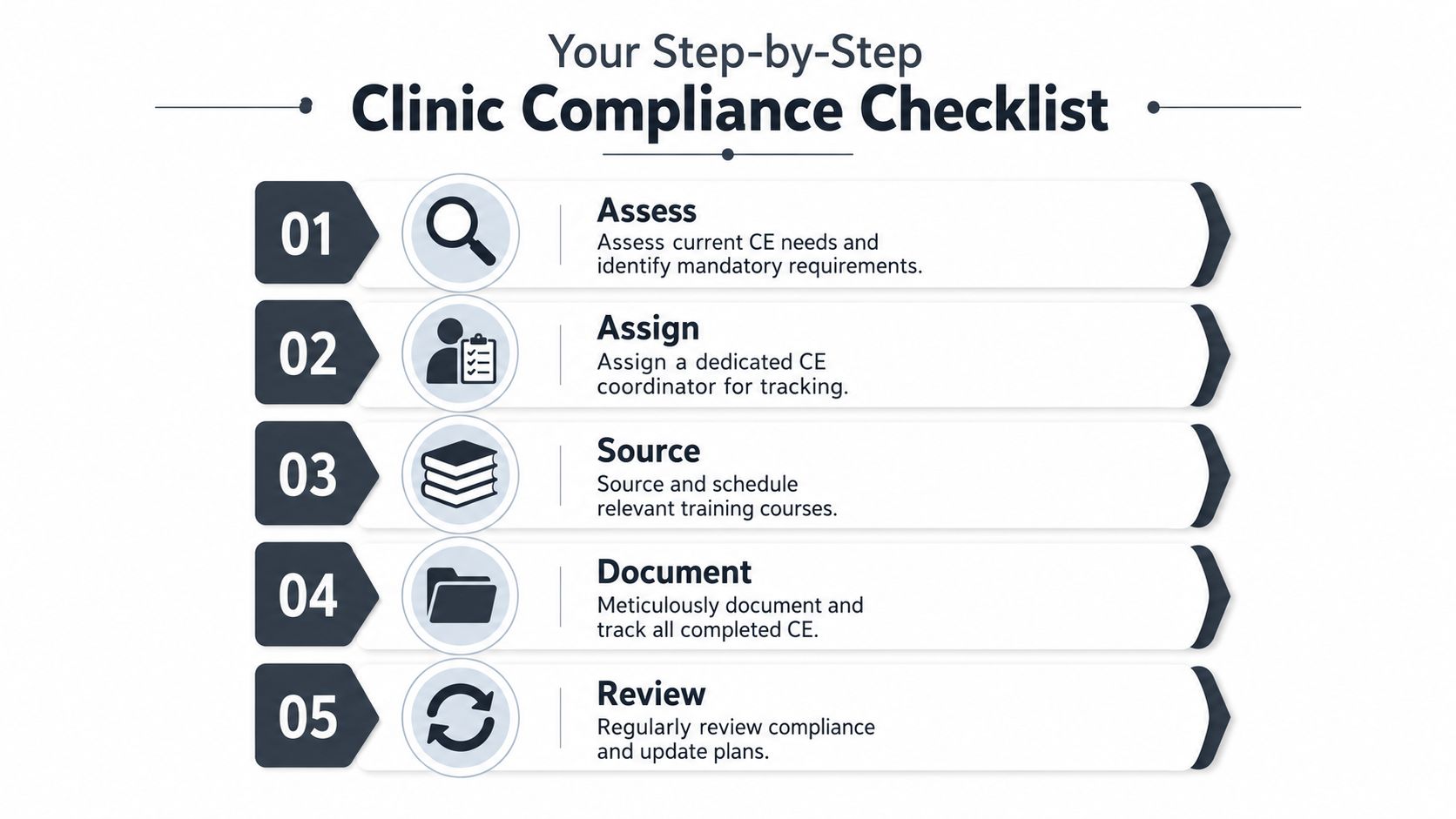
Build a system before you need one
Use this checklist in order:
Map every practitioner to a regulator
Start with names, registration bodies, scopes of practice, and renewal timing. If you skip this step, the rest becomes guesswork.Appoint one internal owner
One person should chase certificates, maintain logs, and flag gaps. Shared responsibility usually becomes nobody's responsibility.Approve training before anyone books it
A good course can still be the wrong course. Vet the provider, the topic, the likely category fit, and the evidence they'll issue on completion.Budget for compliance, not just equipment
Clinics often price the device, consumables, and launch marketing, then underestimate the cost of proper training time, supervised practice, and backfill for staff off the floor.Prepare an audit file continuously
Waiting until renewal or inspection week creates panic. Keep records updated as soon as each activity is completed.
What good compliance looks like in practice
A useful clinic file usually includes:
- A master training matrix with each staff member, role, governing body, and current status.
- Course evidence such as certificates, attendance records, assessment results, and practical sign-offs.
- Scope alignment notes showing which treatments the practitioner may perform, under what supervision, and based on which training.
- Reminder dates for annual and cyclical requirements.
- A policy for missing documents so gaps are escalated quickly.
Manager's shortcut: If you can't hand a document to an auditor within minutes, treat it as missing.
Managers should also think about knock-on costs. If a practitioner's compliance status is uncertain, you may need to pause certain services, reschedule patients, or increase oversight. That affects revenue and staffing. It also affects credibility with patients who expect a clinic using advanced technology to run disciplined processes.
Risk planning doesn't stop at education records. Clinics should also review broader business exposure, especially where treatment advice and procedural services overlap. For that wider view, essential protection for beauty professionals is a useful reference point when assessing operational risk around documentation, treatment delivery, and professional responsibility.
Finding Accredited Courses and Documenting Training
Training only helps if the regulator accepts it and the clinic can prove it happened properly. In aesthetics, that means choosing educational activities with care and building a file that survives questions later.
How to vet a course before paying for it
Before approving any programme, ask five practical questions:
Who is the course meant for
A course may be clinically useful but aimed at a different registration class or scope of practice.What evidence will be issued
Attendance email confirmations aren't enough on their own. You want formal proof of completion.Is the learning structured
A clear agenda, faculty details, learning outcomes, and assessment method make an activity easier to justify.Does it support the practitioner's actual work
Generic beauty education may not help a practitioner performing regulated laser procedures.Can the clinic store it properly
If the course provider's records disappear, the clinic still needs its own copy.
Many teams overvalue convenience. The shortest course, the cheapest webinar, or the easiest certificate may not be the best compliance choice. Clinics should prefer training that leaves a solid paper trail and clearly relates to the procedures the practitioner performs.
What to keep in every training file
Each completed activity should have its own evidence pack. Keep it simple and consistent.
- Certificate of completion with the practitioner's name and activity title.
- Programme or agenda showing what was taught.
- Attendance proof where available.
- Assessment result or practical sign-off if the activity included competence checking.
- Internal note linking the activity to the practitioner's role and treatment scope.
- Storage copy in both the central clinic register and the individual staff file.
A strong filing process also supports treatment governance. If a complaint arises over burns, poor outcomes, or incorrect settings, training documents often become part of the clinic's internal review.
Keep records as if a regulator, insurer, and patient representative may all ask for them separately. Because one day they might.
For laser clinics especially, documentation should tie education to operational control. Training records, treatment protocols, consent workflows, maintenance logs, and incident reports should speak to each other. A disciplined record-keeping system for aesthetic practice makes that easier because it reduces the gap between training completed and training evidenced.
How Omega Lasers Training Aligns with Your CE Goals
A clinic buys a new laser, the supplier trains the team, certificates go into a folder, and everyone assumes the CE side is covered. That assumption is where problems start.

Omega Lasers training can support your continuing education plan, but only if the clinic treats it as documented competence training tied to scope of practice, not just handover on a machine. In South Africa, that distinction matters because there is still a practical gap between device-specific training and what a professional council may accept as formal CEU or CPD activity for a specific registration category.
That grey area affects laser technicians more than clinic owners often expect. A therapist may be fully trained on a device and still not have clear proof that the activity satisfies their formal renewal framework in the way they assumed. The safe position is to use Omega Lasers training for what it does well: building device competence, creating evidence of safe use, and strengthening the practitioner file. Then check separately whether the practitioner's regulator accepts that activity toward formal education requirements, as noted earlier in the article.
Where Omega training adds real compliance value
Good device training closes a risk gap that generic CPD often misses. A practitioner might attend a broader aesthetics course and still lack working knowledge of settings, pulse selection, contraindications, test patching, adverse event response, or when to stop treatment and escalate.
That is where supplier-led training has practical value. If Omega Lasers provides structured teaching on the actual platform used in the clinic, with named attendees, dated certificates, practical supervision, and a defined syllabus, the clinic gets evidence that is directly connected to the treatments being performed.
For clinic managers, that has a financial angle too. If a patient is burned, poorly screened, or treated with the wrong parameters, informal training is hard to defend. Documented device training gives you a far better starting point for internal review, insurer queries, and staff remediation.
How to use it properly for CE planning
Do not treat manufacturer training as an automatic substitute for formal CE or CPD. Treat it as one part of the practitioner's education mix.
In practice, Omega Lasers training aligns best with your CE goals when you do three things:
- Match the training to actual treatments performed by that staff member.
- Keep full evidence of the course content, trainer, date, device, and practical component.
- Log it against the practitioner's professional category so you can decide whether it supports formal renewal, internal competence, or both.
That last point is where many clinics get caught out. One training session may be operationally appropriate for the whole team, but its formal compliance value may differ between practitioners depending on registration status and scope.
What to ask Omega Lasers for before booking
Ask for the paperwork before you pay, not after training has happened.
Request:
- A certificate of completion with the practitioner's full name and the specific device trained on
- A course outline or syllabus showing safety content, indications, contraindications, parameter selection, and practical use
- Trainer identification and training date
- Practical assessment or supervised sign-off if hands-on competence is part of the session
- Clear wording on the training purpose, especially whether it is being presented as device competence training, professional development activity, or both
If Omega Lasers can provide those items consistently, the training sits in a much stronger compliance position. It may not remove the need for separate accredited CPD activity, but it does help the clinic prove that staff were trained properly on the technology they use on patients.
That is the standard worth paying for.
FAQs for Clinic Managers on Continuing Education
What if a staff member is part-time
Part-time status doesn't remove professional obligations. The safer approach is to track the person by registration category and actual treatment duties, not by how many days they work in the clinic. If they perform regulated procedures, keep the same standard of evidence you'd require for full-time staff.
Do online and international activities count
They can be useful, but usefulness and acceptability are not the same thing. Check whether the activity matches the practitioner's governing framework, supports current scope, and produces proper documentation. If there's any doubt, get clarity before paying and before logging the activity as compliant.
What happens if records are incomplete
Treat incomplete records as a live risk issue, not an admin inconvenience. Don't wait for renewal month. Reconstruct what you can immediately, request replacement certificates, document missing items, and decide whether the practitioner should continue performing the relevant treatment until the file is brought up to standard.
Should one clinic policy cover every staff member
No. Use one internal process, but not one educational standard. Your clinic should have a single way of approving, recording, and reviewing training, while the actual requirements differ by profession, scope, and regulator.
Is manufacturer training enough on its own
Not always. Manufacturer training can be clinically valuable and operationally necessary, but managers still need to test whether it fits the practitioner's formal continuing education requirements. The safest approach is to combine supplier training with robust internal records, role-based compliance tracking, and regulator-aware course selection.
What's the most common management mistake
Leaving continuing education to individual staff members without central oversight. Staff may attend good training and still miss required categories, timing rules, or documentation standards. Clinics need one person owning the compliance picture across the whole team.
If your clinic is adding laser or multi-technology treatments, Omega Lasers can help you build a cleaner bridge between device onboarding, documented training, and operational readiness. For clinics that want compliant systems, not just equipment, that matters.