




You're probably sitting with a few tabs open right now, comparing somatology colleges, trying to work out which qualification will really help you build a real career. One prospectus says “advanced”, another says “international standard”, and a short course can look tempting when you want to start earning quickly.
That's exactly where many new students get stuck. The problem isn't only choosing a campus or a timetable. The key decision is whether the course will prepare you for the work you'll perform in a salon, spa, or medical-aesthetic environment, especially when treatments involve skin health, advanced peels, and energy-based devices.
Always ensure the information is accurate and true, as this concerns aesthetic lasers, energy-based devices, and health.
If you're researching somatology courses in South Africa, look beyond brochures. You need to understand the academic pathway, the legal grey areas around practice, and the gap between traditional training and modern device-based aesthetics. That's where good career decisions are made.
Table of Contents
- What Is Somatology and Why Is It a Health Science
- Your Educational Pathway in Somatology
- Accreditation and the Unregulated Reality of Somatology
- What a High-Quality Somatology Curriculum Includes
- How to Choose the Right Somatology College
- Your Career After Graduation and the Need for CPD
What Is Somatology and Why Is It a Health Science
Somatology isn't just about making people look better. It's a health science discipline centred on the skin, the body, treatment safety, and the practitioner's ability to assess before touching a client. That distinction matters because the work often deals with barrier function, inflammation, contraindications, healing response, and device-led interventions.

Why somatology is more than beauty work
A strong somatology foundation brings together anatomy, physiology, dermatology, cosmetic science, hygiene, client assessment, and treatment planning. In practice, that means a therapist isn't only following a facial protocol. They're making judgement calls about whether a peel is appropriate, whether a skin condition needs referral, and whether the client's history changes the treatment plan.
That's why formal study carries weight. According to the Diploma in Somatology programme description, somatology training in South Africa is accredited at NQF Levels 6 through 8, and the standard diploma requires a three-year curriculum with scientifically grounded modules in anatomy, dermatology, and holistic health management, preparing graduates for advanced procedures such as laser therapies and chemical peels.
Short beauty courses have their place. They can introduce basic service skills and help someone test interest in the field. But they don't replace a structured health-science education if your aim is long-term clinical credibility.
Practical rule: If a course teaches treatments without teaching the science behind tissue response, client risk, and contraindications, it's not enough for advanced aesthetic practice.
Why formal study matters
The skin doesn't forgive guesswork. A practitioner who understands inflammation, wound response, pigment risk, and sanitation will work very differently from someone trained only to complete a sequence of steps.
A serious somatology education usually develops these habits:
- Assessment first: reading the skin, history, medication use, and treatment suitability before booking the procedure
- Treatment logic: knowing why one modality is appropriate and another is not
- Safety discipline: recognising when to postpone, modify, or refer
- Professional conduct: documenting properly, working ethically, and protecting the client
In the treatment room, clients often can't tell the difference between a polished sales pitch and genuine competence. Employers can. So can insurers, trainers, and medical-aesthetic practices.
If you want a career with range, not just a job with a treatment menu, start from the health-science side of somatology.
Your Educational Pathway in Somatology
Students often ask which route is “best”. The honest answer is that it depends on the work you want to do later. The wrong choice usually happens when someone picks the shortest option instead of the qualification that matches their intended scope.
The main qualification routes
Here's a practical comparison of the common qualification types you'll come across when reviewing somatology courses in South Africa.
| Qualification Type | Typical Duration | NQF Level | Scope of Practice |
|---|---|---|---|
| Certificate or short course | Short-format study, varies by provider | Often not equivalent to the diploma pathway | Usually suited to basic beauty services and entry-level practical exposure |
| Diploma in Somatology | Three-year curriculum | Level 6 | Broad professional preparation for skin and body treatments, client care, treatment planning, and more advanced aesthetic practice |
| Advanced diploma or degree pathway | Post-diploma or higher academic progression | Levels 7 to 8 | Deeper academic development, advanced practice, education, management, and specialised professional growth |
The biggest mistake I see is assuming all qualifications lead to the same professional standing. They don't. A short course may help you start offering limited services, but it won't carry the same academic depth or professional weight as a full diploma or higher qualification.
How to read the pathway practically
Think about your career in stages, not in months.
If you want to work in a general salon setting, a lower-level entry route may get you into the environment faster. If you want to move into advanced skin work, treatment planning, clinic culture, and technology-led services, you'll need stronger academic preparation.
Use this lens when comparing options:
- Start with the end role: Do you want spa work, skin-focused work, clinic work, education, or ownership?
- Check academic depth: A qualification should develop reasoning, not just routine.
- Review treatment exposure: You need practical training, not only classroom theory.
- Look at progression: Good qualifications leave room for higher study and specialist upskilling.
A qualification should open doors two years from now, not only on graduation day.
Another useful test is to ask what happens after the first job. Can the course still support you when you want to move into advanced facials, peels, consultation-heavy practice, or device-assisted treatments? If the answer is unclear, that's a warning sign.
A strong educational pathway gives you more than a certificate. It gives you language, confidence, standards, and the ability to keep growing without having to rebuild your foundation later.
Accreditation and the Unregulated Reality of Somatology
A student finishes a recognised diploma, walks into her first clinic job, and assumes the qualification settles her professional standing. Then important questions start. Which treatments fall within clinic policy, what can be delegated, what needs medical oversight, and what happens when a client asks for a device-based procedure she was never properly trained to assess?

What accreditation actually tells you
Accreditation answers one question well. It shows whether a qualification sits inside South Africa's recognised education system and whether the programme has academic substance beyond a short skills course.
For somatology, that matters because the training is not limited to beauty routines. It includes health, safety, ethics, client assessment, and the scientific base needed for responsible treatment planning. A recognised qualification signals that the provider has built a formal curriculum rather than a collection of demonstrations.
The deeper issue is what accreditation does not do. It does not create a protected professional register for somatologists, and it does not automatically settle scope questions in every workplace.
A published review of somatology regulation and curriculum explains that South African programmes can be academically demanding while graduates still work in a profession with limited statutory clarity. That mismatch is one of the most overlooked realities in training selection, as discussed in the published review of somatology regulation and curriculum.
The gap students usually discover too late
In practice, academic recognition and legal certainty are different things.
Students often assume that if a college is offering a serious diploma, the profession must already have the same kind of statutory structure seen in other health-related fields. That assumption causes problems later, especially in skin clinics, medi-spa settings, and businesses that use advanced technology.
Without clear profession-specific statutory regulation, the market fills the gap unevenly. One employer may insist on strong consultation standards, supervised practical training, and careful device protocols. Another may put a newly qualified therapist on a machine after a brief in-house handover. Those are not small differences. They affect client safety, practitioner confidence, indemnity risk, and your reputation in the first years of practice.
The regulatory gap also affects how you should judge a course:
- Academic recognition matters, but it is only the starting point.
- Clinic-readiness matters more in an uneven market, because employers do not all apply the same standards.
- Technology training matters, especially if you plan to work around peels, advanced skin treatments, or energy-based devices.
- Documentation and referral judgement matter, because poor boundaries create risk long before a complaint reaches management.
This is why I tell students to ask harder questions than “Is it accredited?” Ask how the college teaches treatment limits, consent, contraindications, escalation, and device safety. Ask whether the practical training reflects real clinic conditions. If your goal is modern aesthetic practice, review the provider's skin care and advanced aesthetic training options and compare that depth with the general diploma content.
Course design also matters here. A provider that understands the profession properly will not build a syllabus around trends alone. It will sequence theory, practical exposure, safety, and professional judgement in a way that prepares graduates for work, which is the same principle outlined in this curriculum development guide.
A recognised certificate can get you interviewed. Good judgement, clear boundaries, and proper technical training are what keep you safe in practice.
For students, the practical takeaway is simple. Choose a qualification with academic standing, then test whether it prepares you for the unregulated parts of the job: inconsistent employer standards, insurance questions, referral limits, and the reality that some advanced devices sit closer to medical risk than many colleges admit.
What a High-Quality Somatology Curriculum Includes
Not all diplomas are equal in the treatment room. Some build excellent foundational judgement. Others still lean too heavily on traditional beauty content and don't prepare graduates for modern aesthetic practice.

The subjects that build clinical judgement
A high-quality somatology curriculum should teach both the “why” and the “how”. When the science is weak, the practical work becomes mechanical. When the practical work is weak, graduates freeze the moment a real client presents with mixed concerns, a complex history, or an unexpected skin response.
Look for a curriculum that includes these core areas:
- Foundational sciences: anatomy, physiology, chemistry, pathology, dermatology, and pharmacology-related understanding
- Treatment application: facials, body therapies, massage, peels, hygiene protocols, consultation, and aftercare
- Client safety: contraindications, infection control, skin assessment, ethics, and documentation
- Business readiness: retail, client communication, professionalism, and basic operational competence
If you've never reviewed a programme critically before, a good way to frame it is to compare the sequence, logic, and practical relevance of modules against a curriculum development guide. It helps you see whether a course is organised around outcomes that matter in practice, rather than only around subjects that sound impressive in a brochure.
Where many programmes fall short
The modern industry expects more than classic spa training. Clinics increasingly want graduates who understand advanced modalities, consultation standards, and the realities of regulated equipment. That's where some programmes still lag.
According to the analysis of curricula at five Universities of Technology, there is a disconnect between academic training and the industry's demand for advanced, regulated laser technology skills, and many programmes don't explicitly address the SAHPRA licensing requirements that apply to devices used in clinical settings.
That matters because device work is not just “another treatment”. It involves:
- Technology literacy: understanding wavelength, indication, tissue interaction, and treatment limitations
- Regulatory awareness: knowing that equipment standards and licensing aren't optional details
- Practical competence: being trained on current systems, not outdated equipment that doesn't reflect real practice
- Clinical judgement: knowing when a device is appropriate and when a manual treatment is safer
A curriculum may be academically respectable and still leave a graduate underprepared for a clinic that uses advanced aesthetic equipment. Before you enrol, compare the formal qualification with supplementary training options in skin care courses that focus on treatment technology, consultation standards, and practical application in a modern aesthetic setting.
A good curriculum doesn't just teach treatment steps. It teaches you how to think when the client in front of you doesn't fit the textbook example.
That's the standard worth paying for.
How to Choose the Right Somatology College
A student walks into my clinic with a fresh qualification, a neat certificate, and shaky hands the first time a real client asks, "Am I a candidate for this treatment?" That gap matters more than the prospectus, the campus photos, or the treatment list on a brochure.
Choose a college the same way you would choose a place to build your professional reputation. Look past the marketing and test whether the training will still serve you three years into practice, when clients are more complex, technology is more demanding, and poor habits are expensive to fix.
Questions worth asking before you enrol
Ask hard questions early. A good college will answer them clearly, without dodging, overselling, or hiding behind polished language.
Use this checklist when you visit or enquire:
- Accreditation status: Ask how the qualification sits within the NQF and what formal recognition it holds.
- Lecturer background: Ask who is teaching practical subjects and whether they have current clinic experience.
- Practical exposure: Ask how often students work on models, what supervision looks like, and how competence is assessed.
- Technology exposure: Ask which devices students train on and whether that equipment reflects what modern clinics use.
- Clinical standards: Ask how the programme teaches consultation, contraindications, consent, infection control, and recordkeeping.
- Workplace readiness: Ask where graduates usually start working and what skills employers consistently expect from them.
Then ask the question many colleges prefer to keep vague. How does the programme prepare students for working in a field that does not have the same statutory structure many health professions have in South Africa? That answer tells you whether the college is honest about the profession you are entering.
A serious programme should also explain the difference between learning treatment steps and being trusted to make treatment decisions. That is where career longevity starts.
What a reliable answer sounds like
Good colleges speak in specifics. They can show you the clinic rooms, explain student supervision, walk you through assessment standards, and tell you what a graduate is ready to do on day one versus what still needs mentorship in the workplace.
Weak colleges rely on broad promises. They talk about confidence, success, and exciting careers, but struggle to explain treatment boundaries, referral judgement, or how students are prepared for SAHPRA-regulated device environments they may encounter after graduation.
Watch for practical signs:
- A good sign: you can see the training space, hygiene systems, consultation flow, and how practical sessions are run
- A good sign: staff can explain how students are taught to document properly, obtain informed consent, and recognise when not to treat
- A warning sign: the sales conversation focuses on glamour, uniforms, and treatment variety, while avoiding regulation, safety, and accountability
- A warning sign: the college lists many treatments but cannot explain how students build depth, repetition, and clinical judgement in each one
Students who are still deciding between a broader beauty route and a more health-science-based path should compare somatology with beauty therapy courses in Cape Town before enrolling. The right choice depends on where you want to work, how clinical you want your role to become, and whether you plan to move into advanced skin and device-based practice later.
One more practical point. If your long-term plan includes private practice, mobile services, or a niche clinic model, start thinking like an owner while you study. It helps to validate your business idea before you invest further in specialised training, stock, or equipment.
If a college only tells you what you can perform, but not what you will be accountable for, the training is incomplete.
The right college gives you more than a qualification. It gives you judgement, professional discipline, and a realistic starting point for the kind of work South African clients and clinics will expect from you.
Your Career After Graduation and the Need for CPD
Graduation is the start of professional life, not the finish line. The qualification gets you into the room. Your judgement, standards, and ongoing learning determine whether you stay there and grow.
Where the qualification can take you
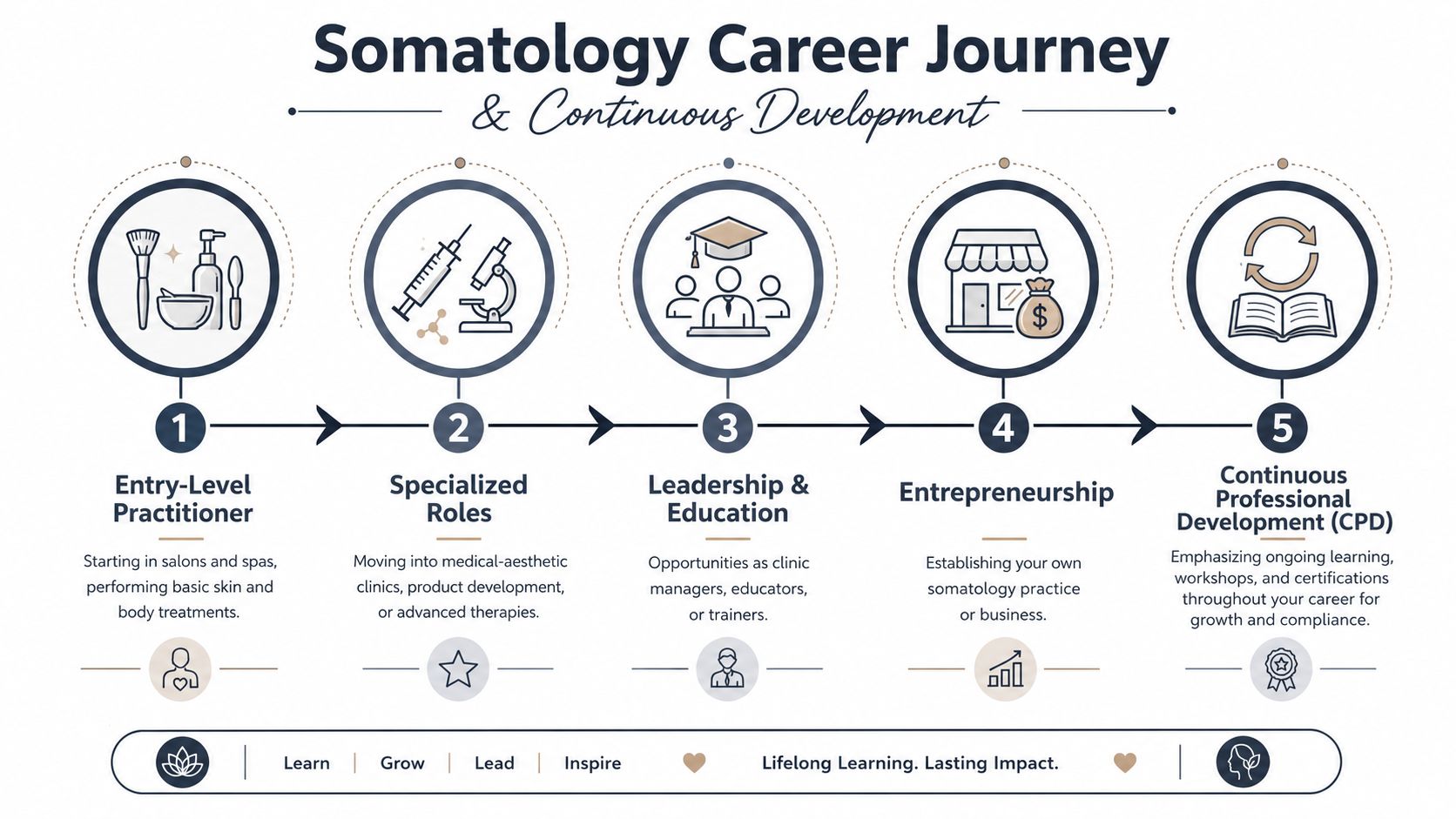
A solid somatology qualification can lead into several directions. Some graduates start in salons or destination spas. Others move toward skin-focused clinics, front-of-house consultation roles, education, sales support, training, or eventually business ownership.
The progression usually depends on three things:
- Your foundation: how well your original training developed technical and professional habits
- Your environment: whether your workplace values standards, supervision, and real treatment growth
- Your willingness to specialise: advanced skin and technology work require more study, not less
I always tell younger therapists not to rush the wrong opportunity. A role that gives you disciplined consultation training and proper supervision is often better than one that lets you perform more treatments before you're ready.
Why CPD matters in real practice
In an unregulated statutory environment, professional development becomes even more important because the field still needs mechanisms that support competence. According to the SAAHSP recognition note on CPD-linked qualifications, the South African Association of Health & Skincare Professionals recognises specific somatology qualifications that qualify professionals for Continuing Professional Development (CPD) points, creating an industry-led way to maintain competency where state regulation is absent.
That matters for career longevity. Techniques change. Devices evolve. Safety expectations rise. Client questions become more complex. If you stop learning after graduation, your practice will eventually show it.
Focus your CPD on the areas that strengthen both credibility and employability:
- Advanced skin knowledge: peels, skin assessment, pigmentation awareness, and treatment planning
- Technology training: safe, indication-based use of modern devices
- Professional systems: consent, records, photography protocols, and client communication
- Business growth: consultation conversion, retention, team leadership, and service design
If your long-term goal is ownership, spend time learning the business side before signing a lease or buying equipment. A practical starting point is this guide on how to validate your business idea, because many talented therapists underestimate what it takes to turn treatment skill into a sustainable service business.
You should also look at structured skill development courses that help bridge the gap between qualification and advanced practice, especially if you want to move into device-based services or more specialised treatment environments.
The strongest somatologists keep studying. Not because a brochure tells them to, but because clients can feel the difference between a practitioner who is current and one who is coasting.
A good career in somatology is built in layers. First your qualification. Then your practical confidence. Then your standards. Then your specialisation.
If you're building a career in advanced aesthetics, the right technology partner matters as much as the right training pathway. Omega Lasers supports clinics, salons, and aesthetic professionals with FDA-approved, CE-certified, SAHPRA-licensed devices, hands-on training, technical support, and business guidance that help practitioners work safely, stay current, and grow with confidence.