



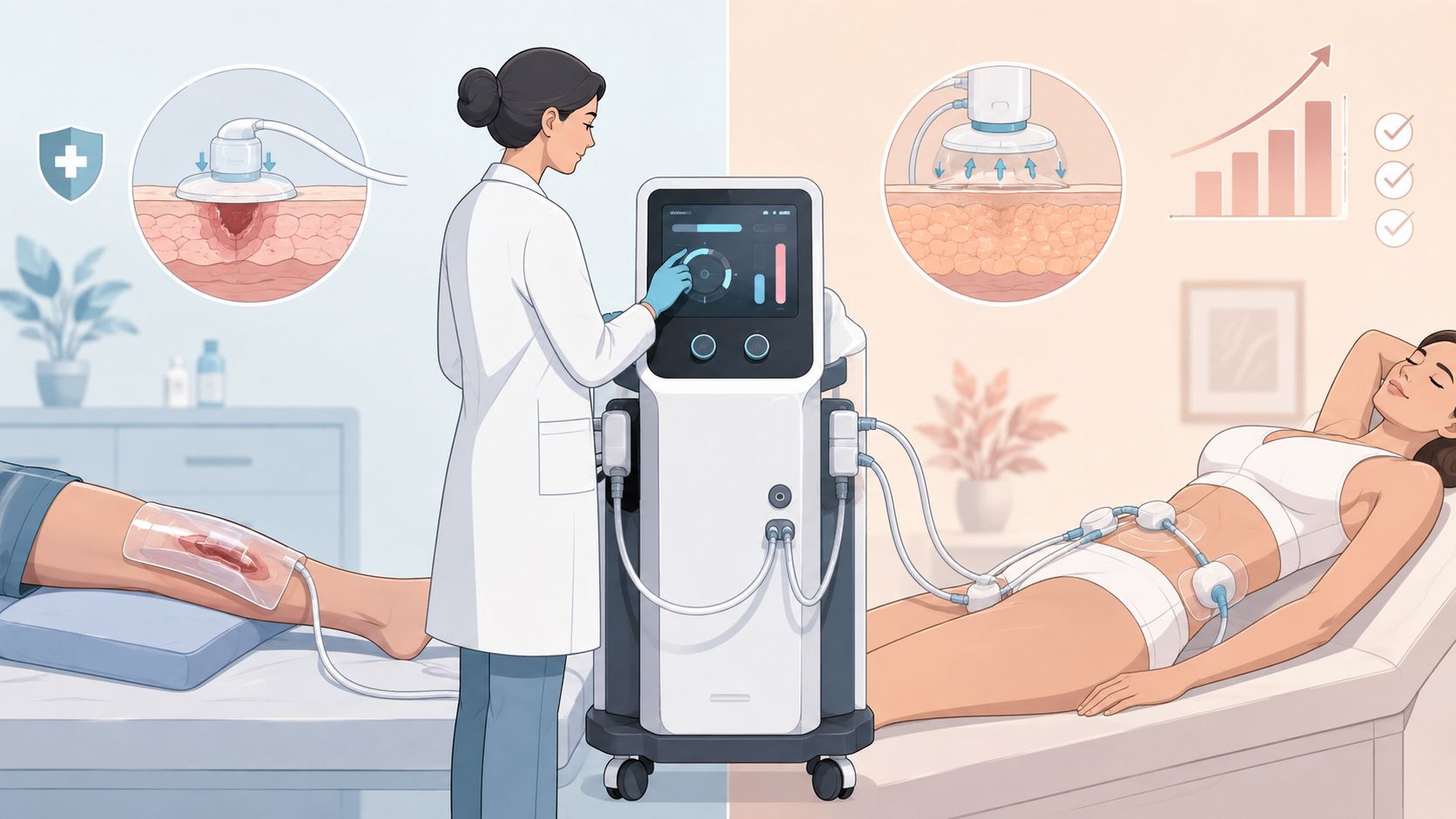
Most advice on a vacuum therapy machine gets the category wrong from the start. Clinics are often sold a single story about lifting, shaping, or “detox”, yet the same suction mechanism sits in two very different worlds, medical negative-pressure wound therapy e aesthetic vacuum therapy, and the buying decision changes completely depending on which one you need.
That distinction matters in South Africa because the device category is no longer niche. The wound-care pathway goes back to the 1990 invention of vacuum-assisted closure, the first patent in 1991, FDA approval in 1995, and millions of patients treated worldwide since then, according to Wake Health's history of V.A.C. therapy. The broader vacuum therapy devices market is also a mature, expanding category, estimated at USD 2.0 billion in 2025 and projected to reach USD 3.3 billion by 2035 em um 5.0% CAGR by Future Market Insights, with a separate estimate placing it at USD 2.1 billion in 2025 e USD 3.5 billion by 2034 em um 6.2% CAGR. That scale usually translates into better parts availability, more training material, and more predictable vendor support for clinics that buy carefully.
If you're choosing a system for a salon or medical aesthetic practice, the first question isn't “Does vacuum therapy work?”. It's “Which problem am I buying for, what evidence supports it, and what claims can I make?”
Índice
- What a Vacuum Therapy Machine Actually Is
- How Controlled Suction Changes Tissue
- Clinical Indications With Real Evidence
- Separating Temporary Plumping From Real Remodelling
- Treatment Protocols and Parameter Settings
- Safety, Contraindications, and Regulatory Scope
- Fitting Vacuum Therapy Into a Multi-Modality Menu
- ROI, Training, and Procurement Checklist for Clinics
What a Vacuum Therapy Machine Actually Is
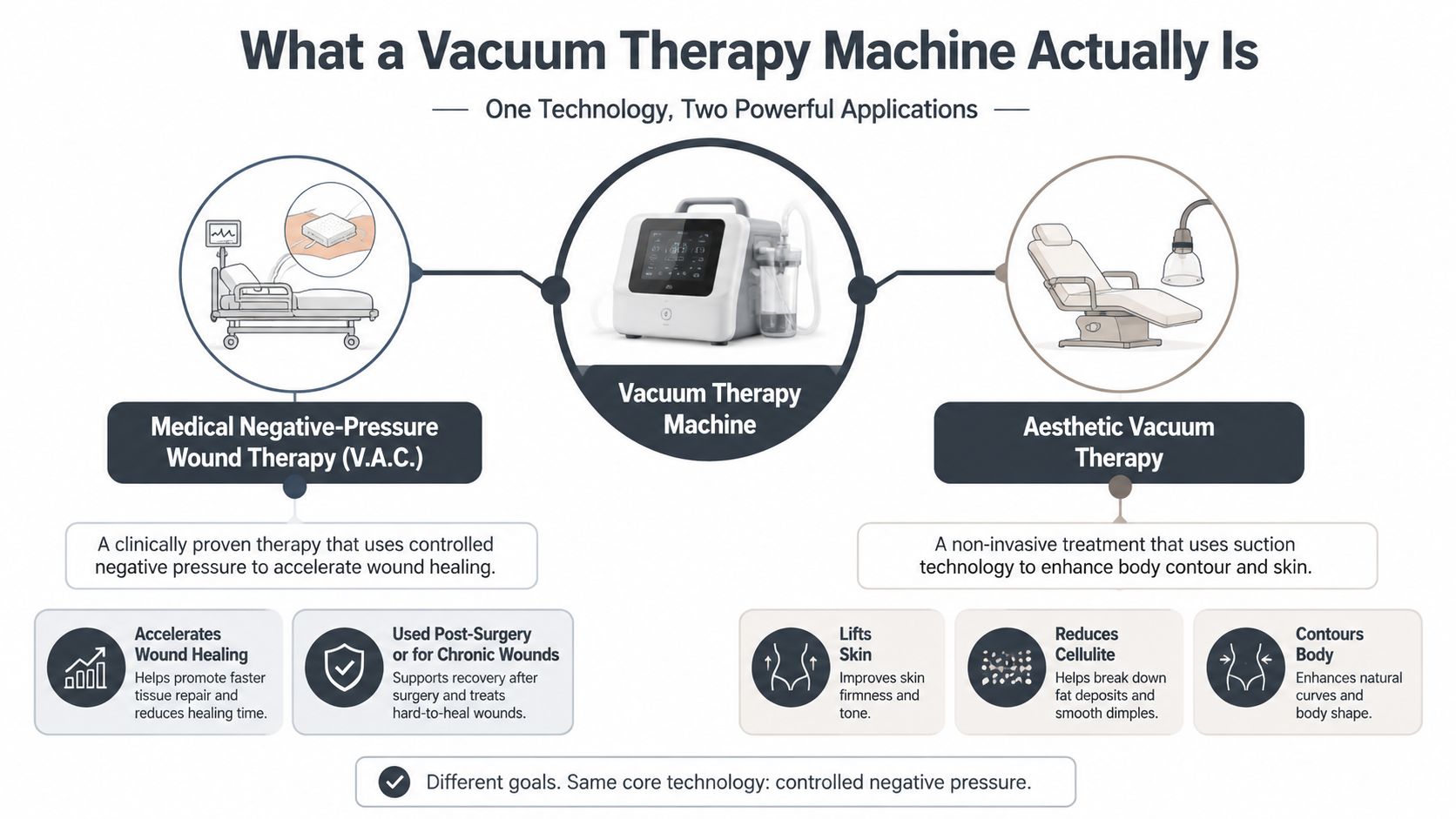
A vacuum therapy machine is not one neat product category. It's a shared mechanism, controlled negative pressure, applied to two different clinical goals, and those goals should never be blurred together in a purchase pitch or marketing brochure.
On the medical side, vacuum-assisted closure is a wound-care technology with a long regulatory trail and durable clinical use. Wake Health's history notes that Louis Argenta and Michael Morykwas developed the suction-based device in 1990, filed the first patent in 1991, and received FDA approval in 1995. That's important because it shows the technology isn't experimental novelty. It's a recognised wound-management category with a defined place in care for diabetic ulcers, burns, and traumatic wounds, among others, and it has been used on millions of patients worldwide. Wake Health's historical overview of V.A.C. therapy is a good reminder that the medical branch of this field is built on decades of adoption, not wellness trend language.
The aesthetic branch uses the same suction principle for a different purpose. Clinics market it for body contouring, lymphatic-style stimulation, or cellulite-focused treatments. That doesn't make it the same as wound therapy, and it doesn't make the evidence base equally strong. It means the machine family overlaps while the clinical claims do not.
Regra prática: if a supplier cannot tell you whether the unit is intended for wound care, body contouring, or both, the conversation is already off track.
For South African buyers, the global market context matters too. A category with a projected multi-billion-dollar future tends to attract more device options, more accessories, and more after-sales infrastructure, but it also attracts more overpromising. That's why the buyer has to separate utilização prevista, regulatory scopee marketing promise before comparing price tags.
For a clinician or clinic owner, the clean way to explain it is simple. A vacuum therapy machine is either a medical negative-pressure wound device or an aesthetic suction device. The mechanism overlaps, the obligations don't.
How Controlled Suction Changes Tissue
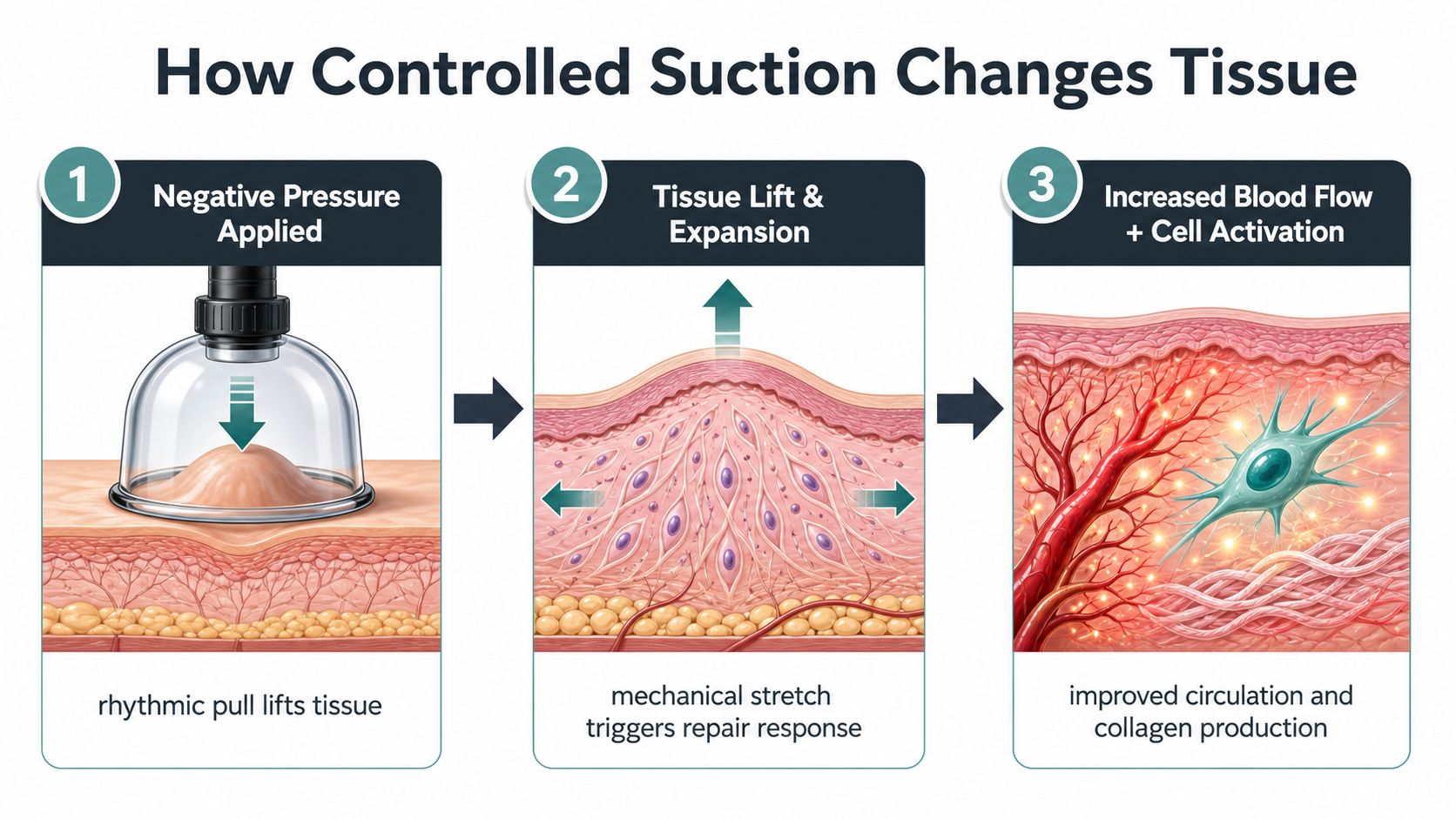
Think of controlled suction as a rhythmic lift on tissue, not a hard yank. The point is to pull tissue just enough to change local mechanics, then release it in a way the body can tolerate. That's why the pressure setting matters so much.
Clinically useful devices don't just switch on and off. The market examples in the brief expose adjustable negative pressure ranges such as 100–500 mbar with pulse rates from 6 to 60 pulses/min, ou 0–0.4 bar pulsed or continuous operation, and up to 0–0.6 bar continuous adjustment. Those ranges tell you the machine is supposed to be tuned to the area, the tissue response, and the goal of the session, not used as a one-size-fits-all suction source. The device specification example shows why a clinician should care about pressure granularity rather than headline suction alone.
Mechanics you can actually feel
In wound care, controlled negative pressure does more than lift skin. A review in the wound-healing literature describes a moist wound environment, improved perfusion, reduced oedema, altered wound fluid composition, and mechanical forces that stimulate a biological response. It also notes that standard VAC therapy can generate tissue strains of 5–20%. That's a useful threshold because it moves the topic away from vague “massage” language and into measurable tissue mechanics. The wound-care review on VAC mechanisms is one of the clearest references for how suction translates into biological effects.
Aesthetic operators often describe the sensation to clients as a pull-and-release pattern. That description is more honest than saying the machine “breaks fat” or “melts cellulite”. The device is mechanically loading tissue, and the response depends on how long, how hard, and how often that load is applied.
If the pressure is too aggressive, the tissue response can shift from stimulation to irritation. If it's too mild, nothing useful happens.
For anyone wanting a plain-language refresher on body structures involved in this process, a basic resource on anatomy for medical researchers can help staff align their language with what they're seeing on the treatment table.
Why tissue mechanics matter in practice
In aesthetics, the practical use of these mechanics is usually tied to superficial mobilisation, fluid movement, and transient tissue lift. In wound management, the same physics supports wound-bed preparation and granulation tissue formation. Those are different endpoints, and a good clinic protocol should name the endpoint before it names the setting.
That distinction helps with training too. Operators who understand strain, pulsation, and tissue response are much less likely to chase a higher number just because the machine allows it. The best sessions usually come from measured adjustment, not from maximum suction.
Clinical Indications With Real Evidence
The strongest case for a vacuum therapy machine sits in wound care and a few defined medical applications, not in generic body-shaping claims. The evidence trail is uneven, so clinics need to be precise about where the machine earns its keep.
Onde as provas são mais sólidas
The medical category has the clearest historical and regulatory footing. As noted earlier, Wake Health documents the invention timeline, first patent, and FDA approval of V.A.C. therapy, and the technology has since been used on millions of patients worldwide. That matters because wound care is a real clinical use, not a cosmetic reinterpretation of suction.
For erectile dysfunction, one long-term study of the vacuum constriction device reported regular use by 69% of one patient group and 70% of another, with patient satisfaction of 82% e 84%, and partner satisfaction of 87% e 89%. The same study found that the median number of successful intercourse episodes per month increased from 1 before the device to 4 during and after use in one group, which is the kind of outcome clinicians can discuss with patients in functional terms. The PubMed study on vacuum constriction devices gives concrete numbers that are more useful than broad claims of “improved performance”.
Where the evidence is weaker
Penile elongation is a good example of the limits. A study of 37 sexually active men with a stretched penis length under 10 cm used vacuum treatment three times per week for 20 minutes per session over 6 months. The mean length changed only from 7.6 cm to 7.9 cm, efficacy was about 10%, patient satisfaction was 30%, and adverse events included one penile haematoma and one case of glans numbness, both of which resolved spontaneously. The authors concluded the method was not effective for penile elongation. The PubMed report on penile elongation is useful precisely because it prevents overclaiming.
| Indicação | Nível de evidência | Typical Outcome |
|---|---|---|
| Wound care with VAC therapy | Stronger historical and clinical foundation | Supports wound management and granulation-focused care |
| Erectile dysfunction support with vacuum constriction devices | Moderate, with measurable functional outcomes | Can improve intercourse frequency and satisfaction in suitable patients |
| Penile elongation | Weak | Minimal change, low satisfaction, not effective in the cited study |
The broader lesson is straightforward. Vacuum-based technologies can be useful, but only when the indication, outcome measure, and patient selection are tight. Once the claim becomes “this machine does everything”, the evidence stops cooperating.
Separating Temporary Plumping From Real Remodelling
Most aesthetic sales pages blur the line between temporary cosmetic plumping and durable tissue change. That gap is where clinics either build trust or lose it.
The research brief points to a review of vacuum massage that found “little evidence for the efficacy” and said the overall quality of studies was poor. That is the kind of line a clinic owner should take seriously, because it means the field has more marketing certainty than data certainty. The practical implication is straightforward. Do not sell suction as a substitute for surgery, and be cautious about promising cellulite reduction, circumference change, or lasting contour change unless your own protocol and follow-up support the claim. For clinics considering more advanced remodelling, a Morpheus8 treatment uses a different mechanism and should be framed that way.
How to frame the client conversation
A more honest consultation sounds like this. A client may leave looking a bit smoother, more lifted, or more flushed after a session, but that does not prove long-term remodelling. If results are real, they usually need repeated sessions, disciplined aftercare, and clear maintenance planning.
The mistake many clinics make is packaging every result as if it is permanent. That creates short-term excitement, then disappointment when the tissue settles back. A better approach is to separate:
- Immediate effects, which can include visible plumping or a lifted look after treatment.
- Course-based effects, which depend on repeated sessions and a consistent protocol.
- Maintenance effects, which are the most realistic expectation for many aesthetic buyers.
Where the sales pressure gets dangerous
Some providers push vacuum therapy as if it can replace surgery or mimic advanced contouring procedures. That framing does not hold up well against the evidence base described above. It can still be a useful service, but it should be sold as a supportive, lower-intensity modality, not as a surgical substitute.
Practical language for staff: “You can expect an immediate cosmetic response and, for some clients, a course-based improvement. We do not position this as a replacement for procedural body contouring.”
That sentence protects the clinic. It also makes the treatment easier to integrate into a broader aesthetic plan, because it sets the right expectation from the start.
Treatment Protocols and Parameter Settings
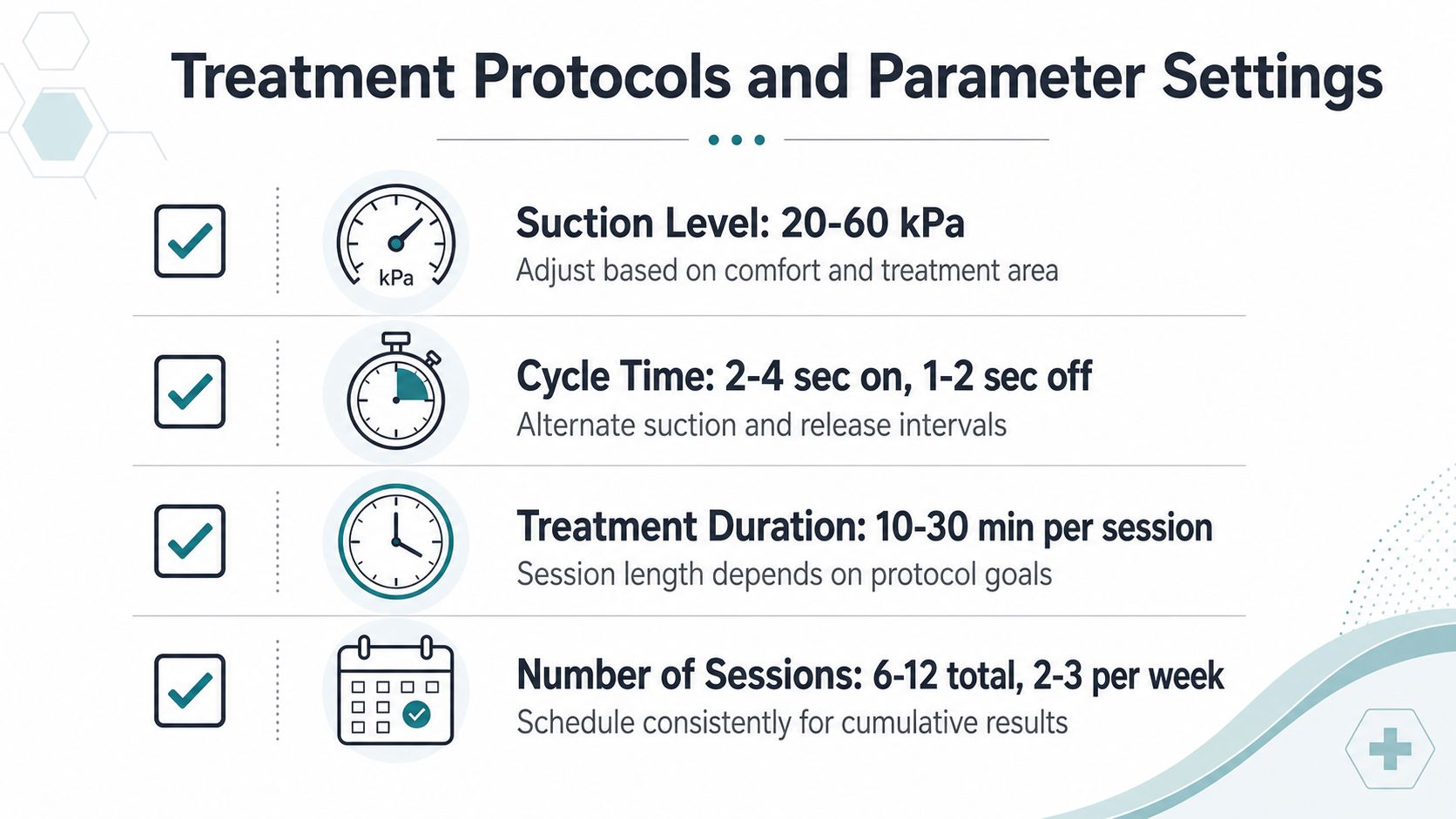
Good vacuum therapy is mostly about titration. Start too high and you bruise tissue, chase redness, or create client discomfort. Start too low and the session becomes expensive theatre.
The device brief shows that clinically useful machines commonly offer adjustable suction and pulsation, which is the whole point of the platform. For body work, the operator should think in two modes, continuous e pulsed negative pressure. Continuous suction gives a steadier load, while pulsed delivery is easier to use when the goal is lighter stimulation and better tolerability.
A practical session framework
A working protocol in a clinic usually needs four decisions before the session starts.
- Suction level: use the lowest setting that creates a visible but comfortable tissue lift.
- Mode: choose pulsed suction for more delicate or lymphatic-style work, continuous suction when deeper mechanical load is intended.
- Timing: keep the session length within a planned window instead of letting the treatment drift.
- Course structure: decide in advance whether the client is on an initial series or a maintenance schedule.
The visual checklist above gives a generic protocol structure, but the discipline is to adapt it to skin response and client feedback. The machine is not the protocol. The operator is.
How to titrate in the room
Start low, then increase only if the tissue responds well. Watch capillary refill, look for excessive erythema, and ask whether the sensation is firm or sharp. If the client reports pain, pinching, numbness, or lingering soreness, stop and reduce the setting immediately.
The best session is the one that can be repeated safely next week.
That principle matters more than any single number on the display. A clinic should also document the final pressure range, body area, and client reaction so the next session can be adjusted instead of guessed.
For course planning, keep the logic simple. An initial block of treatments makes sense when you're trying to assess response, and maintenance makes sense when the client wants to hold a look or sensation that fades between visits. The right cadence depends on the indication, but the habit of documenting response is what turns a machine into a service line.
Safety, Contraindications, and Regulatory Scope
Safety is where vacuum therapy either becomes a disciplined service or a liability. The machine may be non-invasive, but the wrong client, wrong setting, or wrong claim can still create problems.
The most relevant contraindications in an aesthetic setting include active infection, bleeding disorders, vascular disease, deep vein thrombosis, unexplained lumpse diabetes with peripheral neuropathy. Neutral medical guidance also treats these as meaningful red flags for vacuum or negative-pressure based treatments. In plain terms, the therapy is not universally benign, and screening has to happen before the first session, not after a complication.
What to ask before treatment
A proper intake should check for recent injury, clotting history, known vascular problems, sensory loss, unexplained swelling, and any area that feels abnormal to the client. If the treatment region has a suspicious lump, signs of infection, or a history that suggests vascular risk, the safest move is referral rather than treatment.
The regulatory boundary matters just as much. A wound-care VAC system is a medical device for a defined clinical use, while aesthetic suction devices sit in a different treatment category. Clinics that blur the two can drift into misleading claims quickly, especially if staff start describing cosmetic treatment as if it were wound therapy. That's where training, documentation, and intended use need to stay aligned.
For anyone building a quality process around device selection and oversight, medical device quality assurance explained is a useful reference point for the mindset, even if your local compliance obligations are different. It reinforces the basic principle that device quality is not just about the hardware, it's about records, checks, and controlled use.
A simple pre-session safety check
- Screen for infection: don't treat through redness, heat, discharge, or unexplained pain.
- Check vascular risk: ask about clotting issues, DVT history, and major circulation problems.
- Confirm sensation: avoid areas with reduced protective sensation, especially in clients with neuropathy.
- Inspect the skin: skip fragile, broken, or suspicious tissue.
- Escalate borderline cases: if the history is unclear, refer rather than improvising.
For a clinic, this is not bureaucracy. It's how you keep a low-risk modality low-risk.
The internal standard should be as clear as any competency process used for energy-based devices, which is why a structured approach to competency assessment is worth adopting even for suction-based services. If staff can't explain who should not be treated, they're not ready to run the machine unsupervised.
Fitting Vacuum Therapy Into a Multi-Modality Menu
A vacuum therapy machine usually performs best as part of a broader service menu, not as the centrepiece. That's the commercial reality clinics need to accept.
Vacuum therapy is a low-friction, entry-level service in many practices. It's easier to explain than heat-based remodelling, less intimidating than invasive work, and often useful as a bridge into other treatments. It does not replace muscle-focused body contouring, heat-driven remodelling, resurfacing, or laser services. It supports them when the clinic uses it intelligently.
Where it tends to fit well
Aesthetic operators often use suction-based work around body programmes when the goal is comfort, perceived smoothness, or a preparatory lymphatic-style session. That makes sense before or after more intensive contouring work, provided the practitioner isn't pretending the suction alone is doing all the heavy lifting.
Vacuum therapy also makes operational sense because it can be delivered with relatively straightforward staff training compared with more technically complex platforms. That can make it a good lead service for new clients who aren't ready to buy a higher-ticket treatment immediately.
Where it doesn't belong
It's a poor substitute for procedures whose mechanism is completely different. A muscle-focused body device, RF microneedling, fractional resurfacing, or laser hair removal all solve different problems. If a client needs texture improvement, tone correction, or hair reduction, suction is not the answer.
The smartest menu strategy is to use vacuum therapy as a supporting service, not a one-device clinic identity. That reduces overreliance on one modality and creates a cleaner client journey.
Clinics usually make more durable decisions when each device has one clear job.
That's the test. If the machine has a crisp role in intake, a clear place in the appointment flow, and a sensible upsell or referral path, it earns its shelf space. If it's just there because the market says “vacuum” sells, it probably won't hold its own.
ROI, Training, and Procurement Checklist for Clinics
If you're buying a vacuum therapy machine, the commercial question is not what it costs. The question is whether your team can run it safely, position it transparently, and fit it into a service ladder that clients understand.
Vacuum therapy usually has low consumable pressure compared with many aesthetic platforms, so the economic case often depends more on throughput e package design than on disposables. If the machine is positioned as a gateway service, it can help fill the calendar and move clients into more advanced treatments later. If it's treated as a stand-alone miracle treatment, it tends to underperform.
O que deve ser verificado antes de assinar
- Profundidade de formação: make sure the supplier offers hands-on protocol training, not just a demo.
- Apoio técnico: ask who helps when suction, tubing, or control issues appear.
- Regulatory fit: confirm the device's FDA, CE, and SAHPRA status where relevant to the intended use.
- Condições de garantia: check what the warranty covers and how long support lasts.
- Marketing help: favour suppliers that help you explain the service clearly, not just deliver a box.
The buying decision should also reflect your clinic's existing stack. If you already have higher-value modalities, vacuum therapy may work best as an introductory or complementary line. If you're building a new practice, it can be a manageable first service, provided the staff know how to screen, set parameters, and explain limits without overselling.
For a structured way to think about payback, return on investment calculation is a useful financial discipline to apply before procurement. Don't guess at break-even. Map your likely treatment volume, your consultation conversion rate, and the role this service plays in the wider menu.
A good vacuum platform should do three things: fit your regulations, fit your staff's competence, and fit your client story. If it fails any one of those, keep shopping.
If you're comparing device options for a South African clinic and want a clearer view of what fits your menu, your compliance obligations, and your revenue model, speak with Lasers Omega. They work with aesthetic practices that need regulatory-ready systems, training, and commercial support, which is exactly the combination a vacuum therapy buying decision should demand.