



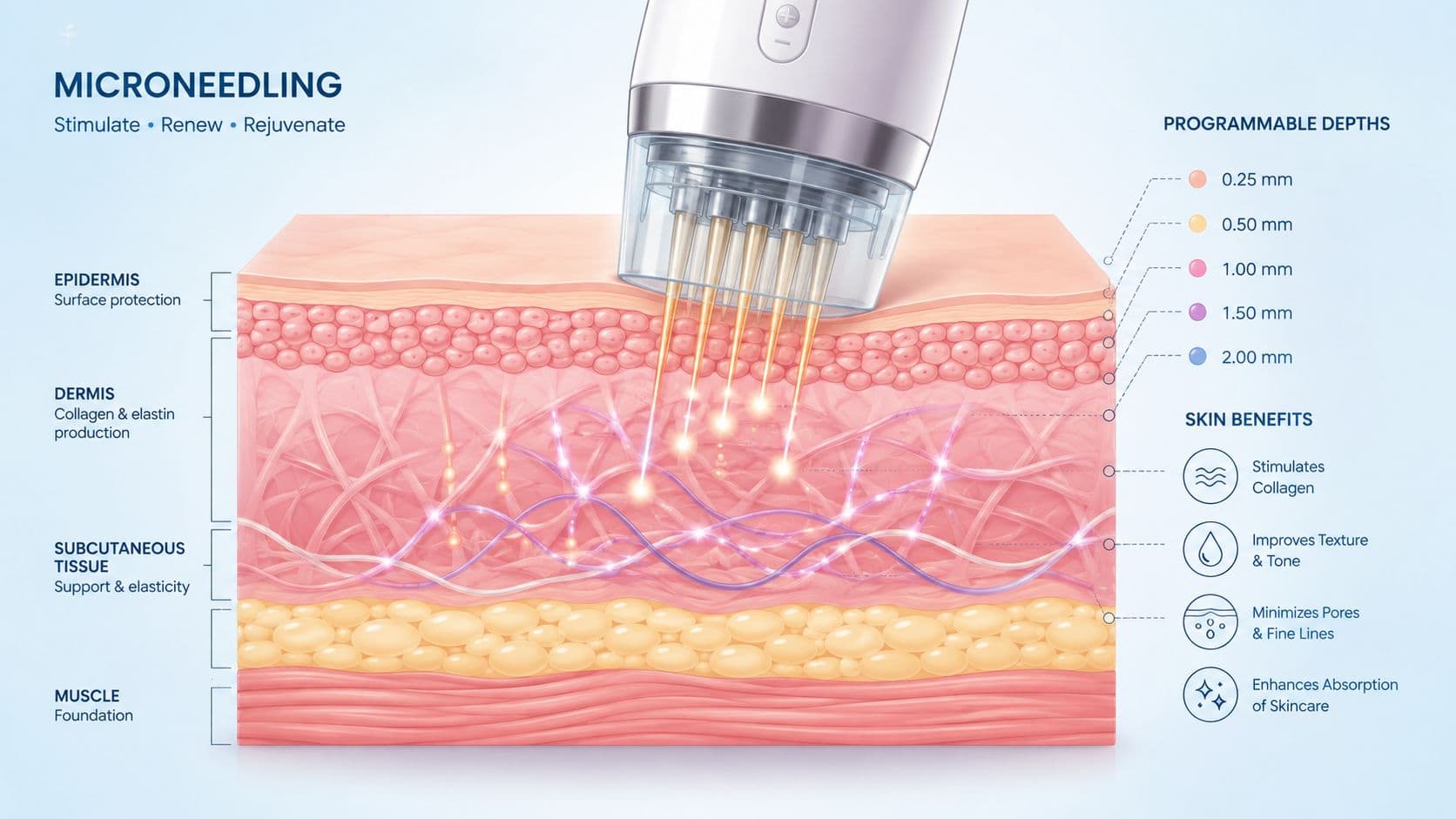
You're sitting in a consult room, or maybe you're on the clinic side watching patients ask for firmer skin, softer acne scars, and less downtime than a resurfacing laser. Morpheus 8 treatment sits right in that gap. It's a fractional radiofrequency microneedling system that uses controlled heat at programmable depths to remodel skin, and the practical question for both patient and clinic owner is simple, what does it really do, who does it suit, and when is it the wrong choice?
The best way to judge it is to separate the marketing from the mechanics. Morpheus8 isn't “magic needling”, it's a depth-based energy device that changes how tissue heals, with the collagen response, downtime, pigmentation risk, and expected course all tied to how the handpiece is set and who is treating the skin. For South African readers, that matters even more because access, darker skin safety, and realistic pricing all shape whether the treatment is useful or just aspirational.
Índice
- What Morpheus 8 Treatment Actually Does to Skin
- The Technology Behind the Needle
- Clinical Evidence and Expected Results
- The Full Patient Journey From Consultation to Recovery
- Safety, Side Effects, and the Darker-Skin Question
- Morpheus 8 Compared to Other Skin Treatments
- Adding Morpheus 8 to Your Clinic the Smart Way
- Questions Patients and Clinics Still Ask
What Morpheus 8 Treatment Actually Does to Skin
A patient often arrives after a long run of “almost right” solutions. The skin is a bit looser than it used to be, the acne scars aren't dramatic but they're still there, and the face has lost that clean, firm look. On the clinic side, the owner sees a service that books well because it promises something patients want, a visible change without the full recovery of surgery.
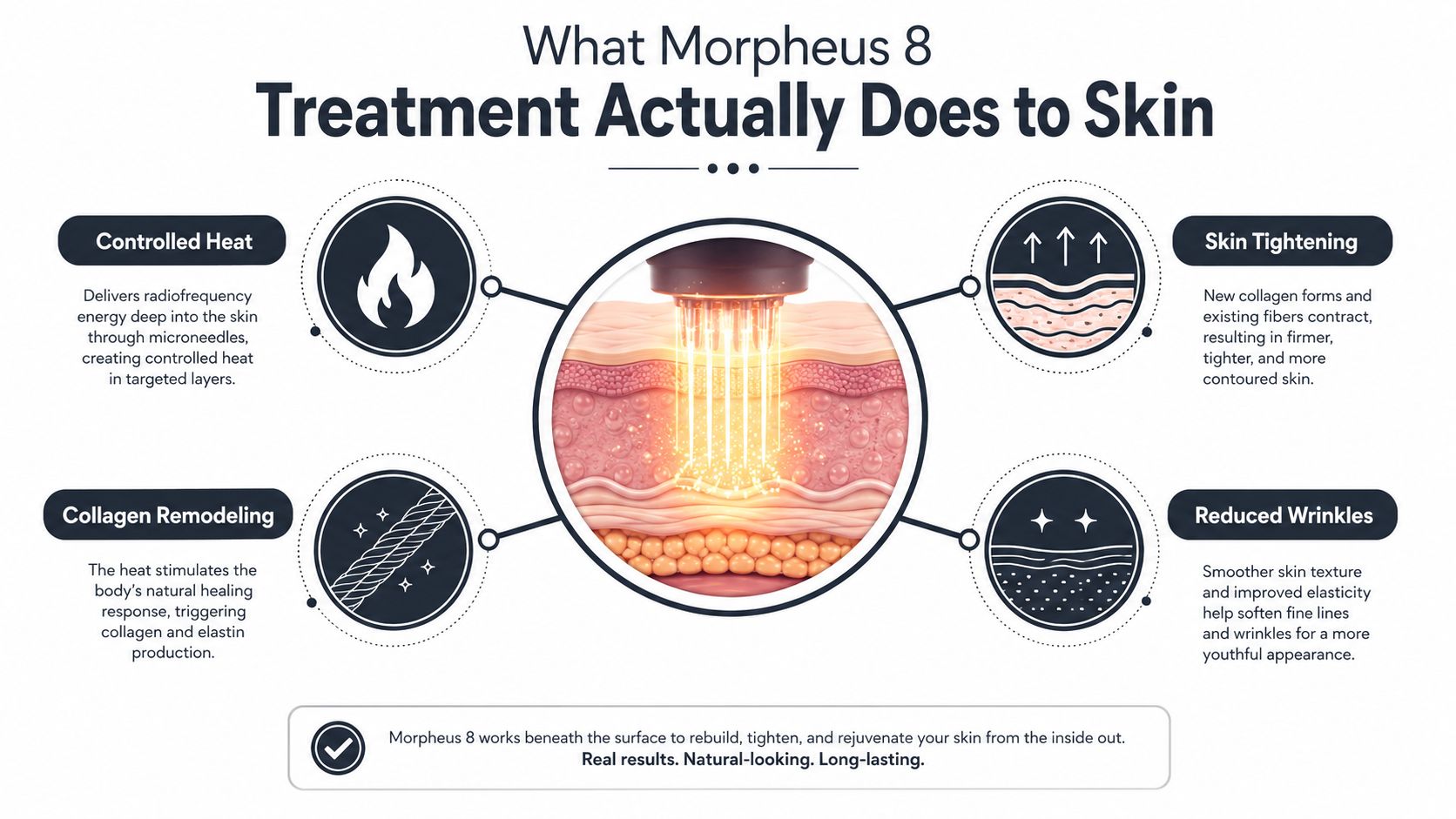
Morpheus8 works by pairing microneedling com radiofrequency heat. The needles create controlled micro-injuries, then the RF energy heats deeper tissue so the skin responds with repair, tightening, and new collagen and elastin formation. That combination is why it's used for texture, laxity, scars, and contour-adjacent concerns rather than simple surface polishing, as described in clinical treatment summaries and patient education material from the treatment ecosystem itself (RealSelf).
Why the result looks gradual rather than instant
The first visible change is often a tighter, slightly fresher look, but the value comes later as the wound-healing response builds. That delayed improvement is part of the appeal for patients who want change without looking “done”. It's also why a consultation has to focus on timing, because the skin you see on treatment day is not the skin you'll judge three months later.
Regra prática: If a patient wants a dramatic overnight transformation, Morpheus8 is usually the wrong expectation, even when it's the right technology.
For clinic owners, the message is equally blunt. Selling it as a quick surface fix undercuts the mechanism. Selling it as a controlled remodeling treatment sets the right conversation from the start and reduces post-treatment disappointment.
The Technology Behind the Needle
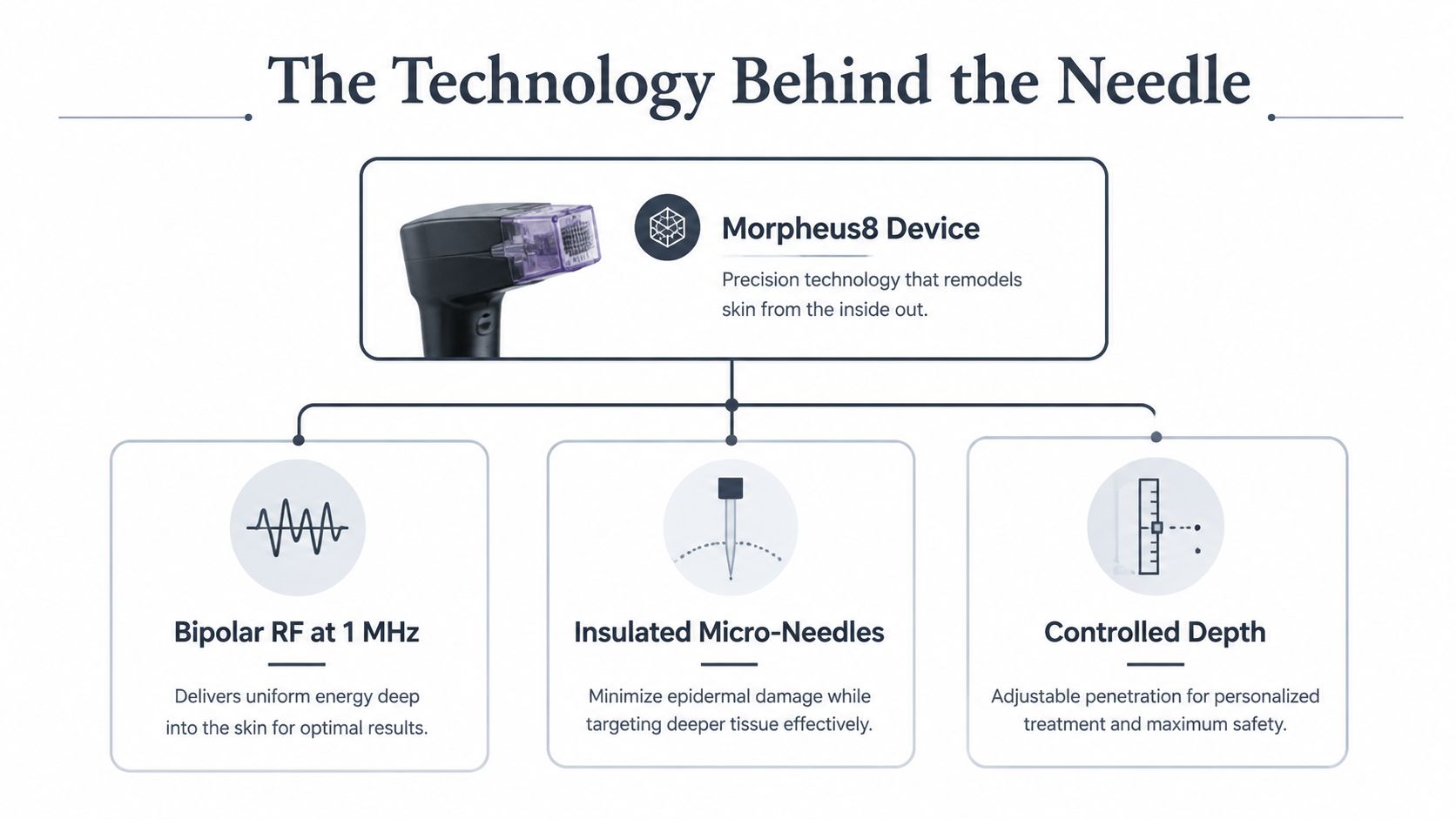
Morpheus8 delivers microneedling e radiofrequency heat in the same treatment pass. The needles create controlled channels in the skin, then the RF energy heats the tissue below the surface so the body responds with repair, tightening, and new collagen and elastin formation. That combination is why the device is used for texture, laxity, scars, and contour-adjacent concerns rather than simple surface polishing, and the mechanism is consistent with the clinical treatment summaries and patient education materials around the platform (SkinCeuticals professional treatment overview).
The practical advantage is depth control. Surface injury is limited, while the energy is placed where the clinician wants thermal change. In a clinic setting, that difference matters because it lets you treat the dermis and, with body treatment, deeper tissue planes without turning every session into a broad thermal burn.
Depth is the primary treatment variable
Professional materials describe facial penetration depth of up to 4 mm, with about 1 mm of tissue heating ability beyond that (SkinCeuticals professional treatment overview). The body platform goes deeper. Morpheus8 Body uses a 40-pin fractional RF microneedling tip with programmable depths of 2, 3, 4, 5, 6, and 7 mm, plus a 7 mm thermal profile and an additional 1 mm heat profile for a maximum effective reach of 8 mm (technical device documentation).
That depth range changes what the treatment is doing. At lower settings, the work stays closer to the skin. At greater depth, the device reaches into the subdermal adipose layer, which is why the body applicator is used differently from a facial tip. For a clinic owner, that means the handpiece choice should follow anatomy and endpoint, not marketing language. For a patient, it explains why a jawline session and an abdomen session can feel like different procedures even though they use the same system.
Energy needs to be titrated, not guessed
The body applicator also supports up to 30 energy levels in Fixed and Burst modes (technical device documentation). That gives the operator room to match thermal dose to tissue thickness, anatomical area, and skin tolerance. Higher energy can improve the remodeling response, but it also raises the chance of discomfort and post-inflammatory pigmentation, especially in skin that is more reactive or in patients who have recently tanned.
Clinically, depth and energy should be chosen together. A deeper setting with too much heat is harder to justify on darker skin types or on thin facial areas. A lighter setting may be safer, but it will usually ask for more conservative expectations about tightening. The treatment plan should reflect that trade-off before the first pass is made.
For patients who want to understand how this differs from standard needling, a basic microneedling platform behaves differently because it creates controlled channels without the same RF thermal component, as outlined in Omega Lasers' microneedling reference.
Clinical Evidence and Expected Results
A clinic conversation about Morpheus8 should begin with measurable outcomes and realistic limits. In a peer-reviewed clinical case series of 20 post-facial-plastic-surgery patients, the mean Global Aesthetic Improvement Scale score improved from 3.35 pre-treatment to 1.76 post-treatment com P < 0.001, and it remained improved at three months at 1.52, again with P < 0.001. The same report stated that 85% of patients were rated “very much improved”, and it reported no adverse events in that cohort (peer-reviewed case series).
Those numbers help with consent because they frame what improvement looked like in a treated group. Patients do not need a sales pitch, they need a clear explanation of the change they can reasonably expect, and clinics need to know that the published safety profile in that series was clean.
Adoption tells you something, but not everything
Service-level data reports more than 2.5 million procedures worldwide and an average of 8.2 treatments per minute (clinical service source). That does not replace clinical judgement, but it does show that the platform has moved well beyond niche use.
For a clinic owner, broad adoption usually means more familiarity among clinicians and patients, and treatment protocols tend to become more standardised over time. The same source also cites comparative acne-scar and satisfaction data, including 75% acne-scar improvement versus 50% with fractional CO2 laser alone and overall patient satisfaction rates above 88.9% in controlled trials (clinical service source).
A small number of well-chosen facts matters more than a long list of claims. The practical question is whether the indication matches the depth. If the main issue is deeper laxity or scar architecture, Morpheus8 tends to fit better than a treatment that only works at the surface.
For a clinic owner in South Africa, that means the service line should be matched to the local patient mix, skin types, and price sensitivity, not just to demand generated by social media. For patients, the honest message is simple, Morpheus8 can produce visible tightening and texture change, but the result depends on indication, settings, and how far the clinic is willing to push depth versus downtime and pigmentation risk.
The Full Patient Journey From Consultation to Recovery
The process starts before anyone touches the skin. A proper consultation looks at the treatment target, the patient's pigmentation risk, sun exposure habits, active acne, scarring history, and tolerance for downtime. That assessment matters because the same device can be conservative on one face and aggressive on another, and the wrong starting point causes most avoidable complaints later.
Before treatment
Patients should arrive with a clean face and a plan that reflects skin condition, not just the calendar. A strong clinic protocol usually asks about recent sun exposure, current retinoid use, and whether active acne needs to settle first. If the skin barrier is already irritated, the treatment day is the wrong day.
The practical numbing step is part of the comfort strategy, not a luxury. Many clinics use a topical anaesthetic before treatment, and patients often benefit from clear pre-visit instructions that explain what to stop and why. For a simple consumer-facing reference on how clinics explain numbing, an internal guide such as topical anaesthetic cream guidance is more useful than vague reassurance.
During and after the session
Once the skin is numb, the operator selects the tip, depth, and energy based on the area being treated. That's where experience matters. The face often needs a different pattern from the body, and a patient with denser skin or a scar-prone history needs a different hand than someone using the treatment for mild crepiness.
Short-term recovery is usually manageable, but it isn't invisible. A patient should expect 3 to 5 days of redness and pinpoint bruising, according to patient-facing clinical summaries (Haute Living guide). The same type of summary describes typical visible improvement in 2 to 4 weeks, with maximum collagen remodelling appearing at 3 a 6 meses and treatment courses often structured as 3 sessions spaced 4 to 6 weeks apart (Haute Living guide).
Tell patients to expect a process, not a reveal. The early swelling settles first, the texture changes next, and the collagen work finishes much later.
That timeline is also how clinics avoid unnecessary follow-up calls. If you say the redness is short-lived, the skin settles in stages, and the meaningful lift is delayed, patients tend to interpret the recovery window correctly instead of panic-checking every mirror glance.
Safety, Side Effects, and the Darker-Skin Question
A patient who hears that Morpheus8 is “safe for all skin tones” is getting an oversimplified answer. In a sunny, pigment-prone market like South Africa, the better question is whether the treatment can be used on darker skin, under what conditions, with which settings, and by whom. Good clinicians separate those decisions early, because skin tone is only one part of the risk picture.
Professional safety summaries note that higher energy use is generally restricted to Fitzpatrick skin types I to IV, while darker skin types V to VI call for capped energy and a more cautious approach, with one regional distributor source noting a cap around 20 and a bleaching regimen for darker skin (clinical safety summary, regional distributor material). That does not make the treatment unsuitable by default. It means conservative settings and strong operator judgement matter more as pigmentation risk rises.
Contraindications need to be screened properly
The same clinical safety summary lists important exclusions, including pacemakers or active electrical implants, metal or silicone implants in the treatment area, pregnancy or nursinge recent or active skin cancer (clinical safety summary). Those are not optional screening questions. They separate a routine appointment from an avoidable complication.
Risks in higher-pigment populations include hiperpigmentação pós-inflamatória, keloid tendency in predisposed patients, and greater sensitivity to UV exposure after treatment. A sunny climate makes aftercare discipline more important, not less. If the patient will not protect healing skin from sun, the risk profile changes immediately.
A useful consent conversation is plain and specific. The device can be appropriate, but only if the clinician adjusts depth and energy conservatively, the skin is stable, and the patient can follow aftercare. That is more honest than promising the same response across every skin type.
For broader recovery support, barrier-focused products and a restrained home routine are part of risk management, not just upsells. A clinic can point patients to skin barrier repair products guidance when they need a simple post-procedure regimen.
Morpheus 8 Compared to Other Skin Treatments
A patient who wants texture improvement, mild tightening, and some scar refinement often ends up in the middle of the treatment map, and Morpheus8 sits there for a reason. It reaches deeper than traditional microneedling, usually creates less surface injury than aggressive resurfacing, and it cannot replace surgery when laxity is clearly structural. The practical question is simple. How much change is needed, and how much recovery can the patient tolerate?
| Tratamento | Depth of Effect | Tempo de inatividade típico | Sessões necessárias | Dark-Skin Suitability |
|---|---|---|---|---|
| Morpheus8 | Dermal to subdermal remodeling | Short, often a few days of redness and pinpoint bruising | Often a short course, commonly staged | Often suitable with conservative settings |
| Fractional CO2 laser | Strong surface and dermal resurfacing | Usually more noticeable recovery | Often a staged course | More caution needed because pigment risk is higher |
| HIFU | Deeper tightening focus, less surface change | Often minimal | Usually fewer sessions | Generally considered workable, but response varies |
| Traditional microneedling | Mostly superficial texture work | Mild | Usually multiple sessions | Often used cautiously across skin tones |
| Surgery | Structural lifting | Longest recovery | A single procedure, not a course | Depends on surgical plan |
Where Morpheus8 fits best
Morpheus8 fits best when the patient wants more than texture improvement but is not ready for surgery. It also makes sense for mixed concerns, where mild laxity and scar quality both matter. The comparative acne-scar data cited earlier, 75% improvement versus 50% with fractional CO2 alone, supports the idea that depth-based RF microneedling can be a strong option in the right scar pattern.
The trade-off is control. Deeper settings can drive more remodeling, but they also increase the need for conservative technique in higher-pigment skin, where post-inflammatory hyperpigmentation matters more. Lower-energy treatment may be safer, but it can also mean a slower or softer response. That is the practical balance clinics have to explain clearly before treatment.
HIFU may suit some lifting goals, while traditional microneedling is better for lighter texture work and lower-intensity maintenance. Surgery belongs in a different conversation entirely, when the issue is structural excess rather than skin quality. A clinic that explains those differences well earns better consent and fewer disappointed follow-ups.
For staff training, a training video creation guide can help standardise how indications, aftercare, and patient expectations are explained.
Adding Morpheus 8 to Your Clinic the Smart Way
A clinic that adds Morpheus8 without a protocol usually ends up with inconsistent outcomes. The device should be mapped by indication and anatomy, not treated as a one-setting-fits-all machine. Face, neck, body, and scar work all need different depth and energy logic, and the person operating the device needs enough training to recognise when to slow down.
Training matters because outcomes depend on both technique and judgement. If your team needs a structured way to brief staff on indications, contraindications, and aftercare, a training video creation guide can be a practical starting point for building internal education materials around device use and patient counselling.
Regulatory and commercial basics
In South Africa, the purchase decision should include Aprovação da FDA, Marcação CEe Licenciamento SAHPRA of the device and consumables. Those aren't marketing flourishes, they're part of a responsible procurement process. The economics also need realism, because a service that's sold as a single promo session can create mismatched expectations when the actual course needs more than one visit.
Omega Lasers is one regional supplier that positions a broader device stack for clinics, including Impulso EM, HydroLuxe, Derma Proe SkinSkan Pro alongside skin, facial, and body services. That kind of multi-device setup can help a practice route patients based on need, for example analysis, resurfacing, body contouring, and complementary facial work, instead of forcing one tool to do everything.
Pricing and patient education
The SA pricing conversation should be honest and local. Patients need to know that a course is different from a single promotional visit, and clinics need to communicate maintenance in a way that doesn't overpromise longevity. In practical terms, the consultation should explain the expected timeline, the likely number of appointments, and why before-and-after photos can't substitute for a proper indication check.
One of the easiest mistakes is marketing the device as a universal skin fix. A better approach is to position it as one part of a layered treatment plan, then explain where it sits in the sequence. That protects outcomes, reduces refunds, and gives the clinic a more credible voice with patients who ask careful questions.
Questions Patients and Clinics Still Ask
Clients usually ask the same four questions. How many sessions will I need, what does maintenance look like in a high-UV climate, what should a full course cost locally, and how can I tell whether the provider knows how to use the device properly?
The honest answer is that marketing often compresses a course into one polished session, but published patient guidance more often describes 3 sessions spaced 4 to 6 weeks apart with maintenance shaped by the patient's goals and how their skin behaves over time. Haute Living guide In South Africa, maintenance deserves more attention than it often gets in lower-sun settings, because UV exposure can influence healing and pigment risk. That matters for both the patient planning treatment and the clinic owner setting expectations at consultation.
For pricing, the useful question is not “what is the cheapest session”, it is “what does the full course cost for my area and skin goals”. A single appointment can sound affordable and still leave the patient under-treated if the plan really needs more than one visit. For provider skill, ask who operates the handpiece, how depth is adjusted by area, and whether pigment risk and contraindications are screened properly. If those answers are vague, keep looking.
Clinics also need to train staff to speak plainly about trade-offs. Deeper settings may improve tightening in selected areas, but they also raise the need for careful screening and post-treatment instructions. Lower energy can be safer for some darker skin types, yet it may give a gentler result and a slower path to change. That balance is what responsible Morpheus8 service looks like in practice, especially in the South African market where sun exposure is part of everyday counselling.
If you are a clinic owner, bring your team back to the basics, depth, energy, screening, and patient education, then choose equipment and training that support those standards. If you are a patient, book a consultation that includes skin type, sun risk, and a real recovery discussion, then compare that plan with what the clinic offers. Explore Omega Lasers if you want to see how device training, patient education, and a multi-platform clinic setup can support a more responsible Morpheus8 service line.