



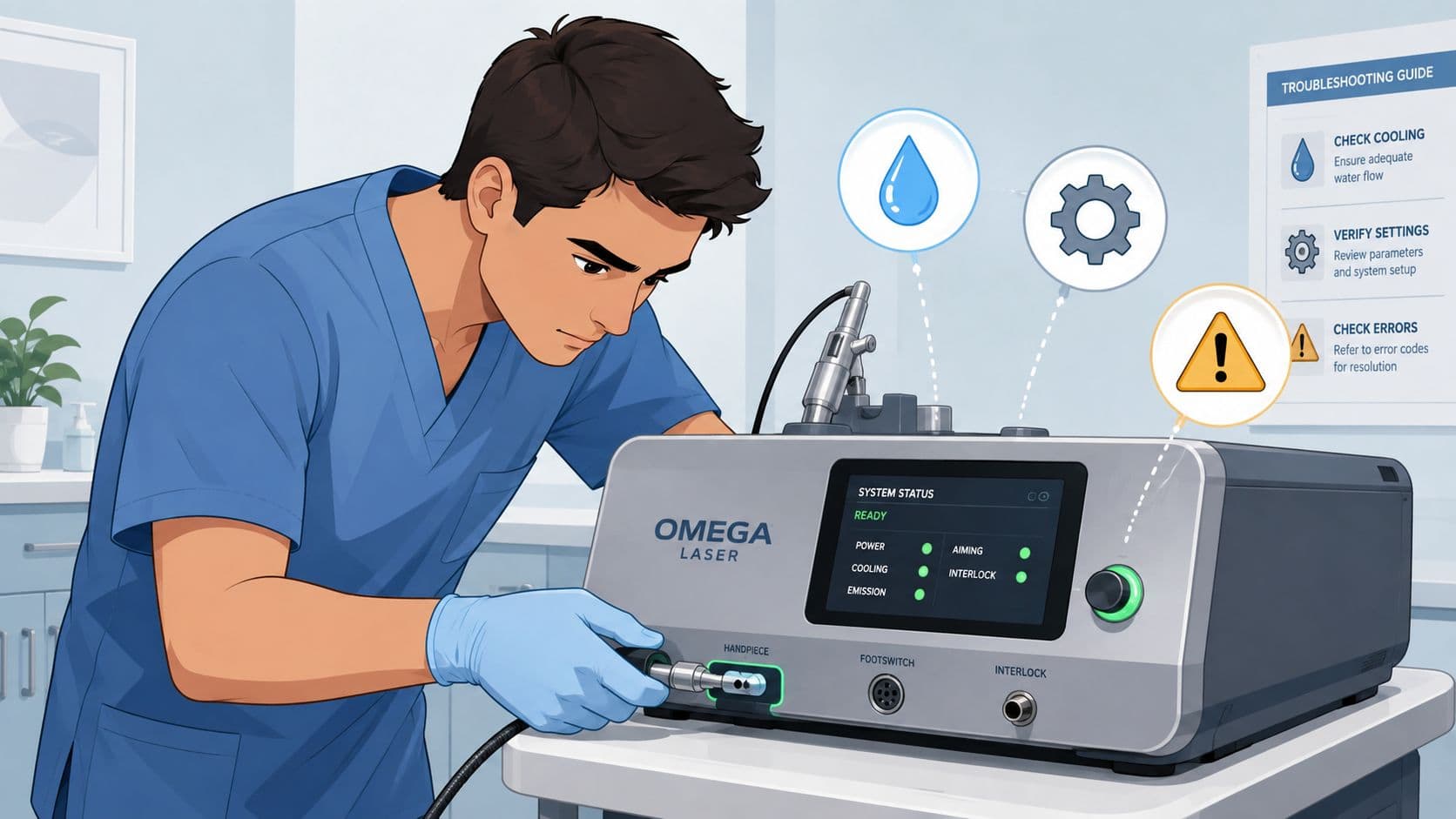
The room is ready, the client is wearing protective eyewear, and your 10am appointment is already running behind. Then the laser platform powers on but refuses to fire, or displays an unfamiliar warning just as treatment is about to begin. The instinct is often to restart everything, change a setting, or replace the part that looks suspicious.
That reaction wastes time and can create a second fault. Troubleshooting common issues with aesthetic lasers starts with the environment, the operator, and the sequence of events, then moves towards the device itself. In South African clinics, power interruptions, water quality, room conditions, training gaps, and incomplete maintenance records can produce symptoms that look like hardware failure. A calm first-pass process protects the client, the device, and the clinic's schedule.
Índice
- Why Your Laser Device Suddenly Stops Working
- The First-Pass Checklist Every Clinic Should Follow
- Fixing the Four Most Common Laser Device Faults
- The Hidden Causes Behind Repeat Device Failures
- When to Escalate to Omega Lasers Technical Support
- Building a Preventive Maintenance Routine for Maximum Uptime
Why Your Laser Device Suddenly Stops Working
A laser that won't fire hasn't necessarily failed. A door interlock may be open, the handpiece may not be seated correctly, the cooling system may be outside its operating range, or the system may have detected an unsafe input. The correct response is to stop treatment, keep the client safe, and establish what changed immediately before the fault appeared.
South African clinics operate in an environment where service interruptions are common and unevenly distributed. In 2024, 55.2% of households reported experiencing water interruptions, enquanto 33.7% reported some dysfunctional water supply service. Weekly interruptions affected 13.9% of households nationwide, with higher reported rates in Mpumalanga at 39.4%, KwaZulu-Natal at 28.5%, and Limpopo at 26.0%, de acordo com o South African water interruption data. For a clinic, that means a cooling fault may reflect a wider continuity problem rather than a failed pump.
Start with the event, not the error code
Ask the last operator three questions:
- What was the device doing immediately before the fault?
- Did the room lose power, change temperature, or experience a water or cooling interruption?
- Was a handpiece, cable, consumable, or treatment parameter changed?
Write the answers down before resetting the system. The sequence matters. A device that fails after a power event requires a different investigation from one that stops after a handpiece change or a coolant refill.
Regra prática: A fault becomes easier to diagnose when you preserve the evidence. Photograph the display, record the time, note the operator, and avoid repeated resets before you know what triggered the warning.
The World Health Organization's laboratory equipment guidance recommends identifying the symptom, checking recent changes and logs, verifying power and environmental inputs, isolating one variable at a time, and documenting every intervention before retesting. It also warns that sample quality, reagent storage, water supply, and electrical supply can mimic equipment failure, a principle that applies directly to clinics using cooling-dependent energy-based devices. The WHO equipment repair and maintenance guidance supports this structured approach.
A technician who starts by changing one variable can often restore operation without opening the machine. Someone who replaces a board, drains a system, or alters calibration without a diagnosis may turn a manageable input problem into a warranty or safety issue. The first objective isn't to make the error disappear. It's to identify why the device created it.
The First-Pass Checklist Every Clinic Should Follow
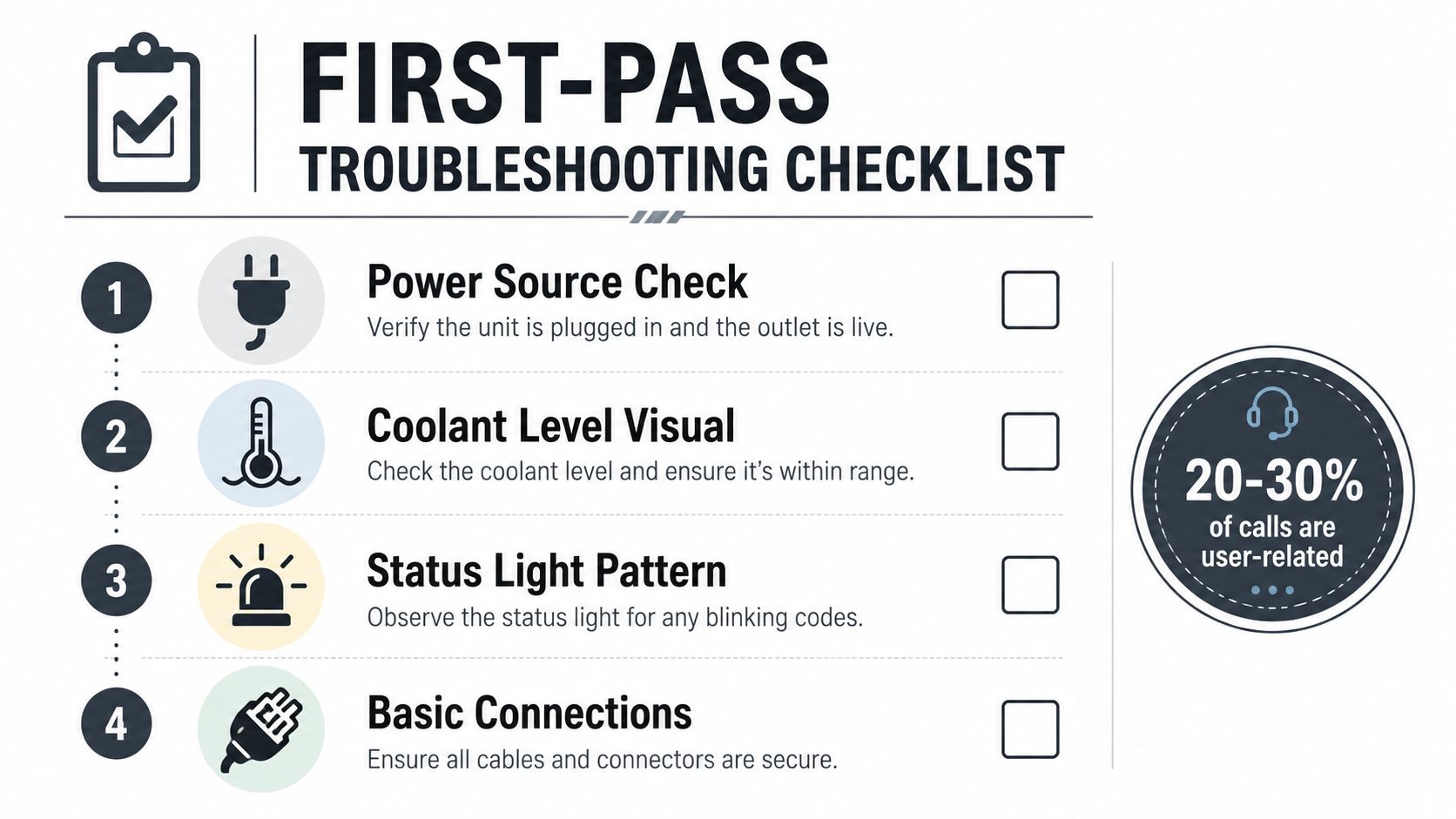
Run the first pass in the same order every time. Consistency prevents a rushed operator from skipping the simple checks that explain a surprising number of service calls.
The first step is safety. Stop treatment, remove the client from the treatment area if necessary, and don't bypass an interlock or safety warning. Check whether the device is receiving power, whether the main switch and approved connections are secure, and whether an adapter or external power component shows heat damage, looseness, or an unusual smell. Don't keep cycling the power if the device trips protection repeatedly.
Work from external inputs inward
Confirm the visible coolant level and inspect the area around the reservoir, tubing, fittings, and handpiece for leakage. Check that vents aren't blocked by walls, storage, dust, or linen. Confirm that the room hasn't become unusually hot and that the device has adequate clearance for heat dissipation.
Then inspect basic connections. Reseat only the connections identified in the manufacturer's operating instructions, and check that the handpiece, footswitch, emergency stop, and required communication cables are properly engaged. A loose connection can produce a communication fault that looks like a software or control-board problem.
The order matters because 20% to 30% of maintenance calls may be user-related, according to an engineering study cited in the South African Journal of Industrial Engineering equipment maintenance review. The same source references a hospital equipment manual stating that most problems are caused by user error and about another quarter by power-supply issues. Those figures don't prove that every clinic fault is simple, but they justify a disciplined external check before internal repair.
Interview the operator and change one variable
Ask whether the operator changed a treatment mode, attached a different handpiece, refilled coolant, moved the machine, or noticed a warning before the shutdown. Review the device log if the platform provides one, and compare the timing with the clinic's power or environmental record.
Retest only after documenting the intervention. If you reseat a cable, record that action. If you confirm coolant level, record it. If you restart the device, record the restart and the result. Never change several inputs at once, because you won't know which action corrected the symptom.
A short, organised record also makes technical support more efficient. Clinics can align their process with their broader quality assurance procedures by treating each fault as a documented quality event rather than an isolated annoyance. If the device still shows the warning, stop before opening panels or changing parts.
Fixing the Four Most Common Laser Device Faults
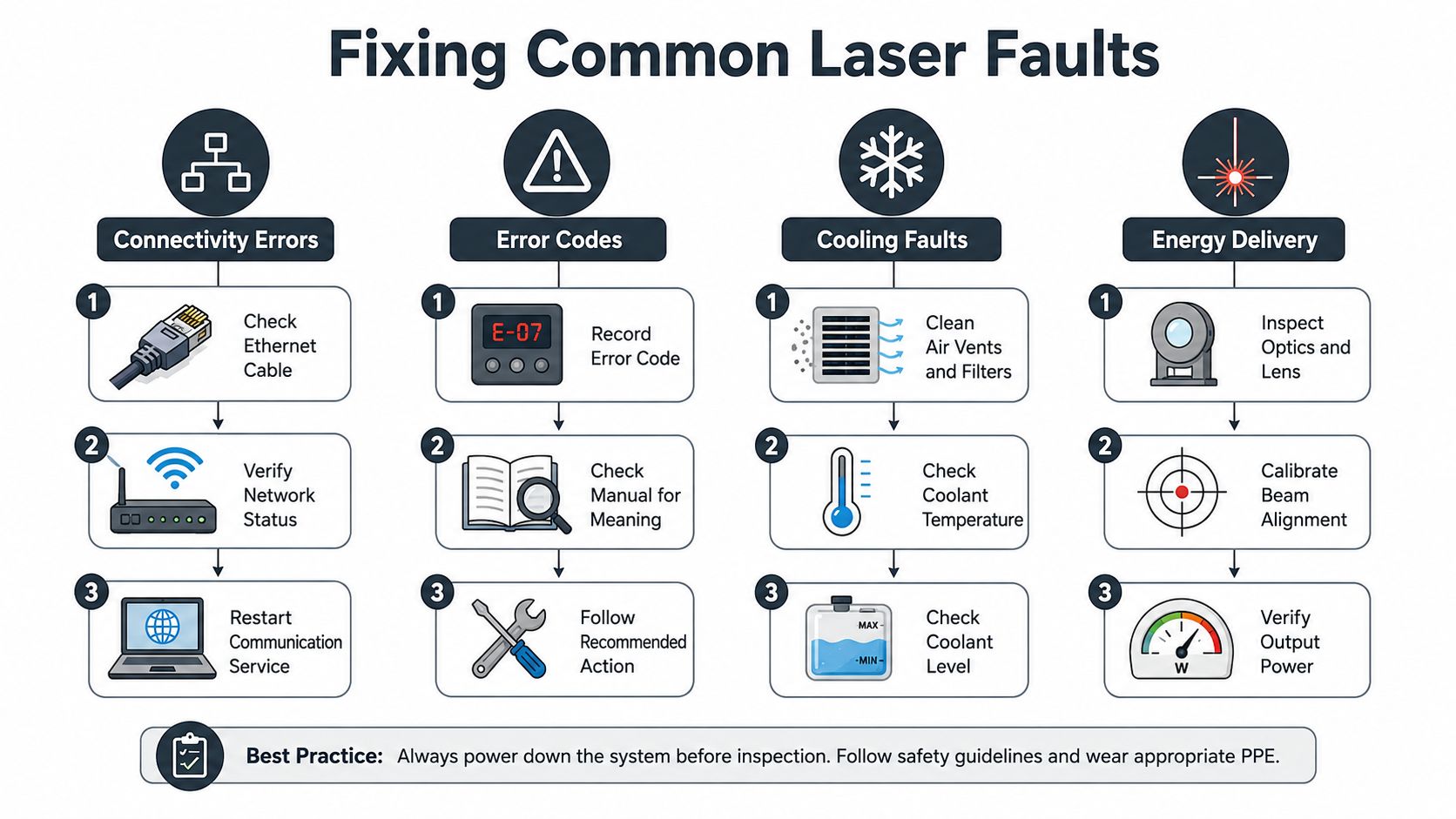
Most support calls fall into four practical categories. The category helps you choose the next check, but it doesn't replace the manufacturer's manual or a safety assessment.
Connectivity and communication errors
The symptom may be a handpiece that isn't recognised, a control screen that can't communicate with a module, or a system that remains in a waiting state. Start with the approved external cable and connector checks. Confirm that the handpiece is compatible with the selected mode, that the connection is fully seated, and that no interlock or emergency stop remains active.
If the device was moved or cleaned shortly before the fault, inspect for cable strain or a connector that was disturbed. A communication problem that appears only after a particular handpiece is attached points towards that accessory or its connection. A fault that remains across approved accessories requires escalation rather than repeated reconnection.
Displayed error codes
Record the full code, accompanying text, time, treatment mode, and device state. Read the code against the current operating manual before taking action. Some messages are informational or require a controlled reset, while others indicate that treatment must stop.
Don't clear a code just because the screen becomes usable. If the warning returns, repeated resets are no longer troubleshooting. Preserve the record and contact technical support, especially when the code relates to emission, temperature, electrical protection, or an internal safety circuit.
Cooling system faults
Check the visible coolant level, approved fluid specification, tubing, fittings, vents, and room conditions. Water quality can affect cooling performance, and a recent refill or interruption in supply may be more relevant than a suspected pump failure. Don't add an unapproved fluid or mix products because the reservoir appears low.
A cooling warning that follows a hot room, blocked vent, leak, or interrupted supply should be treated as an input or environmental investigation first. A visible leak, abnormal noise, rapid temperature rise, or recurring warning means treatment should stop and support should take over.
Inconsistent energy delivery
Uneven output can appear as inconsistent client sensation, variable treatment response, a warning during firing, or a result that differs from the expected setting. Check the treatment mode, handpiece seating, consumable condition, lens cleanliness where the manual permits operator cleaning, and the device's required calibration status.
Consumable wear and calibration drift can produce inconsistent delivery without proving that the laser source has degraded. Don't compensate by increasing energy or repeating passes. That can increase clinical risk while hiding the original cause.
Where a clinic needs external measurement, dimensional verification, or equipment assessment beyond routine operator checks, precision laser scanning services may provide a useful specialist resource. For the laser platform itself, use the manufacturer's approved diagnostic route.
Escalate when a fault involves an internal electrical component, emission control, coolant leakage, abnormal heat, repeated safety warnings, or any condition you can't verify safely from the operator's instructions. A device that appears to work after a risky workaround isn't restored. It has become harder to trust.
The Hidden Causes Behind Repeat Device Failures
Repeated faults often indicate a repeated operating condition. Replacing the same component without examining power quality, room conditions, operator behaviour, and maintenance records treats the symptom while preserving the cause.
Power continuity deserves particular attention in South African clinics. Industry coverage of the local aesthetic-devices market reports that clinics in Eskom load-shedding zones report 20% higher maintenance expenditure to protect sensitive optics, while high-end platforms can cost over USD 100,000 and limited rural technical support can prolong downtime, as described in South African aesthetic-devices market coverage. Those figures make power protection and service planning operational decisions, not optional extras.
Look for patterns in the log
A repeat fault after load-shedding points towards power continuity or restart procedure. A warning that appears after a specific operator uses the device points towards training, setup, or parameter selection. A cooling fault that appears during hotter periods points towards room temperature, airflow, coolant condition, or cleaning controls.
Create a simple fault record with:
- Time and operator: Record who used the device and when the symptom appeared.
- Treatment context: Note the handpiece, mode, settings, consumable, and client stage.
- Environmental event: Capture power interruptions, room changes, coolant work, movement, or cleaning.
- Action and result: Document one intervention and the outcome before trying another.
Training gaps can reinforce these patterns. A South African study found that only 27.78% of surveyed tertiary institutions offered laser hair removal training, enquanto 20% dessas instituições não ofereciam formação prática e A disciplina 50% não incluiu qualquer exame prático. The study also noted the absence of a statutory regulatory board for cosmetic laser and IPL hair removal in South Africa, with many suppliers providing only 2 to 4 days of informal training, as discussed in the South African aesthetic-laser training source.
A short demonstration doesn't prove competency. Operators need documented training, supervised practice, clear startup and shutdown procedures, and a way to refresh knowledge when a device or treatment mode changes. Clinics can use structured avaliação de competências records to identify whether recurring faults cluster around particular tasks or staff members.
For visual reinforcement, concise one point lesson examples can help teams standardise a single critical action, such as checking coolant before startup or confirming a handpiece connection before treatment. The most useful lesson is the one an operator can follow correctly during a busy day.
When to Escalate to Omega Lasers Technical Support
Self-troubleshooting has a boundary. Stop when the next action would require opening a panel, bypassing a safety circuit, altering calibration, working near high-voltage components, handling a coolant leak, or changing a warranty-critical part. A device that fires inconsistently, overheats, emits an unexplained odour, or repeatedly trips protection shouldn't return to clinical use because a restart temporarily cleared the warning.
Use a clear stop rule
The supplied escalation visual identifies practical triggers such as more than 30 minutes of troubleshooting effort, repeated error codes, a visible coolant leak, and a warranty-critical component. Treat those triggers as a decision aid, not as permission to continue unsafe work for a fixed period. If a safety issue appears immediately, escalate immediately.
Before contacting support, prepare one organised diagnostic pack:
- Identidade do dispositivo: Record the model, serial number, handpiece, and software or firmware information where displayed.
- Fault evidence: Photograph the complete error message, status lights, connectors, and any visible leak or damage.
- Event history: Note recent power interruptions, relocation, cleaning, coolant work, unusual room conditions, and operator changes.
- Treatment context: State the mode, settings, consumable, and whether the fault occurred during startup, standby, or firing.
- Maintenance record: Include the last service, cleaning, calibration, part replacement, and previous occurrence of the same symptom.
Don't send a vague message saying that the laser has stopped working. “The device is broken” forces support to begin at the beginning. A timestamped photograph and a concise sequence of events let the technician distinguish a setup issue from a component fault.
Omega Lasers states that its systems include a Garantia do fabricante de 2 anos, and its support model includes technical assistance that can be delivered remotely or through video consultation. Warranty protection depends on following approved operating and maintenance procedures, so document what you checked and don't attempt unauthorised repair. The company's serviço pós-venda route is the appropriate channel when the first-pass checks don't resolve the problem.
Building a Preventive Maintenance Routine for Maximum Uptime
Prevention works when it becomes a repeatable clinic habit rather than a folder of instructions nobody opens. Assign responsibility for daily checks, keep the record with the device, and review recurring faults at management level.
Build the routine around operating risk
Daily startup checks should cover visible damage, power connections, emergency stop status, handpiece seating, coolant level, vents, and the device's self-check messages. The operator should record abnormalities before the first client, not after a failed treatment.
Weekly environmental inspections should examine dust around vents, room airflow, storage near the platform, cable strain, coolant condition, and the effect of recent power events. Clinics in areas with regular interruptions should also confirm that their approved backup and surge-protection arrangements are suitable for the device. Don't select protection equipment by guesswork. Ask the manufacturer or a qualified electrical professional to confirm compatibility and required capacity.
Monthly review should bring together calibration status, service intervals, consumable replacement, operator competency records, and unresolved support cases. A maintenance log becomes valuable when managers look for patterns, such as faults associated with one room, one handpiece, one treatment mode, or one operator.
Training belongs in the same system. Keep signed records of initial instruction, supervised competency, refresher training, parameter guidance, cleaning procedures, and escalation rules. This approach distinguishes a genuine device failure from a process failure and helps the clinic correct the cause before it produces another cancelled appointment.
The result is a practical uptime strategy: protect the power supply, control the room, verify the inputs, train the people, and escalate before risk increases. A reliable troubleshooting process doesn't just restore equipment. It protects client safety, treatment consistency, revenue, and trust.
Omega Lasers supplies FDA-approved, CE-certified, and SAHPRA-licensed aesthetic laser and multi-technology systems, supported by training, technical assistance, and after-sales service. If your clinic needs a more organised approach to device uptime and troubleshooting common issues, visit Omega Lasers to explore its systems and support options.