




A clinic can look organised on the surface and still be one skipped check away from a messy Friday. The laser is booked back to back, a client notices uneven results, and someone realises the startup checklist never made it past the front desk because the usual operator was off sick. That's the moment quality assurance procedures stop being paperwork and start being the difference between a controlled service line and a problem you have to explain later.
Índice
- When a Missed Check Almost Becomes a Story
- What Quality Assurance Means in a Regulated Clinic
- Foundational Building Blocks of a Laser Clinic QA Program
- Staff Training and Competency Assessment
- Regulatory Compliance Mechanics for FDA, CE and SAHPRA
- KPIs, Audit Cadence and Corrective Action Loops
- Continuous Improvement and Your 90-Day QA Rollout
When a Missed Check Almost Becomes a Story
A busy clinic doesn't fail all at once. It misses one startup check, skips one handover note, and lets one small drift sit because the day is already full. In an aesthetic environment, that's enough to turn a routine treatment into an uncomfortable conversation with a client and a long afternoon for the person in charge.
The near-miss that clinics recognise too late
The pattern is familiar. A device that has been working well starts behaving slightly differently, but nobody records the change because the team trusts the last session, the last patient, and the last clean bill of health. By the time somebody compares notes, the evidence trail is thin, the operator who noticed the issue has gone home, and the next shift has to guess what happened.
That is exactly why quality assurance procedures need to be built as a system, not a memory exercise. In regulated South African device settings, the point is not merely to spot defects at the end. The point is to create documented compliance, traceability, and post-market control, which is the practical implication of SAHPRA's device oversight framework and the broader medical-device quality culture that comes with it (ISO quality management and quality assurance).
Regra prática: if a check matters to patient safety, it needs an owner, a log, and a follow-up path when it fails.
What the reader should be able to build
A clinic-ready QA system doesn't need to be overengineered. It needs clear responsibilities, repeatable checks, and records that survive a staff change. That means each day, each treatment, and each corrective action leaves an auditable trail that another manager can pick up without starting from zero.
In practice, that is the core promise of a defensible system. It lets you answer the questions auditors, owners, and senior clinicians pose, namely who checked it, when they checked it, what the result was, and what changed after the finding. If you can answer those four questions consistently, you're not relying on luck.
What Quality Assurance Means in a Regulated Clinic
A clinic can run full days, fill the diary, and still fail QA if nobody can prove who checked what, when they checked it, and what happened after a problem was found. In that setting, quality assurance is the management system that shows the service delivered matches the standard the clinic says it follows. Quality control is the hands-on checking that keeps the process within those limits while treatment is underway. Compliance is the rule set, internal and external, that tells the clinic what must be documented, retained, and defended.
QA, QC and compliance are not the same thing
Clinics often blur those three terms into one checklist. That causes gaps. The better model is the one used in controlled industries, where one party verifies acceptance and another controls production, which the Federal Highway Administration guidance on QA and QC describes clearly for concrete work, with QA assigned to the verifying side and QC to the party doing the work (FHWA guidance on QA and QC). In a clinic, management verifies the system, while practitioners and technicians control the day-to-day process.
South African clinics need that separation because device oversight is tied to formal regulatory accountability, not informal habit. SAHPRA operates within the medical-device oversight environment that followed the National Health Amendment Act of 2013 and the move away from the former Medicines Control Council, which pushed the sector toward a more structured QA culture built on safety, efficacy, compliance, and auditability (ISO quality management and quality assurance). Auditors do not want a neat filing cabinet. They want proof that the same process was followed, the same way, more than once, with a trail that still makes sense after staff turnover.
A good clinic QA file is not a folder of forms. It is evidence that the system worked the same way twice.
What ISO 13485 means in day-to-day terms
ISO 13485 is the quality-management standard for medical devices, and for a local distributor or manufacturer, alignment with controlled procedures sits inside the licensing environment in South Africa. For a clinic using energy-based devices, that becomes a lifecycle view of quality, not a once-off sign-off.
That lifecycle includes supplier qualification, installation, training, servicing, complaint handling, and corrective actions, all of which need to be documented and auditable. If a new staff member cannot trace a device issue from the first complaint to the final fix, the system is too loose. If a manager cannot show who approved the device to go back into use, the system is incomplete. The clinic also needs records that are easy to recover, which is why many teams now rely on a modern alternative to dusty binders rather than scattered paper files.
For daily operations, the test is whether the record tells a clean story. If a device complaint, a service visit, and a release-to-use decision sit in separate places, the audit trail breaks. If those steps are linked, the clinic can show control without having to reconstruct the whole day from memory.
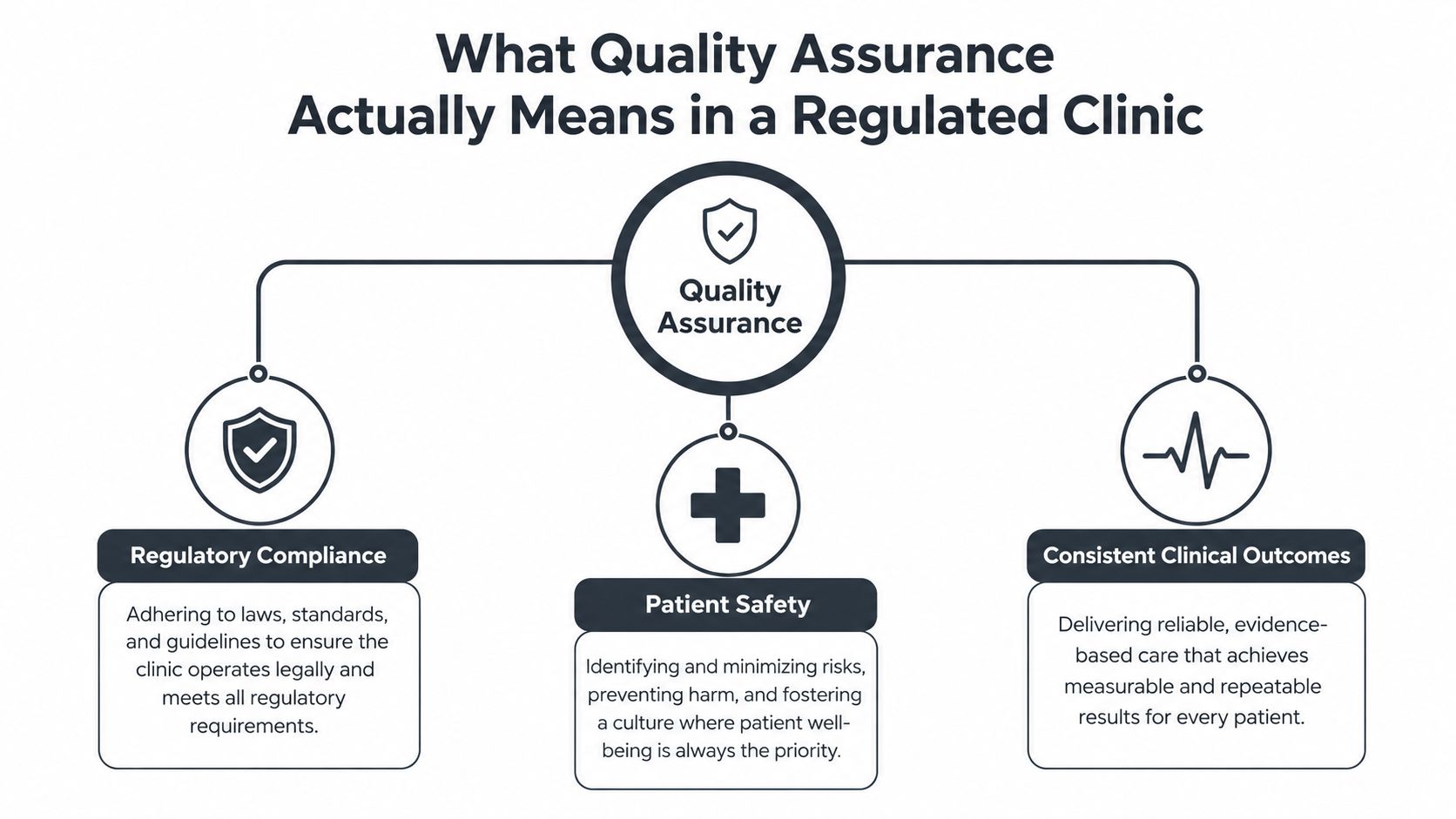
The record itself matters just as much as the check. Clear logging, version control, and a defined owner for every form keep the system usable when a senior clinician leaves or a new manager steps in. That is also where record-keeping for clinic QA stops being admin and becomes operational control.
Foundational Building Blocks of a Laser Clinic QA Program
A clinic QA programme works only when it produces evidence at every stage, not just at the end of the treatment day. The concrete-construction world makes this obvious, because satisfactory QA there depends on specific checks during production, including material checks, batch verification, sampling, and inspection of workmanship at multiple stages (TRB concrete construction source). Aesthetic device work needs the same discipline, even if the risks look different.
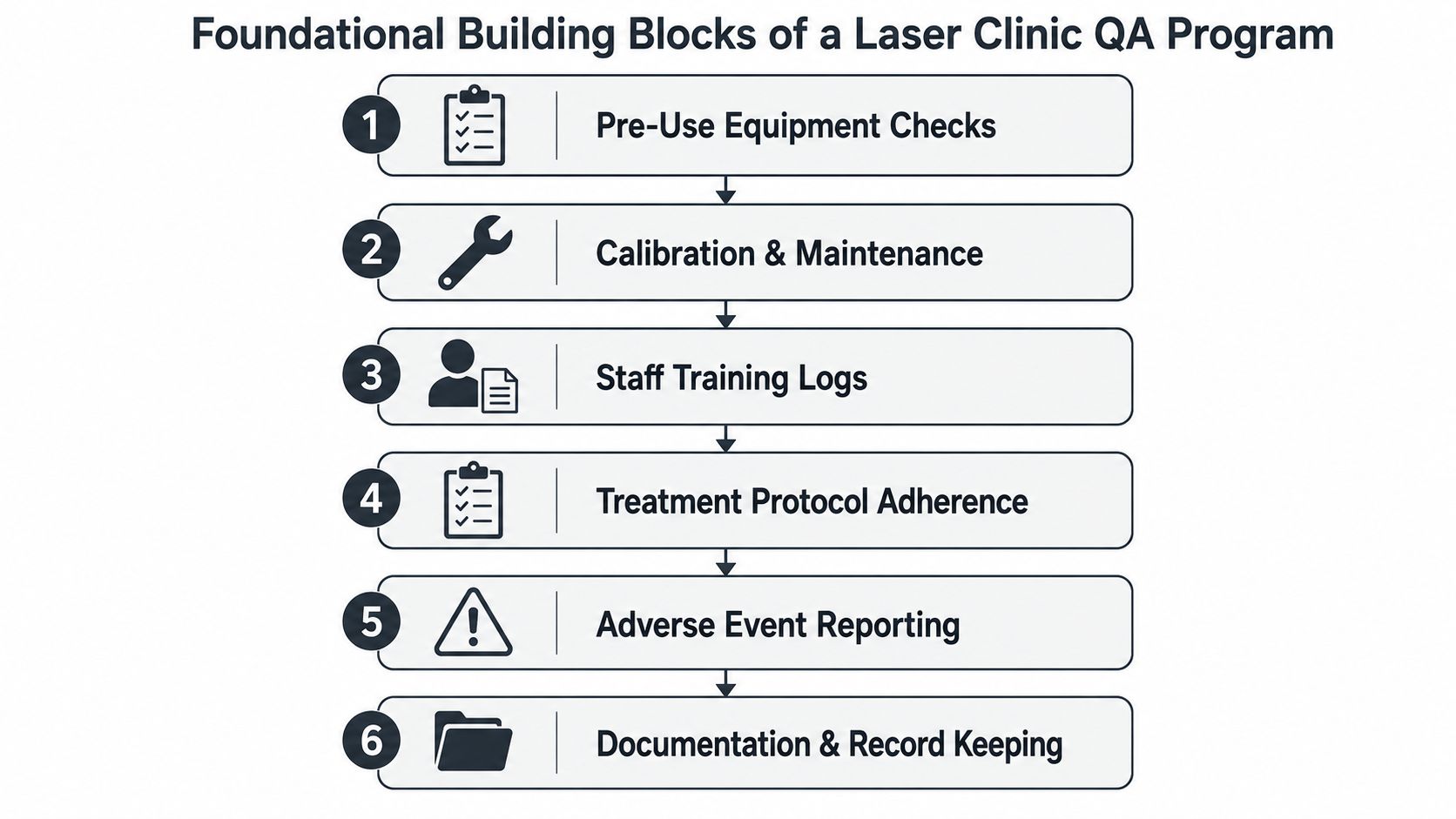
The six blocks that keep the system real
The first block is pre-use equipment checks. Someone must confirm the device powers up correctly, the handpiece is intact, the safety features are live, and the settings match the intended treatment. That check should be logged by the operator or delegated lead before the first client of the session.
The second block is calibration and performance verification. If the device has drifted, you want to know before it touches a client. The log needs the date, device ID, result, and the action taken if the result falls outside threshold.
The third block is safety and electrical checks. These are not decorative. They protect the team as much as the client, and they belong in the same formal record as the treatment itself.
The fourth block is infection control and consumable management. Stock use, expiry checks, and cleaning records need a clear trail so a missing consumable or poor handover doesn't become a service interruption or a safety issue.
The fifth block is recordkeeping. Good records are not just neat, they are operational memory. A clinic that wants durable structure should treat its documentation like a controlled manual, not a pile of dusty binders, and a modern alternative to dusty binders can help set the standard for that discipline (Pebb policy and procedure manual).
The sixth block is incident reporting and corrective action. A defect that gets observed but never escalated is not managed, it's hidden.
What good evidence looks like
The best clinics make every stage visible. Startup checks happen before treatment, not after. Mid-shift checks catch drift while the day is still recoverable. Post-treatment notes close the loop so the next operator knows what changed and why.
Perspetiva operacional: one clean end-of-day sign-off won't rescue a process that had no traceable checkpoints during the day.
For recordkeeping discipline, the internal guide on manutenção de registos should be aligned with the same control mindset used across the rest of the programme (Orientações da Omega Lasers sobre a manutenção de registos). A clinic that can't show what it did, when it did it, and who signed it off doesn't really have a QA system yet.
A practical QA artefact list
- Startup logs: confirm device readiness before use.
- Calibration logs: show whether performance stayed within acceptable limits.
- Consumable and cleaning records: prove process control and hygiene.
- Incident notes: capture deviations, complaints, and immediate actions.
- Corrective action register: track fixes to closure.
- Release sign-off: document the point at which the device or service returned to use.
Staff Training and Competency Assessment
A good procedure fails fast if the person using it has never been trained properly. Competency has to sit inside QA, not beside it. The concrete-paving guidance is blunt on that point, because formal QA programmes need personnel training, laboratory certification, process standardisation, communication flow, documentation, and recordkeeping to work properly (Iowa QA and QC guidance).
Build competence in stages
Comece por initial device training. Every operator should learn the device, the treatment protocol, the safety steps, and the clinic's escalation rules before they work unsupervised. Training is not only about how to run the machine, it is about recognising when not to run it.
Then move to supervised practice. A new operator should work under observation until the lead clinician is satisfied that setup, communication, patient positioning, treatment flow, and post-treatment instructions are all being handled correctly. Each observed case should be logged with date, device, supervisor, and any gap identified.
After that, use written and practical assessment. A signature without proof of competence is weak evidence, especially when staff turnover is high. A better file includes a competency matrix, sign-off criteria, and a record of any remediation before independent practice is allowed.
Keep competence current
Refresher training should happen whenever a new device, protocol, or regulatory update lands. Clinics often assume an experienced operator can transfer skills automatically from one platform to another. In practice, device-specific settings, handpiece behaviour, and treatment flow can differ enough to require re-validation.
The internal training structure should tie neatly into the clinic's broader people processes, including the staff development record kept for performance, retraining, and succession planning, as set out in Omega Lasers staff training and development. That way, if someone leaves, the clinic does not lose the knowledge with them.
If the only person who knows how to pass the device audit is the person who is on leave, the clinic has a continuity problem, not a training programme.
What auditors want to see
They want proof that training is current, role-specifice repeatable. They also want to see what happens after a gap is found. If an operator misses a protocol step, the file should show retraining, re-observation, and a sign-off that the gap was closed.
A simple rule works well here. No operator should touch a device unsupervised until the clinic can produce the training record, the competency sign-off, and the current protocol version in the same file. The file also needs a clear owner, usually the lead clinician or practice manager, so there is no argument about who checks the log, who chases overdue refreshers, and who closes the loop after a failure. That is the level of discipline that survives staff changes and external review.
For clinics that want a cleaner way to structure those reviews, it helps to improve team efficiency with QA by making training evidence, reassessment, and escalation visible in one routine rather than scattered across inboxes.
Regulatory Compliance Mechanics for FDA, CE and SAHPRA
Regulatory compliance gets easier when it's treated as a file structure rather than a vague obligation. A clinic should be able to pull one device folder and show the approval evidence, the operating documents, the service history, and the post-market record without hunting across inboxes and desktop folders.
What belongs in every device file
For each device, the file should contain FDA clearance evidence, CE certificate of conformity, SAHPRA licence information for the local distributor, calibration records, and the user manual. Those items don't replace clinic controls, they support them.
The logic is simple. If the device itself was cleared, certified, or licensed through formal channels, the clinic still has to prove it was installed, used, and maintained under a controlled process. That includes traceability of consumables, complaint handling, adverse event reporting, and recall awareness. The file should show not only what the device is, but what the clinic did with it.
Measure what can fail, then link it to action
The quality question in healthcare-style operations is usually the same one: what should we measure, how often, and what happens when a metric fails? That framing is central to measurable QA systems in service delivery (Data4Impact quality assurance approach). In a clinic, that means tracking device uptime, complaint trends, calibration drift, and incident patterns, then assigning a documented response every time a threshold is crossed.
The result is a clean compliance trail. If a complaint lands, it's logged. If a calibration check drifts, it's investigated. If a consumable batch raises concern, it's traceable back through the records. The system is not about creating more paperwork, it's about making sure the paperwork tells the same story as the treatment room.
| Regime | Approval Evidence Required | Post-Market Obligations | Clinic-Level Artefacts |
|---|---|---|---|
| FDA | Clearance evidence on file | Complaint handling, traceability, incident awareness | Device folder, complaint log, service record |
| CE | Certificate of conformity | Recall awareness, use within intended scope | User manual, conformity file, staff acknowledgement |
| SAHPRA | Local distributor licence evidence | Documentation, traceability, corrective action | Licence copy, calibration log, corrective action register |
How to keep the compliance file usable
A file that nobody can access or use effectively is not compliant in practice, even if it contains the right documents. Use one location per device, keep the latest version visible, and store the supporting history behind it. The internal checklist for this area should align with the clinic's own lista de verificação de conformidade regulamentar process so that approvals, service records, and incident notes stay in the same evidence chain (Omega Lasers regulatory compliance checklist).
The strongest compliance systems are boring in the best way. They make inspection day feel like a retrieval exercise, not a rescue mission.
KPIs, Audit Cadence and Corrective Action Loops
Most generic QA content stops at “do audits regularly”. That's not enough. A clinic needs a small set of metrics it can track, a cadence the team can sustain, and a review meeting that forces decisions instead of polite nodding.
Keep the KPI set small and honest
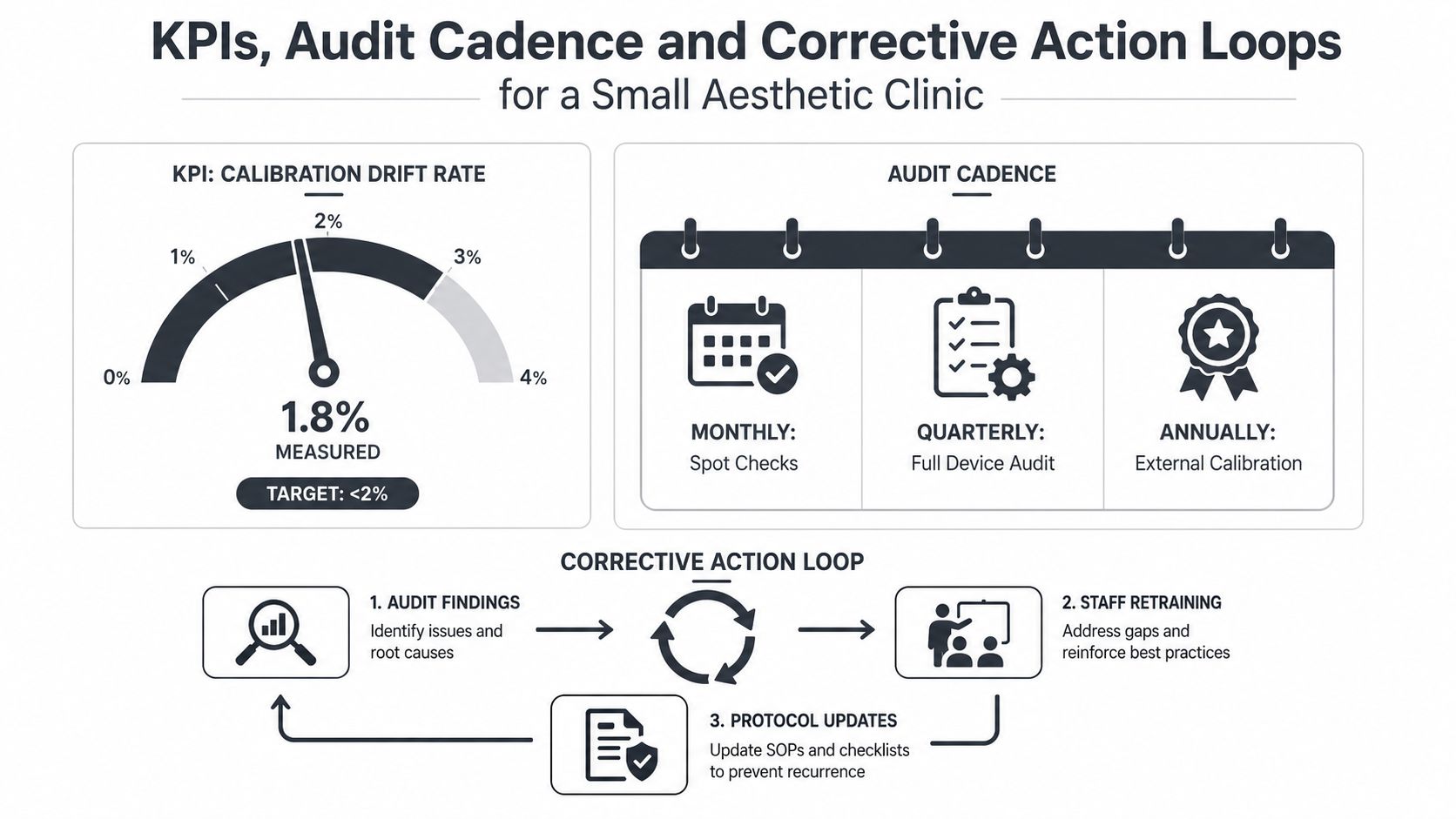
The most useful KPIs are the ones that show whether the system is drifting. Calibration drift rate tells you whether the device is staying within limits. Tempo de inatividade do equipamento shows whether maintenance or handling is interrupting service. Treatment-related incidents tell you whether process failures are reaching the client experience.
Add complaint closure time, training currencye audit non-conformance count. Together, those indicators give management a picture of whether the clinic is stable, stretched, or sliding. The goal is not to track everything, it's to track the things that require action when they move.
Management rule: if a KPI doesn't change a decision, it doesn't belong on the dashboard.
Match each metric to a cadence
Daily checks should cover startup readiness, open incidents, and any device issue that could affect the next client. Weekly review works well for recurring deviations, staff coverage, and overdue corrective actions. Monthly management review should look at trends, open complaints, and whether the previous fixes held.
Quarterly audit cycles are where you step back and test the whole system. That's when you check whether logs are complete, whether staff sign-offs are current, and whether the corrective-action register still reflects reality. Structured QA guidance also supports planned testing, defect reporting, regression or release checks, and post-release monitoring rather than a single acceptance event (Testlio QA process guidance).
Use numeric thresholds, not vibes
Eurachem's QA training materials lay out a standard significance-testing workflow, define the hypothesis, select the test, choose a significance level, determine degrees of freedom, calculate the test statistic, and compare it with a critical value or p-value (Eurachem essential statistics). The clinic version doesn't need the lab jargon, but it does need the same logic.
If a metric fails, the response should be predefined. Who investigates, who signs the fix, who rechecks the result, and when the case closes all need to be named. That's what turns an audit from a finding into a controlled improvement loop.
Continuous Improvement and Your 90-Day QA Rollout
A QA programme only becomes durable when the clinic uses its own findings to change the way it works. That's the heart of Plan-Do-Check-Act, which is why audit findings, incident trends, and KPI misses should lead to updated procedures, refresher training, and better procurement choices rather than a blame cycle that dies in the next busy week.
Turn findings into process changes
Plan means writing the standard and assigning the owner. Do means running the standard in the room, on the device, and in the logbook. Check means comparing the result against the target and looking for repeated drift. Act means tightening the procedure, retraining the team, and standardising the fix so it sticks.
That cycle is where many clinics fall apart. They spot incomplete logs, tolerate single-point-of-failure operators, leave deviations undocumented, or let calibration certificates go stale because the business is busy and the issue feels small. Small issues are exactly how QA systems erode.
For a deeper document-control habit, the clinic's audit team can also benefit from a structured audit checklist guide when they build their own review pack (Superdocu compliance audit checklist guide). Use it as a prompt for discipline, not as a substitute for your own device-specific controls.
A 90-day rollout that a clinic can actually run
Days 1 to 30: draft the core procedures, name the owners, create the device file structure, and verify that calibration and service records are current. Train the team on startup checks, incident escalation, and how to complete the logs without gaps.
Days 31 to 60: run the first internal audit, review the first KPI set, and close any quick corrective actions. Re-observe any operator who still needs support, then update the training matrix so no one is relying on memory.
Days 61 to 90: run the second review cycle, confirm that fixes held, and formalise the versions that worked. By the end of that window, the clinic should have a routine that can survive leave, turnover, and a busy treatment list without falling apart.
The best QA rollout is the one that becomes ordinary. If the team can do it on a hectic Tuesday, it's real.
If you're building or tightening a laser-clinic QA system, Omega Lasers can help with compliant devices, training support, and practical implementation guidance that fits real clinic operations. Visit Lasers Omega to explore systems and support built for clinics that need repeatable outcomes, stronger control, and a cleaner audit trail.