



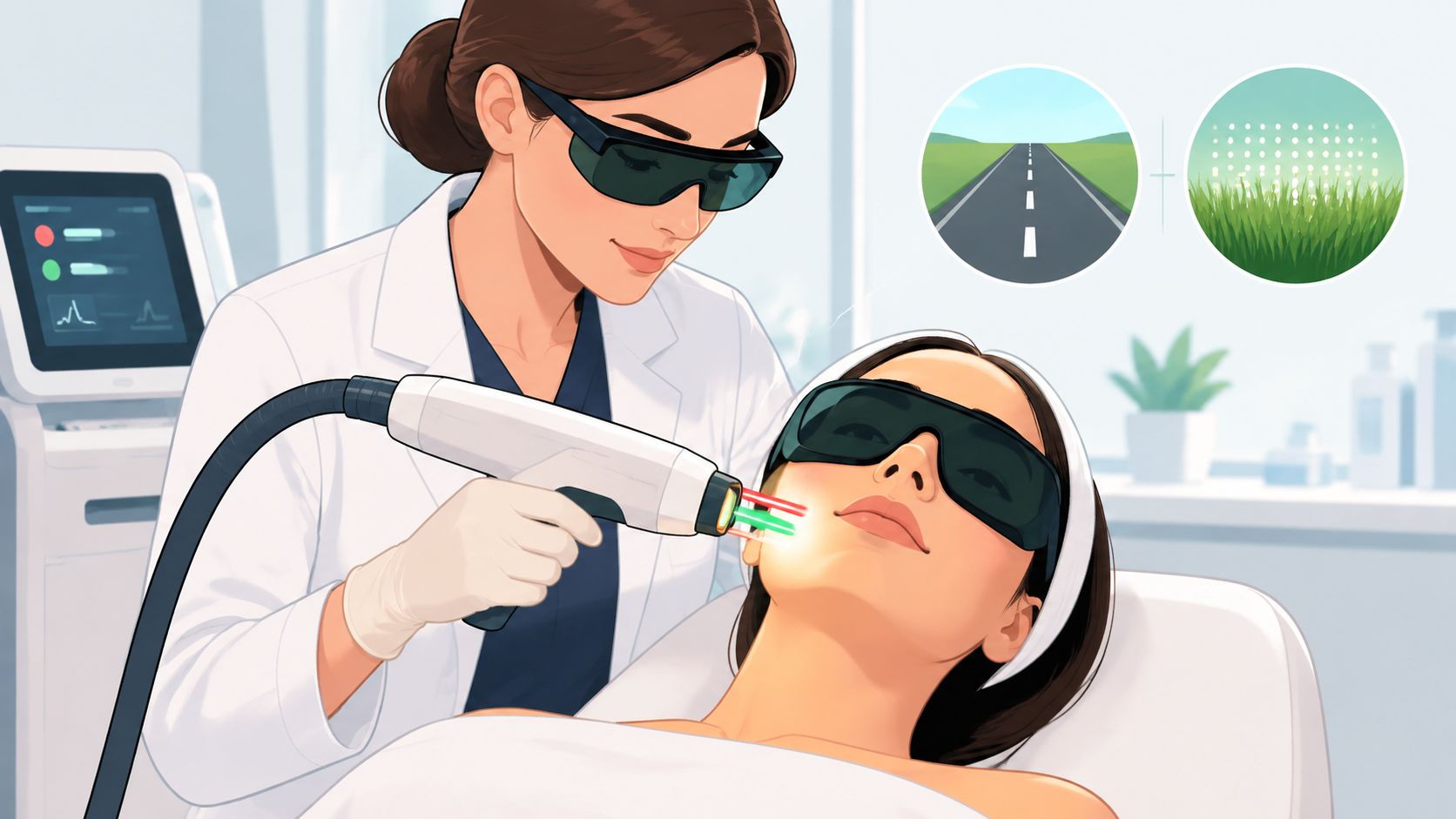
“Zero downtime” is the most popular promise in skin rejuvenation laser marketing, and it's also one of the least useful ways to choose a treatment. A patient may leave the clinic quickly, yet still experience erythema, swelling, heat, sensitivity, peeling, or pigment changes during recovery. A 2026 facial CO₂ laser cohort recorded mean pain of 4.8, erythema in 50% of patients, and oedema in 24%, although no blistering, post-inflammatory hyperpigmentation, or scarring was documented in that record. The authors also cautioned that the findings couldn't be generalised to Fitzpatrick V–VI patients, because those patients weren't represented. Read the cohort's full safety findings.
South African clinics need a more honest vocabulary. Laser rejuvenation sits on a spectrum, from gentle non-ablative treatments that preserve the surface to fractional and fully ablative procedures that deliberately create controlled injury. The correct choice depends on skin type, the condition being treated, treatment intensity, and the patient's actual tolerance for recovery, not on whichever device has the strongest marketing.
Índice
- Rethinking the Zero Downtime Promise
- How Skin Rejuvenation Laser Technologies Work
- Laser Rejuvenation Versus Chemical Peels
- Patient Selection and Contraindications
- Treatment Workflow and Safety Protocols
- Regulatory Compliance and SAHPRA Requirements
- Growing Your Clinic with Laser Rejuvenation Services
Rethinking the Zero Downtime Promise
“Zero downtime” usually means the patient can resume ordinary activity quickly. It doesn't mean the skin has experienced no biological stress. Even a low-intensity treatment can produce temporary warmth, redness, dryness, or sensitivity, while more aggressive resurfacing creates a visible recovery period that must be planned rather than minimised in conversation.
That distinction matters particularly in South Africa, where clinics treat a broad range of Fitzpatrick skin types, including many patients with pigment-rich skin. A promise that sounds reassuring can become unsafe if it encourages a practitioner to understate the possibility of post-inflammatory colour change or to select energy settings based on a generic protocol.
Regra prática: Sell the treatment plan, not the fantasy of no recovery.
Recovery is part of the treatment
Non-ablative systems heat targeted dermal structures while leaving the epidermal surface substantially intact. They can suit patients seeking gradual improvement in tone, texture, or early photoageing, but the outcome may require a staged plan and careful expectation-setting.
Ablative resurfacing removes part of the epidermis and creates a stronger remodelling response. Fractional delivery limits the injury to microscopic columns, leaving untreated skin between treatment zones to support healing. That can reduce recovery compared with fully ablative treatment, but it doesn't make recovery disappear.
Clinicians should describe what the patient might see and feel, how long ordinary activities may be affected, and which symptoms require contact with the clinic. The consultation should also cover sun exposure, skincare, previous pigment reactions, and whether the patient can follow aftercare consistently.
The right question is not “Which laser is best?”
The useful question is, “Which degree of controlled injury is justified for this patient's concern?” A patient with mild texture irregularity and limited downtime may be better served by a conservative non-ablative protocol. Someone with deeper textural change may accept a longer recovery for a more intensive approach, provided the indication and skin characteristics support it.
O skin resurfacing overview can help teams explain this spectrum in patient-friendly language. It should supplement, not replace, a proper consultation and device-specific training.
How Skin Rejuvenation Laser Technologies Work
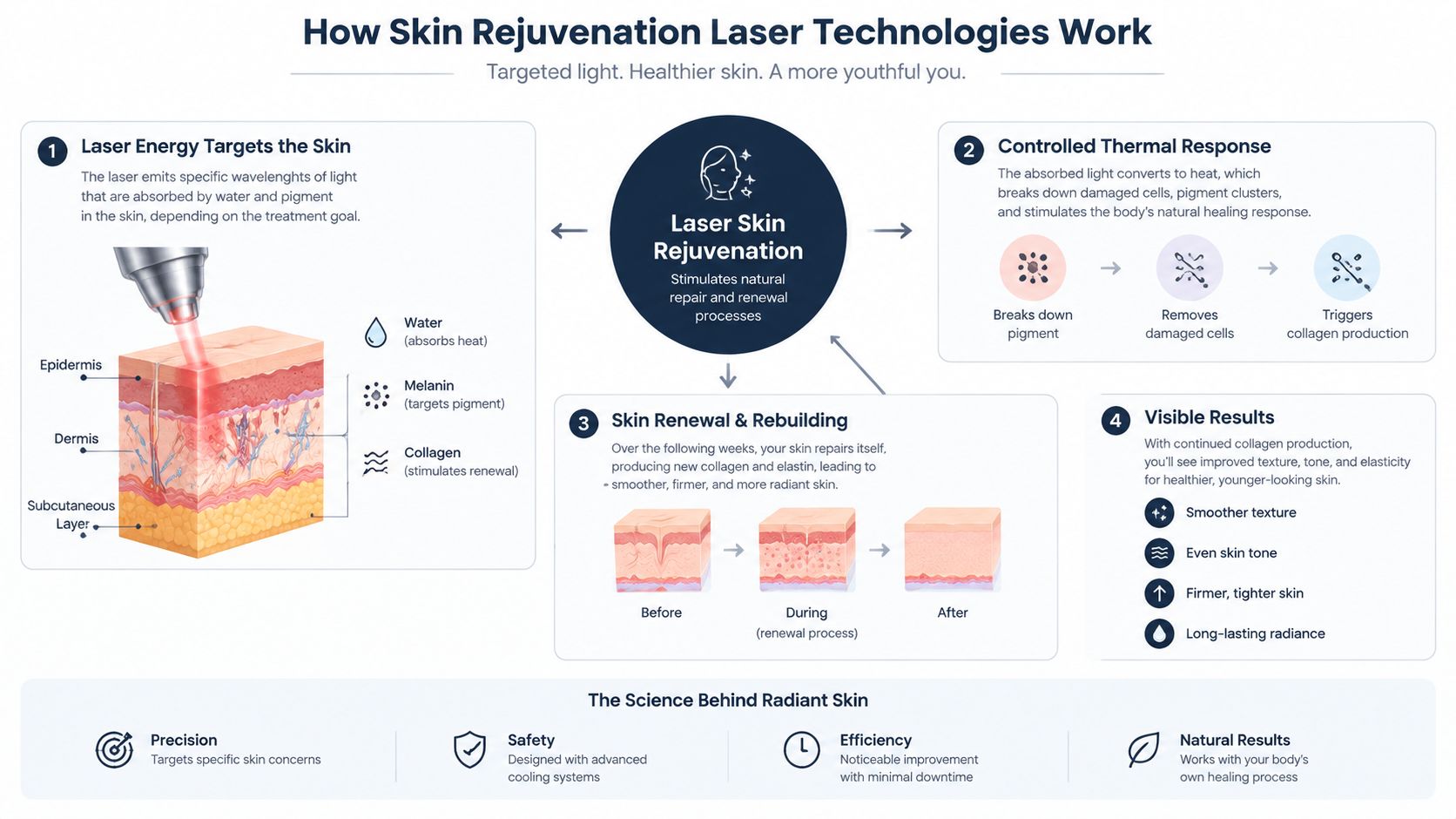
A laser rejuvenation treatment begins with a simple principle. The device delivers light at a selected wavelength, and tissue components absorb that energy according to their optical properties. The practitioner controls the clinical effect through wavelength, fluence, pulse duration, spot size, density, and the pattern of delivery.
The aim isn't to heat everything indiscriminately. It's to create a predictable interaction with a target such as melanin, water, or another chromophore, while protecting surrounding tissue. This is why a treatment that appears gentle on the surface can still produce a meaningful inflammatory response underneath.
Ablative treatment
Um ablative laser vaporises or removes controlled layers of the epidermis and may extend into the superficial dermis. The road-resurfacing analogy is useful for patients. The practitioner removes damaged surface material, then relies on wound healing and collagen remodelling to improve texture.
This approach can produce stronger resurfacing, but it also creates greater barrier disruption and a more demanding aftercare requirement. It isn't appropriate because a patient wants a dramatic result. The clinician must weigh the depth of the concern against skin type, contraindications, infection risk, pigmentation history, and the patient's ability to manage recovery.
Erbium resurfacing is often discussed when a practice is assessing intensive facial treatment options. For a commercial planning reference, clinics can review this guide to full-face erbium resurfacing price, while remembering that a published price discussion doesn't replace local costing, consumables, staffing, and clinical assessment.
Non-ablative treatment
A non-ablative laser preserves the epidermal surface while heating the dermis. The treatment seeks remodelling without removing the outer layer, which may make it attractive for patients who can't accommodate substantial visible recovery.
The trade-off is that a gentler surface effect doesn't automatically mean a negligible inflammatory response. Heat, redness, sensitivity, and pigmentary reactions remain relevant, especially where the operator uses unsuitable settings or treats a patient with an active contraindication.
Wavelength selection also matters. A platform that includes different wavelengths can allow the clinic to match treatment to the target rather than forcing every concern through one protocol. Teams explaining wavelength choices may find the YAG laser treatment guide useful when discussing how device design influences treatment planning.
Entrega fracionada
A fractional laser treats microscopic columns of tissue rather than the entire surface uniformly. Think of aerating a lawn. Small treated channels are distributed across the area, while untreated skin remains between them to support repair.
Fractional technology can be ablative or non-ablative. The word “fractional” describes the pattern, not the total intensity. A fractional ablative treatment can still produce substantial erythema, swelling, discomfort, and peeling, so the phrase shouldn't be used as a shortcut for “no downtime”.
Multi-wavelength platforms give clinics more flexibility, but flexibility increases the need for training and documentation. A device is only as safe as the assessment, settings, maintenance, operator competence, and aftercare surrounding it.
Laser Rejuvenation Versus Chemical Peels
Lasers aren't automatically superior to chemical peels. A 2026 meta-analysis covering 38 studies and 1,695 patients found comparable overall efficacy between the two approaches. Lasers required about 2 fewer sessions on average, but caused more transient erythema and pain, while post-inflammatory hyperpigmentation rates were similar. Review the meta-analysis record.
That result should change how clinics consult. The more expensive or technically advanced option isn't necessarily the better option for every patient. A peel may offer a sensible pathway for a patient who wants progressive improvement, has limited budget, or isn't ready for laser-associated discomfort and recovery.
Laser Rejuvenation vs Chemical Peels
| Fator | Laser Rejuvenation | Chemical Peels |
|---|---|---|
| Overall efficacy | Comparable overall efficacy to chemical peels in the meta-analysis | Comparable overall efficacy to lasers in the meta-analysis |
| Sessions | Required about 2 fewer sessions on average in the meta-analysis | Required more sessions on average in the comparison |
| Erythema and pain | More transient erythema and pain were reported | Lower levels of these effects in the comparison |
| Post-inflammatory hyperpigmentation | Rates were similar to chemical peels | Rates were similar to lasers |
| Treatment control | Allows controlled delivery through wavelength, energy, density, and pattern | Depends on chemical choice, concentration, application, and exposure |
| Melhor ajuste | Patients seeking device-based resurfacing and willing to accept procedure-specific recovery | Patients suited to a progressive surface exfoliation strategy |
Match the intervention to the concern
For acne scarring, a laser may be useful when the main problem is textural irregularity and the patient accepts a more procedural approach. A peel may be more appropriate where the concern is superficial unevenness, dullness, or selected pigmentary change without a strong resurfacing indication.
Melasma deserves particular caution. Heat and inflammation can aggravate pigment in susceptible patients, so a clinic shouldn't present laser as a universal answer. Diagnosis, trigger control, sun protection, and a conservative plan matter more than the novelty of the device.
Photoageing often responds to either pathway, depending on the depth of the changes and the patient's recovery tolerance. Combination treatment can be considered, but only when the practitioner can explain why each modality is being used and how cumulative inflammation will be controlled.
A good consultation doesn't ask which treatment has the strongest reputation. It asks which treatment gives this patient an acceptable balance of improvement, risk, cost, and recovery.
Pricing should reflect that clinical reasoning. A peel shouldn't be positioned as an inferior substitute, and a laser shouldn't be sold as a guaranteed shortcut. Transparent comparisons build trust and help the practice avoid over-treating patients who could achieve a suitable result through a simpler route.
Patient Selection and Contraindications
Patient selection determines whether a skin rejuvenation laser service is clinically responsible. The consultation must establish the condition being treated, the patient's baseline skin behaviour, medication history, previous procedures, pigment response, sun exposure, and ability to follow aftercare.
Several contraindications require postponement or exclusion rather than a modified sales conversation. Relevant restrictions include active psoriasis or lichen planus, herpes simplex, active neoplastic disease, a tendency to scar, recent retinoid use, pregnancy, and tanning before or after treatment. The clinical rationale is straightforward. Active inflammation, impaired healing, photosensitivity, infection risk, or unstable pigment can make an energy-based procedure inappropriate.
A practical screening sequence
Start with diagnosis. “Uneven pigmentation” can describe different conditions, and treating the appearance without identifying the cause can produce disappointing or harmful results.
Then assess the skin. Fitzpatrick IV–VI patients require particular care because darker skin contains more epidermal melanin, which can compete for laser energy and increase the risk of unwanted pigmentary change when treatment is poorly matched. The answer isn't to deny treatment automatically. It's to use conservative decision-making, appropriate wavelength selection, cautious settings, patch testing, and thorough consent.
The evidence base has limits. The facial CO₂ cohort mentioned earlier recorded pain, erythema, and oedema, but didn't include Fitzpatrick V–VI patients, so its reassuring absence of documented blistering, post-inflammatory hyperpigmentation, and scarring can't be applied broadly to all South African patients.
Do not treat until the risk is understood
A patient should be able to explain the expected recovery, possible pigment changes, aftercare obligations, and the possibility that the treatment may be postponed. Informed consent isn't a formality. It's a test of whether the patient understands the trade-off.
Use a documented checklist covering:
- Skin condition: Confirm the diagnosis and identify active inflammation or infection.
- Histórico médico: Ask about pregnancy, retinoids, herpes simplex, scarring, neoplastic disease, and relevant treatment history.
- Pigment behaviour: Record previous post-inflammatory hyperpigmentation and tanning patterns.
- Treatment readiness: Confirm the patient can follow sun avoidance and aftercare instructions.
- Test response: Use a patch test where indicated, especially for sensitive or dark skin.
Treatment Workflow and Safety Protocols
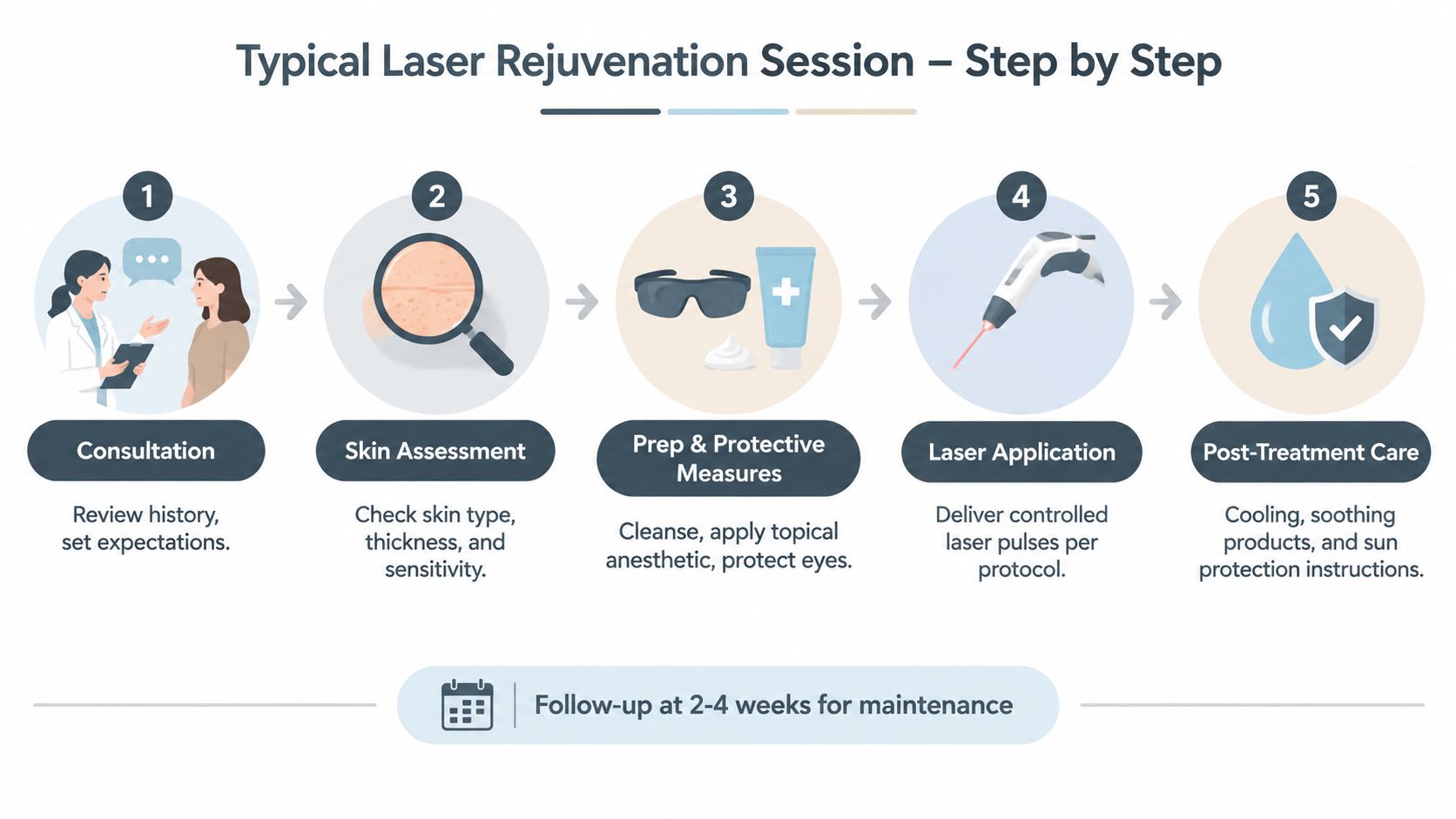
A safe session starts before the handpiece touches the skin. The practitioner should document the indication, examine the treatment area, confirm contraindications, explain expected effects, and record baseline photographs under consistent conditions. Patients need clear written aftercare, not just verbal reassurance given at the reception desk.
Prepare the patient and room
Cleanse the area and remove products that could interfere with treatment. Apply topical anaesthetic only when appropriate for the procedure and the patient, following the clinic's medical protocol. Protective eyewear is mandatory for both patient and operator, with the correct protection for the wavelength being used.
Room preparation is easy to overlook. South African laser safety guidance advises removing mirrors and covering windows to reduce reflective beam hazards. The same guidance recommends asking whether the laser is compatible with the patient's skin type and requesting a patch test, particularly for sensitive or dark skin. Review practical laser safety guidance for clinics.
Deliver controlled energy
The operator should follow a documented protocol rather than improvise during treatment. Confirm the device, wavelength, handpiece, spot size, pulse structure, fluence, density, cooling approach, and endpoint criteria before beginning.
A patch test doesn't guarantee a complication-free full-face treatment, but it can reveal an unacceptable response before exposure is expanded. Record the test area, parameters, timing, visible response, and follow-up decision.
During treatment, communicate continuously. Pain that exceeds the agreed expectation, unusual whitening, excessive swelling, or an unexpected endpoint should prompt reassessment. The patient's comfort matters, but comfort isn't the only safety marker.
Give aftercare that patients can follow
Cooling and soothing measures should match the treatment depth. Use gentle cleansing and avoid introducing irritating products while the barrier is compromised. Sun protection and avoidance of tanning are central to reducing pigmentary complications, especially in darker skin.
Document immediate erythema, swelling, discomfort, and any unexpected reaction. Arrange follow-up according to the procedure and clinical risk, and instruct the patient to contact the clinic if symptoms worsen rather than settle.
A written laser safety protocol gives the team a repeatable operational standard. It should sit alongside device training, maintenance records, incident procedures, consent documents, and individual treatment notes.
Regulatory Compliance and SAHPRA Requirements
South African clinics can't treat laser regulation as an equipment-purchasing detail. Class 3 and Class 4 laser devices must be registered with SAHPRA, and clinics must appoint a Laser Safety Officer for each machine. This framework has helped position rejuvenation lasers within clinical environments rather than treating them as ordinary beauty equipment. Review South African laser safety guidance.
SAHPRA's 2026 industry communication is titled “Regulatory Requirements for License Applications for Importation, Manufacturing and Use of Laser Systems”. It states that licensing for laser systems is handled under the Hazardous Substances Act, Act 15 of 1973, confirming that use is governed through a formal regulatory process. Access SAHPRA's document library.
Build a compliance file
A responsible clinic should be able to show more than an invoice for the device. Maintain an organised file containing:
- Device documentation: Registration and licensing records applicable to the system.
- Safety leadership: The appointed LSO, responsibilities, training, and machine-specific oversight.
- Operational controls: Room risk assessment, protective eyewear checks, signage, and reflective-surface controls.
- Clinical records: Consultation, consent, patch-test findings, settings, endpoint, photographs, and aftercare.
- Maintenance evidence: Servicing, calibration, repairs, and fault reporting.
The regulatory picture has an important complication. In Gauteng, IPL and laser treatments are reported as popular for rejuvenation, yet a University of Johannesburg study found that they aren't governed by specific legislation or licensing in South Africa, allowing use in non-medical fields such as beauty therapy. The study also identified poor adherence to protocol guidelines among Somatologists, including inadequate minimum training time and limited workshop attendance. Read the University of Johannesburg study.
Separate legal minimums from professional standards
The absence of specific practitioner licensing for some settings shouldn't become a reason to lower standards. It should prompt clinics to exceed the minimum through documented competency, supervised training, clear escalation pathways, and disciplined treatment records.
IPL and LED devices are excluded from the specific registration and licensing requirement described for Class 3 and Class 4 laser systems in South African industry guidance. That distinction doesn't remove the need for safe operation, informed consent, staff training, or appropriate clinical governance. Review the South African device framework.
Growing Your Clinic with Laser Rejuvenation Services
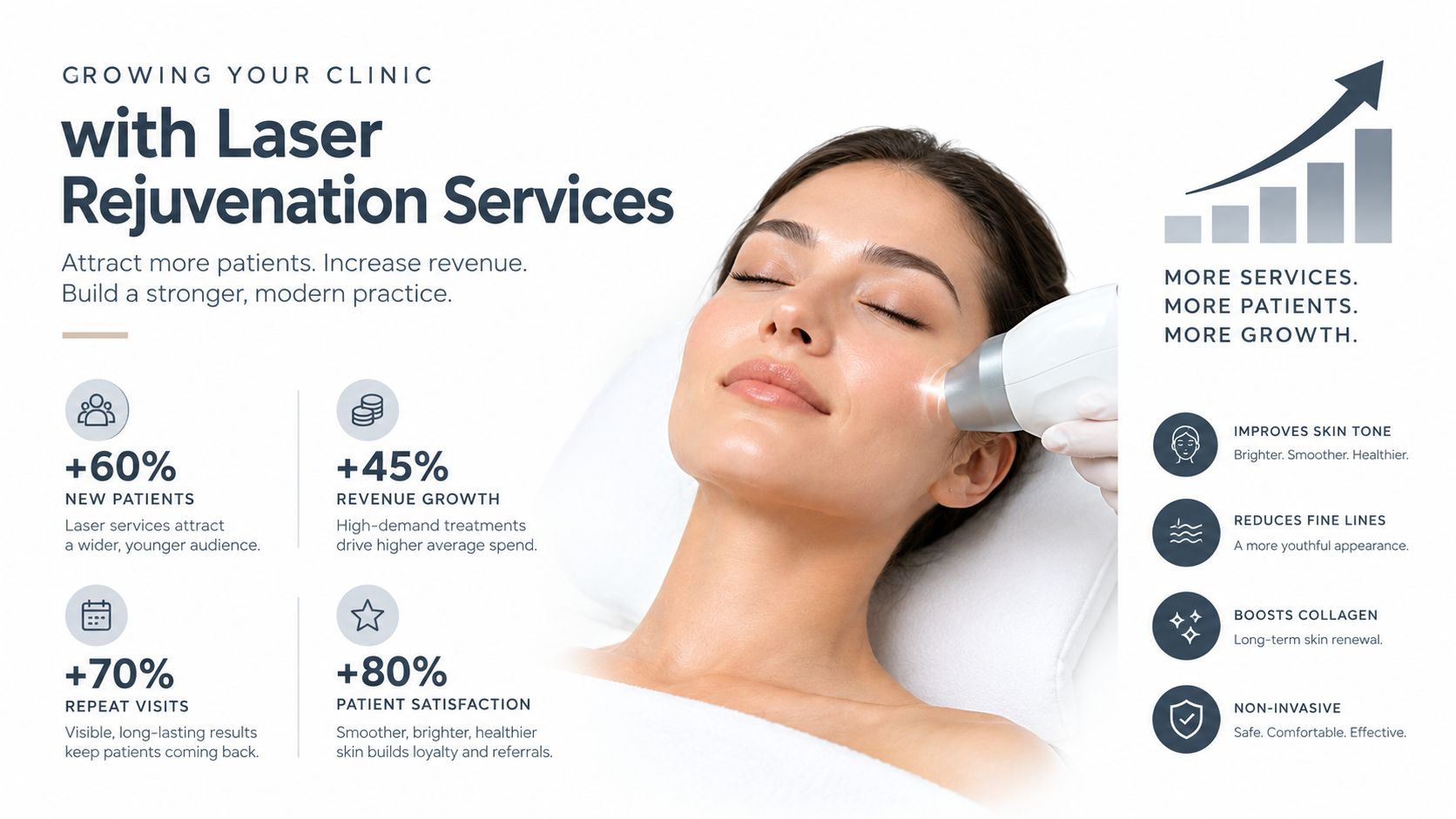
The South African market supports a considered case for adding resurfacing services. The skin resurfacing market was estimated at USD 3.5 million in 2020 e prevê-se que atinja USD 5.7 million by 2027, o que representa um 7.3% CAGR. Ablative treatments accounted for 57.14% of revenue in 2020, indicating the established commercial importance of higher-intensity resurfacing and rejuvenation procedures in the local aesthetic-laser space. Review the South Africa market outlook.
Growth doesn't justify buying the most aggressive platform. It justifies building a service that the clinic can deliver safely, explain accurately, and support with repeatable protocols.
Choose the platform around clinical use
Assess the device against the concerns your patient base presents. A multi-wavelength or multi-technology platform can give a clinic more treatment flexibility, but only if the team understands the indications and limitations of each modality.
Before purchase, verify:
- Regulatory position: Confirm applicable FDA approval, CE certification, and SAHPRA licensing documentation for the system.
- Clinical versatility: Check whether the platform supports the rejuvenation, resurfacing, pigment, vascular, or texture indications you intend to offer.
- Profundidade de formação: Require practical education covering darker skin types, contraindications, patch testing, settings, endpoints, and complication management.
- Apoio técnico: Establish who handles servicing, faults, consumables, software, and escalation.
- Apoio comercial: Assess whether the supplier provides education, marketing guidance, business development support, and patient acquisition tools.
- Ownership protection: Review warranty terms, maintenance obligations, and the likely cost of keeping the system operational.
Price the service by value and risk
Avoid a single generic “laser facial” price. Create treatment tiers based on the indication, treatment area, intensity, preparation, clinical time, consumables, follow-up, and aftercare. Packages can support continuity, but they shouldn't pressure a patient into sessions before the practitioner confirms suitability.
Position the service around honest outcomes. Use language such as texture refinement, gradual tone improvement, or resurfacing for selected indications, rather than promising permanent correction or zero recovery. Show patients what recovery may involve, explain why settings differ between skin types, and make safety part of the value proposition.
Omega Lasers supplies FDA-approved, CE-certified, and SAHPRA-licensed systems, including Derma Pro, an RF microneedling system for facial and body treatments, alongside laser and multi-technology platforms for rejuvenation and resurfacing. Its support model includes device training, technical and marketing support, business guidance, after-sales service, a clinic finder, and a two-year manufacturer warranty.
If you're planning to add or refine skin rejuvenation laser services, visit Lasers Omega to explore compliant device options, clinical training, technical support, and practical guidance for building a safer, more sustainable treatment offering. Speak with the team about matching your clinic's patient profile, treatment goals, and operating model to the right platform.