



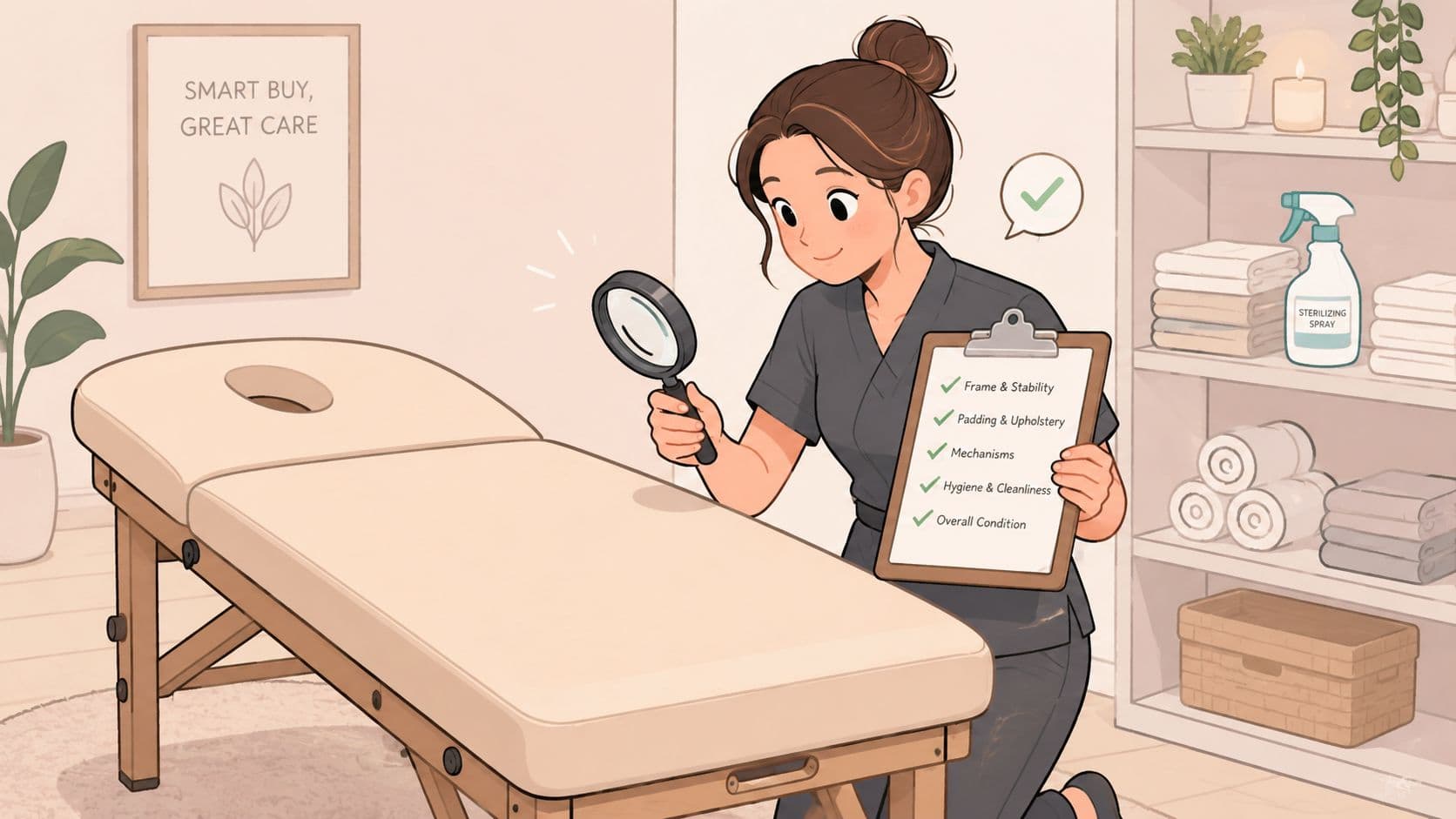
You're standing in a treatment room with rent due, a chair needing replacement, and a list of equipment that still isn't paid off. Then a second hand massage bed for sale pops up at a price that looks almost silly, and the temptation is obvious. I've walked enough used-bed viewings to say this plainly, the cheap listing is never the full story. The question is whether the bed will survive clinic use, clean up properly, and still leave margin for the things that move your business forward.
Índice
- Why a Second Hand Massage Bed Is Worth Considering
- Where to Find Second Hand Massage Beds in South Africa
- The Pre Purchase Inspection Checklist You Should Never Skip
- Pricing Benchmarks and How to Negotiate Without Losing the Deal
- Sanitisation, Repairs, and Refurbishment After You Buy
- Safety, Warranty, and Transport Considerations
- Matching the Bed to Your Clinic Workflow
Why a Second Hand Massage Bed Is Worth Considering
Clinic owners often frame this as a cash-saving decision, but the test is harsher. You need to keep capital tied up in the treatment room low enough to fund the services that bring repeat bookings, while still buying equipment that will not embarrass you in front of clients.
I have seen owners nearly commit to the first bed they find because the asking price looks irresistible. Then the upholstery smells stale, the hinges creak, and the seller cannot explain where it was stored. That kind of “deal” turns into a repair job, a sanitation problem, and a slow drain on your opening budget.
Used massage beds can still make strong business sense because resale in this category behaves more like used furniture than specialised medical gear. Well-maintained units often trade at a fraction of their original price, while fair or repairable beds drop much lower, and like-new units still command more when the history is clean. That gives you room to protect cash for higher-return equipment and avoid taking the full depreciation hit on every item in the room.
Regra prática: buy used when the bed helps you open, stabilise, or expand without forcing you to cut corners elsewhere.
The trade-off is just as real. You inherit unknown use, unknown storage, and possibly tired mechanisms. Hygiene perception matters, client comfort matters, and a noisy or unstable bed damages confidence in the room faster than a scuffed cabinet ever will.
A second hand bed is worth considering when you can inspect it properly, price the risk accurately, and walk away from anything that smells like trouble. That standard keeps the deal from becoming a regret.
Where to Find Second Hand Massage Beds in South Africa
Start where the listings live, not where you wish they lived. In South Africa, the strongest signal is the big classified marketplace layer, where private sellers, therapists, and small operators post quickly and price aggressively. That's where you'll see the widest mix of conditions, from lightly used portable beds to units that look like they were dragged through a storage room.
Gumtree South Africa is usually the first stop because it surfaces the broadest spread of used massage beds and related salon equipment. Use it when you want volume and fast price discovery. Ask immediately about age, storage, motion, and whether the seller can prove the bed's history. If they can't answer basic questions without hesitation, treat it as a warning sign.
Facebook Marketplace and local reseller groups are useful when you want to catch a therapist exiting the industry or a clinic clearing a room quickly. These listings can be cheap, but they're often thin on documentation. You're buying from a person, not a merchant, so insist on clear photos, video of moving parts, and a pickup address that matches the story.
Industry auctions and clinic liquidations are where you look for heavier stock and better-maintained units. These tend to be more disciplined than random private sales, but you still need to check storage, transport, and whether the equipment was serviced before closure. A liquidation listing sounds tidy, yet the condition can vary wildly.
Refurbishment dealers and registered equipment sellers sit at the cautious end of the market. They're the right choice if you need a stronger paper trail or a warranty conversation. Expect a higher asking price, but also expect less nonsense.
If you're already browsing broader salon stock, the Omega Lasers salon equipment for sale page can help you think beyond the bed itself and compare the treatment room as a whole.
The pattern is simple. Private listings are fast and cheap, liquidations are better for stock consistency, and refurbishment channels are better for peace of mind. Don't anchor on one advertised price. Compare condition-adjusted offers across several listings before you even think about negotiating.
The Pre Purchase Inspection Checklist You Should Never Skip
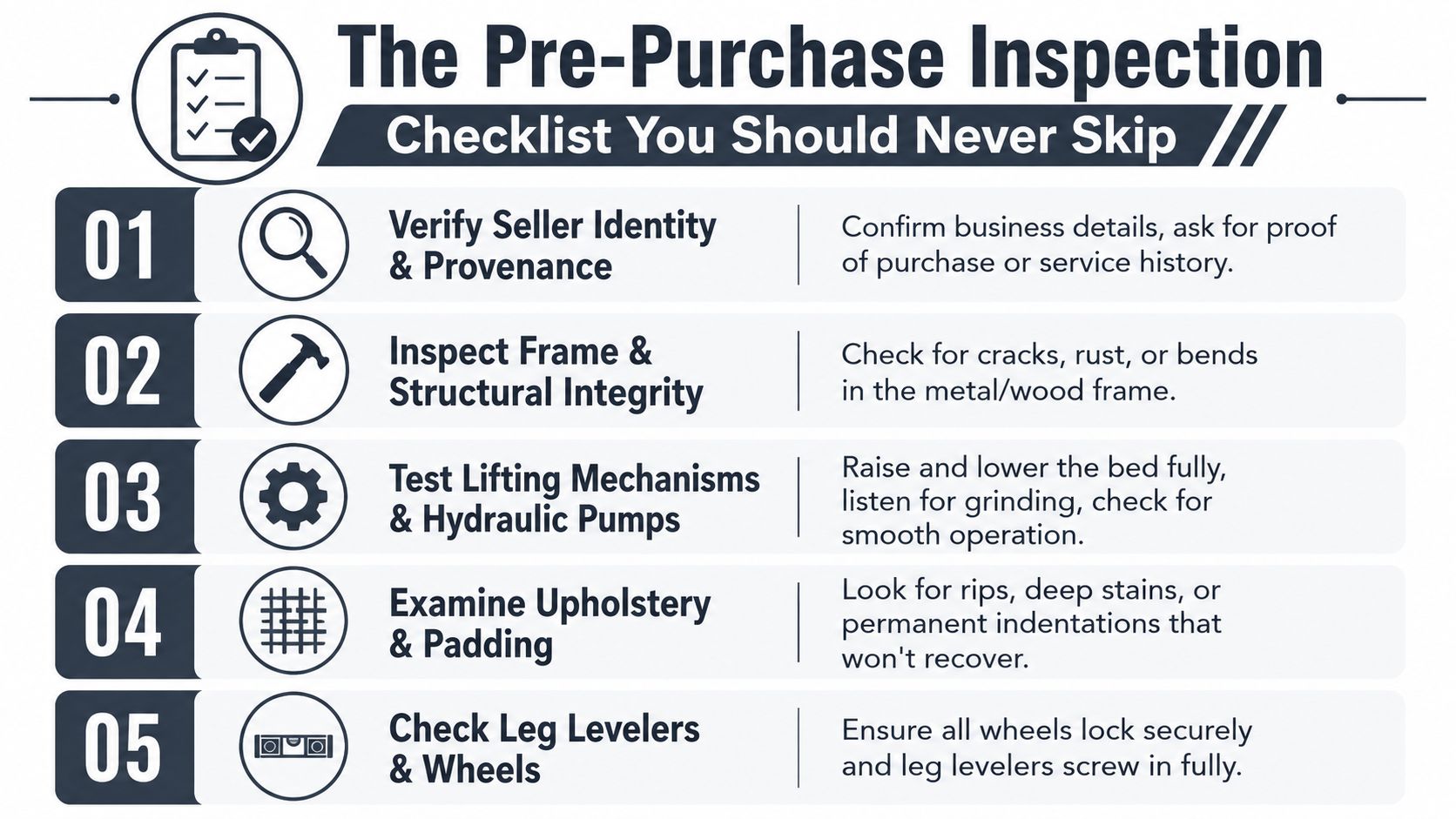
The mistake I see most often is buyers talking too much and checking too little. If you can inspect the bed in person, do it in order and do not let the seller hurry you. A cheap-looking listing can still hide expensive problems, and those problems show up later in client complaints, repairs, and downtime.
Start with who is selling it
Verify the seller's identity and ask where the bed came from. A clinic owner, therapist, or liquidator should be able to explain its use history in plain language. If the story keeps changing, walk away.
Then check whether the seller can show proof of purchase, service notes, or at least a believable timeline. Missing paperwork is not always fatal, but it removes the evidence you need to judge risk properly. A bed with no origin story is usually priced that way for a reason.
Move to structure before comfort
Look for frame cracks, rust, weld defects, bent supports, and damaged leg locks. Check the hinges on folding models because they take a beating that sellers love to play down. If the legs wobble or the frame flexes under light pressure, you are not looking at a bargain, you are looking at a liability.
Inspect the wood sheet beneath the table too. Dents or cracks there often mean the bed was dropped or stored badly. That matters because hidden abuse shows up later as squeaks, instability, or uneven support.
Test the upholstery and hygiene story
Press the padding and see if it springs back properly. Check for tears, permanent indentations, deep stains, mould, and bad odours. Smoke exposure and pet proximity are not cosmetic details, they are sanitation and client-experience problems.
Ask where the item was stored, whether it sat in a smoke-filled room, near pets, or in a garage or storage bin. That history tells you more than a polished listing photo ever will. For a broader framework for vetting second-hand gear, see Gym Membership Tips on used equipment, where hidden wear and poor documentation are treated as deal risk, not trivia.
If the seller will not let you test it, leave.
Powered models need one more pass. Test motors, actuators, heaters, control boxes, and cable wear near pivot points. If you hear grinding, see fault codes, or feel jerky motion, you already know enough. A bed that fails in motion is a bed that will cost you twice, once to buy and again to fix.
Pricing Benchmarks and How to Negotiate Without Losing the Deal
Price is where most buyers get lazy. They compare the asking number to their budget, not to the bed's condition, and that's how they overpay for a tired unit. The correct anchor is original retail and the condition tier in front of you.
Well-maintained used beds usually sit at 40% to 60% of original price. Fair or repairable units should sit meaningfully below that because you're taking on labour, parts, and downtime. If the bed is pristine and under three years old, the market can support a higher percentage, but only when the history, accessories, and function are clean.
Here's the negotiation method I trust.
- Lead with condition, not hostility. Say what you saw, not what you think the seller owes you.
- Name the defects clearly. Missing headrests, worn vinyl, sluggish motors, missing bags, or damaged zips all justify a lower offer.
- Tie each defect to your cost. Don't argue abstractly. State that you'll need to repair, replace, or service the item before client use.
If the seller is organised, responsive, and has service history plus immediate availability, I'll pay closer to asking price. That's especially true when the bed is complete and you can put it into rotation fast. Convenience has value, and sellers who've maintained their gear deserve credit for that.
| Bed type | Good condition (40% to 60% of retail) | Fair / repairable | Like-new under 3 years |
|---|---|---|---|
| Portable | Best value when lightweight and complete | Only worth it if the frame and locks are sound | Strong buy if clean, foldable, and fully accessorised |
| Stationary | Pay up only for stable frames and clean upholstery | Discount hard for wear, stiffness, or missing parts | Worth considering if the room needs a premium look |
| Powered or thermal | Buy only with proven motion and service history | Price in repairs before you commit | Acceptable when controls, heat, and motion are flawless |
A useful mindset is simple. If the discount doesn't cover the defects plus your refurbishment margin, it isn't a deal. It's just someone else's exit problem.
Sanitisation, Repairs, and Refurbishment After You Buy
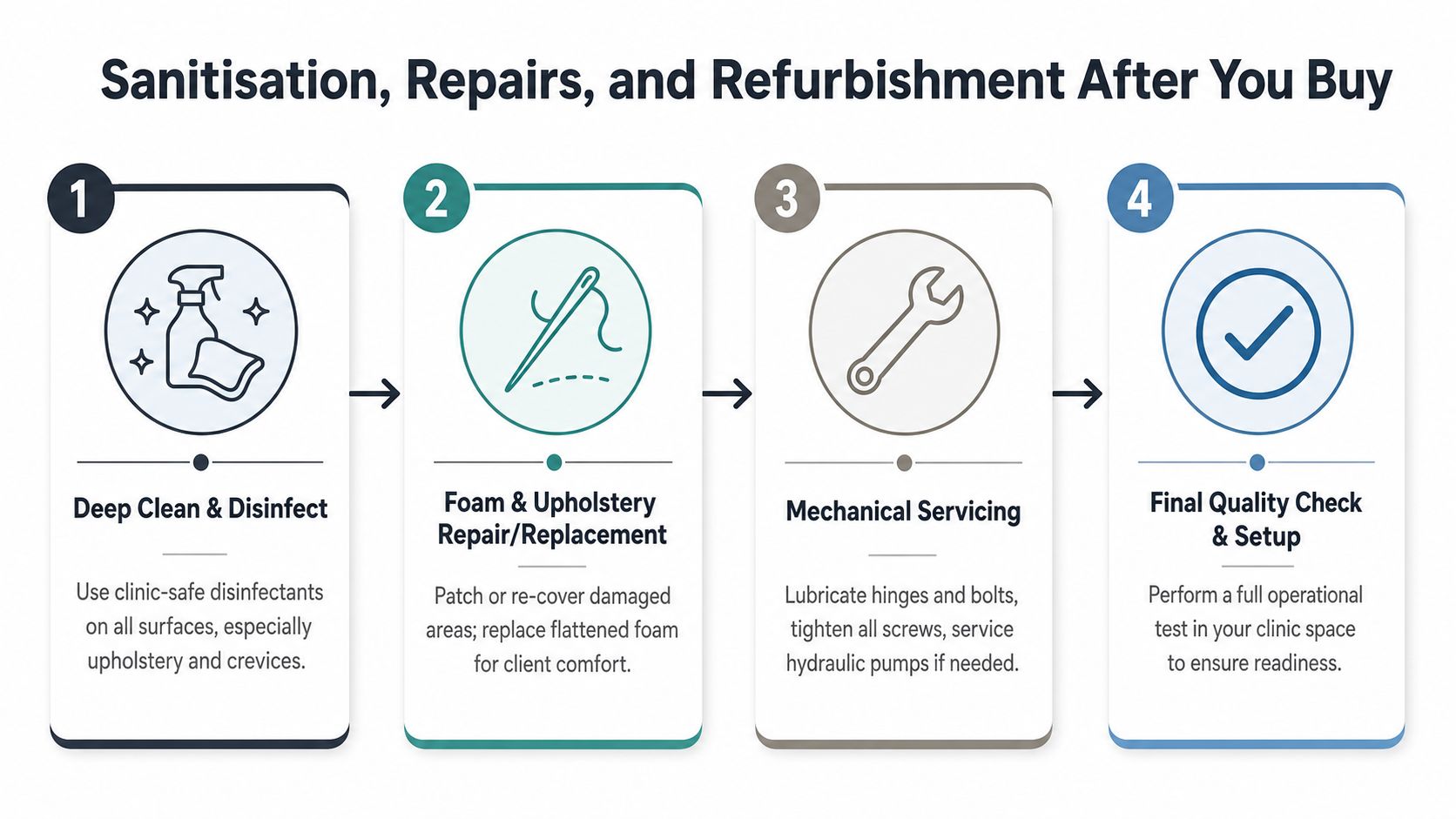
The moment the bed lands in your clinic, treat it like incoming equipment, not décor. Clean it fully before it touches a client room, because a bargain bed that looks tired still feels tired after one wipe-down. Clients notice the first impression fast, and they notice it without saying a word.
Clean first, then repair
Use clinic-safe disinfectants on all surfaces, especially crevices, seams, and face cradle areas. After that, inspect the upholstery again under bright light. Dirt hides damage, and damage hides price.
If the foam has deep indentations, replace it rather than pretending it will recover. Torn vinyl should be patched or re-covered with a non-porous PU or medical-grade alternative. Missing bolts, loose hinges, and squeaky joints are small fixes that change how professional the bed feels immediately.
Service the mechanics before first use
If the bed moves, lift, lower, tilt, or heat, test every function before it sees a client. Lubricate hinges and bolts, tighten screws, and service hydraulic or motor components if needed. Do not guess on powered beds. Faults on first use are far more expensive than faults discovered in your garage.
For a practical finishing touch, I like a clean underlayer and fresh disposables on day one. Using disposable bed sheets from Omega Lasers helps a refurbished bed look clinic-ready straight away, especially when you're still waiting on a full re-cover or deeper cosmetic repair.
You don't need a workshop overhaul to make a used bed presentable. You need disciplined cleaning, a few parts, and a refusal to put anything half-done into client use. That's the difference between a clinical asset and a compromise.
Safety, Warranty, and Transport Considerations
The cheap bed is rarely the cheap part. Transport, safety checks, and warranty assumptions can flip the maths fast, especially on powered models. If you ignore that, you'll spend more after the purchase than you saved at the viewing.
Electrical safety matters most on beds with motors or heaters. If you can't verify service history or safety testing, assume the unit may need attention before it's safe for regular use. A seller saying “it worked last time” is not documentation.
Warranty transfer is usually weak in private sales, so don't build your decision around it. Price the bed as if you're carrying the risk yourself. That's the honest way to buy.
Transport also gets underestimated. Portable foldable beds are manageable, but stationary and powered beds usually need a bakkie or small van and two people. Protect the bed with blankets and secure it properly, because transit damage can undo a good purchase in one careless trip. If you've never moved heavy items before, the guidance on moving heavy furniture safely is a useful reminder that lifting technique and load protection matter just as much as muscle.
Collect the paperwork at handover. Get proof of purchase, seller ID, the serial number if it exists, and any service records the seller can provide. That record won't guarantee quality, but it gives you something to fall back on if a problem shows up after delivery.
Bottom line: if the seller can't support the sale with basic documentation, the risk belongs to you.
Matching the Bed to Your Clinic Workflow
The right bed isn't the best-looking one, it's the one that fits how your clinic works. A mobile therapist needs a different bed from a busy aesthetic room. If you buy the wrong format, the “savings” disappear into inconvenience.
Match the bed to the job
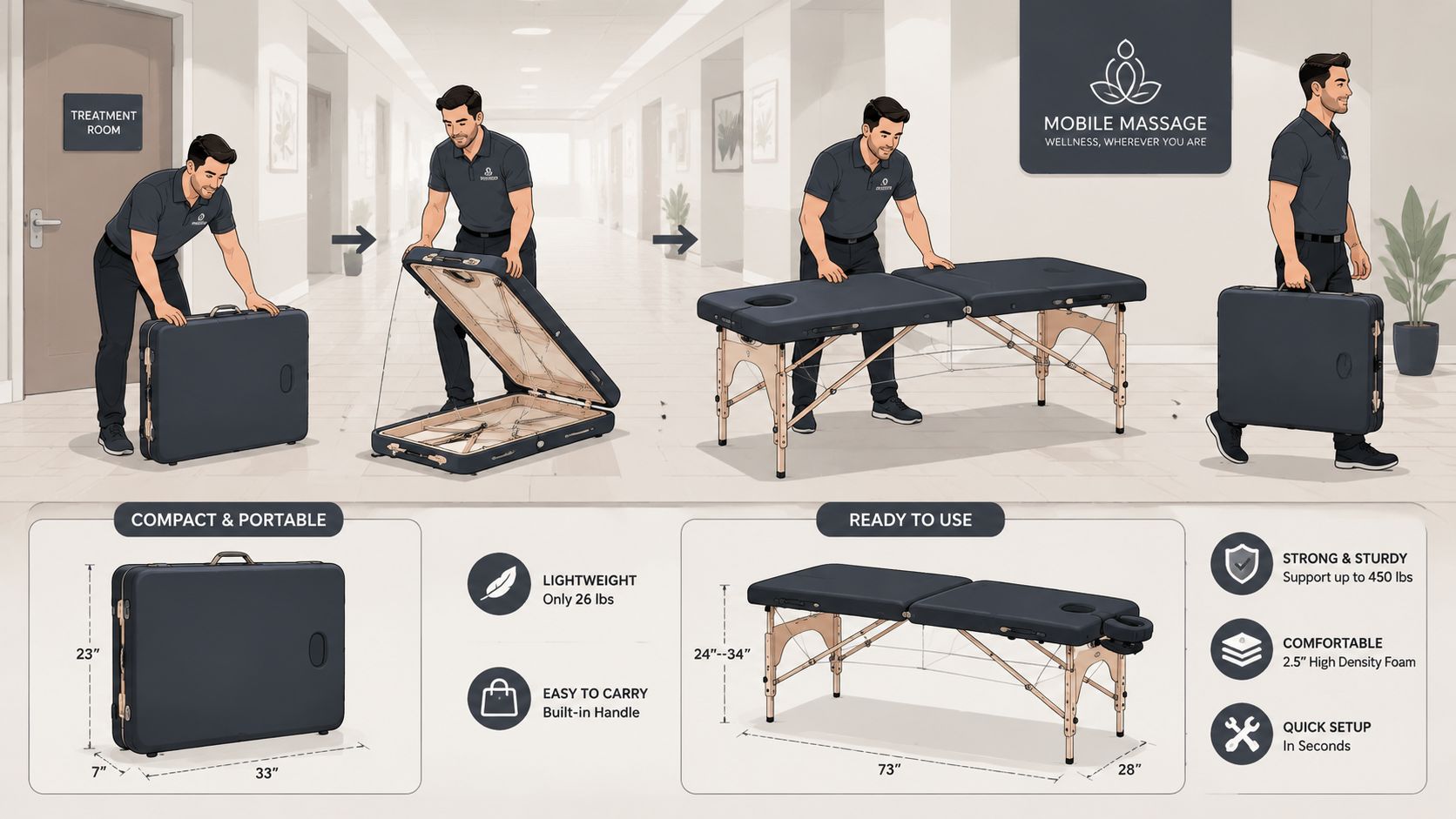
If you travel, choose lightweight foldable construction and uncomplicated setup. A mobile therapist lives or dies by portability, fast packing, and a frame that won't punish the back on repeat carry-ins. If you're filling a fixed treatment room, stability and wipe-down surfaces matter more than weight.
A busy aesthetic clinic should lean towards a stationary or powered bed with strong load capacity and easy cleaning. The visual impression matters too. Clients who walk into a polished treatment room judge the bed before they judge the menu of services.
If massage is only one service among others, the bed should support the room, not dominate your budget. That's why it makes sense to pair a used bed with higher-investment technology only when the bed is reliable and the rest of the room is pulling its weight. A platform from Omega Lasers portable bed for massage is the kind of reference point that helps you separate transport-friendly solutions from fixed-room gear.
Use a hard decision rule
Buy used only if the bed matches at least 80% of your ideal spec and still leaves room for refurbishment inside your first 90 days. If it falls short on fit, don't talk yourself into it because the price is low.
Walk away immediately if you see visible frame damage, mould or smoke odour, or any motor or heater fault on a powered model. Those are not negotiable defects. They're exit signals.
Your checklist on the next viewing should be blunt. Inspect in person. Price by condition, not age. Budget for refurbishment. Only buy what fits the way you work. The cheapest bed is often the most expensive purchase once repairs, downtime, and client impressions are added together.
Omega Lasers helps clinics build treatment rooms that work harder, not just look better, with advanced medical-aesthetic systems, training, and support that make growth more predictable. If you're weighing a used massage bed against other clinic investments, visit Omega Lasers to see how the right equipment can support your room, your clients, and your return on investment.