




You're standing at the point where a deposit looks small, a certificate looks reassuring, and the pressure to get staff trained keeps building. That's exactly when clinics and salons make expensive mistakes. They buy a course because it's cheap, quick, and polished on the sales page, then discover later that the paperwork won't satisfy an insurer, the training didn't prepare the team for the actual device, or the certificate doesn't map to the right regulated pathway.
That failure is avoidable. Accredited training providers aren't just a compliance formality, they're the filter that separates recognised, outcomes-based training from a slick short course that leaves you exposed. In a regulated skills environment, accreditation is how training gets counted, quality-assured, and tied to credible credentials, which is exactly why it matters for aesthetic lasers and other energy-based devices. Omega Lasers' own training and development page is a useful reminder that staff education has to be treated as part of the business system, not an afterthought, and you can review that approach on its staff training and development page.
Índice
- Why the Wrong Training Choice Hurts More Than You Think
- What Accreditation Actually Means for Aesthetic Training
- A Practical Verification Checklist Before You Pay
- Course Content and Assessment Standards You Should Expect
- Onsite, Blended or Online Which Format Actually Works
- Pricing, ROI and the Real Cost of Retraining
- Questions to Ask Any Provider Before You Enrol
Why the Wrong Training Choice Hurts More Than You Think
A salon owner calls after a painful lesson. She paid for a weekend laser course because the presenter sounded confident and the certificate looked official. The team completed it, everyone was happy, and she booked treatments. Then the insurer asked for NQF-aligned credentials, the local compliance conversation got uncomfortable, and the certificate she'd bought stopped looking like an asset and started looking like a receipt for wasted money.
That kind of mistake is common because training feels like a purchase, when it's a risk decision. In South Africa's regulated skills environment, provider accreditation is what helps distinguish recognised training from unaccredited short courses, especially where practice must map to documented competencies and defensible staff development pathways. Government accreditation guidance also makes the core point plain, programmes should culminate in unit standards and/or qualifications registered on the National Qualifications Framework and the curriculum must align to those standards (South African government accreditation guidance).
The real cost is the second payment
The first payment goes to the course. The second payment goes to the replacement course, the time lost while your team is untrained, and the confidence damage when staff hesitate around a device they were supposed to master. That's the part owners underestimate.
Regra prática: If a certificate can't be tied to a current, recognised programme, it's not training. It's a document.
For clinics, this is especially sharp. Aesthetic laser work isn't a casual upsell, it involves safety, contraindications, device handling, and post-treatment judgement. If the training provider can't show you exactly what was taught, assessed, and recognised, you're not buying capability. You're buying uncertainty.
The easiest way to avoid that trap is to stop asking whether a course “sounds good” and start asking whether it is verifiable, current, and relevant to the actual treatment you'll deliver. That's the lens that saves money.
What Accreditation Actually Means for Aesthetic Training
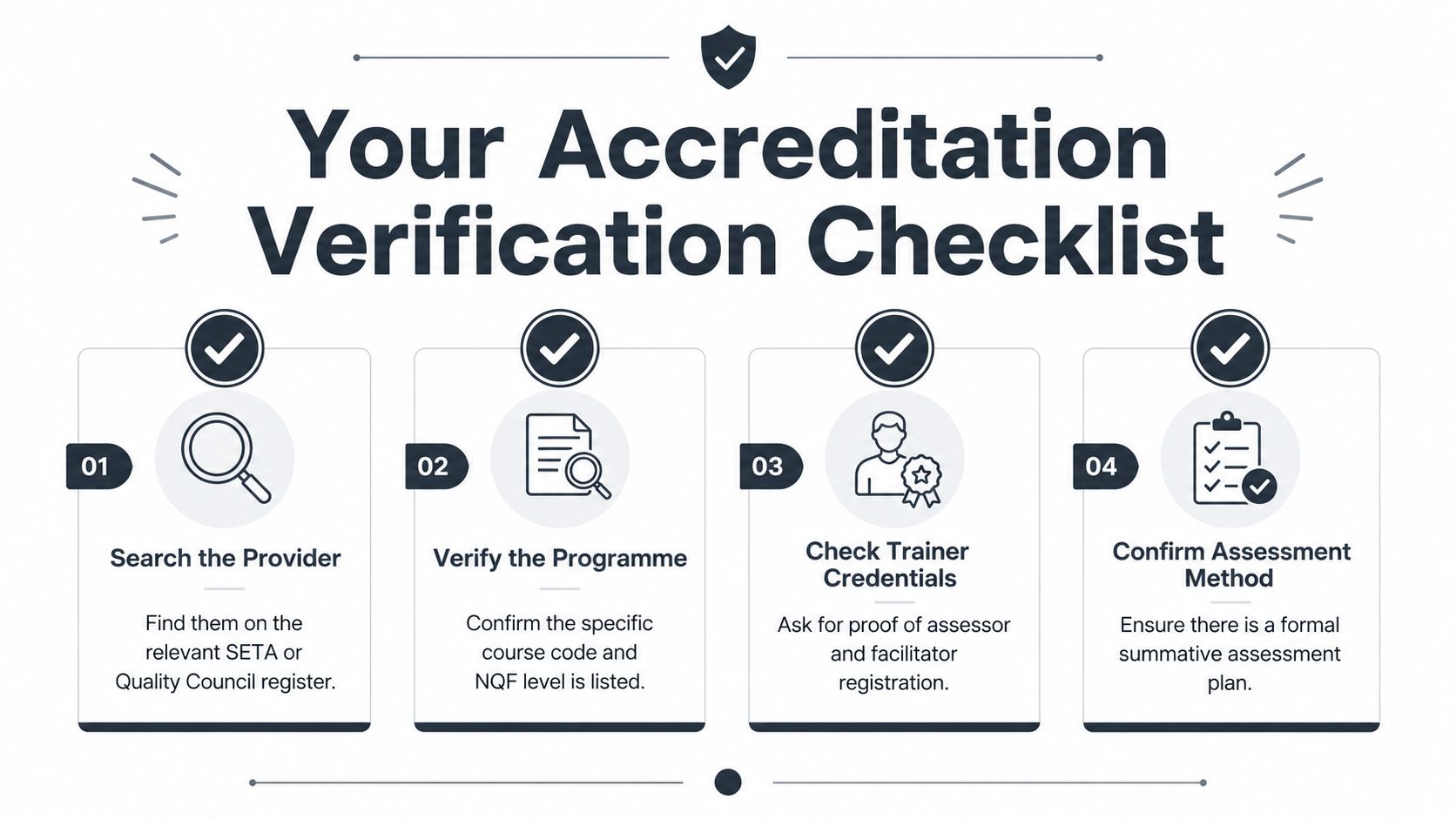
Accreditation is not a decorative badge. It means a third party has reviewed the provider, the specific programme, and the assessment against a recognised standard. In South Africa, that matters because approval is often programme-specific e time-limited, so a provider can be accredited for one course and not for the laser device course you're considering. The INSETA provider list is a good illustration of how status, dates, regions, contacts, and specific learning programmes are tracked separately, not bundled into one universal claim.
Ask for the exact programme, not the marketing name
If a website says “we are accredited”, that's not an answer. It's the first question you should ask back. You need the exact course title, the current approval status, and the body that granted it. If the provider can't name the programme code or show where the course sits in the formal register, walk away.
That principle isn't unique to South Africa. Buyers in other education markets are trained to check whether a qualification or diploma is recognised, not just advertised as such. A useful example is this guide on UK university recognition for diplomas, which reinforces the same buyer habit, verify the recognition pathway, don't trust branding alone.
Why the NQF link matters
For aesthetic clinics, the NQF link is the difference between a training day and a recognised learning pathway. Government guidance requires programmes and assessments to culminate in registered unit standards and/or qualifications, with curriculum and materials aligned to them (South African government accreditation guidance). That's the question every owner should keep on the table.
If you need a practical model for how to think about continuing learning, Omega Lasers' continuing education requirements page is worth reviewing as a business reference point. It sits in the same category of thinking, training is only useful when it's structured, current, and tied to real performance expectations.
A Practical Verification Checklist Before You Pay
A clinic owner who buys training on a promise alone usually pays twice. First for the course, then again to fix the gaps it left behind. Before you pay a deposit, use the same verification call every time. Keep it short, direct, and uncomfortable if needed.
Check the register first
Start with the register, not the sales pitch. Ask which SETA or quality council lists the provider, and ask for the exact programme title as it appears on that record. If they answer with broad language like “we work with accredited bodies” but cannot name the body, stop there. A provider that is properly listed will say so plainly.
Ask for the programme name and current status
You need the exact programme name, the current status, and the assessment route. That tells you whether the course you are buying matches the course that was approved, not a rebranded version with weaker content. Ask for the accreditation expiry date too. If that date is missing or brushed aside, treat it as a warning sign.
Demand performance data, not slogans
Ask for retention, completion, and pass data in writing. A provider should be able to explain how learners move through the course and where they usually drop out. Do not accept vague claims about “high success rates” unless they can show the numbers behind them. If the figures are withheld, you are being asked to buy blind.
You also need to know whether the provider can prove learner outcomes when challenged. A clean way to pressure-test that is to ask for a document trail, then verify the credentials against a public record or internal register. Omega Lasers' credential verification page is a useful example of the kind of check a clinic should insist on before paying.
Good providers do not hide behind sales language. They can show the numbers, the register entry, and the route the learner follows from enrolment to assessment.
Check the person who will teach
Trainer credentials matter just as much as provider credentials. Ask who will deliver the device training, what they are qualified to teach, and whether they can show assessor or facilitator registration where that applies. A polished enrolment team proves nothing about the person who will stand in front of your staff and teach laser settings, client screening, or post-treatment management.
If you want a practical example of how to find an online medical certification provider, use the same discipline here. Verify the pathway, verify the educator, and verify the outcome before money changes hands.
Course Content and Assessment Standards You Should Expect
A credible aesthetic course should feel structured, not improvised. If the provider can't show you how the content maps to outcomes, the learning material probably isn't strong enough to trust with a device that can affect skin, comfort, and client confidence.
Content must match the real work
Government guidance requires alignment to registered unit standards or qualifications, and international course accreditation requirements also expect every applicable learning outcome to be covered, with materials kept under version control (South African government accreditation guidance), (training course accreditation requirements). That means the course should cover the actual work your staff will do, not just the marketing-friendly parts.
For aesthetic lasers and energy-based devices, I'd expect explicit coverage of safety, contraindications, device operation, maintenance basics, post-treatment complications, and escalation pathways when something looks wrong. If those topics are missing, the programme is thin.
Assessment has to prove competence
A proper course doesn't stop at attendance. South African accreditation guidance says the course and summative assessment must align with the certificate programme's purpose, scope, and intended learning outcomes (AAA accreditation guidance). That means the assessment should test whether the learner can do the work, not just remember definitions.
A strong provider will show you a real assessment structure. You should be able to see how supervised practice, practical demonstration, and final assessment fit together. If the answer is “we do a short quiz and issue a certificate”, that's not enough for device work.
Bottom line: Aesthetic training should produce repeatable competence, not just course completion.
Watch for these thin-course signals
A course is probably too light if the provider can't show version-controlled materials, can't explain how outcomes are assessed, or keeps using broad language like “introductory”, “masterclass”, or “certificate of attendance” while selling it as device competence. Those are not the same thing.
Keep one simple standard in mind. If the content, practice, and assessment don't line up, the certificate won't protect you.
Onsite, Blended or Online Which Format Actually Works
Online theory has a place. It can handle anatomy, skin typing, contraindications, and regulation efficiently, and that's useful because staff can revisit material without wasting clinic time. But theory is not the part that keeps a client safe when the machine is in hand.
Use online for knowledge, not for device mastery
A fully online “device certification” is a red flag if the course claims to cover hands-on laser work. Device competence requires supervised practice on the actual machine or a closely comparable system, because buttons, settings, patient positioning, and response patterns need live correction. If the provider cannot explain how practical skill is observed, corrected, and signed off, the course is incomplete.
Blended delivery usually makes the most sense. Put the conceptual material online if it's well structured, then do the practical component onsite, either at the provider's location or in your clinic if the equipment and supervision are appropriate. That gives your team a chance to learn the theory first and then apply it under supervision.
Purely online works only for narrow theory
If the course is about background knowledge, online can be efficient. If it's about operating aesthetic lasers or other energy-based devices, online-only is too weak for most clinic use cases. The risk is simple, staff may understand the presentation but still freeze when they need to choose settings, manage discomfort, or recognise an adverse reaction.
Don't buy convenience where supervision is the real requirement.
That's also why your buying question should be practical, not ideological. Ask where the hands-on practice happens, who supervises it, what device is used, and how competency is judged. If the answer is vague, the format is probably a compromise dressed up as flexibility.
Pricing, ROI and the Real Cost of Retraining
A training budget is easier to approve when you stop calling it a cost and start measuring the downside of getting it wrong. The visible number is the course fee. The hidden numbers are retraining, idle staff time, and the damage from one poor client experience that comes from poor technique or weak understanding.
Pay for capability, not for a certificate
A clinic that plans to offer laser hair removal or skin rejuvenation should treat staff training as part of the treatment model. Every booked session depends on someone on the team being able to deliver consistently, explain the process clearly, and manage aftercare properly. If the training doesn't produce that, the cheaper course becomes expensive very quickly.
A credible provider earns its keep. Omega Lasers, for example, pairs device supply with formação em máquinas laser, technical support, marketing support, and business development guidance, which is the right shape of offer for a clinic that needs both capability and implementation support. I'd still insist on the verification checks above before signing anything, but the model itself is sensible because it recognises that devices and staff education have to work together.
Think in sessions, not in invoices
If you know what a treatment session earns, you can work out how many booked visits cover the training spend. That calculation is clinic-specific, but the logic is universal. If a stronger course reduces hesitation, improves client trust, and lowers the chance of avoidable mistakes, it pays back through better utilisation and fewer do-overs.
The wrong training has its own bill. You pay once for the course, again for the replacement course, and again in operational drag while the team stays uncertain. That's before you count the softer damage, when clients notice poor explanations, inconsistent results, or a lack of confidence in the practitioner.
The business case is simple
Don't ask, “Can we afford the better training?” Ask, “Can we afford to retrain after a weak one?” That's the key comparison. The clinic that takes training seriously protects the device investment, protects the client relationship, and gives staff a standard they can meet.
Questions to Ask Any Provider Before You Enrol
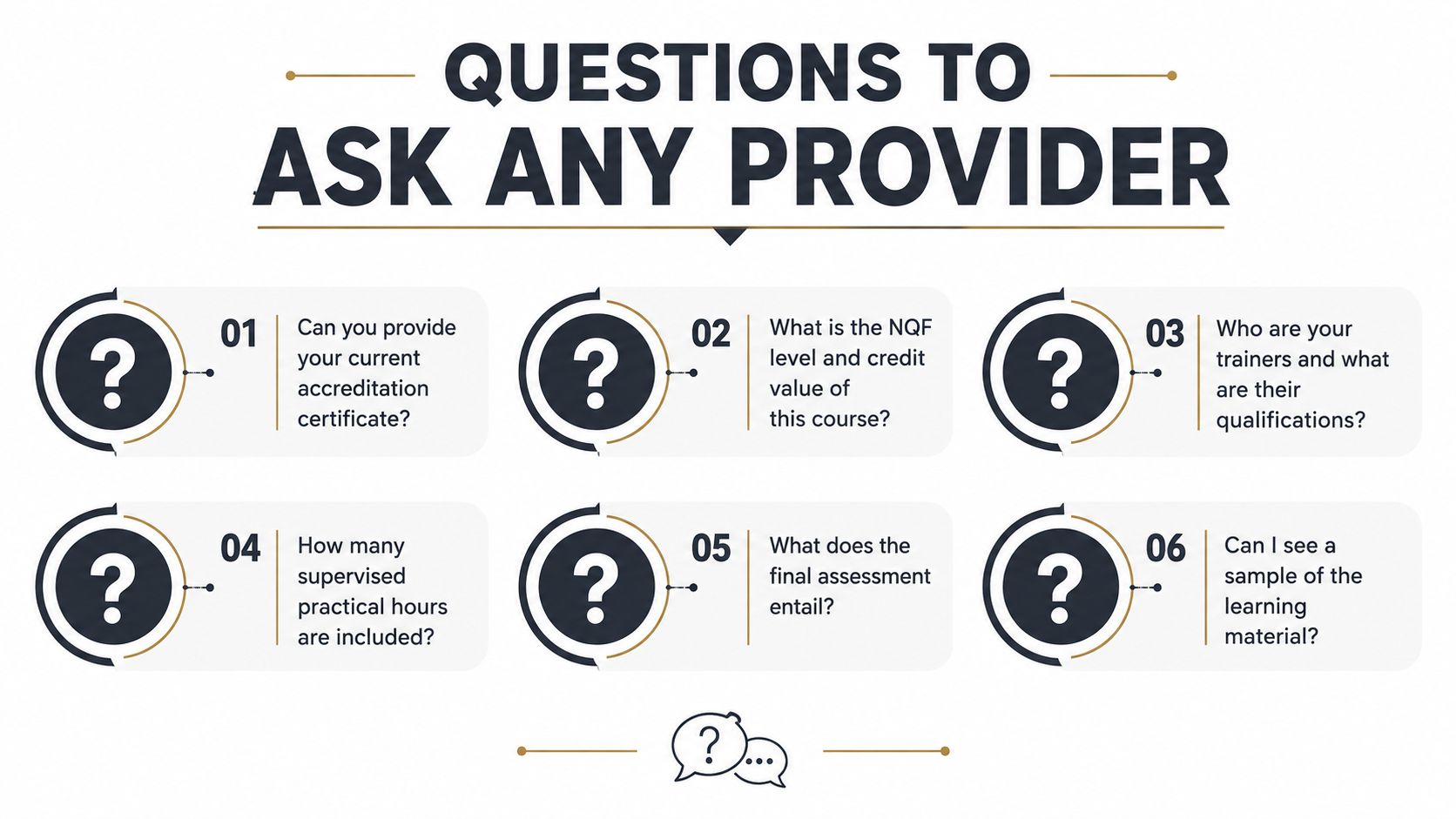
Take these six questions into every sales call. Keep them in one note on your phone and don't move on until you've got clear answers.
The questions
- Can you provide your current accreditation certificate? If they can't show current proof, don't book.
- What is the NQF level and credit value of this course? If they don't know, they probably don't have a properly structured programme.
- Who are your trainers and what are their qualifications? You need the person, not the brand.
- How many supervised practical hours are included? Device work without practice is weak.
- What does the final assessment entail? If the answer is just “an exam”, keep asking.
- Can I see a sample of the learning material? Thin notes usually mean thin teaching.
What makes me walk away
I'd walk away if the provider won't name the accrediting body, refuses to discuss assessment, or hides behind vague claims about recognition. I'd also walk away if they can't explain the practical component in plain language. A polished brochure doesn't fix a missing pathway.
The safest buying rule is still the simplest one. Verify the register, verify the programme, verify the trainer, and verify the assessment. If any of those four breaks down, your deposit is better kept in your account.
If you're ready to train your team properly, start by reviewing Omega Lasers and the support they provide around device education, technical help, and business development. Then use the checklist in this article to test any provider before you pay, because the right training should protect your clinic, not just decorate it with paper.