



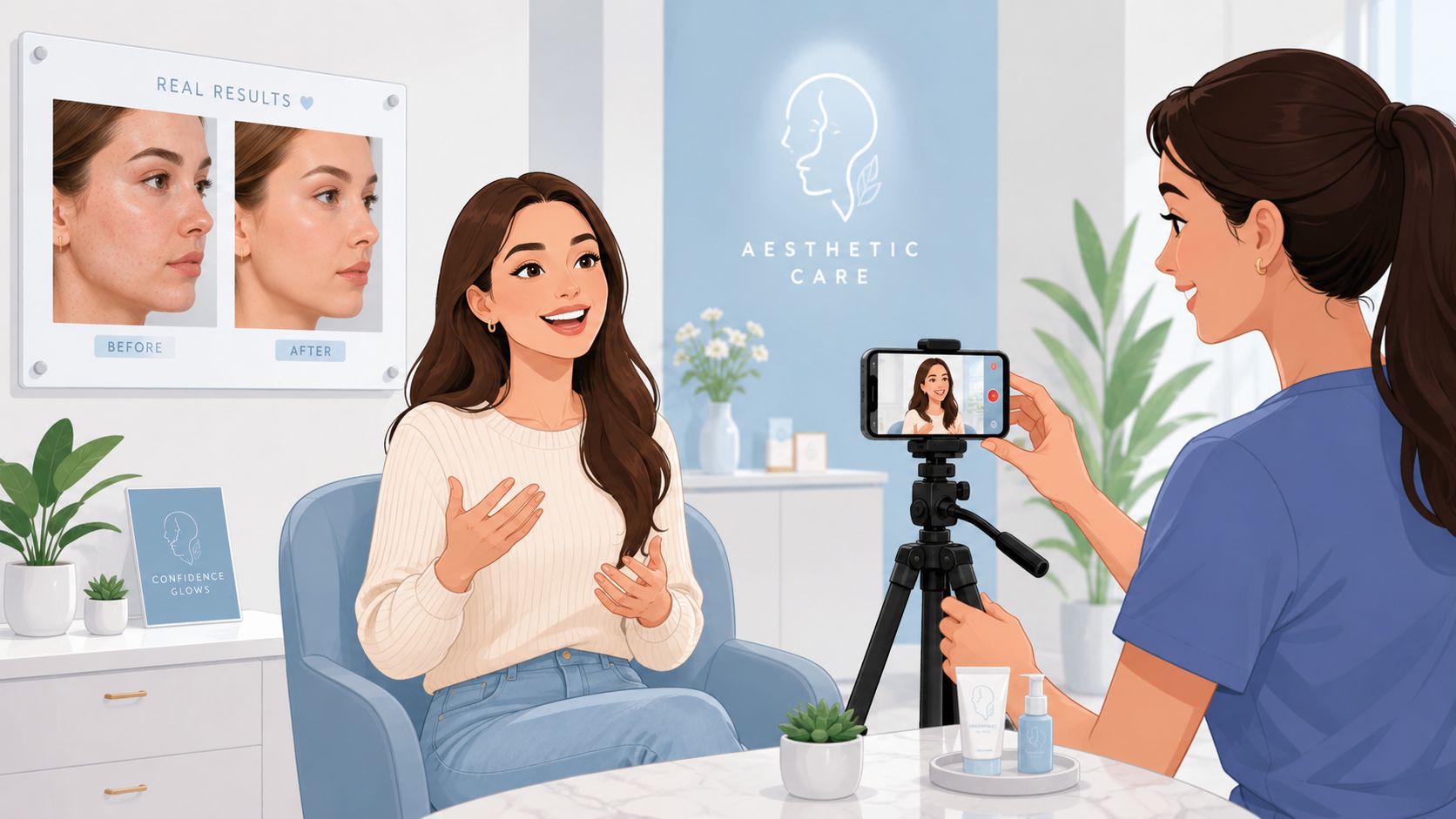
Your receptionist is chasing confirmations on WhatsApp. Your therapist has a full day booked. A patient leaves happy, says “I love my results”, then disappears without posting anything useful online. Meanwhile, a competing clinic with weaker service looks busier because its website, Instagram, and Google profile are filled with convincing patient stories.
That's the position many South African aesthetic clinics are in. They're delivering solid treatments, often with advanced technology and good clinical standards, but they're not turning patient experience into a business asset. That gap costs bookings, weakens trust, and makes every marketing rand work harder than it should.
Certifique-se sempre de que a informação é precisa e verdadeira, uma vez que se trata de lasers estéticos, dispositivos baseados em energia e saúde.
Índice
- Why Patient Testimonials Are Your Clinic's Most Powerful Asset
- Navigating Consent and Compliance in South Africa
- The Art of Asking for Powerful Testimonials
- Producing Professional Before and After Visuals
- Strategic Placement for Maximum Testimonial Impact
- Tracking ROI and Managing Your Online Reputation
Why Patient Testimonials Are Your Clinic's Most Powerful Asset
Most clinic owners treat patient testimonials as decoration. They collect a few kind words, place them on a homepage, and move on. That overlooks their true potential.
Patient testimonials are evidence of operational quality. They show whether your systems, communication, treatment delivery, and follow-up are strong enough for patients to describe their experience clearly and confidently. In aesthetics, that matters more than polished ad copy because the patient isn't buying a commodity. They're buying judgement, safety, comfort, and visible change.
A useful testimonial doesn't just say “great service”. It confirms the parts of your clinic that reduce decision friction. In Johannesburg, patient satisfaction has been linked to practical factors such as waiting times under 2 hours and clinic proximity, with satisfaction also shaped by cleanliness, safety, effective care, and medicine availability according to Frontiers in Health Services. For an aesthetic clinic, that means the most persuasive stories often mention simple things: easy booking, a clinic that's convenient to reach, short waiting, a calm environment, and staff who explain treatment properly.
That's why the clinics with the strongest testimonial libraries usually aren't the loudest marketers. They're the ones running a tighter patient journey.
Testimonials reveal what your clinic really sells
A patient may come in for laser hair removal, skin rejuvenation, resurfacing, or body-focused treatment. But the review they leave often centres on what they felt:
- Confidence in the clinician: They understood what was being done and why.
- Comfort in the process: The appointment felt organised, not chaotic.
- Trust in the setting: The clinic felt clean, safe, and professionally run.
- Relief from friction: Parking, distance, delays, and rebooking didn't become a headache.
Those are business drivers, not soft extras.
Regra prática: If a testimonial could be copied and pasted onto any clinic's website, it's too vague to help you convert.
Why authentic stories outperform polished claims
Paid messaging tells people what you want them to believe. Patient testimonials show what someone else experienced. That difference matters most when the treatment is elective, high trust, and visually judged.
Prospective patients don't just want reassurance that your device works. They want proof that the whole process feels safe, worth the money, and likely to deliver a result they'll be happy to live with. A strong testimonial closes that gap because it combines outcome with emotion.
The clinics that use testimonials properly don't treat them as marketing fluff. They treat them as a mirror. If reviews consistently praise consultation clarity and smooth scheduling, keep leaning into that. If reviews are thin, generic, or inconsistent, the problem usually sits deeper than marketing.
Navigating Consent and Compliance in South Africa
Before you publish a single review, image, or video, sort out your governance. South African clinics can't afford to be casual here. One sloppy process around consent, privacy, or editing can turn a useful testimonial into a compliance risk.
A major pitfall in South Africa is failing to follow HPCSA and SAHPRA guidelines, which can invalidate testimonials. The same guidance also stresses the value of specific, open-ended questions, and notes that video testimonials are 3x more persuasive than text for aesthetic treatments according to Acrobatant's healthcare testimonial guidance. Stronger persuasion is valuable. Non-compliance is expensive. Both realities exist at the same time.

What compliant consent actually looks like
Many clinics rely on broad intake paperwork and assume that covers future marketing use. It usually doesn't. Testimonial consent should be separate, specific, and easy for the patient to understand.
At minimum, your process should cover:
- The exact material being used: Written quote, video, voice note, photos, before-and-after images, or all of the above.
- Where it will appear: Website, social media, paid campaigns, clinic screens, printed brochures, or training material.
- Identity options: Full name, first name only, initials, anonymous, or blurred visual use.
- Withdrawal rights: The patient must know they can revoke permission and how to do it.
- Storage and privacy handling: Your team should know who can access raw files and how they're retained.
Aesthetic clinics should also build privacy practice into their day-to-day operations. That includes how media is captured, stored, transferred to marketing staff, and removed if consent changes. A practical starting point is tightening your clinic's approach to patient confidentiality standards.
A good consent form protects both parties. A weak one protects neither.
How to keep testimonials ethical and representative
Compliance isn't only a paperwork issue. It's also about how you present the patient's experience.
Don't script people into making claims they wouldn't naturally say. Don't over-edit their language until it sounds like advertising copy. Don't pair a modest outcome with dramatic framing that creates the wrong expectation. In aesthetics, the line between persuasive and misleading is thinner than many clinics realise.
There's another issue that gets ignored. Many testimonial collections lean heavily toward affluent, camera-confident, urban patients. That creates a distorted picture of who your clinic serves and who feels welcome. If your actual patient base is broader than your marketing suggests, your testimonial strategy is narrowing your appeal.
Use this checklist before publishing any patient testimonial:
| Check | What to confirm |
|---|---|
| Consent | Signed, specific, separate from treatment consent |
| Accuracy | Wording reflects the patient's real experience |
| Privacy | No accidental disclosure in visuals or captions |
| Context | Result shown honestly, without exaggeration |
| Representation | Patient stories reflect the community you serve |
A compliant clinic doesn't just collect stories. It documents permission, protects dignity, and publishes with restraint.
The Art of Asking for Powerful Testimonials
Most bad testimonials aren't the patient's fault. They're the clinic's fault for asking lazy questions.
If you ask, “Were you happy with your treatment?”, you'll get “Yes, very happy”. That's polite, but it won't persuade anyone. Strong patient testimonials come from a better prompt, a better moment, and a calmer process.

Choose the right patient and the right moment
Don't ask every patient in the same way. Pick people who are clearly satisfied, emotionally at ease, and able to describe what changed for them. That might be immediately after a treatment experience they found smooth and reassuring. It might be after they've seen visible improvement and can explain the difference in daily life.
A practical selection filter looks like this:
- Results are visible or strongly felt: The patient can describe a real outcome.
- Communication was smooth: There was no confusion around price, downtime, or aftercare.
- The patient is comfortable sharing: They don't feel pressured, rushed, or exposed.
- The format fits the person: Some patients speak well on video. Others write better than they talk.
If your team needs a prompt structure to guide the conversation, this resource on testimonials to win healthcare clients is useful because it pushes beyond generic praise and helps shape a more specific story.
Use prompts that pull out detail
Open-ended questions work because they force recall. The patient has to think about the problem they had, the hesitation they felt, and the shift they noticed after treatment.
Use prompts such as:
- What were you trying to fix before you came in?
- What nearly stopped you from booking?
- What was your first impression when you arrived at the clinic?
- What changed for you after the treatment or series of sessions?
- What would you tell someone who is on the fence?
You can also ask the open-ended question highlighted in the compliance guidance: “What are the three main benefits of your experience?” That tends to produce more concrete language than “Tell us about your visit”.
The best testimonial usually follows a simple arc. Problem, hesitation, experience, result.
Keep the recording process light. A patient shouldn't feel like they're entering a formal interview. Sit them in a quiet room, keep the camera still, and let staff respond naturally rather than reading from a script. If they stumble, don't jump in too quickly. Real speech carries more trust than polished performance.
Poor testimonial collection creates two common problems. Either the content is too vague to convert, or it sounds so managed that prospects stop believing it. The middle ground is where the value sits. Specific, calm, and unmistakably human.
Producing Professional Before and After Visuals
A clinic can deliver excellent aesthetic outcomes and still lose trust because the visuals look careless. That's common. The treatment may be clinically sound, but the before-and-after photos are taken under different lighting, from different angles, with different facial expressions, and against a cluttered background. The result looks unreliable.
In aesthetics, the visual record is part of the testimonial. If the image quality is inconsistent, the patient story weakens.

Build a repeatable photo routine
You don't need a studio setup to create credible visuals. You need consistency.
Set a fixed area in the clinic for photography. Use the same wall, the same light source, the same camera distance, and the same standing marks on the floor. If you move from room to room depending on who's free, your image library will become uneven within weeks.
A workable routine includes:
- Lighting first: Use soft, even lighting. Don't mix window light one day and overhead light the next.
- Standard positioning: Match chin angle, body posture, camera height, and distance every time.
- Neutral background: Remove distractions so the eye goes straight to the treatment area.
- Clean framing: Crop consistently and avoid dramatic zoom differences.
- Specific photo consent: Separate image-use permission from treatment paperwork.
For clinics that want a more standardised capture workflow with less room for staff variation, structured image systems such as a 360 photo booth approach can help bring order to before-and-after documentation.
What weak visuals do to good results
Poor visuals create suspicion, even when the treatment outcome is real. Prospective patients often don't know why a photo feels unconvincing. They just know they don't trust it.
Here's where clinics usually go wrong:
| Erro comum | What the patient thinks |
|---|---|
| Different lighting in each image | “This may be manipulated.” |
| Different angle or posture | “I can't compare these properly.” |
| Heavy filters or beauty mode | “This doesn't look medically credible.” |
| Busy background or clutter | “This clinic feels disorganised.” |
If you want to present transformations clearly on your site, a visual format like showcase transformations using Divi can help patients compare images in a more controlled way. The format matters less than the accuracy. If the original photography is weak, no layout will rescue it.
One more point matters. Don't chase drama. Accurate progress photography beats sensational contrast every time. A modest but honest improvement supports trust. An overstated visual claim can damage it.
Strategic Placement for Maximum Testimonial Impact
A testimonial hidden on a generic reviews page won't do enough work. Placement changes performance.
Reviews don't just make people feel positive; they influence decisions. Eighty-nine percent of patients accept treatment plans when influenced by patient reviews, compared with 67% through standard referrals, and review-influenced patients generate nearly three times more referrals de acordo com Prospyr Med's testimonial guide. That means placement isn't a branding choice. It's part of your sales process.
Match the story to the buyer's objection
Every service page should answer a different question.
A laser hair removal page often has to reduce anxiety around pain, session frequency, comfort, and consistency. A skin rejuvenation page may need to address downtime, realism of results, and whether the clinician assessed the patient properly. A body treatment page may need social proof around confidence and repeat visits.
Don't place random testimonials everywhere. Match them intentionally:
- Service pages: Use testimonials that describe the exact concern tied to that treatment.
- Consultation booking page: Use testimonials that reduce fear around first contact and assessment.
- Pricing or package pages: Use stories that reinforce value, not bargain language.
- Waiting area screens: Use calm, believable stories that reassure patients already in the clinic.
A testimonial is strongest when it appears exactly where a patient is hesitating.
Turn testimonials into part of the patient journey
Think across the full pathway, not one platform at a time. A prospect may discover your clinic on social media, check reviews, visit a treatment page, send a message, then book days later. Testimonials should support each step with the right level of detail.
A simple deployment model works well:
Discovery stage
Use short clips, quote graphics, and simple result-led stories to create familiarity.Consideration stage
Put fuller patient testimonials on treatment pages and enquiry follow-ups where patients are comparing options.Decision stage
Use targeted proof close to booking, especially around safety, comfort, communication, and visible outcomes.Retention stage
Reuse stories in aftercare emails and internal displays to reinforce confidence in continuing treatment.
If your team struggles to keep this content organised, editorial planning methods from social media content planning for creators can help turn scattered reviews into a consistent publishing rhythm.
The key is simple. Don't dump all testimonials into one corner of the internet and expect them to sell for you. Place them where patients are making decisions.
Tracking ROI and Managing Your Online Reputation
If you can't tie patient testimonials to business outcomes, they stay in the “nice marketing extra” category. That's where many clinics leave them. The smarter move is to treat them like any other revenue-linked asset and measure what they influence.
At the same time, clinics have to manage scepticism. In some underserved settings, patients struggle to verify whether online testimonials are genuine because weak digital infrastructure and privacy concerns make verification harder. A scoping review found 42 mentions of poor internet connectivity as the top barrier e 22 mentions of data privacy concerns, which reinforces why clinics must present testimonials transparently and make authenticity easy to assess through the review on virtual clinics in underserved regions.

Measure what testimonials actually influence
You don't need a complex dashboard to start. You need a few clear indicators that link patient stories to patient action.
Track metrics such as:
- Booking source notes: Ask new leads what influenced them to enquire. Capture whether they mention reviews, videos, or before-and-after stories.
- Page-level conversion behaviour: Compare enquiry activity on treatment pages with and without embedded testimonials.
- Treatment plan acceptance patterns: Watch whether prospects who mention reviews move faster into treatment.
- Patient referral generation rate: Identify whether patients who engage strongly with your clinic's testimonial content also refer others.
Your reputation systems should also be documented. Clinics that gather, store, and assess review data in a structured way make better decisions than clinics relying on gut feel. A disciplined framework for data collection methods in clinics helps turn anecdotal feedback into usable operational insight.
Respond to reviews in a way that builds trust
Online reputation is not only about praise. It's about how your clinic behaves when a patient is unhappy in public.
The worst response is defensive detail. Don't argue treatment specifics online. Don't imply the patient is wrong. Don't reveal private information in an attempt to defend the clinic. Even when your facts are stronger, a public back-and-forth makes everyone trust you less.
A better response model looks like this:
- Acknowledge the concern: Keep the tone calm and professional.
- Avoid clinical specifics: Protect privacy at all times.
- Invite offline resolution: Move the matter into a direct conversation.
- Record the issue internally: Check whether the complaint points to a fixable process problem.
- Close the loop: Once resolved, update internal training if the complaint revealed a recurring weakness.
Trust doesn't come from having only positive reviews. It comes from handling visible criticism with discipline.
Authenticity also needs visible signals. Where consent allows, use patient first names or initials, realistic language, consistent dates, and unpolished but credible storytelling. If every review sounds identical, prospects notice. If every result looks too perfect, prospects hesitate. In markets where people already struggle to verify what's real, your clinic must remove that doubt deliberately.
A clinic with a strong online reputation usually does three things well. It collects feedback consistently, responds to criticism calmly, and uses what it learns to improve the patient experience. That's where testimonial ROI becomes real. Better stories come from better operations, and better operations produce more referrals, stronger retention, and easier conversion.
If you're building or expanding an aesthetic clinic and want technology support that aligns with compliance, training, patient experience, and profitability, Lasers Omega is worth a serious look. Its portfolio is built for clinics that need safe, effective, SAHPRA-licensed systems, plus the practical business support required to turn strong treatment outcomes into stronger retention and revenue.