




A client has just come out of a treatment room unhappy. Your therapist is flustered. Reception can hear the raised voice. You're trying to protect the client relationship without throwing your team under the bus or creating a refund precedent that hurts the clinic for months.
That's the test of how to handle difficult clients in aesthetics.
In South Africa's regulated aesthetic industry, generic customer service advice isn't enough. You're not just calming emotions. You're managing consent, treatment expectations, device safety concerns, documentation, and a legal environment where poor records can turn an awkward complaint into a formal problem. Always ensure the information is accurate and true, as this concerns aesthetic lasers, energy-based devices, and health.
Índice
- Preventing Conflict with Flawless Onboarding
- Mastering the Art of In-the-Moment De-escalation
- Implementing Fair and Firm Resolution Policies
- Your Defence System Documentation and Consent
- Training Your Team for Unity and Confidence
- Perguntas mais frequentes
Preventing Conflict with Flawless Onboarding
A client arrives for her first laser appointment convinced she will see a major change after one session. Your therapist knows the protocol requires a course of treatments, patch-test rules apply, and aftercare will affect the result. If that gap is not closed before the first pulse, the complaint has already started.
Good onboarding protects revenue, staff confidence, and clinical standards. In South African aesthetics, it also does something generic customer service advice often misses. It gives you a lawful, defensible way to set expectations early by using compliance, consent, and device records as part of the consultation, not as paperwork the client signs on the way out.
Build trust before the first treatment
Clients in a regulated market want proof. They want to know who is treating them, whether the device is compliant, whether the treatment is appropriate for their skin or hair type, and what could go wrong. Treat those questions as a sign of caution, not disrespect.
In practice, clinics reduce friction when they show their standards instead of trying to reassure verbally. SAHPRA-related compliance, manufacturer guidance, and device-specific treatment parameters should be easy to explain in plain language. If you use systems such as Omega Lasers, consultation is the right time to show relevant treatment settings, protocol ranges, and suitability checks that support your recommendation. That turns the conversation from sales talk into clinical reasoning.
Use a short, repeatable structure:
- Treatment purpose: Explain what the treatment can reasonably improve and what it cannot.
- Compliance and device proof: Show relevant licence and device documentation when the client needs reassurance.
- Suitability check: Explain why the client is suitable, unsuitable, or needs to wait.
- Risks and downtime: State likely reactions, less common risks, and recovery expectations clearly.
- Client responsibilities: Cover session spacing, aftercare, sun exposure, home care, and review timing.

Set expectations that can survive emotion
Aesthetic clients rarely complain in technical language. They complain in emotional language. “It didn't work.” “Nobody told me.” “I paid this much for that?” Your onboarding has to hold up once the client is disappointed, anxious, or impatient.
A 2025 industry report on handling difficult clients in service businesses found that 43% of difficult-client cases in aesthetic clinics involve clients refusing to acknowledge multi-session protocols, and the same report found that clinics that proactively shared device performance data during consultation saw a 39% drop in “slow results” complaints within 6 months. The lesson is practical. Show the treatment plan, the interval between sessions, and the expected pace of change while the client is calm enough to absorb it.
Vague promises create emotional debt. If the consultation sounds optimistic and the consent form sounds cautious, the client will remember the optimistic part.
Regra prática: If a client can leave the consultation still believing one session will solve a multi-session concern, onboarding is incomplete.
Use language that is clear enough to repeat back:
“This treatment is a course, not a once-off fix. We should expect gradual change over a planned series, and your result depends on correct spacing, your biological response, and aftercare.”
For discomfort, use the same approach:
“We aim to keep you comfortable, but this is not a sensation-free treatment. I'd rather set that expectation properly now than have you feel caught off guard later.”
Create an onboarding system your team can repeat
Strong onboarding should not depend on your most experienced therapist being on shift. It should depend on a process the whole team can follow, document, and defend.
Every clinic should standardise five things:
- Consultation flow: Ask the same history, contraindication, goal, and expectation questions every time.
- Signed terms: Record pricing, cancellation rules, realistic treatment limits, and communication boundaries.
- Channel rules: Decide where clinical advice is given, where urgent concerns go, and what staff should not handle over WhatsApp or social media.
- Client confirmation: Ask the client to explain the treatment timeline and likely outcome in their own words.
- Post-treatment check-in: Follow up early after the first session so confusion can be corrected before it hardens into blame.
This is also where device data becomes useful. If your platform stores settings, treatment history, or progress records, use that information to support consistency between consultation, treatment, and follow-up. It protects the clinic and helps the client feel they are being managed through a process, not sold a promise.
If you're refining your service workflow beyond the treatment room, this perspective on AI-powered customer support for loyalty is useful because it focuses on consistency, response quality, and relationship protection rather than empty automation.
Mastering the Art of In-the-Moment De-escalation
A client is upset mid-visit. Her voice is louder now. She says the treatment feels unsafe, she wasn't told this would happen, and she wants “someone senior”. This isn't the moment for a long clinical lecture. It's the moment for control, tone, and sequencing.

What to do in the first sixty seconds
The first mistake staff make is talking too much. The second is sounding defensive. When a client is flooded emotionally, extra explanation often feels like resistance.
Start with body language. Sit or stand at their level. Keep your hands still. Lower your voice slightly. Don't crowd the doorway, don't cross your arms, and don't continue treatment while trying to calm them.
Then use a short sequence:
- Pause the service
- Acknowledge the concern
- Clarify the immediate issue
- Move to a private space if needed
- State the next step clearly
“I can see you're upset, so I'm stopping here. I want to understand exactly what's worrying you most before we do anything else.”
That sentence does three jobs. It signals safety, shows control, and avoids admitting fault before facts are clear.
Scripts that calm without conceding
The “feel, felt, found” structure still works when it's adapted to aesthetics and used naturally. The point isn't to recite a formula. The point is to validate emotion without agreeing to an inaccurate claim.
“I understand how this feels unsettling. Other clients have felt anxious when the treatment sensation or process was different from what they expected. What we've found is that once we review the treatment plan, the device settings, and the safety steps together, the concern usually becomes much clearer.”
If the objection is specifically about device safety, go concrete instead of vague reassurance. In this category, a documented ZA insight reports that 68% of aesthetic complaints stem from mismatched expectations about treatment safety, and that showing SAHPRA licences and FDA/CE certificates can reduce unsafe treatment objections by 41%. That makes compliance a live de-escalation tool, not just an operations file.
Use a script like this:
“Let's slow this down. I'm going to show you the clinic compliance documents relevant to this treatment, then I'll explain what we're doing today, what sensation is expected, and where we stop if you're not comfortable proceeding.”
One more rule matters here. Never argue about “attitude”. Deal only with behaviour and facts. If the client interrupts, set a boundary without escalating the tone.
| Situation | Better response | Poor response |
|---|---|---|
| Client raises voice | “I want to help, and I need us to speak one at a time.” | “Calm down.” |
| Client says treatment is unsafe | “Let me show you the clinical and compliance basis for today's treatment.” | “It's perfectly safe, trust me.” |
| Client demands instant fix | “I can outline what we can do today and what requires review first.” | “That's not our problem.” |
For teams that want more examples of verbal handling patterns, this article on handling difficult customers is worth reading because it highlights practical conversational control rather than generic politeness.
Implementing Fair and Firm Resolution Policies
A client is angry at reception, your therapist is rattled, and someone wants to “just refund and move on.” That is the point where clinics train clients to pressure staff, or they show that complaints are handled by policy.
In a South African aesthetics clinic, resolution policy is not just a customer service tool. It is a risk control system. SAHPRA obligations, consent scope, treatment records, and device data all shape what you can offer, what you should refuse, and how you explain that decision without inflaming the matter.
Use a tiered response instead of improvising
Every complaint does not need the same answer. A post-treatment reaction that falls within consent is different from a communication failure. A dissatisfaction complaint with no clinical issue is different from a case that needs senior review. If you treat all three the same, you either give away margin unnecessarily or you miss a real risk.
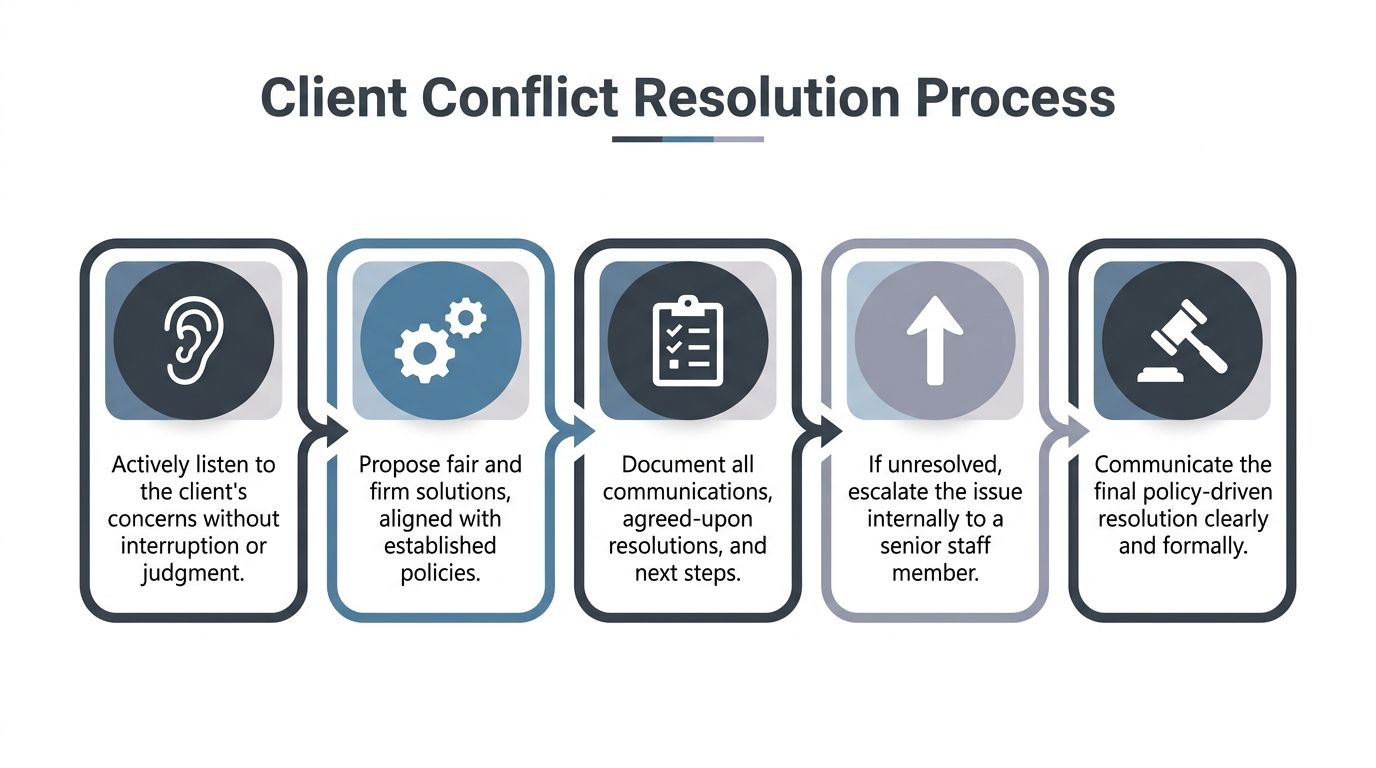
A practical internal framework looks like this:
- Level one, clarification and review: Use this where the issue appears to be misunderstanding, a normal short-term response, or confusion about treatment timing and expected results.
- Level two, service recovery: Use this where the clinic can offer a reasonable corrective step, such as a review appointment, senior reassessment, or limited follow-up treatment that stays within the original consent and clinical judgment.
- Level three, commercial resolution or discharge: Use this where further treatment is not clinically appropriate, trust has broken down, or the client's conduct makes continuation unsafe for staff.
The rule is consistency. If one staff member offers a free add-on, another offers a refund, and management reverses both later, the client learns that persistence changes the answer.
The boundary line every clinic needs
A documented clinic protocol on boundary enforcement and client retention reports that a 2-step boundary-enforcement methodology reduced repeat conflict incidents by 68% and that clinics following the protocol saw a 74% retention rate among previously difficult clients. The figures matter less than the operating principle. A written acknowledgment followed by one formal, time-bound solution stops the clinic from bargaining against itself.
That structure works well in regulated aesthetic practice because it ties the response to records rather than emotion. The client sees a clinic that is organised and responsive. Your team sees that there is one process, not a different answer from each person behind the desk.
Use the method like this:
- Acknowledge in writing. Summarise the concern in neutral language. Confirm that the clinic is reviewing the file, treatment notes, consent scope, and any available device log.
- Offer one formal solution. Give a single clear option with a deadline. That could be a no-charge review, a senior clinical assessment, a limited corrective service, a partial commercial gesture, or a decision to end treatment.
If you use systems such as Omega Lasers that capture treatment settings and session data, bring that into the review. It helps separate a true treatment variance from a result the client dislikes. That distinction protects both your staff and your decision-making.
“We've documented your concern and reviewed the treatment record. Our formal solution is a no-charge review appointment with senior assessment, after which we'll confirm whether a corrective service is clinically appropriate.”
Do not stack multiple offers in the same message. One reasonable option is easier to defend and easier to administer.
If the client rejects a fair resolution and becomes abusive, threatening, or manipulative, end the matter professionally. Issue a written no-further-service decision, keep it brief, and match it to the existing record. Front-desk arguments only create fresh facts that work against you later.
Refunds need careful wording. If you choose one, tie it to a signed release and a clear statement that the payment closes the matter. A refund without boundaries often reopens the complaint instead of ending it.
Your Defence System Documentation and Consent
A client says she was never told that results would vary, your therapist is certain the discussion happened, and the file has a signed form but no clear notes about that conversation. In a South African aesthetics clinic, that is how a routine complaint turns into a regulatory risk. SAHPRA expectations, POPIA duties, and device-specific treatment records all put pressure on one point. Your file has to stand on its own.

What belongs in every client file
Documentation is not admin. It is your defence system.
For clinics using regulated aesthetic devices, that system needs more than a signed consent page and a few treatment notes. It needs a record that shows what was assessed, what was explained, what was done, what the device recorded, and what happened afterwards. That matters when a client complains, when staff accounts differ, and when an external reviewer asks whether the treatment matched the indication and the consent.
A defensible client record should include:
- Consultation notes: Goals, contraindications, relevant medical history, previous procedures, and the expectation-setting discussion.
- Signed consent forms: Specific to the actual laser or energy-based treatment performed, not a broad form that tries to cover every service in the clinic.
- Treatment details: Date, operator, area treated, settings used, tissue response, adverse events, and aftercare instructions.
- Device-generated session data: Where available, keep the treatment parameters and session logs exported or stored with the file. Systems such as Omega Lasers give clinics an objective record that helps confirm whether the treatment delivered matched the planned protocol.
- Clinical images: Before and after photos taken consistently, stored securely, and supported by image consent.
- Communication records: Calls, WhatsApp messages, emails, complaints, follow-ups, and any commitments made by the clinic.
- Commercial records: Quotes, invoices, package terms, prepaid session balances, and any credit, refund, or corrective offer.
Treat any record created after the fact as weak evidence.
Why delayed notes damage good cases
I have seen clinics lose ground on a defensible case because the treatment itself was sound, but the notes were completed late and read like a reconstruction. That creates avoidable doubt. A regulator, insurer, or attorney will ask a simple question first. Was this written at the time, or after the complaint started?
Late notes usually leave out the details that matter most. Exact wording. Timing. The client's stated concern. The skin response observed in the room. The reason a setting was chosen or adjusted. Once those points are missing, staff fill the gap from memory, and memory shifts under pressure.
Real-time entries are stronger because they tie the consultation, consent, treatment, and follow-up into one consistent timeline. Device data strengthens that timeline further. In laser and energy-based treatments, session logs can help show whether the complaint relates to an actual treatment variance, an expected but unwanted response, or expectations that were never aligned properly at consultation.
Use a short internal checklist after any difficult interaction:
| Record item | Standard |
|---|---|
| Complaint summary | Neutral wording, no blame or opinion |
| Timeline | Exact date and time of treatment, concern raised, and clinic response |
| Staff involved | Full names and roles |
| Client communication | Key statements quoted as accurately as possible |
| Supporting records | Consent, photos, treatment notes, and device log attached or referenced |
| Resultado | What was offered, what was accepted, and what remains open |
Consent also has to match reality. If the treatment plan changes, the consent process changes with it. A generic form will not save a clinic that performed a different procedure, used a different device, treated a new area, or proceeded after a material change in risk.
Good documentation does two jobs at once. It helps resolve fair complaints quickly, and it gives the clinic a solid position when a complaint is unfair. In this industry, that is not paperwork. It is risk control.
Training Your Team for Unity and Confidence
Clients can sense internal confusion in seconds. Reception says one thing. The therapist says another. The owner arrives and offers a third version. That's how minor friction turns into a credibility problem.
A clinic only handles difficult clients well when the team sounds aligned under pressure.
Train the words, not just the policy
Most staff training fails because managers explain the rules but never rehearse the language. Staff need exact phrases for refunds, complaints, delays, dissatisfaction, and safety questions. Otherwise, they'll improvise with whatever sounds polite in the moment.
Build training around role-play, not lectures. Use common scenarios from your own clinic:
- A client says the treatment “did nothing” after one session.
- A client wants money back at reception in front of other guests.
- A client says a therapist promised results that weren't realistic.
- A client becomes hostile when told to attend a review first.
Run each scenario twice. First with the staff member's natural response. Then with the clinic-approved wording. That repetition matters because people don't rise to policy under pressure. They fall back to rehearsal.
“You don't need to win the argument. You need to hold the standard.”
Give staff authority with limits
Unity doesn't mean every issue must wait for the owner. It means each person knows what they can solve alone and where escalation begins.
A practical split looks like this:
- Reception can schedule a review, acknowledge frustration, and log the complaint.
- Therapists can explain treatment rationale, pause treatment, and escalate safety concerns.
- Managers can approve formal service recovery, final written responses, and no-further-service decisions.
Refunds sit in a separate category because they carry legal and reputational consequences. A documented standard for refunds in professional spa and clinic management is to require the client to sign a legal release confirming the refund is for services rendered with no admission of guilt from either party. Your team must understand that a refund is not just a payment reversal. It is a controlled closure process.
Train staff on the documents they touch:
- Consent forms: What they mean and when they must be updated.
- Incident logs: How to write facts instead of opinions.
- Refund releases: Why they matter and who is authorised to present them.
- Escalation notes: What a manager needs before stepping in.
A confident team sounds calm because they know the script, the limit of their authority, and the next person in line.
Perguntas mais frequentes
How do you professionally fire a difficult client
Start with the file, not the feeling. Review the record, confirm what the clinic offered, and check whether the client's behaviour makes ongoing treatment unsafe, unproductive, or disruptive to staff.
Then send a short written notice. Keep it neutral. State that the clinic won't be continuing the professional relationship, confirm any final administrative step, and direct future communication to one designated contact if needed. Don't justify the decision with a long emotional history. Don't argue. Don't leave the door half open if the decision is final.
A useful structure is:
- acknowledgment of prior communication
- confirmation that treatment won't continue
- any outstanding administrative action
- communication boundary going forward
How should a clinic respond to a negative online review
Reply once, calmly, and without discussing clinical details in public. Thank the client for the feedback, state that the clinic takes concerns seriously, and invite the person to continue the matter privately through the formal complaints channel.
Avoid three traps:
- Don't argue facts publicly: Even when the review is unfair, public rebuttals usually make the clinic look reactive.
- Don't reveal confidential details: Clinical context belongs in the file, not in a review thread.
- Don't copy-paste a cold template: It should sound human and measured.
A solid response is brief: thank them, acknowledge the concern, state that privacy limits what can be discussed publicly, and invite direct contact through the clinic's designated route.
When should you stop communicating and call a lawyer
Do it when the dispute moves beyond service recovery and into legal threat, defamation risk, harassment, or regulator-facing exposure. Also escalate when the client demands admissions you cannot safely make, contacts staff repeatedly after being told the process, or threatens public pressure unless money is paid.
Three red flags matter:
- the client alleges injury and is demanding fault admission
- the client threatens legal action or regulator complaint in writing
- the client continues contact after a clear final response and boundary notice
Once you reach that point, stop freelancing. Preserve every record. Keep communication centralised. Tell staff not to engage privately. The clinic's job then is documentation, consistency, and restraint.
If your clinic wants fewer complaints, clearer consults, and stronger client confidence around laser and energy-based treatments, Lasers Omega is worth exploring. Their FDA-approved, CE-certified, and SAHPRA-licensed systems, paired with training, technical support, and business guidance, can help clinics build safer onboarding, better expectation-setting, and more consistent treatment delivery from day one.