




A clinic owner usually reaches the same point sooner or later. The treatment rooms are busy, clients keep asking about permanent hair reduction, and the next capital purchase will either become a strong revenue stream or an expensive lesson parked in the corner.
That’s why the best laser hair removal machine isn’t merely the machine with the biggest spec sheet. It’s the platform that fits your skin-type mix, your booking volume, your staffing, your compliance obligations, and your appetite for growth. A fast machine with poor support can hurt your schedule. A safe machine with slow treatment turnover can limit profitability. A versatile platform with weak training can expose the clinic to avoidable risk.
Demand is there. The laser hair removal market has expanded strongly, and the 18 to 34 age group accounts for approximately 52% of all procedures, which matters if your clinic targets younger clients looking for long-term grooming solutions and convenience (laser hair removal market demographics).

In South Africa, the decision carries extra weight. Your patient base is rarely uniform. Clinics often treat a broad range of phototypes, frequent sun exposure, hormonal hair patterns, and clients who need convenience as much as results. That changes what “best” means. A machine that performs well in a narrow demographic can still be the wrong asset for a South African practice.
Índice
- The Four Pillars of a Smart Laser Investment
- A Deep Dive into Laser Hair Removal Technologies
- Calculating Your Return How Speed and Efficacy Drive Profit
- Recommended Configurations for Your Practice
- The Partnership That Powers Your Growth Beyond The Machine
The Four Pillars of a Smart Laser Investment
Clinic owners often compare machines in the wrong order. They start with price, then ask about wavelength, then look at aesthetics of the handpiece and console. The better sequence is stricter. Judge the machine on four pillars: clinical efficacy, regulatory integrity, patient experience, and business viability.
Clinical efficacy
Hair removal equipment only earns its place if it produces consistent reduction across real-world patients. Professional systems materially outperform home devices. Clinical data shows 85 to 88% permanent hair reduction for professional-grade diode lasers versus 46 to 52% for at-home devicese 95% of patients treated by professionals report satisfaction (professional versus home-use outcomes).
That gap matters for more than marketing. It affects rebooking, referral confidence, review quality, and whether your team can stand behind the treatment plan without hedging every consultation.
Regra prática: If a machine cannot deliver dependable outcomes across the skin types you actually treat, it isn’t cheaper. It just delays the cost.
Regulatory integrity
In this category, “almost compliant” doesn’t count. You want a machine with the right approvals and licensing for the market you operate in. For a South African clinic, that means taking FDA clearance, CE certification, and SAHPRA licensing seriously and confirming exactly which model and configuration hold those credentials.
Use a shortlist like this when you review a supplier:
- Documentação específica do modelo: Ask for compliance documents tied to the exact machine model, not a parent brand.
- Service traceability: Confirm who handles repairs, maintenance, and parts locally.
- Operator documentation: Check whether treatment protocols, contraindications, and training records are properly supplied.
- Consumable clarity: Make sure any recurring parts or accessories are available without long downtime.
Experiência do paciente
Clients don’t judge your investment by wavelength charts. They judge it by discomfort, treatment time, downtime, and whether they trust your team enough to complete the full course.
Cooling matters here. So do pulse options, handpiece ergonomics, and whether the machine stays comfortable on denser areas and more reactive skin. A platform that can treat effectively but feels harsh in practice may still underperform commercially because clients stretch intervals, avoid larger areas, or don’t refer friends.
Comfort isn’t a soft metric. It affects completion rates.
Business viability
The final pillar is where many buying decisions become more honest. A machine can be clinically strong and still be the wrong purchase if it slows your diary, needs excessive maintenance, or requires a staffing model you don’t have.
Look at total ownership, not just the invoice. Ask:
- How long are common treatment areas taking in daily use?
- How many staff can competently operate the platform after training?
- What happens when the machine needs service?
- Does the machine’s ideal patient profile match your clinic’s actual demand?
A smart investment works as both a treatment platform and a commercial system. If one pillar is weak, the machine usually exposes that weakness within the first few months of operation.
A Deep Dive into Laser Hair Removal Technologies
Technology choice shapes almost every downstream result in your clinic. It affects who you can treat safely, how quickly you can treat them, how comfortable the session feels, and how broad your booking base can become. That’s why the best laser hair removal machine is usually the machine whose technology matches your patient mix, not the one that wins an online popularity contest.
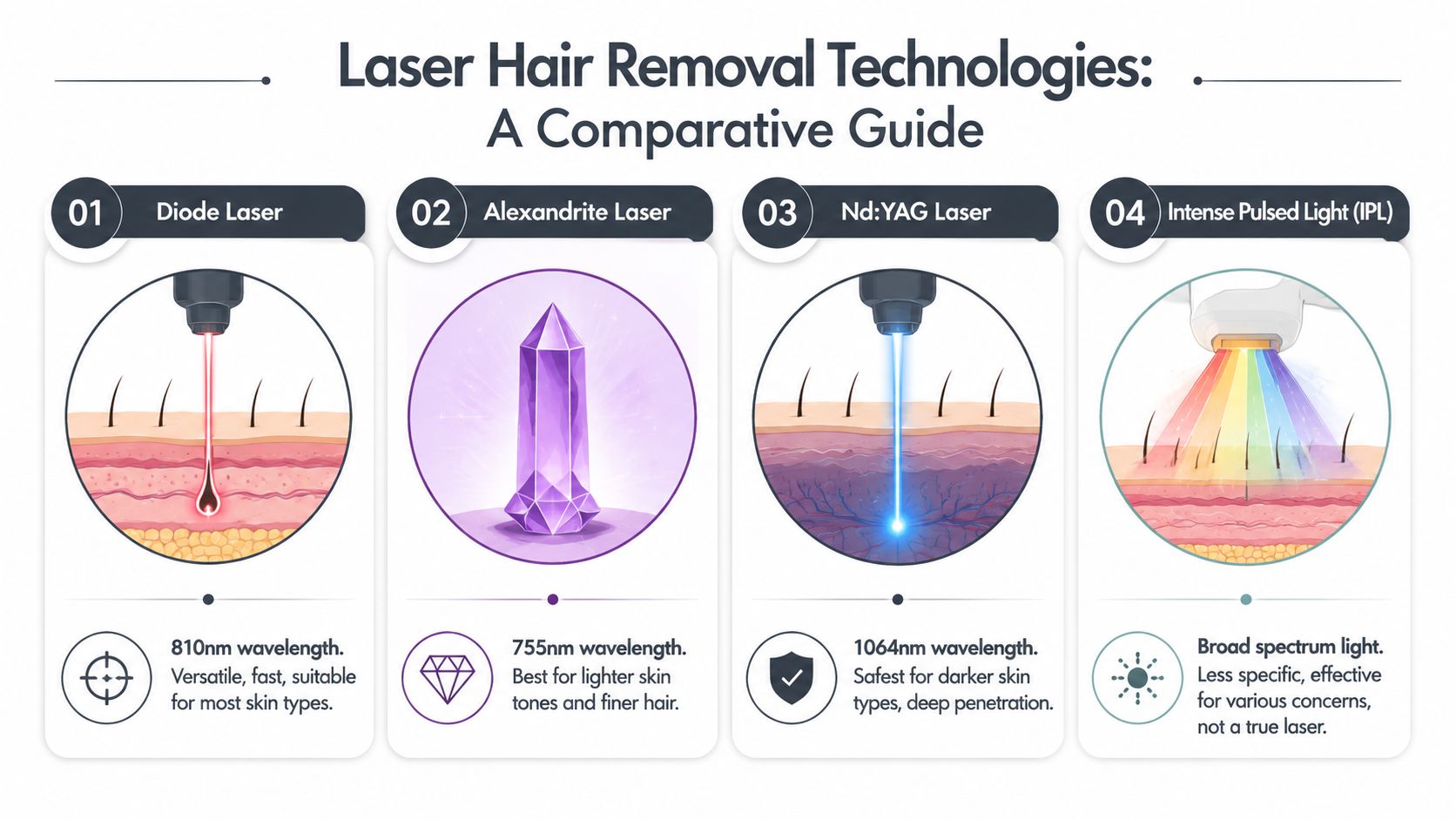
Laser Technology Comparison at a Glance
| Tecnologia | Comprimento de onda | Best For (Fitzpatrick) | Nível de dor | Velocidade |
|---|---|---|---|---|
| Laser de díodo | 810nm | Broad range, often I-VI depending on platform | Moderate to lower with good cooling | Rápido |
| Alexandrite Laser | 755nm | Lighter skin tones | Moderado | Very fast |
| Nd:YAG Laser | 1064nm | Darker skin tones and deeper follicles | Moderate to higher without strong cooling | Moderado |
| Intense Pulsed Light (IPL) | Broad spectrum light | Selective use cases, less targeted than true lasers | Variável | Variável |
For clinics comparing platform categories, sistemas profissionais de depilação por laser de díodo are often considered because they sit in the middle of the market on versatility, operator familiarity, and treatment speed.
Alexandrite systems
Alexandrite platforms work at 755nm and are widely chosen for lighter skin tones and finer hair. Their appeal is obvious in busy clinics. They’re fast, they can clear large areas efficiently, and experienced operators often like their responsiveness on suitable candidates.
The limitation is equally clear. Alexandrite isn’t the forgiving choice for every phototype. In a mixed South African practice, that matters. If your client base includes darker skin tones, recently tanned patients, or a lot of year-round sun exposure, an Alexandrite-only strategy can narrow your safe treatment window.
A clinic with a lighter-skinned urban demographic may still do very well with this technology. But if your consultations regularly involve Fitzpatrick IV to VI, Alexandrite on its own is rarely the whole answer.
Fast on the right client is valuable. Fast on the wrong client is a liability.
NdYAG systems
Nd:YAG operates at 1064nm and is valued for deeper penetration and safer treatment on darker skin types. In practices serving diverse phototypes, this wavelength often becomes indispensable because it expands who you can treat with confidence.
The trade-off is practical. Nd:YAG monotherapy can be slower on some treatment areas, and patient comfort depends heavily on cooling quality, settings, and operator judgement. Clinics that choose an Nd:YAG-centric platform typically do so because safety breadth matters more than pure speed.
That can be the right decision for medical practices, especially where post-inflammatory risk, pigmentation concerns, and skin-type diversity are routine parts of consultations.
Diode platforms
Diode systems, commonly centred around 810nm, sit in a commercially attractive position because they’re versatile and widely adopted. They often offer solid speed, broad treatment use, and accessible workflows for trained operators. The category includes single-wavelength and multi-wavelength designs, and that distinction matters more than many buyers realise.
Single-wavelength diode systems can perform well, but they don’t always offer the same flexibility across skin types and hair presentations as broader platforms. In South Africa, where clinics often need to move between lighter skin, darker skin, tanned skin, coarse hair, and hormonally driven growth patterns, that flexibility isn’t a luxury.
A key local data point supports that. In SAHPRA-licensed trials, dual-wavelength systems combining 755nm Alexandrite and 1064nm Nd:YAG achieved 85% hair reduction on skin types IV to VI versus 72% for standard diode lasers, with 35% faster treatment times (South African dual-wavelength benchmark data).
That doesn’t mean diode is weak. It means a clinic shouldn’t treat all diode categories as equal. A basic diode platform and a more advanced multi-wavelength platform solve different business problems.
IPL and hybrid systems
IPL isn’t a true laser. It uses broad-spectrum light rather than a single coherent wavelength. That makes it less selective for hair removal and more dependent on careful parameter choice. Some clinics still use IPL for entry-level service menus or mixed aesthetic offerings, but it usually isn’t the answer for owners looking to build a dedicated, premium hair removal centre.
The reason is simple. Hair removal rewards precision. True laser systems are generally better aligned with that requirement, especially when your goals include repeatable outcomes, efficient body work, and safe treatment across varied skin presentations.
Hybrid and multi-technology platforms can be useful if your business model depends on combining hair removal with adjacent treatments. But if hair removal is intended to become a flagship revenue engine, most clinic owners benefit from choosing a dedicated hair-removal-capable platform first and layering other modalities later.
What works in South African practice
In local buying decisions, the technical winner often comes down to one question. Are you building around a narrow ideal patient, or around the patient mix you see every week?
For many South African clinics, the strongest long-term answer is not a single hero wavelength. It’s a platform with enough wavelength flexibility and cooling performance to handle diversity without forcing the practitioner to compromise on either safety or throughput.
That’s why dual-wavelength and multi-wavelength systems get so much attention from experienced buyers. They reduce the number of clients you have to turn away, narrow the gap between efficacy and safety, and make your booking book more resilient through changing seasons and skin conditions.
Calculating Your Return How Speed and Efficacy Drive Profit
Most buying mistakes happen after the demo. The machine looks polished, the handpiece feels good, the rep talks about power, and the owner signs before doing the harder calculation. Can this platform produce enough safe, repeatable treatments per day to justify the capital outlay?

Throughput is the hidden profit lever
Treatment speed directly shapes revenue capacity. One of the clearest blind spots in this category is that many clinics compare outcomes without comparing how many appointments the machine lets them complete in a day. That matters because advanced systems capable of full-body treatments in 15 to 20 minutes instead of 30 to 45 minutes change technician utilisation and booking density in a meaningful way (treatment speed and clinic profitability).
A faster machine doesn’t automatically mean higher profit. It has to maintain comfort, consistency, and safety. But when it does, the operational effect is substantial:
- More appointment slots: Shorter sessions open room for additional bookings without extending clinic hours.
- Less operator fatigue: Efficient spot sizes and smoother delivery reduce physical strain over a full day.
- Better schedule resilience: Running slightly ahead is operationally safer than constantly catching up.
- Higher-value area acceptance: Clients are more likely to book larger treatment areas when sessions feel manageable.
A machine earns profit through completed appointments, not headline specifications.
Um quadro prático de ROI
A useful ROI model for hair removal should stay simple enough to use and strict enough to be honest. Start with five inputs from your own practice:
- Average fee per treatment area or package
- Average number of laser bookings per day
- Working days per month
- Direct operating costs, including maintenance, consumables, training, and staffing
- Total capital cost, including finance costs if applicable
Then compare two scenarios. One reflects the treatment times your current or lower-tier option allows. The other reflects the schedule density possible with a faster, more efficient machine. The point isn’t to force optimistic assumptions. It’s to see whether increased throughput changes payback materially.
If you want a more clinic-specific planning model, this repartição do ROI do laser de díodo para profissionais sul-africanos is a useful starting point for structuring your assumptions.
What owners often miss in the maths
The invoice price is only part of the commercial picture. The machine’s real cost and value also depend on:
| ROI Factor | O que verificar |
|---|---|
| Tempo de treino | How quickly your team can operate confidently and consistently |
| Risco de inatividade | How repairs, parts, and servicing affect booked treatments |
| Treatment mix | Whether the machine supports small areas only, or profitable full-body and package work |
| Conforto do doente | Whether discomfort limits rebooking on larger or sensitive areas |
| Seasonal suitability | Whether recently tanned clients can still be treated safely |
Some machines look economical because the sticker price is lower. But if they narrow your eligible client pool, slow your diary, or create more aftercare issues, the payback can stretch badly.
A better investment often comes from balancing speed, comfort, and adaptability rather than chasing either raw power or the cheapest entry point.
Recommended Configurations for Your Practice
A clinic owner in Sandton with three operators, a growing package book, and frequent Fitzpatrick IV to VI consultations should not buy the same machine as a solo mobile provider working part-time across Johannesburg. The machine has to fit the business model first, then the treatment menu. If it does not fit your staffing, patient mix, and booking pattern, it becomes an expensive constraint rather than a profit centre.
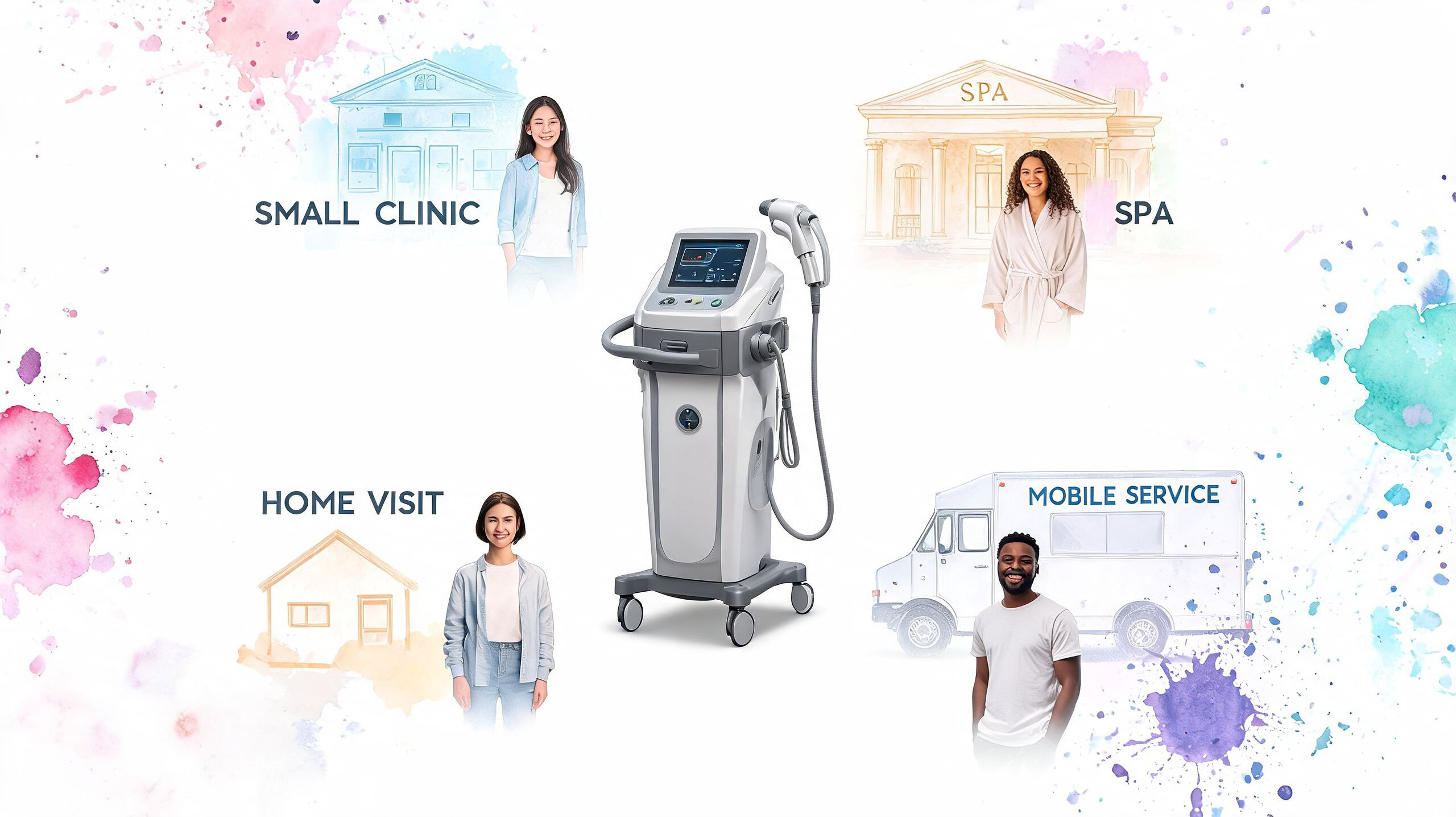
In South Africa, that fit matters even more because clinics routinely see mixed phototypes, recent sun exposure, and price-sensitive clients who still expect visible results with limited downtime. A good buying decision is not only about wavelength selection. It is about how many safe, repeatable treatments the platform can produce each week, how quickly operators become confident, and how easily the supplier can keep the machine in service.
High-volume urban medispa
A busy medispa needs output. The commercial pressure is simple. Keep treatment times short, keep comfort acceptable on larger areas, and keep enough flexibility to treat a broad range of skin presentations without constantly turning clients away.
The configuration that usually works best includes:
- Multi-wavelength capability: Useful for varied phototypes and seasonal tanning patterns.
- High cooling performance: Helps maintain treatment pace on sensitive and larger areas.
- Large spot sizes with strong repetition rates: Improves throughput on legs, backs, and package bookings.
- Operator-friendly presets with manual control: Supports consistency across multiple therapists.
For this model, a multi-wavelength platform such as those supplied by Omega Lasers fits the commercial requirement well because the category supports higher-volume treatment flow and a wider service mix.
Boutique salon or first-time buyer
First-time buyers often misjudge capacity. Some buy too low and outgrow the machine within a year. Others buy a feature-heavy system that sits underused because the team is still learning consultation, settings, and rebooking discipline.
A practical starting configuration usually includes:
- A diode-based platform with a clear workflow: Faster to implement for a smaller team.
- Arrefecimento fiável: Important for client comfort and confidence on repeat visits.
- Simple controls and accessible training: Reduces operator hesitation.
- Enough treatment range to add body packages later: Protects the investment as demand grows.
The best first machine is usually the one your team will use confidently every day, not the one with the longest specification sheet.
Buy for the clinic you can build over the next 12 to 24 months, with realistic booking density and operator skill in mind.
Dermatology and doctor-led clinic
Doctor-led practices usually need more control and more documentation. These clinics often see higher-risk cases, clients with pigmentation history, reactive skin, or referrals after poor outcomes elsewhere. That changes the purchasing criteria.
The stronger configuration often includes:
- Broader wavelength options
- Detailed parameter adjustment
- Consistent cooling and skin-protection features
- Clear treatment protocols and compliance records
- Supplier support that understands clinical governance
In this setting, a dual-wavelength or advanced multi-wavelength system often makes better business sense because it supports a wider range of suitable candidates without forcing the practitioner into narrow protocol choices.
Mobile and flexible operators
Mobile work changes the priority list. Portability matters, but transportability alone does not create a viable service. The machine still has to produce consistent outcomes, survive regular movement, and fit a treatment menu that can be delivered safely outside a fixed clinic room.
The right mobile configuration usually prioritises:
- A manageable footprint
- Good build quality
- Straightforward maintenance
- Clear safety checks for changing environments
- A focused menu of profitable treatment areas
A simpler diode platform is often the better commercial decision here. It is easier to move, easier to maintain, and easier to standardise across locations.
The best configuration for any practice is the one that matches four things closely: patient profile, operator skill, appointment volume, and service support. Get that match right, and the machine can move from capital expense to reliable revenue generator.
The Partnership That Powers Your Growth Beyond The Machine
A laser purchase doesn’t end when the crate arrives. That’s when the critical commercial test starts. Can your team use the platform confidently, can the supplier keep it running, and can the clinic convert the technology into repeat bookings over time?
Training protects outcomes and reputation
Even a capable platform can underperform if the operators are hesitant, inconsistent, or poorly trained on skin assessment and parameter selection. Hair removal is deceptively simple from the outside. Inside the treatment room, operator skill affects comfort, safety, treatment pace, and whether the client returns.
Good training should cover more than turning the machine on. It should include:
- Consultation discipline: Contraindications, expectations, and treatment planning
- Skin and hair assessment: Matching settings to phototype, hair calibre, and treatment area
- Practical workflows: Positioning, spacing, overlap control, and comfort management
- Response management: Knowing what normal endpoint responses look like and when to stop
- Documentation habits: Protecting the clinic with proper records and aftercare guidance
Clinics that want structured operator development should look closely at laser hair removal training for aesthetic professionals.
Support affects uptime
After-sales service sounds less exciting than wavelength discussions, but it often has more impact on profitability. A machine that is down for too long doesn’t just create an engineering problem. It creates cancellations, rescheduling pressure, frustrated clients, and lost confidence at reception.
Ask direct questions before buying:
| Support Question | Porque é importante |
|---|---|
| Who provides technical support locally? | Faster response usually means less diary disruption |
| Are parts stocked or imported on demand? | Delays can stretch downtime |
| Is preventative maintenance scheduled clearly? | Planned service is easier to manage than emergency repair |
| What training is included after staff turnover? | New hires shouldn’t reset clinic competence |
| Is protocol support available for difficult cases? | Teams need backup when presentations are complex |
The machine is the asset. Uptime is the business.
Decision checklist before you sign
A disciplined buyer puts every supplier through the same filter. That keeps the sales process from becoming emotional or purely price-driven.
Use this checklist:
Adaptação clínica
- Can this platform treat the skin types and hair patterns my clinic sees most often?
- Is the cooling system strong enough for larger and sensitive areas?
- Does the machine support both speed and treatment precision?
Compliance fit
- Are the approvals and licences current for this exact model?
- Is there clear documentation for safe operation and maintenance?
- Will my insurer and governance process be comfortable with the paperwork?
Adaptação comercial
- How many treatments can I realistically add per day?
- What are the likely recurring costs?
- How much downtime risk am I accepting?
Operational fit
- How steep is the training curve for my current staff?
- Can multiple operators deliver consistent outcomes?
- Is the user interface practical in a busy clinic setting?
Supplier fit
- Will this supplier answer the phone after installation?
- Do they offer refresher training and business support?
- Can they help the clinic stay productive as the service grows?
The clinics that get the strongest returns usually don’t buy on excitement. They buy on fit, support, and repeatability. That’s what turns a machine into a profit centre rather than a line item.
If you’re comparing platforms and want a supplier that understands both device performance and clinic economics, Lasers Omega is worth reviewing alongside your shortlist. Look closely at the machine specifications, the training pathway, the support model, and how well the platform fits your actual patient mix before you commit.