




A lot of clinic owners sit with the same spreadsheet open for days. The treatment menu looks promising, the new device could expand revenue fast, and the supplier quote seems manageable. Then one question stops everything. How many treatments do you need each month before the device pays for itself instead of draining cash?
That's where break even analysis stops being an accounting exercise and starts becoming a clinical business tool. In aesthetics, small errors in costing create big problems because a treatment that looks profitable at headline price can become thin very quickly once consumables, technician time, maintenance, training, and compliance are included. Always ensure the information is accurate and true, as this concerns aesthetic lasers, energy-based devices, and health.
Most articles give a neat formula and leave it there. That's not enough for an aesthetic clinic. The primary pressure points are hidden variable costs and bundled services, especially when you're selling treatment plans rather than one-off appointments.
Índice
- Understanding Break Even Analysis
- Calculating Break Even with Formula
- Clinic Example with Omega Lasers Device
- Using the Break Even Spreadsheet Template
- Running Sensitivity and Scenario Analysis
- Strategies to Accelerate Break Even
- Conclusion and Next Steps
Understanding Break Even Analysis
A clinic owner considering a new laser device usually starts with revenue first. How many bookings can it generate? What can each treatment sell for? The better question is harder and more useful. What level of activity covers every fixed and variable cost without producing a loss?
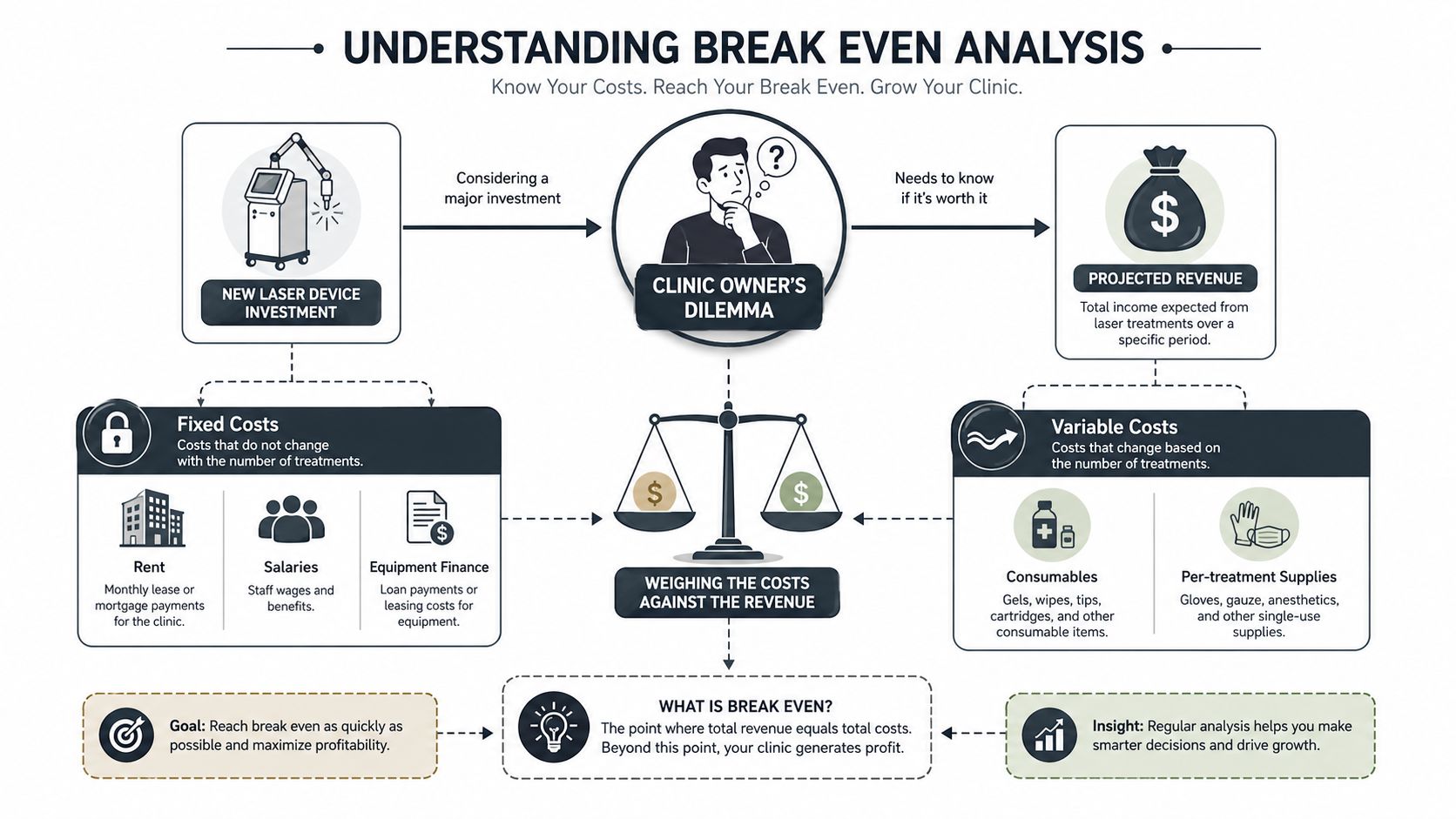
In practice, fixed costs are the expenses that keep showing up whether the treatment room is full or empty. In an aesthetic setting, that usually includes rent, salaries, software, insurance, equipment finance, and other overheads tied to keeping the clinic open. Custos variáveis move with treatment volume. Think consumables, cooling products, disposable items, and the direct labour attached to each appointment.
Why clinic owners get this wrong
The biggest mistake isn't bad maths. It's incomplete costing. A clinic can feel busy and still lose money because the owner priced around market expectations instead of contribution margin. If the service mix is strong on turnover but weak on margin, the appointment book creates activity, not profit.
Break even analysis gives you a decision line. It tells you the exact point where revenue matches total costs and profit is R0, which is the formal South African definition used in business planning and accounting education through the standard formula explained in this South African break-even guide.
Regra prática: If you can't separate fixed costs from treatment-level variable costs, you're not ready to set pricing on a new device.
What it helps you decide
Used properly, break even analysis helps a clinic owner answer questions such as:
- Whether a device is affordable: A finance instalment may look manageable until you layer in staffing, training, and room utilisation.
- What sales target is realistic: A monthly target should come from contribution, not hope.
- Where cash-flow pressure will show up first: New clinics often underestimate how long it takes for utilisation to catch up with overhead.
If you're building projections, start with disciplined inputs rather than optimistic top-line sales. A proper clinic financial forecasting approach makes the break-even number far more useful because it ties your monthly target to actual operating assumptions.
Calculating Break Even with Formula
Break even analysis for clinics works best when you use two views. One measures the number of treatments required. The other measures the revenue value required. Both matter, because some owners manage by appointment volume while others manage by monthly sales.

The two formulas that matter
Break-even in units
Total Fixed Costs ÷ Contribution Per Unit
Break-even in sales value
Total Fixed Costs ÷ Contribution Margin
In South African accounting notes, break-even in units is taught as total fixed costs divided by contribution per unit, while break-even in sales value is total fixed costs divided by the contribution margin. The same notes also place sensitivity analysis alongside break-even work because small changes in price or cost shift profitability materially in real operations, as outlined in these UNISA break-even analysis notes.
Defining the variables properly
Here's the cleanest way to set up the calculation in a clinic:
- Fixed costs: Monthly overheads that don't change directly with treatment count.
- Selling price per treatment: What the client pays for one appointment or one package allocation.
- Variable cost per treatment: The direct cost consumed in delivering that appointment.
- Contribution per treatment: Selling price minus variable cost.
The formal South African version is stated as Fixed Costs ÷ (Sales Price Per Unit – Variable Cost Per Unit). One standard example uses fixed costs of R115,000, a selling price of R50, and variable cost of R25, producing 115,000 ÷ (50 – 25) = 600 units, as shown in this South African break-even example.
Break even tells you the minimum commercially acceptable volume. It doesn't tell you whether the market will deliver that volume.
When to use units and when to use sales value
Utilização units when your clinic tracks operational capacity tightly. This works well when each treatment slot is relatively standard and you need to know how many appointments a therapist or doctor must complete.
Utilização sales value when your menu is mixed. If the clinic sells different treatments, varying package types, or combinations of sessions and add-ons, the revenue threshold is often more useful than a raw treatment count.
A good working habit is to keep your inputs consistent every month:
- Pull fixed overheads from the same bookkeeping category set.
- Update variable costs from actual supplier invoices and payroll assumptions.
- Recalculate contribution whenever pricing changes.
- Review package pricing separately from single-session pricing.
If the input discipline is weak, the formula will still work. The answer just won't help you.
Clinic Example with Omega Lasers Device
A realistic clinic example starts with the wrong instinct. The owner sees a high-value treatment and assumes the selling price will carry the investment. That's where break even analysis often breaks down in aesthetics.
Take a clinic adding a multi-wavelength hair removal platform. The fixed-cost side may include device finance, staff training, licensing-related administration, room overhead allocation, and baseline marketing. The variable-cost side is where owners usually undercount. Cooling gel, disposable tips, technician labour, patch test time, post-care items, and service-linked consumables all belong in the calculation.
The calculation table you actually need
Before doing any maths, build the model around contribution, not turnover.
| Métrica | Amount |
|---|---|
| Monthly fixed costs | Enter your clinic's total monthly overhead allocation for the device |
| Preço médio do tratamento | Enter the average selling price per appointment |
| Variable cost per treatment | Enter total direct treatment cost per appointment |
| Contribution margin per treatment | Treatment price minus variable cost |
| Break-even treatments needed | Monthly fixed costs divided by contribution margin per treatment |
Aesthetic clinics are often taught a simplified monthly version: monthly overheads divided by average treatment margin gives the treatments needed per month. One example uses £4,000 in monthly overheads and an £180 average margin, resulting in 23 treatments monthly, or roughly 6 per week, in this clinic business plan guide. The currency differs, but the logic transfers directly.
Where owners understate the real break-even point
The most common error is using average ticket price instead of contribution margin. That mistake understates break-even volume by 40–60% and leads to cash-flow failures in 68% of new clinics within 12 months, according to this medical aesthetic break-even analysis reference.
That's why a device can look profitable in a launch plan and still become a monthly cash drain. Revenue is not contribution. A treatment sold at an attractive headline price may leave too little behind to cover fixed costs.
If your spreadsheet doesn't show direct cost per appointment, your break-even number is probably too low.
The same issue gets worse when clinics bundle services. A course of hair removal might be sold alongside prep products or follow-up care. A resurfacing offer may bundle consultation, treatment, and aftercare. If you're also considering how clients evaluate treatment outcomes, this resource on achieving perfect skin resurfacing is useful because it reflects the kind of treatment-planning context that affects package design and pricing.
Margin of safety matters here too. Once the clinic reaches break even, the next question is how far above that line current sales sit. A thin buffer leaves the device vulnerable to cancellations, seasonality, or a rise in consumable cost. If you want to model the commercial side of that decision in more detail, this repartição do ROI do laser de díodo para profissionais sul-africanos is a practical next read.
Using the Break Even Spreadsheet Template
A spreadsheet template is useful only if it mirrors how clinics earn and spend money. A generic one-line calculator won't help much once you have multiple treatment categories, package sales, or a mix of retail and service revenue.
Set the fixed-cost section first
Start with the monthly costs that stay in place whether one client books or twenty do. Keep these grouped clearly so you can review them fast each month. The categories should reflect your operation, not someone else's template.
At minimum, most clinics should create separate rows for:
- Occupancy costs: Rent, utilities, and room-related overhead allocation.
- People costs: Salaries, fixed wages, and any non-variable staffing costs.
- Equipment and support: Finance repayments, maintenance, software, and training-related overhead.
Build service-level variable cost lines
The next section should track variable cost per treatment by service line. Don't use one blended estimate unless every treatment consumes the same resources. Hair removal, rejuvenation, and resurfacing rarely carry identical direct costs.
For each treatment line, include the direct consumables and labour assumptions tied to delivery. That makes your contribution margin visible, and it makes repricing easier when a supplier cost changes.
Add bundled services the right way
Many standard calculators prove inadequate. If your clinic sells a combination of hair removal and skin rejuvenation packages, one average selling price won't tell the truth unless it's linked to weighted profitability.
Calculating weighted average gross profit for multi-modality service bundles is critical, as ZA clinics often sell combined packages that standard calculators cannot handle, as noted in these break-even examples for multi-product businesses.
A practical template should let you enter:
- Each service line's selling price
- Each service line's variable cost
- Expected sales mix across those services
- Weighted average contribution margin
Working approach: Customise the template categories so they match your real consumables, technician wages, maintenance fees, and package structure. If the categories are too broad, your answers will be too soft to manage from.
Once that's built, the spreadsheet can update break-even treatments and break-even sales value automatically whenever you change pricing, cost inputs, or service mix.
Running Sensitivity and Scenario Analysis
A break-even model that uses only one set of assumptions is too fragile for clinic planning. Treatment demand moves. Supplier pricing changes. Staff costs shift. Even a small pricing adjustment can change how many appointments the clinic needs to stay above water.

What to test first
South African accounting teaching explicitly pairs break-even work with sensitivity analysis to test how changes in costs or selling prices affect profitability, as described in these South African accounting notes on break-even sensitivity.
In clinic terms, test the assumptions that move most often:
- Treatment price: What happens if competitive pressure forces a lower selling price?
- Variable cost: What happens if disposables or labour cost more than planned?
- Fixed costs: What happens if overhead rises after launch?
Use three scenario views
A simple structure works best:
Cenário de base
Use the current assumptions you believe are most realistic.
Best case
Use a stronger booking mix, cleaner scheduling, and better margin control.
Worst case
Assume slower uptake, lower realised prices, and higher direct treatment costs.
The point isn't to guess perfectly. It's to see how exposed the clinic is if one assumption changes at the wrong time.
Watch the margin of safety
Margin of safety shows how much room exists between current sales and break-even sales. In difficult trading conditions, that buffer matters more than headline turnover. One primer notes that for ZA clinics facing volatile consumer spending, the calculation (Current Sales – Break-Even Sales) / Current Sales should exceed 20% to improve survival in downturns, and it also argues that many standard resources ignore this local planning need in clinic settings, as discussed in this primer on breakeven analysis.
A useful monthly review asks:
- Are we still above break even if bookings soften?
- Which cost line is moving fastest?
- How much price pressure can we absorb before margin becomes unsafe?
That's the difference between a static spreadsheet and a planning tool.
Strategies to Accelerate Break Even
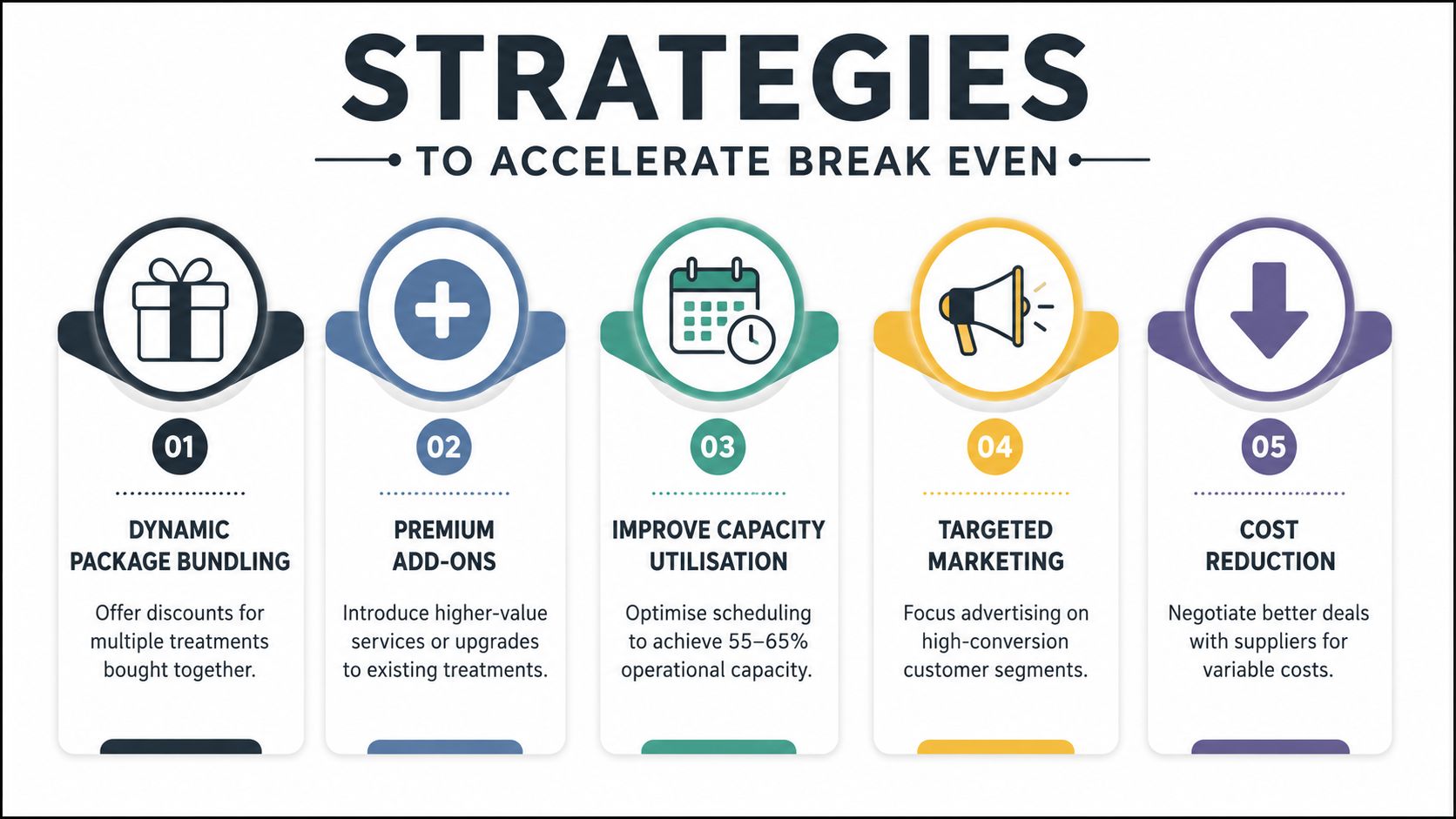
Faster break even usually comes from three levers. Improve contribution margin, raise utilisation, and stop variable cost leakage. Most clinics try to solve the problem with marketing alone. That rarely works if pricing and delivery economics are weak.
Focus on the levers that change the answer
Clinics using SAHPRA-compliant laser systems can reach break even in 2–4 months when utilisation reaches 55–65% and fixed costs stay under 20% of projected Year 1 revenue, according to this aesthetic clinic benchmark reference.
That benchmark points to what proves successful:
- Tighten package design: Bundles can lift realised value, but only if each component protects contribution margin.
- Improve scheduling discipline: Empty treatment slots destroy utilisation. Waiting lists, confirmation workflows, and cluster booking help.
- Control direct treatment inputs: Review every per-treatment item. Consumables often drift upward without anyone noticing.
- Use add-ons selectively: Premium upgrades work when they add margin without adding disproportionate treatment time.
A busy diary doesn't guarantee a short path to break even. High utilisation only helps if the appointments are priced and costed properly.
What usually fails
Discounting too early is a common mistake. It can fill the book while weakening the exact margin needed to recover fixed costs. The better move is selective offers tied to package uptake, repeat booking, or underused time slots.
Another weak strategy is financing a device without matching the repayment schedule to realistic capacity. If the payment is fixed but bookings are still ramping, month one to month three can become the hardest period. Reviewing clinic equipment financing options alongside your break-even model helps avoid that mismatch.
Loyalty structures, rebooking systems, and cross-selling can help, but only after the underlying margin is sound. The sequence matters. First fix pricing and costs. Then drive volume.
Conclusion and Next Steps
Break even analysis gives a clinic owner a hard commercial line. It shows when a treatment menu supports the business and when it only creates busy rooms and weak cash flow. The clinics that use it well don't stop at one formula. They track hidden variable costs, model bundles properly, and test how price or cost changes affect safety.
Take four actions now. Gather real fixed and variable cost data. Build or update your spreadsheet. Run base, best, and worst-case scenarios. Then make one pricing or package adjustment and review it monthly.
If you're planning a new device purchase or want stronger financial visibility before expanding services, Lasers Omega can help with device finance, training, and business development support built for aesthetic clinics in South Africa.