



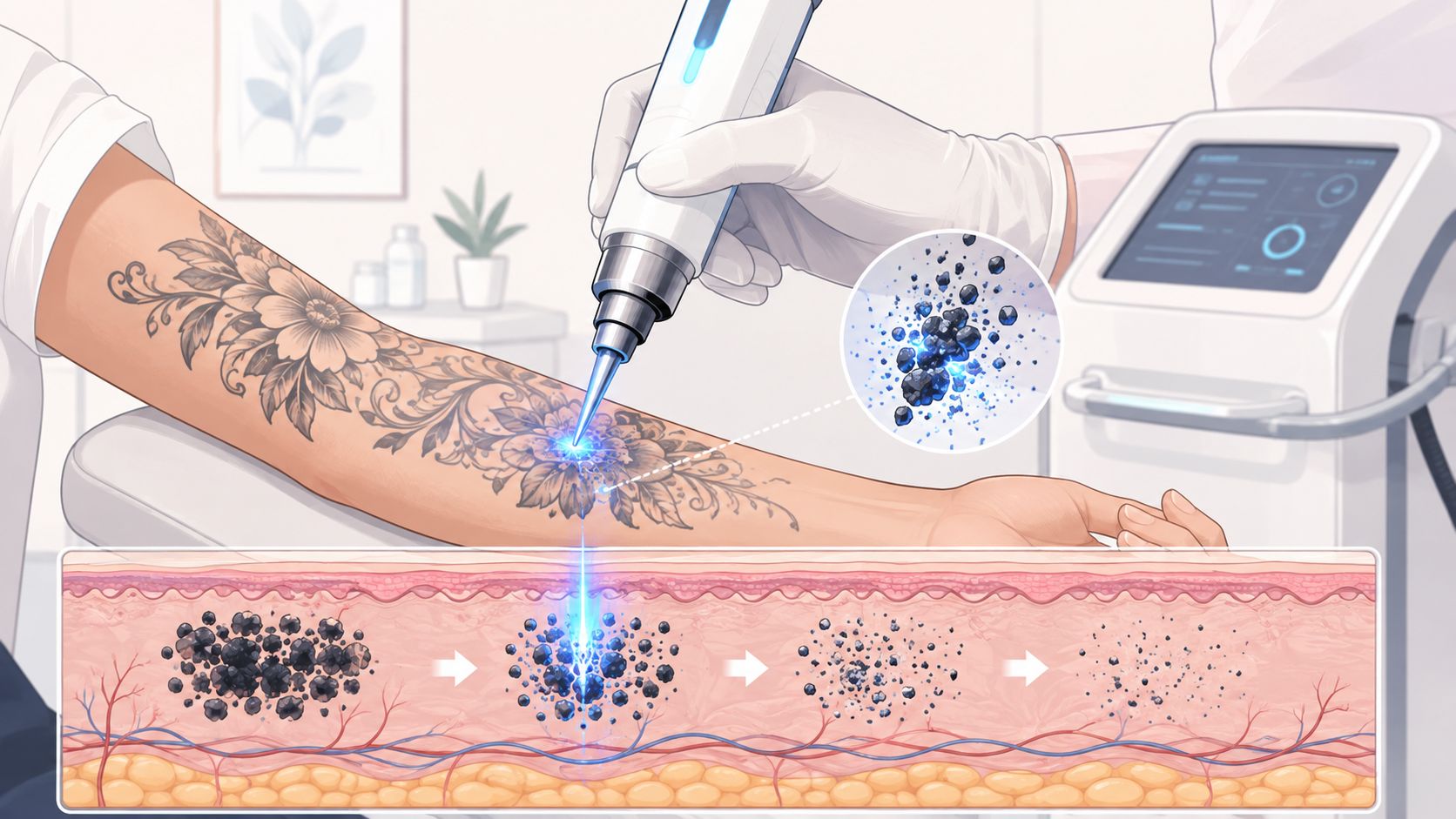
A clinic can know the problem before it knows the answer. A patient walks in with a stubborn black tattoo, or a mixed-colour design that has outlived its meaning, and the team has to decide whether to keep offering conventional removal or invest in a higher-precision platform that can deliver cleaner fading with fewer compromises. In South Africa, that choice isn't only about clinical performance, it's about skin tone diversity, treatment expectations, throughput, and the kind of service a practice wants to be known for.
Picosecond laser tattoo removal has become the premium conversation because the physics are different, not just the marketing. The technology already had reproducible clinical results in the mid-2010s, and the evidence base gives clinics a realistic way to frame outcomes, safety, and business planning. For practitioners who want to understand the science first and the commercial case second, this guide walks through the mechanism, wavelength selection, protocols, safety, comparison with nanosecond devices, and the practical ROI questions a South African clinic has to answer before buying a system.
Table of Contents
- Introduction to Picosecond Laser Tattoo Removal
- Understanding the Key Concepts of Picosecond Lasers
- Matching Wavelengths to Tattoo Pigments
- Clinical Indications and Treatment Protocols
- Safety Profile Adverse Effects and Aftercare
- Comparing Picosecond and Q-switched Lasers
- Practical Clinic Considerations for Device Selection and ROI
- Case Studies and Key Conclusions
Introduction to Picosecond Laser Tattoo Removal
A clinic that is weighing tattoo removal equipment usually starts with a practical question, which option keeps patients satisfied without leaving chairs empty for long periods? The answer sits at the point where pigment physics, skin biology, and clinic economics meet. Picosecond laser tattoo removal matters because it can clear visible ink in relatively few sessions, which helps clinics balance patient expectations with appointment availability.
The clinical value is real. Human trials reviewed in the literature showed strong clearance results across a range of tattoos, with many achieving more than 70% pigment clearance after a limited number of treatments. That kind of evidence gives staff a safer way to frame consultations, because the conversation can focus on likely progress rather than on promises of instant removal. The same review also indicated that picosecond devices performed better than nanosecond devices for mainly black and blue ink tattoos, with only minor side effects (PubMed review).
Practical rule: patients respond better when you explain a realistic treatment range, not a fantasy of instant removal.
For South African practices, the point is even more practical. Clinics in ZA often treat a broad mix of skin phototypes, so a removal platform has to do two jobs at once, clear pigment efficiently and stay conservative enough to protect surrounding skin. In darker skin tones, that balance matters because excess heat can raise the risk of unwanted pigment change. Picosecond systems fit that need well, which is why they have moved from promising technology to a serious premium option for aesthetic clinics and medical spas. For clinic owners, the ROI question is not only how well the device works, but how reliably it can be used across varied skin types without creating avoidable downtime or corrective work.
The article follows a simple order. First comes the physics, then pigment targeting, then protocols, then safety, then the buying decision, and finally the business case for clinics that want to add or upgrade tattoo removal services. If you are a clinic owner, a medical aesthetic doctor, or a practitioner training a team, the aim is to leave with a usable framework, not just a stack of interesting facts.
Understanding the Key Concepts of Picosecond Lasers
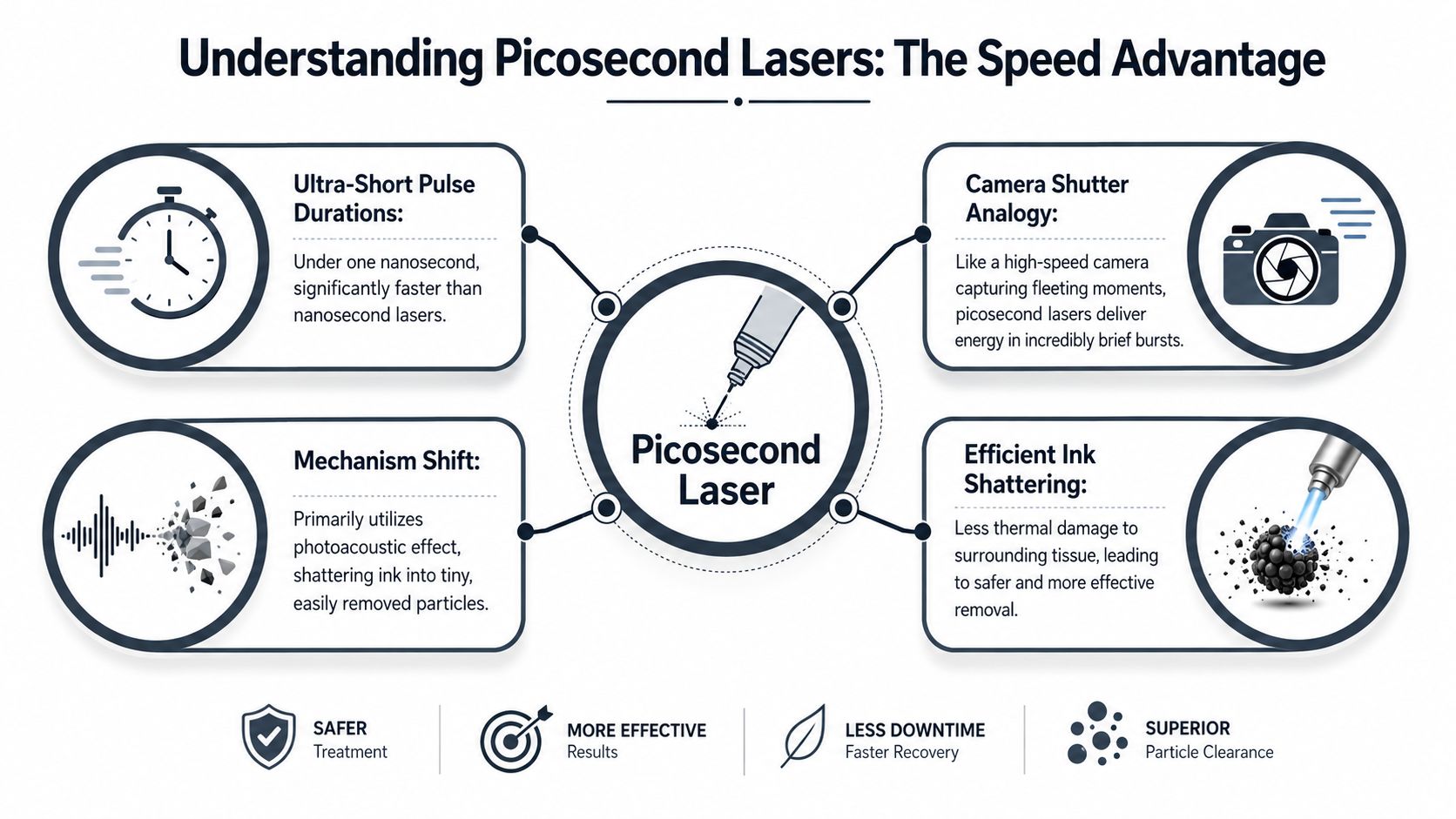
A clinic that starts a picosecond tattoo removal treatment needs a clear mental model before it touches the skin. The pulse is so short that the energy reaches the pigment before heat can spread widely into the surrounding tissue, which is why the technology is discussed as a precision tool rather than a blunt one.
Why the pulse duration changes the outcome
Picosecond tattoo removal works by delivering pulses shorter than the pigment's thermal relaxation time, so photoacoustic fragmentation does most of the work and the body then clears the ink through phagocytosis and lymphatic drainage (PMC review). In simple terms, the laser shakes pigment apart instead of heating the whole area. The ink breaks into smaller fragments, and those fragments are then processed gradually by the body.
That difference matters in daily practice because the way energy is delivered shapes the skin response. A longer pulse gives heat more time to drift into nearby tissue, which raises the chance of unnecessary injury. A shorter pulse keeps more of the effect on the target pigment, and that is why picosecond devices are often described as more selective for difficult tattoos and generally safer than longer-pulsed options in the right cases (PMC review).
The tighter the energy stays around the pigment, the less the surrounding skin has to absorb.
What operators actually do in clinic
Clinical technique is usually conservative. Reported series describe single-pass, non-overlapping treatment with small spots and low repetition rates, and one series reported settings of 450 ps pulses, 2 to 3 mm spots, 4 to 5 J/cm² fluence, and 1 to 2 Hz repetition for black tattoo removal (PMC review). Those numbers are less useful as a universal recipe than as a reminder that picosecond work is staged and controlled, not rushed.
For clinics in South Africa, that measured approach matters even more because darker phototypes are common in everyday practice. Less thermal burden gives the operator a better margin when planning around pigment change risk, which is one reason these systems are often considered for safer treatment planning in higher-risk skin types. If a practitioner understands that the laser fragments ink into fine particles instead of blasting the area with heat, the rest of the treatment plan becomes much easier to explain and to apply.
For clinics comparing device options, a technical overview such as the Omega Lasers Nd:YAG laser resource can help frame how wavelength choice and pulse delivery affect treatment behaviour in practice.
Matching Wavelengths to Tattoo Pigments
A tattoo that looks simple from the surface can behave very differently once the laser hits it. The practical starting point is the wavelength, because pigment absorbs some light bands far better than others. Dark black and blue ink responds well to 1064 nm, red, orange, and yellow superficial pigment is usually targeted with 532 nm, and green to blue-green inks are better addressed with 755 nm. That is not a slogan, it is the logic that guides the whole treatment plan.
Wavelengths and Pigment Targets
| Wavelength (nm) | Pigment Colour | Typical Depth |
|---|---|---|
| 1064 | Black, blue | Deeper pigment |
| 532 | Red, orange, yellow | More superficial pigment |
| 755 | Green, blue-green | Variable, often mid-depth |
Mixed-colour tattoos need layered thinking. A black outline can sit at a different depth from the fill colours, so one wavelength rarely solves the full design in a single pass. In clinic terms, that means the operator has to read the tattoo the way a mechanic reads an engine, part by part, rather than assuming one setting fits every component.
Fluence still has to be handled carefully. Clinical literature on picosecond devices shows that pigment can clear with lower fluence than Q-switched lasers, and one review reports picosecond alexandrite settings around 1 to 2 J/cm² compared with Q-switched ruby or Nd:YAG settings in the 4 to 12 J/cm² range (PMC review). The same review also notes black tattoo treatment with 2.68 to 5.25 J/cm², 550 to 750 ps pulses, and 1-month intervals.
Practical rule: choose the wavelength for the ink, then titrate fluence conservatively for the skin in front of you.
That rule matters even more in South African practice, where darker phototypes are common and pigment-change risk has to be built into the plan from the start. A red accent may need a different wavelength from the black body of the tattoo, and a green segment may respond better to a separate pass or a different session plan. The patient usually understands the treatment better when the clinic explains that the laser does not see tattoo art, it sees absorption behaviour. For a broader technical overview of Nd:YAG configuration in practice, the internal training reference at Omega Lasers' Nd:YAG resource can help staff keep wavelength selection and pulse delivery in the same clinical frame.
Clinical Indications and Treatment Protocols
A good tattoo removal consult starts with the tattoo in front of you, not with a preset machine setting. A dense professional piece on a distal limb behaves very differently from a small amateur black tattoo on the torso, and skin phototype changes the margin for error as much as ink colour does. The clinic that plans well usually gets cleaner clearance, fewer surprises, and a more realistic discussion about return on investment in South African practice, where darker phototypes and regulatory expectations both shape how cautiously you work.
Building the treatment plan before the first pulse
The literature on picosecond tattoo removal supports staged treatment rather than one-off thinking. A review in PubMed describes strong clearance across a range of cases after repeated picosecond sessions, which is useful because it keeps expectations grounded and still leaves room for optimism. For a clinic, that means the consultation should frame progress as a sequence of decisions, not a single dramatic event.
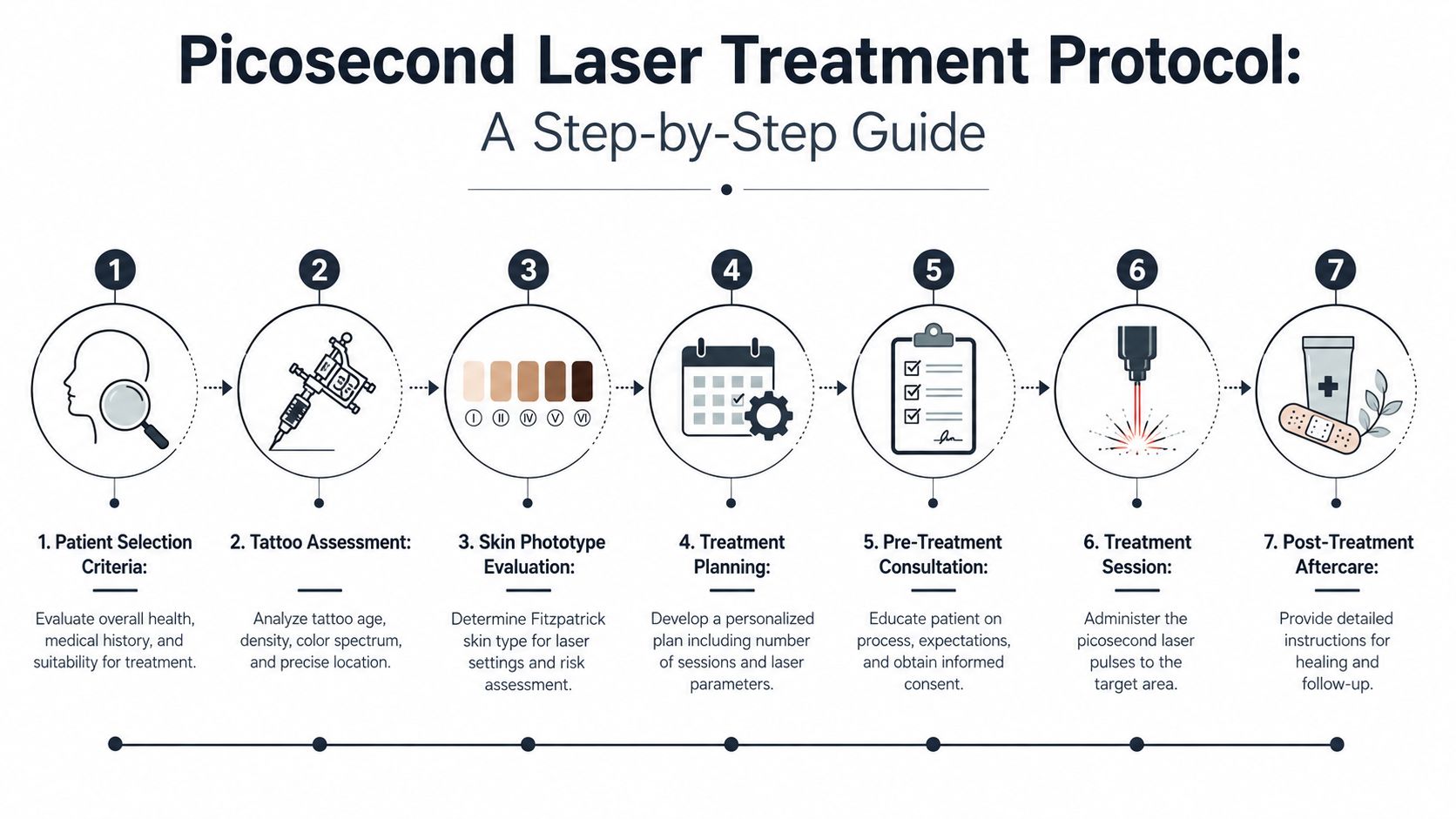
A practical workflow usually follows the same order each time.
- Assess the patient first. Medical history, current skin condition, healing tendency, and previous laser reactions shape the risk profile.
- Evaluate the tattoo itself. Age, density, colour mix, and anatomical location all influence how quickly pigment clears.
- Check skin phototype. This affects how conservative settings should be and how carefully you manage pigment-change risk.
- Plan the session strategy. That includes wavelength choice, test spots when needed, and a staged plan for follow-up.
- Set expectations clearly. Patients need to know that one session rarely tells the full story.
- Treat conservatively. Non-overlap and careful fluence selection reduce unnecessary skin stress.
- Review the response and document it. The skin's reaction tells you what to do next, and the record helps if adverse events need to be reported through Omega Lasers' adverse event reporting guidance.
A consultation phrase that works well is simple. “We are building safe clearance over time.” That helps patients understand why black ink is often the easiest place to start, while multicoloured tattoos need a more segmented plan. The clinical logic is straightforward. Picosecond systems tend to do best when the plan matches the tattoo's actual colour profile, not a generic removal promise.
Clear planning does more for satisfaction than overconfident fluence ever will.
Safety Profile Adverse Effects and Aftercare
A clinic in South Africa can have the right device and still run into avoidable problems if the safety plan is loose. Skin tone range, sun exposure, and the way patients follow aftercare all shape the result. DermNet notes picosecond lasers remain relatively contraindicated in Fitzpatrick skin types 4 to 6 because these patients are more susceptible to laser side effects, and it lists postinflammatory hyperpigmentation, hypopigmentation, blistering, scarring, and crusting as possible adverse effects (DermNet). The broader literature also describes side effects as usually mild and notes that picosecond devices can cause less tissue injury than nanosecond lasers.
How to reduce risk without overpromising safety
Conservative settings are the practical answer. For a darker phototype, the safer mindset is to start with test spots where needed, increase settings slowly, and check healing closely before deciding on the next pass. That approach matters in South Africa because seasonal UV exposure can turn a manageable pigment response into a longer recovery if the patient returns to sun too soon. Device choice helps, but it cannot replace careful post-treatment behaviour.
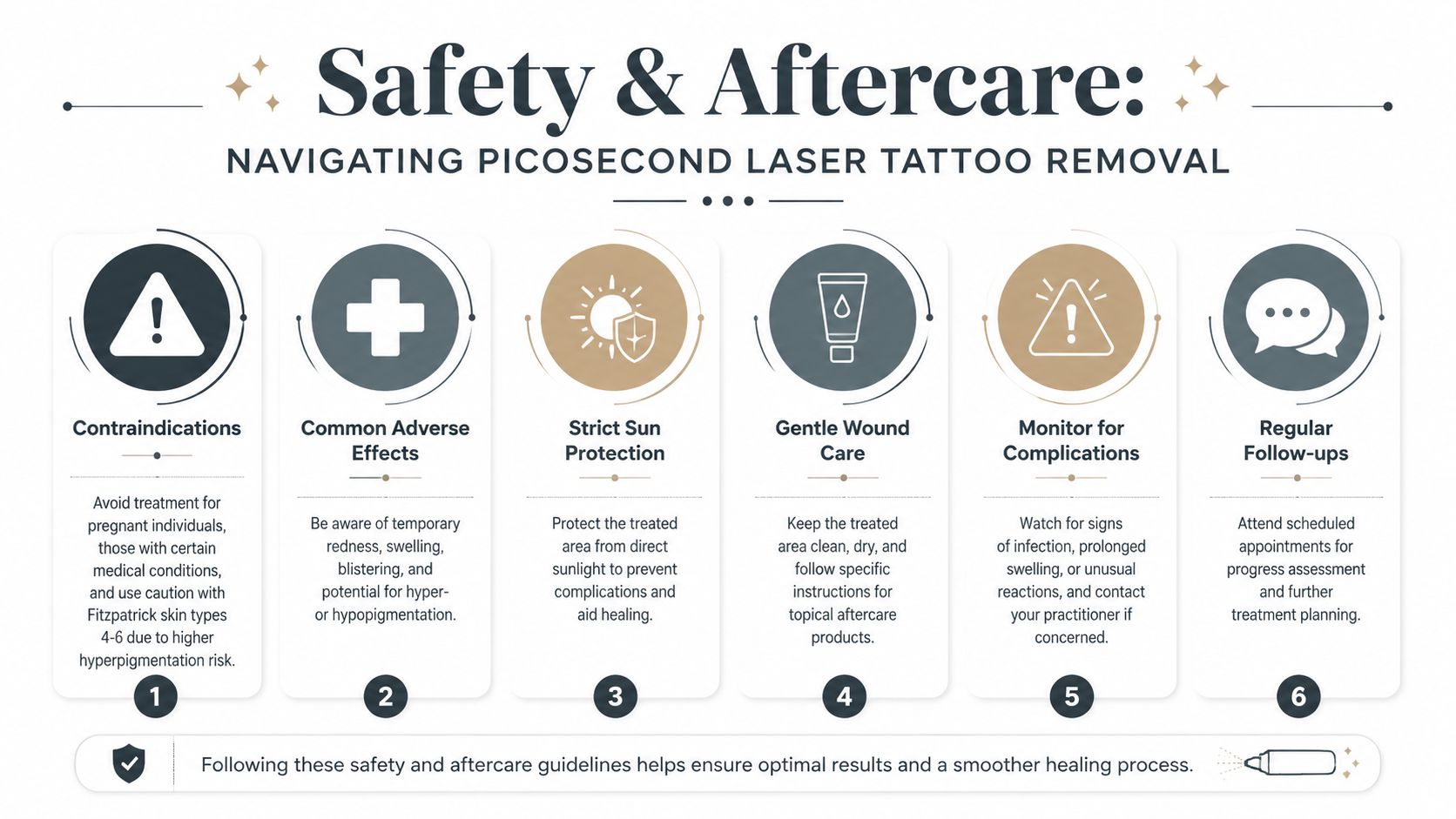
Patient instructions should stay plain and actionable.
- Use sun protection consistently. Treated skin should stay out of direct sun while it settles.
- Keep the area clean and dry. Gentle wound care lowers the chance of irritation.
- Watch for abnormal reactions. Persistent swelling, infection signs, or unexpected pain need review.
- Expect temporary redness or crusting. Mild reactions can be part of normal healing.
- Book the follow-up. Progress checks help you adjust the next session safely.
- Report pigment changes early. Early input makes it easier to manage hyperpigmentation or hypopigmentation.
Clear escalation steps matter as much as the treatment itself. If staff know exactly what to document and who must review an adverse event, they are less likely to dismiss a problem or leave the patient uncertain. A practical internal reference for that process is Omega Lasers' adverse event reporting resource, which helps teams standardise documentation and escalation.
The message for clinics is straightforward. Picosecond devices can suit careful tattoo removal, but darker skin still calls for restraint, close review, and aftercare that continues after the patient leaves the chair.
Comparing Picosecond and Q-switched Lasers
A clinic that is weighing tattoo removal platforms usually wants the same answer from a different angle, will a picosecond system clear pigment with more precision, or is a Q-switched nanosecond laser enough for the patient mix in front of them? The comparative evidence leans toward picosecond technology for higher clearance on selected tattoos. In one study, more tattoos treated with picosecond lasers reached a strong reduction in colour intensity, and the difference was statistically significant (PubMed comparison). The same study found the advantage was clearest in black and blue tattoos, while multi-colour designs were harder to clear well.
Side by side in clinic terms
| Factor | Picosecond lasers | Q-switched nanosecond lasers |
|---|---|---|
| Clearance on dark ink | Stronger on black and blue ink (PubMed review) | Effective, but generally less efficient on the same targets |
| Reduction in colour intensity | More tattoos reached a strong reduction in colour intensity (PubMed comparison) | Fewer tattoos reached the same level in the comparative study (PubMed comparison) |
| Pain and tissue impact | The comparative study suggested less pain and only small side-effect differences | More heat-based interaction |
| Best use case | Dark ink, precision work, skin-sensitive planning | Established option, especially where budgets are tighter |
The clinical logic is straightforward. Picosecond systems fragment pigment in a shorter pulse, so the tattoo behaves more like fine debris than a stubborn block of colour. That matters in practice because dark tattoos often respond with better clearance per session, while a nanosecond platform may need more sessions to reach a similar endpoint. Q-switched lasers still have a place, especially when the clinic needs a familiar workflow or a lower entry cost, but the comparative data gives picosecond devices the edge when efficiency is the main goal.
Clinical takeaway: if the tattoo is mostly black or blue, the case for picosecond technology is much stronger.
Patient counselling should stay specific. Multi-colour tattoos remain harder to treat well, and the comparative evidence was strongest for monochromatic designs. That means the decision is not just about owning a newer laser, it is about matching the device to the tattoo patterns a clinic sees most often in its own patient base. In South Africa, that choice also has to fit darker skin phototypes, sensible conservative settings, and the local compliance environment, because the best clinical result still has to be delivered safely and within regulatory expectations.
For a clinic owner, the same comparison has a business side. A platform that clears pigment more efficiently can support stronger patient confidence and better utilisation of appointment time, but only if the full operating cost makes sense. A useful way to frame that is to review the actual running expense, not only the purchase price, using Omega Lasers' total cost of ownership resource.
Practical Clinic Considerations for Device Selection and ROI
A clinic buys a picosecond platform for two reasons, better outcomes and a better service model. Those are related, because a treatment that clears pigment more efficiently can support premium positioning, steadier patient flow, and a stronger conversion story in consultations. The equipment itself still has to fit the clinic's staffing, training, and compliance reality.
What to check before you buy
Start with training. Tattoo removal is a technical service, and the operator needs to understand wavelength choice, skin phototype, test spots, fluence titration, and aftercare. Then check regulatory fit, because a device that is well described clinically still has to sit comfortably inside the clinic's compliance framework. In South Africa, practices should confirm the relevant approval and licensing status before they commit to a platform.
Total cost of ownership matters just as much as headline capability. That includes consumables, maintenance, uptime, support response, and warranty terms. If a device is down often, the appointment book feels it immediately.
For clinics building a business case, a useful reference point is Omega Lasers' total cost of ownership resource, which can help teams think beyond the sticker price and into the actual operating cost of a laser service.
Omega Lasers is one supplier that fits this conversation because it supplies medical-aesthetic platforms with training, technical support, marketing support, and a 2-year manufacturer warranty, alongside FDA approved, CE certified, and SAHPRA licensed systems. That doesn't replace due diligence, but it gives a clinic a concrete example of the support model that matters when a device is expected to earn its place in the treatment room.
Why ROI is tied to patient trust
ROI in tattoo removal rarely comes from one dramatic feature. It comes from a chain of smaller advantages, more convincing consultations, more predictable progress, and a better match between what the clinic promises and what the skin can safely deliver. When patients trust the plan, they're more likely to complete it. When the plan is realistic, the clinic spends less time managing disappointment and more time delivering treatment.
The strongest commercial case is therefore also the most clinical one. Choose a system that handles the ink colours you see most often, train the team to use it conservatively, and build the service around repeatable outcomes instead of overselling speed.
Case Studies and Key Conclusions
A Fitzpatrick 5 patient arrived with a black cover-up tattoo placed over older ink. The clinic used a conservative, staged approach, starting with the black pigment and checking the skin carefully between visits. Progress was gradual, not dramatic, but the patient valued the predictability of the plan more than rapid change.
A second patient had a mixed-colour sleeve with red and green sections that responded differently across the design. The team adjusted wavelength selection by colour zone and accepted that the tattoo would not clear evenly on the same schedule. That case reinforced a simple lesson, mixed-colour tattoos need colour-by-colour thinking, not one setting for the whole arm.
The main conclusions are straightforward. Picosecond systems deliver their value through photoacoustic fragmentation, stronger outcomes on black and blue ink, and a more controlled safety profile when they are used with conservative settings. In many cases, patients still need repeated sessions rather than a quick finish, and darker skin requires extra caution, especially in Fitzpatrick 4 to 6 patients.
For South African clinics, the clinical question and the business question sit together. A device has to match the tattoos you see, the skin tones you treat, and the regulatory standards your practice must meet. That is why careful selection matters as much as the technology itself. A system that fits your patient mix and your team's training can support safer decisions, steadier follow-up, and a more realistic service model for local practice realities.
Omega Lasers can help clinics evaluate systems, support implementation, and build a service that fits South African practice realities.