



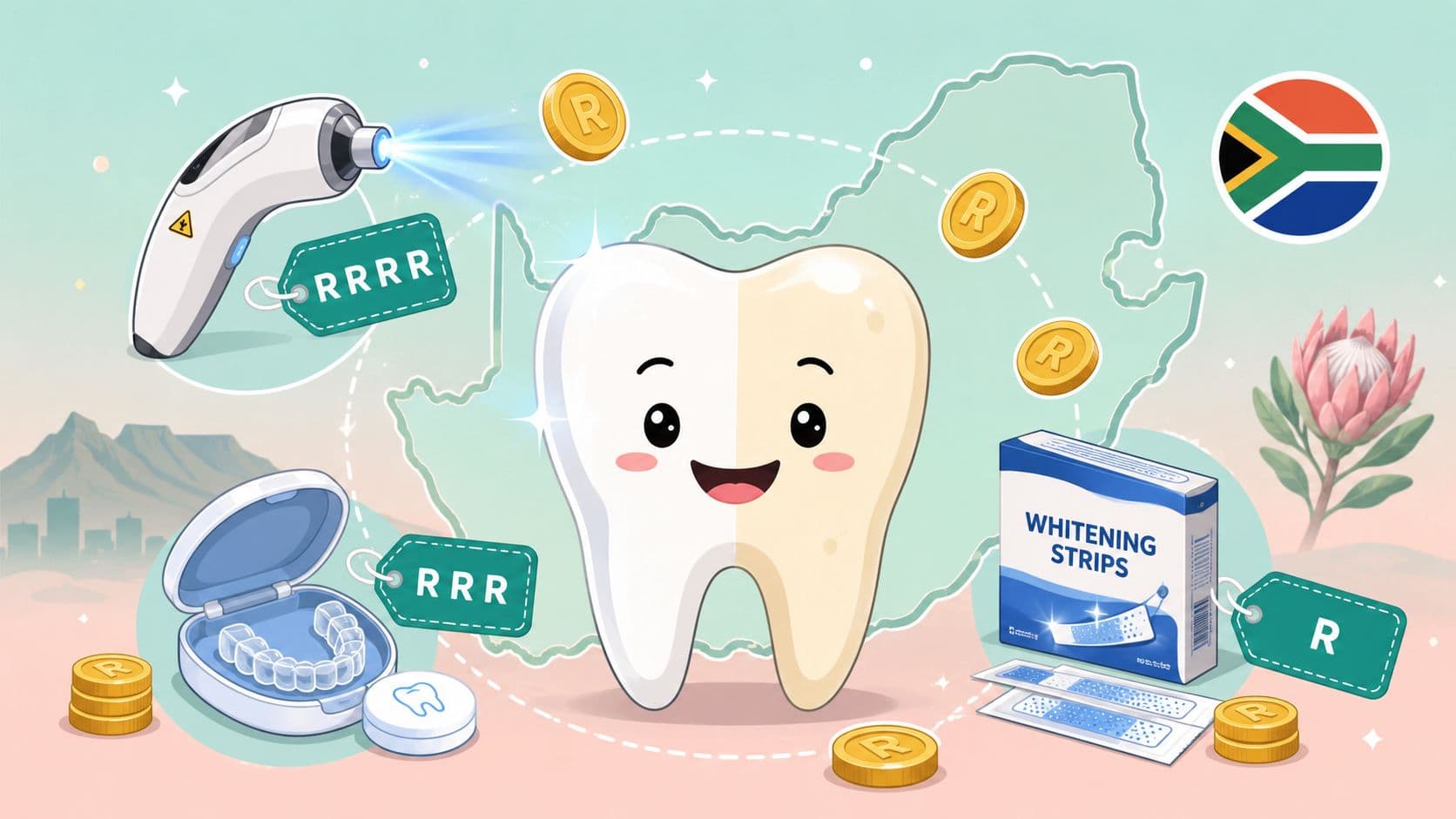
In South Africa, professional in-office whitening can cost around R800 to R950 per session, while custom take-home kits have a higher initial outlay of around R3,500. If you're asking how much is teeth whitening because you want a whiter smile without wasting money on the wrong option, those are the numbers to know first.
That usually means you're standing in one of two places. You're either comparing a proper clinic treatment with a cheaper retail product, or you're a clinic owner trying to work out why one whitening service can charge more than another and still win. In both cases, the same issue sits underneath the price. Teeth whitening isn't just a gel. It's a mix of chemistry, device quality, treatment design, and provider judgement.
Table of Contents
- Your Guide to Teeth Whitening Prices
- The Main Types of Teeth Whitening Explained
- Decoding the Price Tag What You Actually Pay For
- A Realistic Cost Breakdown for South Africa in 2026
- Beyond Price Safety Results and Long-Term Maintenance
- For Clinics Justifying Premium Pricing with Advanced Technology
- Frequently Asked Questions About Teeth Whitening
Your Guide to Teeth Whitening Prices
A brighter smile is one of the few aesthetic treatments people notice immediately, but it's also one of the easiest to misprice. Ask five clinics, and you may hear five very different numbers. That doesn't mean one quote is automatically inflated. It usually means the services aren't identical.
In the local market, the common starting point is straightforward. Professional in-office whitening in South Africa is typically priced around R800 to R950 per session, while custom tray systems sit around R3,500 because the tray fabrication adds a separate technical cost. For many consumers, that gap feels confusing at first. For clinics, it creates a communication problem if the team can't explain the difference clearly.
What the price is really signalling
The common expectation regarding how much is teeth whitening is a single number. In practice, the fee reflects several layers:
- Treatment intensity: A chairside session is built for speed and immediate visible change.
- Customisation level: A take-home kit with custom trays includes fit, planning, and repeatable delivery.
- Provider oversight: Screening matters because whitening isn't suitable in every mouth.
- Technology and workflow: The device, gel strength, and clinical process all affect cost.
Practical rule: Cheap whitening often strips out one of three things first, provider oversight, custom fit, or treatment strength.
That's why a retail strip and a clinic-based whitening service shouldn't be treated as direct substitutes. They serve different buyers, different timelines, and different expectations.
What helps buyers compare properly
A good comparison starts with the method, not the marketing line. If you want a useful consumer-facing overview before choosing a route, this expert guide to teeth whitening options is a sensible primer because it frames the difference between at-home and professional care in practical terms.
For clinic owners, the same principle applies in reverse. If your pricing sounds high, the answer usually isn't discounting first. It's explaining what the client is buying, how the protocol is delivered, and why the result is more controlled.
The Main Types of Teeth Whitening Explained
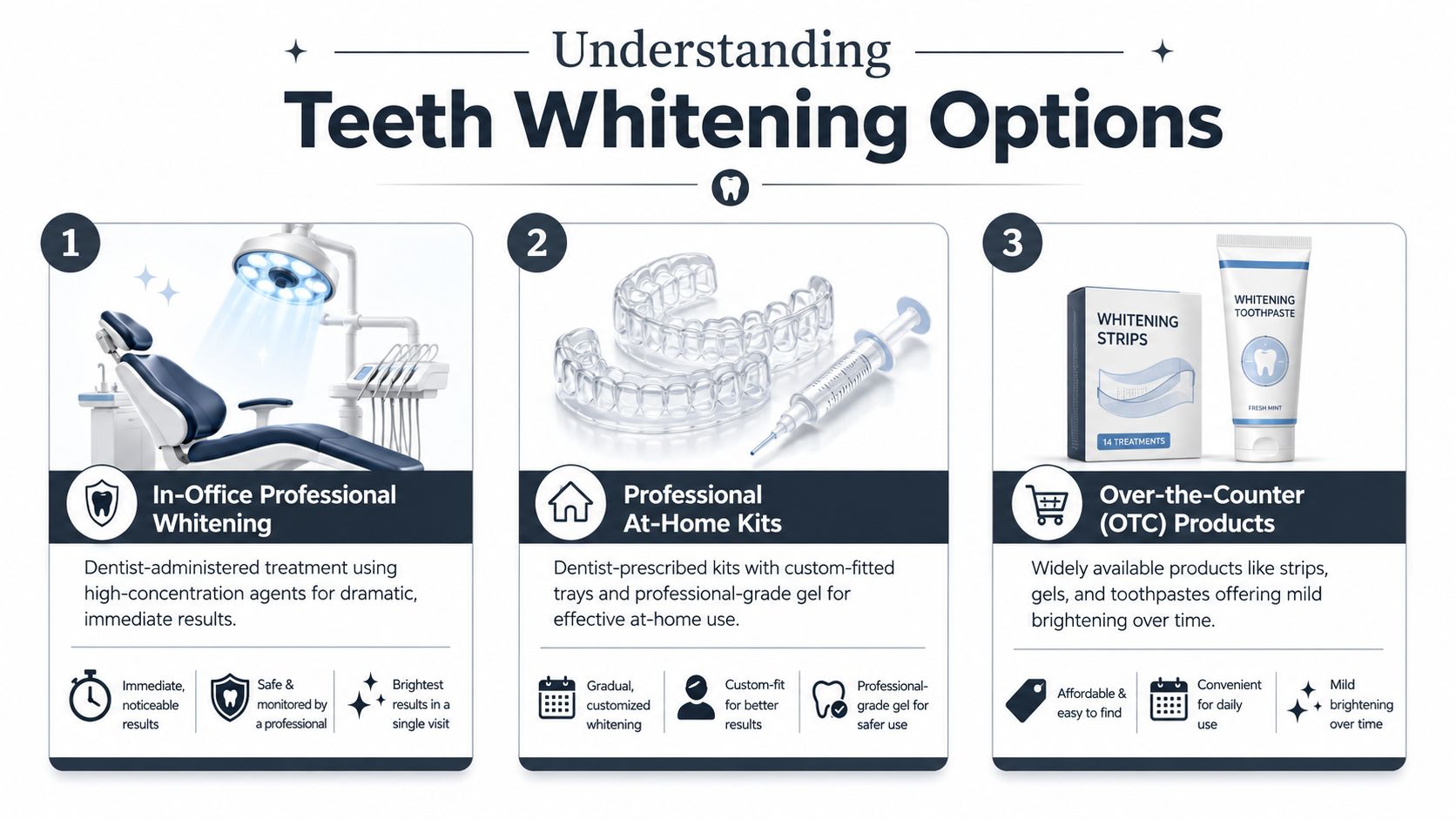
The whitening market falls into three main categories. Each one uses bleaching chemistry differently, and each one asks the client to trade speed, supervision, convenience, and precision in a different way.
In-office professional whitening
This is the fastest and most controlled route. The provider isolates the soft tissue, applies a high-strength whitening agent, and may pair the treatment with a light-activated system. The goal is immediate lift under supervision.
The main advantage isn't just speed. It's control. The provider can watch how the teeth and soft tissue respond, manage comfort, and keep the gel where it should be. That matters when a client wants a result for an event, a media shoot, or doesn't want to spend days managing trays at home.
In practical terms, this is the high-intensity option. It suits clients who value immediacy and are willing to pay for a supervised appointment rather than a slower self-managed routine.
Professional take-home kits
This category sits between chairside treatment and retail whitening. The key difference is the tray. Instead of a one-size-fits-all strip or tray, the client gets a custom-fitted appliance designed to hold the gel closely against the enamel.
That changes the experience in a meaningful way. A custom tray improves gel contact, limits leakage, and makes the application more consistent. It also gives the client a system they can reuse later for maintenance, provided the tray remains in good condition and the provider approves ongoing use.
A custom tray is not just packaging. It's the delivery system.
This route suits clients who want professional oversight but prefer to whiten gradually at home. It also tends to work well for people who don't mind following instructions carefully over a set period.
Over-the-counter products
Retail whitening products usually come as strips, gels, trays, or whitening toothpastes. They're easy to buy, easy to try, and often chosen because the upfront spend feels low.
But they operate in a different category of performance. The fit is generic, the application is less controlled, and the user is fully responsible for following directions and monitoring sensitivity. For some people, they can offer mild brightening. For others, they create frustration because the coverage is uneven or the visible change is too subtle.
A simple way to think about it is this:
- In-office whitening: Fast, supervised, higher intensity
- Professional take-home kits: Slower, customised, more controlled than retail
- OTC products: Convenient, accessible, but limited in precision
That's why the best option isn't universal. It depends on whether the client wants speed, flexibility, budget access, or a more clinically managed result.
Decoding the Price Tag What You Actually Pay For
Two whitening services can look similar in an advert and still be priced very differently in practice. The reason is usually hidden in the treatment architecture. Price sits on top of chemistry, device use, provider skill, and the amount of custom work built into the service.
Chemistry and exposure time drive the treatment
The core technical difference is the bleaching agent itself. According to CareCredit's breakdown of teeth whitening costs, professional in-office whitening typically uses 25 to 40% hydrogen peroxide, while take-home systems typically use 10 to 15%, and light-based systems average 15 minutes per cycle. The same source notes that this helps explain why a local R950 session sits in a different category from over-the-counter strips priced around R25 to R100.
That doesn't mean the most expensive option is always the right one. It means stronger formulations and clinically managed exposure change what the treatment can realistically do.
Expertise is part of the fee
A proper whitening service includes judgement. The provider needs to assess whether the client is suitable, whether sensitivity is likely to be an issue, whether existing dental work may create a colour mismatch, and whether a quick chairside treatment or slower tray-based route makes more sense.
That expertise often gets undervalued because it isn't as visible as the lamp or the gel syringe. But it's one of the main reasons premium services hold their pricing. A lower-cost service often removes the consultative layer first.
Customisation increases cost, but also control
A custom tray system costs more upfront because the provider has to create a precise fit before the client even begins whitening. That's labour, materials, and workflow. The fee doesn't only cover the gel. It covers the precision of delivery.
For clinic owners, pricing discipline holds paramount importance. If you're modelling treatment mix, package design, and service margins, a structured view of financial forecasting for aesthetic clinics helps put premium add-on services into a bigger commercial context.
What usually separates a premium whitening service
- Clinical screening: The treatment starts with suitability, not just scheduling.
- Device-supported workflow: Light-assisted systems add process and equipment cost.
- Soft tissue protection: Safer delivery requires more than applying gel quickly.
- Custom fit where needed: Precision is rarely the cheapest route, but it's often the better one.
If a provider can't explain where the fee goes, the service is probably competing on price alone.
A Realistic Cost Breakdown for South Africa in 2026
If you want a usable local benchmark, South Africa remains relatively accessible for professional whitening. The strongest direct local pricing reference is the South African consumer and clinic discussion captured in this local teeth whitening cost thread, which places professional in-office laser whitening at R800 to R950 per session and custom take-home tray kits at R3,500 total because of the mould fabrication outlay.
Those aren't interchangeable purchases. One is a single-session service. The other includes a custom-made delivery system that changes how the treatment is used over time.
Teeth Whitening Costs in South Africa 2026 Estimates
| Whitening Method | Average Cost Range (ZAR) | Best For |
|---|---|---|
| In-office professional whitening | R800 to R950 per session | Clients who want a supervised treatment with immediate chairside delivery |
| Custom take-home tray kit | Around R3,500 total | Clients who want a tailored at-home protocol with custom trays |
| Over-the-counter strips | R25 to R100 | Buyers focused on the lowest entry cost and mild brightening |
How to read the table properly
The lowest price doesn't automatically mean best value. OTC products sit at the bottom of the market because they don't include assessment, customisation, or supervised delivery. They're accessible, but they also place more risk and more responsibility on the buyer.
The in-office range works well for clients who want visible movement without buying a custom system first. It's also the easiest service for clinics to position as a premium quick treatment, especially when paired with strong consultation and aftercare.
The custom tray category has the highest initial barrier because the tray creation cost lands upfront. But that same cost is also the reason the treatment can become more sustainable over time for the right patient.
South Africa versus international pricing
The local fee structure is notably lower than the US benchmark. GoodRx's review of supervised whitening costs states that the US national average was $508 in 2022, up from $393 in 2019, and notes that cosmetic whitening is generally excluded from standard dental insurance cover. For consumers, that highlights why South African pricing often feels comparatively attractive. For clinics, it shows there is still room to position whitening as a high-perceived-value service without pricing it into an unrealistic bracket for the local buyer.
Beyond Price Safety Results and Long-Term Maintenance
Whitening decisions get worse when people focus only on the first invoice. The smarter question is value over time. A treatment that looks cheaper today can become more frustrating if it causes sensitivity, produces patchy brightening, or needs frequent correction.
Safety changes the value equation
Professionally supervised whitening has one major advantage over DIY use. Someone is watching the process, selecting the route, and adjusting the protocol if sensitivity or soft tissue irritation becomes an issue. That doesn't make every client identical, and it doesn't remove all discomfort, but it does make the treatment more controlled.
If you're trying to understand safer habits around cosmetic whitening, this guide on how to whiten teeth without enamel damage is a useful companion read because it focuses on protecting enamel rather than chasing the fastest visible change.
For practitioners, this is also where governance matters. Whitening may look simple from the outside, but clinic policies, consent, documentation, and escalation standards still matter. Aesthetic businesses that offer treatment without strong clinical boundaries expose themselves unnecessarily, which is why professional indemnity considerations for treatment providers should sit in the background of any serious service menu.
Hidden costs show up later
One of the most overlooked issues in whitening is maintenance. The local market talks a lot about session cost and very little about what happens after. The practical concern is clear in this discussion of whitening cost breakdowns and overlooked maintenance issues, which notes that long-term maintenance and sensitivity care are often omitted from price guides, leaving consumers to discover those costs later.
That matters because the visible treatment fee may only be the first expense. Some clients need additional sensitivity products. Others need repeat management sooner than expected because of diet, smoking, or inconsistent aftercare.
Whitening should be priced and chosen as a programme, not as a one-off moment.
What usually works better in the real world
A practical decision often comes down to fit between client behaviour and treatment design.
- Choose supervised treatment if the client wants a more controlled process and clearer guidance.
- Choose custom trays if the client is disciplined enough to follow an at-home routine properly.
- Be cautious with bargain options when the client has a history of sensitivity or wants a more even cosmetic result.
- Plan maintenance early so the client understands the likely ongoing commitment.
That combination of safety, predictability, and maintenance planning is what separates a satisfying whitening experience from a disappointing one.
For Clinics Justifying Premium Pricing with Advanced Technology
Teeth whitening sits in an interesting commercial position. Clients know what it is, they usually understand the aesthetic benefit immediately, and many are willing to pay for a result that feels fast and visible. But they also compare aggressively, which means clinics can't rely on vague premium language. They need a pricing argument that stands up.
The market supports quality, not just low pricing
South Africa's positioning is commercially useful because buyers are cost-aware without automatically wanting the cheapest possible option. According to this international treatment pricing overview for South Africa, the average cost of teeth whitening or bleaching in South Africa is $180, compared with a US national average of $508.
For a clinic owner, that creates a clear strategic point. The service is affordable enough to attract interest, but still premium enough to protect margin if the offer is built correctly.
Premium pricing has to be explained operationally
Clients pay more willingly when the clinic can show where the value sits. That usually comes down to four levers:
- Technology quality: Better systems support a cleaner, more consistent treatment process.
- Provider training: Staff confidence affects consultation quality and perceived safety.
- Treatment design: Pairing a chairside service with a maintenance pathway creates better continuity.
- Client experience: Comfort, communication, and aftercare shape whether the fee feels justified.
A clinic that merely says “advanced technology” won't hold premium pricing for long. A clinic that explains treatment steps, sets expectations realistically, and shows why the process is safer and more consistent has a stronger commercial position.
How clinics can package whitening more profitably
A standalone session has value, but bundles are usually stronger. An in-clinic treatment can serve as the transformation moment, while a maintenance plan or professionally managed home-care pathway extends the relationship.
That matters for revenue quality, not just turnover. One well-structured whitening client can become a repeat buyer when the clinic builds a sensible follow-up path instead of treating the service as a one-time sale.
For owners evaluating capital purchases and premium treatment positioning, reviewing laser machine price considerations for clinic investment helps frame whitening technology as part of a broader return-on-investment decision rather than an isolated equipment spend.
Premium pricing only works when the client can see the difference before they buy, during the treatment, and after they leave.
Frequently Asked Questions About Teeth Whitening
Does teeth whitening damage enamel
Used appropriately and under proper supervision, whitening doesn't have to mean enamel damage. Problems usually arise when people overuse products, choose unsuitable options, or ignore sensitivity and soft tissue irritation. The safest route is the one matched to the person, not the one marketed as the strongest.
Why do custom kits cost more than a basic session
Because the tray is part of the treatment, not an accessory. A custom kit includes a fitted delivery system that changes how consistently the gel sits against the teeth. That added fabrication work is why the upfront fee is higher than a single in-chair service.
Can crowns, veneers, or bonding whiten too
No. Whitening products act on natural tooth structure. Existing cosmetic or restorative materials won't lighten in the same way, so anyone with visible dental work should ask about colour mismatch before starting treatment.
Is a cheaper whitening option always poor value
Not always. It depends on the goal. Someone who wants mild brightening and understands the limitations may be satisfied with a low-cost product. But if the buyer expects a more uniform, professionally managed cosmetic outcome, the cheapest route often becomes the least satisfying one.
How should clinics explain higher whitening fees
They should be concrete. Explain the device-supported process, the strength and control of the protocol, the consultation, the protection of soft tissue, and the aftercare. Clients rarely object to pricing as strongly as they object to poor explanation.
What's the best way to choose a whitening route
Start with three questions:
- How quickly do you want the result
- How sensitive are your teeth
- Do you want supervision or would you rather manage the process yourself
The right answer usually becomes obvious once those three points are honest.
If you run a clinic, salon, or aesthetic practice and want to add premium device-led treatments with proper training, support, and business guidance, explore Omega Lasers. Their platform approach is built for practices that want safe, credible technology and a stronger commercial model around high-value aesthetic services.