



You're probably weighing the same three pressures every clinic owner faces before buying a laser. You need stronger results, you need safer treatments across a wide client mix, and you need the machine to earn its place on the floor instead of becoming an expensive ornament waiting for repairs.
That's why the best laser hair removal equipment isn't the unit with the loudest spec sheet. In South Africa, the right choice sits at the intersection of clinical safety, SAHPRA compliance, treatment speed, staff usability, and long-term profitability. A machine can look impressive in a demo and still be the wrong investment if it slows bookings, creates support headaches, or limits who you can safely treat.
The business opportunity is real. The South African medical aesthetics market expanded by 28% annually from 2020 to 2025, driven primarily by demand for professional hair removal systems, and advanced SHR technology helped reduce full leg treatment time from 45 to 27 minutes, boosting clinic throughput by 50% and enabling ROI within 8 months for high-volume practices, according to this industry summary on professional laser adoption. That creates room for well-run clinics to grow, but only if they buy with discipline.
Table of Contents
- Choosing Your Next Laser An Investment Not An Expense
- The Seven Pillars of a Smart Laser Investment
- Decoding Laser Technology Wavelengths Spot Sizes and Cooling
- Proof Not Promises Evaluating Certifications and Clinical Evidence
- Your Clinic Profit Engine Calculating Throughput and ROI
- Matching the Machine to Your Mission Use Case Recommendations
- Making Your Final Decision with Confidence
- Frequently Asked Questions
- Do staff need special training to operate professional laser hair removal equipment?
- Is professional equipment really that different from at-home devices?
- Should I buy a single-purpose hair removal laser or a multi-modality platform?
- What should I ask a supplier before signing?
- How do I manage client expectations around results?
- Is comfort really that important for profitability?
- What's the biggest buying mistake clinics make?
Choosing Your Next Laser An Investment Not An Expense
A laser purchase becomes expensive when the wrong machine forces clinical compromises, narrower treatment eligibility, slower sessions, and inconsistent support. The right machine does the opposite. It widens the range of clients you can treat, keeps your diary moving, and protects your reputation when clients judge you on results, comfort, and professionalism.

In practical terms, that means treating laser hair removal equipment like a business system, not a box with handpieces. You're buying treatment capability, yes, but you're also buying speed, confidence for your therapists, fewer cancellations caused by discomfort, and a cleaner path through compliance checks. Those factors directly affect how often the device gets booked and how often clients complete their course.
The strongest buyers ask different questions from the start. They don't ask only, “What's the price?” They ask:
- Who can we safely treat? Your local demographic matters more than a generic brochure.
- How quickly can we treat high-demand areas? Speed affects daily capacity.
- How stable is the support structure? Downtime is lost revenue, not a minor inconvenience.
- How easy is parameter selection for staff? Complex machines often underperform in busy clinics because teams avoid using their full capability.
- Will this still make sense in two years? A cheap unit that limits growth is usually the costly option.
Practical rule: If a supplier can explain energy, cooling, training, service response, and compliance with equal clarity, you're probably speaking to a serious partner. If they only sell speed or “power”, look harder.
South African clinics also have a specific advantage. Demand has grown quickly, and faster SHR-based workflows have made laser hair removal one of the clearest service lines for turning capital into recurring bookings. But the same growth has also filled the market with uneven imports and overstated claims. That's why the best laser hair removal equipment in ZA is the machine that works in your real operating environment, with your team, your client mix, and your support realities.
The Seven Pillars of a Smart Laser Investment
A strong buying decision usually holds up across seven areas. If one pillar is weak, the machine tends to disappoint somewhere else.
Laser technology
Start with the treatment engine itself. Wavelength selection, power delivery, pulse control, and platform design determine what hair types and skin tones you can handle confidently. In ZA, that matters because your client base may include a wide range of phototypes and hair textures. A narrow-application device can leave money on the table and create avoidable clinical risk.
Safety and comfort
Clients don't return because a handpiece looked advanced. They return because the treatment felt manageable and their skin recovered well. Cooling quality, motion technology, and operator control all affect comfort and side-effect management. A machine that allows practitioners to work effectively without pushing clients beyond tolerance will usually produce better course completion.
Clinical proof and certifications
Marketing often distracts buyers. A credible platform should have recognisable regulatory standing for your market and evidence that reflects real treatment outcomes, not just brochure language. Certification tells you whether the device cleared formal requirements. Clinical evidence tells you whether it performs in practice.
Treatment speed and throughput
Fast treatment isn't only a convenience feature. It changes scheduling, staffing, room utilisation, and the economics of every large area booking. A slower machine can still be effective, but it may cap how many sessions you can deliver in a week and how attractive the service feels to busy clients.
The machine that fills your diary is usually not the cheapest one. It's the one your team can run confidently all day without bottlenecks.
Total cost of ownership
Disciplined buyers pull ahead by looking beyond the initial invoice. Ask about maintenance, service intervals, downtime, software reliability, consumables, replacement parts, training refreshers, and whether your supplier has local support. Two devices with similar treatment performance can produce very different margins once those realities show up.
Training and after-sales support
A machine only performs as well as the team using it. Good suppliers don't disappear after installation. They train staff, help standardise protocols, and provide technical support when treatment flow is interrupted. In many clinics, this is the difference between a device that becomes central to the business and one that gets used cautiously.
Practice integration
The final pillar is operational fit. Can the machine suit your room layout, treatment menu, brand positioning, and staffing model? Does it support cross-selling, package design, and repeat booking habits? The best laser hair removal equipment should fit the way your clinic runs.
Here's the mindset shift that matters most:
- Stop comparing only hardware
- Score the full operating model
- Choose the platform that improves revenue quality, not just session count
Decoding Laser Technology Wavelengths Spot Sizes and Cooling
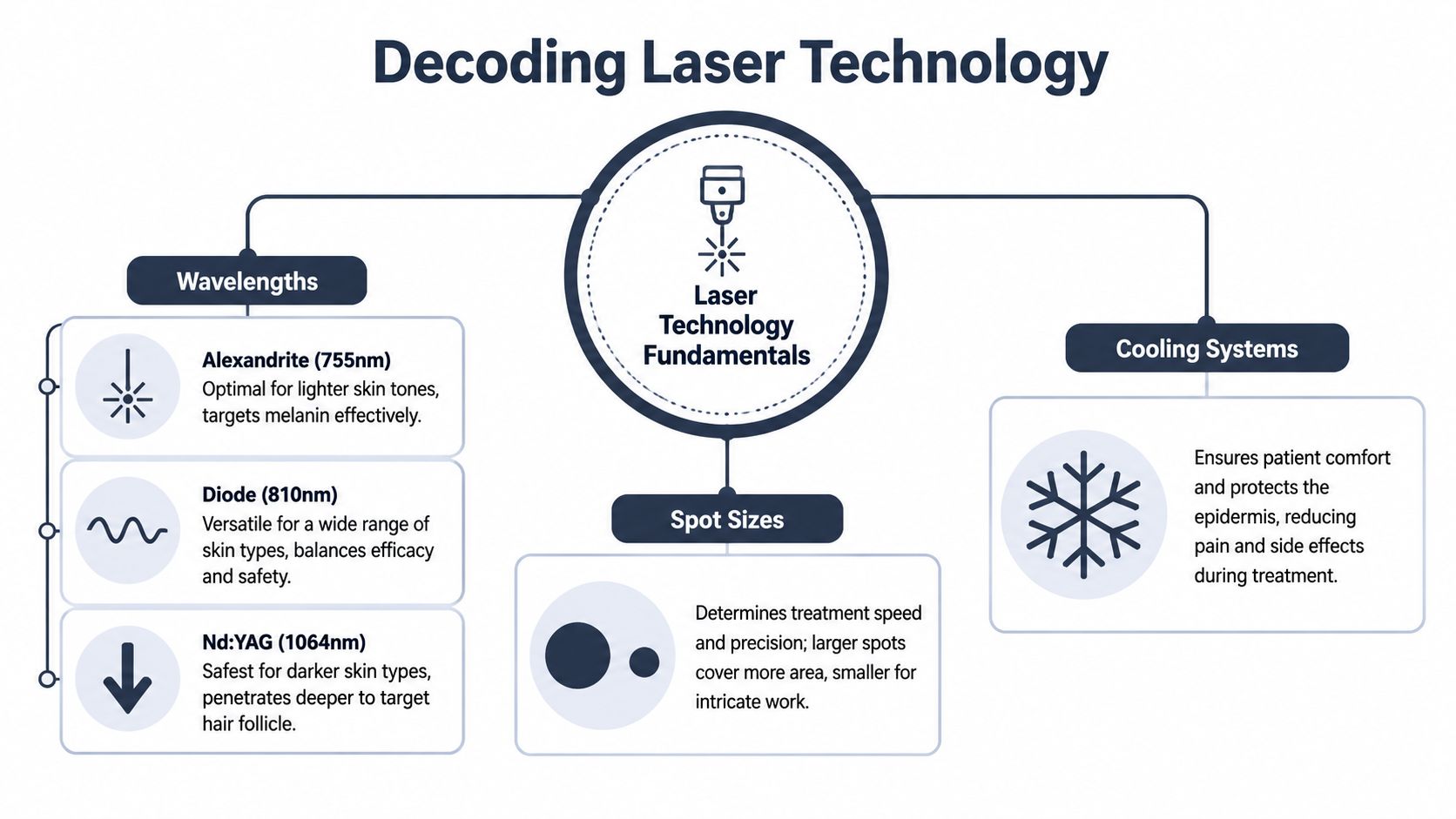
The technical side of laser buying doesn't need to be mysterious. Strip away the jargon and you're really choosing how the machine targets hair, how quickly it covers skin, and how well it protects the epidermis while doing it.
If your team needs a straightforward primer on treatment physics before comparing platforms, this guide to how laser hair removal works is a useful technical refresher.
Wavelength choice changes who you can treat safely
Think of wavelengths as different keys. Each one opens access to a different balance of melanin targeting, depth, and safety margin.
Alexandrite (755nm) is often favoured for lighter skin and can be effective where contrast between hair and skin is high. The problem is that many buyers treat “effective” as “universal”. It isn't. In the South African context, that assumption can create avoidable risk.
Diode platforms are often chosen for versatility because they can sit in a practical middle ground between efficacy and safety across a broader range of clients. That's one reason they appear so often in serious clinic buying conversations.
Nd:YAG (1064nm) reaches deeper and is generally the safer choice for darker skin types because it reduces epidermal melanin competition. In mixed-demographic clinics, this matters a great deal.
The local trade-off is clear. Johannesburg dermatology data showed Nd:YAG hybrids achieved 85% hair reduction on melanin-rich skin, compared with 65% for single-wavelength Alexandrite lasers, which also carried a 40% higher risk of hyperpigmentation if not used correctly on these skin types, according to this overview of laser types for hair removal.
That's why multi-wavelength systems are often the sensible business decision in ZA. They give practitioners more flexibility across Fitzpatrick ranges and hair presentations without forcing the clinic to refer out darker or more complex cases.
Spot size affects revenue more than most buyers expect
Most brochures mention spot size as if it's a technical footnote. It isn't. Spot size affects how much area you cover per pulse, which means it affects appointment length, staff fatigue, and room turnover.
A larger spot size usually improves efficiency on big areas such as legs, backs, and chests. A smaller spot can help with detail work, but if your platform is too slow on broad areas, your diary pays the price. You'll either book longer appointments, reduce daily capacity, or rush treatments. None of those outcomes helps retention.
When clinics underestimate spot size, they often overestimate how many sessions they can realistically deliver in a day.
Cooling is a safety system not a comfort extra
Cooling deserves more respect in buying decisions. It does more than make treatment feel nicer. It helps protect the epidermis, supports higher tolerable treatment parameters, and gives practitioners a steadier working rhythm.
Look for cooling that's built into the treatment experience rather than bolted on as an afterthought. Contact cooling, including sapphire-based approaches on some platforms, can improve confidence on sensitive areas and skin of colour because it supports comfort while helping manage surface heat.
If a device needs heroic operator skill to stay comfortable, it won't scale well across a busy team.
A clinic owner should also think about cooling from a staffing perspective. Experienced laser practitioners can compensate for many machine weaknesses. Newer operators usually can't. Better cooling narrows that gap and helps standardise treatment quality across the roster.
Proof Not Promises Evaluating Certifications and Clinical Evidence
A capital purchase in aesthetics should survive scrutiny from three directions. A regulator should be comfortable with it. A practitioner should be able to defend its safety and treatment logic. A clinic owner should be able to tie its claims to real-world performance.
What certification should mean to a buyer in ZA
In South Africa, local compliance isn't optional. Imported systems sit within a regulatory environment that has tightened, and buyers should treat that as a good thing. It filters out some of the low-grade equipment that creates inconsistent results and support headaches.
The practical baseline is simple. Ask for documentation. Confirm whether the system is positioned for professional clinical use. Check whether the supplier can explain the certification path in plain language. If the answers come slowly or vaguely, step back.
A useful benchmark came when SAHPRA's 2022 directive mandated FDA or CE certification for imported systems, and a later 2024 Cape Town multi-clinic trial involving 850 patients on SAHPRA-compliant devices found modern diode lasers achieved 85% hair reduction at 12 months, while pain scores dropped by 67% with in-motion SHR technology, as outlined in this review of compliant diode laser systems.
If you want a plain-language overview of what FDA status should and shouldn't mean in a buying process, this page on FDA-approved laser hair removal helps frame the discussion.
How to read a clinical claim without being misled
A supplier may present a study, but the existence of a study isn't enough. Read it like a buyer, not a fan.
Look for:
Sample relevance
Does the population resemble the clients your clinic sees?Follow-up period
Hair reduction claims mean more when follow-up extends beyond the immediate treatment window.Technology match
Was the study done on the same wavelength configuration and treatment mode being sold to you?Safety reporting
A serious study reports adverse events, not only success language.Outcome framing
Hair reduction, relapse, pain, and client satisfaction all matter. One favourable metric alone doesn't tell the full story.
Red flags in supplier conversations
Some warning signs show up repeatedly in poor purchasing decisions.
| Red flag | Why it matters |
|---|---|
| “This machine works for everyone” | No platform is universal without protocol nuance |
| Certification is mentioned but not documented | Compliance should be easy to verify |
| No discussion of operator training | Even strong devices underperform with weak onboarding |
| Only before-and-after photos are shown | Images don't replace data or protocol detail |
| Claims focus on power only | Raw power without control can increase risk |
Buy the machine whose evidence can be explained calmly and specifically. Marketing urgency is not proof.
Your Clinic Profit Engine Calculating Throughput and ROI
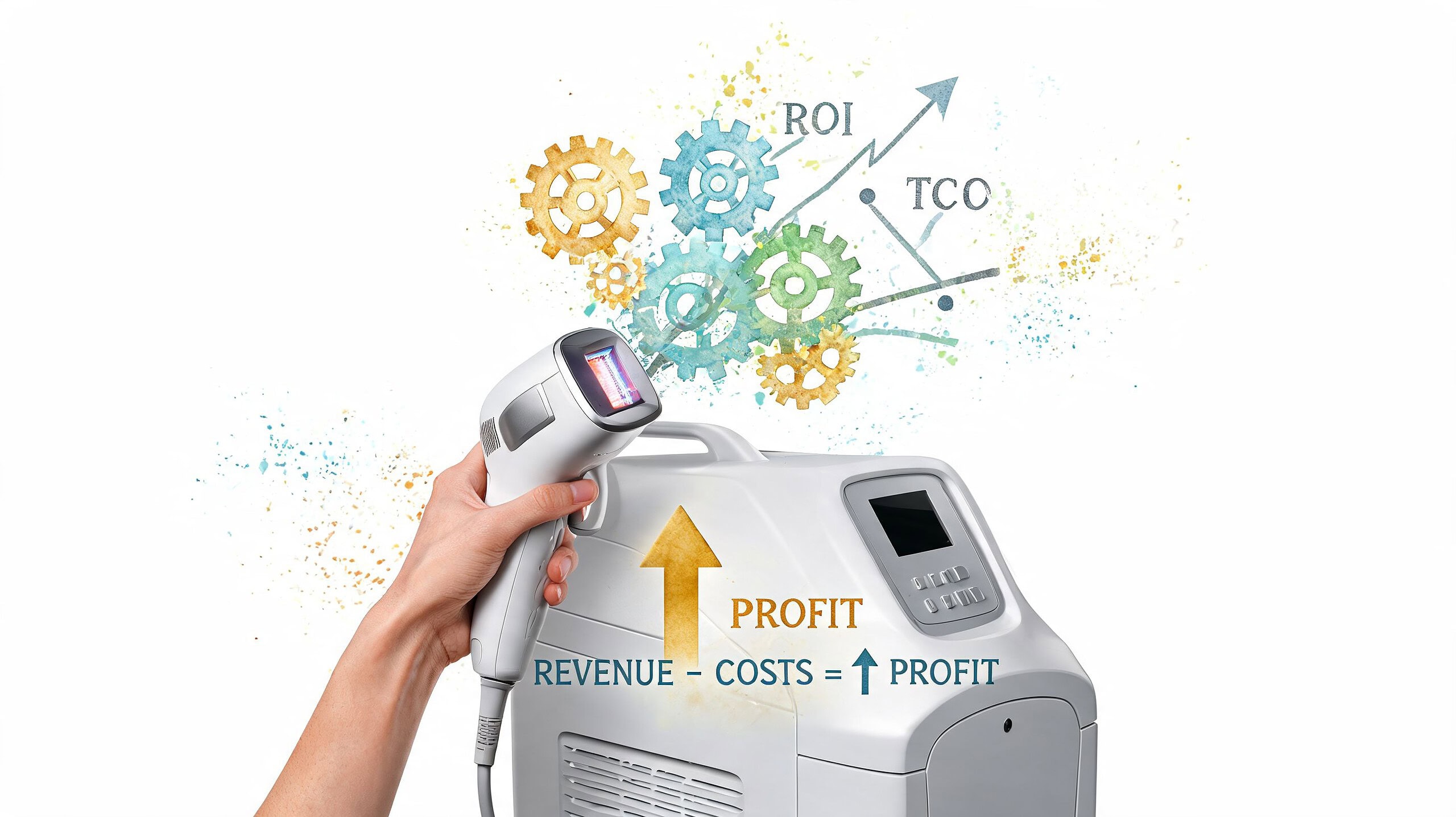
Owners often lose money by focusing too hard on acquisition cost and too little on operating behaviour. The machine doesn't need to be cheap. It needs to produce stable, repeatable revenue without draining time through maintenance, rescheduling, or service delays.
The purchase price is only one line item
The core financial mistake is treating the invoice as the investment total. It isn't. You also need to account for servicing, downtime, missed bookings, staff confidence, support responsiveness, and whether the platform can support package growth beyond hair removal alone.
That matters because Aesthetic Medicine SA data from 2025 found that 70% of clinics using single-function lasers with poor support struggled with ROI due to high maintenance costs of R15,000 per year and service delays. By contrast, clinics using SAHPRA-licensed multi-modality platforms with integrated support saw a 2.5x revenue boost via upselling and reported 40% higher overall profitability, according to this market summary on laser platform ownership in ZA.
If you want a local framework for thinking through numbers before buying, this diode laser ROI breakdown for South African professionals is a practical place to start.
A simple worksheet for decision-making
Use a worksheet before you compare suppliers. It will tell you more than any brochure.
Estimate booking demand
Look at current enquiries, existing waxing or shaving-concern clients, and adjacent services that already indicate demand.Map treatment time by area
A faster machine changes the economics of legs, backs, and package bookings.List support-related risk
Ask how breakdowns are handled, where parts come from, and what training is included.Calculate service-line expansion
Can the platform support additional billable treatments, or is it locked into one narrow function?Score team usability
The best machine on paper still fails if staff avoid using it.
Here's a quick comparison lens:
| Cost factor | Low-priced unsupported unit | Supported professional platform |
|---|---|---|
| Upfront spend | Lower | Higher |
| Service predictability | Uncertain | More structured |
| Staff confidence | Often uneven | Usually stronger with training |
| Downtime impact | Higher risk | Lower risk if support is responsive |
| Revenue flexibility | Narrower | Broader if modality mix is available |
What supported platforms do differently
The strongest systems help the clinic build a service, not just perform a treatment. They tend to come with clearer protocols, more usable training, and enough reliability that the front desk can book confidently without constantly checking whether the machine is “behaving this week”.
That's one reason many buyers now favour platforms that fit into broader practice growth. For example, a four-wavelength system such as Omega Lasers' Tetra Cool sits in the category of equipment clinics evaluate when they want hair removal capability aligned with compliance, cooling, and wider operational support, rather than viewing the purchase as an isolated hardware decision.
A laser becomes profitable when the whole clinic trusts it. Reception books it confidently. Therapists use it consistently. Clients finish their course and refer others.
Matching the Machine to Your Mission Use Case Recommendations
There isn't one universal answer to the best laser hair removal equipment question. The better question is this: best for which clinic model? A startup owner, a high-volume spa manager, and a dermatology-led practice can all make sound decisions and still choose very different equipment.
A buying profile helps prevent expensive mismatch. If a clinic buys for aspiration instead of actual workflow, the machine often ends up underused.
Device Feature Checklist by Clinic Type
| Feature / Consideration | New Solo Practitioner | High-Volume Spa / Salon | Medical / Dermatology Clinic |
|---|---|---|---|
| Core priority | Ease of use and versatility | Speed, reliability, repeatability | Clinical control and broader skin-type confidence |
| Wavelength strategy | Multi-wavelength if budget allows, to avoid early case limitations | Multi-wavelength strongly preferred for mixed client demand | Hybrid or multi-wavelength approach for complex presentations |
| Training needs | High. Supplier onboarding matters a lot | Moderate to high. Standardisation across staff is key | High. Team needs protocol discipline and consultation accuracy |
| Cooling importance | Very high, because comfort helps retention and operator confidence | Very high, because all-day use exposes machine weaknesses | Very high, especially for sensitive or higher-risk clients |
| Spot size preference | Balanced. Must handle both detail work and common body areas | Larger spot sizes are valuable for throughput | Flexible handpiece options matter more than raw speed alone |
| Support model | Responsive technical help and business guidance | Fast service response and minimal downtime | Strong documentation, clinical credibility, dependable support |
| Ideal buying mindset | Buy room to grow, not just the cheapest entry point | Buy for treatment flow and machine uptime | Buy for safety margin, evidence quality, and case range |
| Risk to avoid | Overcomplicated device with weak training | Cheap machine that slows bookings or breaks rhythm | Narrow technology that excludes part of your patient base |
A few practical recommendations sit behind that table.
For a new solo practitioner
Prioritise a machine your team can master quickly. A versatile platform with solid onboarding usually outperforms a technically impressive device that creates hesitation in treatment rooms.For a high-volume spa or salon
Speed and reliability matter more than novelty. If the handpiece overheats, the software interrupts flow, or clients find treatments too uncomfortable, your margins shrink through schedule drag.For a medical or dermatology clinic
Prioritise case flexibility and safety control. You'll likely see a broader mix of skin presentations and a lower tolerance for avoidable side effects, so device selection should reflect that standard.
The right machine should match your client mix first, your treatment menu second, and your budget third. Reversing that order usually creates regret.
Making Your Final Decision with Confidence
By the time you shortlist suppliers, the decision should feel less emotional and more structured. Score each option against the seven pillars: technology fit, safety and comfort, certifications, clinical proof, throughput, total cost of ownership, and after-sales support. If a machine looks strong in one area but weak in three others, it isn't a strong option.
Use live demonstrations carefully. Don't only judge the treatment feel. Watch how the supplier explains settings, consultation logic, contraindications, cooling, maintenance, and service response. That tells you how the relationship will work after installation, when the true test begins.
A final shortlist should answer these questions clearly:
- Can this platform treat our likely client mix safely?
- Will our team use it confidently without over-reliance on one star operator?
- Can the supplier support us when something goes wrong?
- Does this machine help us grow revenue quality, not only session count?
- Can we defend this purchase clinically and commercially?
The best laser hair removal equipment is rarely the one with the flashiest pitch. It's the one that fits your practice model, stands up to compliance scrutiny, and keeps earning trust from staff and clients month after month.
Ask for transparent demonstrations. Ask uncomfortable service questions. Ask to see documentation. Then choose the supplier who behaves like a long-term operating partner, not a salesperson chasing a signature.
Frequently Asked Questions
Do staff need special training to operate professional laser hair removal equipment?
Yes. Even user-friendly systems need structured training. A clinic should expect staff to understand skin typing, contraindications, parameter selection, patch testing, endpoint recognition, and post-care guidance. The machine matters, but operator judgement matters just as much.
Is professional equipment really that different from at-home devices?
Yes. Professional systems are built for stronger clinical performance, broader treatment flexibility, and supervised use. At-home devices may suit consumer convenience, but they don't replace a clinic platform designed for consistent protocols, varied skin types, and higher treatment demand.
Should I buy a single-purpose hair removal laser or a multi-modality platform?
That depends on your business model. A single-purpose system can make sense for a tightly focused clinic with clear demand and strong support. A multi-modality platform often makes more commercial sense when you want to widen treatment options, cross-sell to existing clients, and protect utilisation if one service line slows.
What should I ask a supplier before signing?
Ask for certification documents, training details, service response processes, warranty terms, maintenance expectations, and a realistic discussion of which clients the machine is and isn't suited for. Also ask who provides support locally and what happens if the device goes offline.
How do I manage client expectations around results?
Be precise and conservative. Explain that laser hair removal is a course-based treatment, outcomes vary by skin and hair characteristics, and maintenance may still be needed for some clients over time. Clients trust clinics that explain the process truthfully more than clinics that promise perfection.
Is comfort really that important for profitability?
Absolutely. If treatments are too uncomfortable, clients delay appointments, fail to complete courses, and become harder to retain. Comfort also affects referrals because clients talk about how a treatment felt, not only how it looked weeks later.
What's the biggest buying mistake clinics make?
They buy a machine instead of buying an operating solution. Hardware alone doesn't deliver ROI. Training, support, compliance, usability, and treatment flow are what turn a device into a dependable revenue service.
If you're comparing systems and want a clearer view of what will work in your clinic, speak with Omega Lasers. Their team supplies FDA approved, CE certified, and SAHPRA licensed aesthetic platforms and can walk you through demos, training, support, and practice-fit questions so you can assess the investment properly before you buy.