



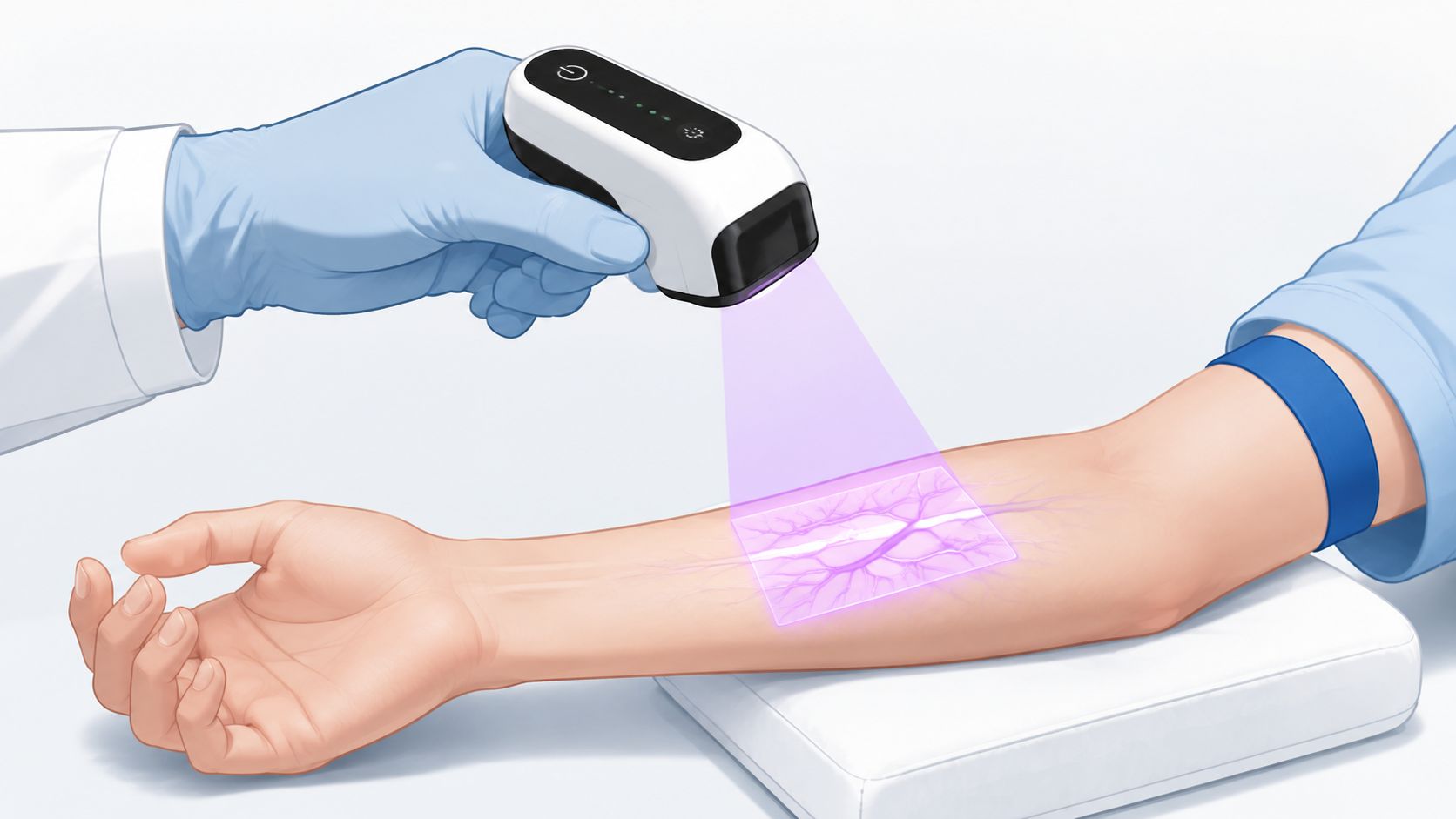
You're in a treatment room with a patient who's had “difficult veins” before, the schedule is running tight, and the second attempt is already starting to erode confidence. In that moment, a vein finder light isn't a gadget, it's a practical way to reduce guessing, improve comfort, and keep the room moving without turning a simple cannulation into a prolonged search.
Table of Contents
- The Cannulation Problem Every Practitioner Recognises
- How Near-Infrared Vein Finder Lights Work
- Where Clinics Use Vein Finders in Real Practice
- Comparing NIR Projection, Transillumination, and Handheld LED Devices
- Skin Tone, Lighting, and the Visibility Gap
- How to Choose a Vein Finder Light for Your Clinic
- Workflow Integration and Return on Investment
- Frequently Asked Questions About Vein Finder Lights
The Cannulation Problem Every Practitioner Recognises
A nurse swabs the arm, palpates once, then again, and the clock starts to feel louder than the room. The patient is trying to stay still, the vein is not cooperating, and everyone knows that a simple access attempt can become a morale problem as much as a technical one. That is exactly where a vein finder light earns attention, because it changes the search from guesswork to guided visualisation.
The people who struggle most with venous access are usually the ones who can least afford repeated attempts. That includes paediatric patients, older adults, dehydrated patients, oncology patients, and people with veins that sit deeper under the skin or are harder to palpate. In day clinics and aesthetic rooms, the issue is similar, even if the procedure is different, because a difficult start can delay everything that follows.
A vein visualisation device is meant to support the clinician, not replace judgement. It helps staff identify a target vein sooner, choose a better puncture site, and avoid unnecessary repositioning when the vein isn't obvious under normal room light. That matters for patient comfort, but it also matters for workflow, because every failed attempt adds time, waste, and stress.
Practical rule: if your team often says, “I can see it, but I can't quite trust it,” a vein finder is worth evaluating.
Used well, the device becomes part of the access routine, not an impressive extra. That's why it helps to assess competency and handling expectations early, rather than treating the device as something staff will “figure out” on the day. If you want a useful reference point for team readiness, review the competency assessment guidance alongside your internal training plan.
How Near-Infrared Vein Finder Lights Work
A vein finder light works because blood and skin do not interact with light in the same way. A simple way to picture it is a torch shining through a thin curtain. Some material lets more light pass, while other material absorbs or scatters it, and that difference makes a hidden shape easier to pick out. Near-infrared vein finders use the same principle below the skin.
The basic mechanism is direct. Deoxygenated haemoglobin absorbs near-infrared light, while surrounding tissue reflects more of it, so veins appear as darker lines in a projected image. A Malaysian Ministry of Health review describes this as a real-time projected image of vein structure for cannulation, and characterises NIR vein finders as generally safe, non-invasive, and well tolerated across adult and paediatric populations, based on limited evidence (Malaysian Ministry of Health review).
The wavelengths to know
Most devices use a narrow band of light rather than a single fixed setting. Near-infrared systems commonly use wavelengths around 740 nm, 850 nm, and in some designs 960 nm, because those ranges suit vein visualisation in clinical imaging (historical and technical review). That does not mean the device is seeing through skin like an X-ray system. The sensor detects contrast created by light absorption, then turns that contrast into a visible map.
A shadow on a wall gives the nearest comparison. The object in front of the light weakens the beam, so the eye reads the shape from the darker area. In a vein finder, the vein is not a shadow in the literal sense, but it appears darker for a similar reason, because the surrounding tissue and the haemoglobin are interacting with the light differently.
Why low power matters
Portable clinical imaging only works if the device is easy to carry and easy to run. The historical and technical review notes that LED-based transillumination designs can use two watts of power or less, which supports portability and low-energy operation. That matters in real rooms where staff need devices that charge easily, hold up during repeated use, and do not become another cable problem.

Where Clinics Use Vein Finders in Real Practice
In a busy emergency bay, the value of a vein finder shows up fast. A patient needs IV access, the first visual scan is unhelpful, and the device gives the team a clearer target without forcing repeated palpation. In that setting, the point isn't spectacle, it's speed, because a quicker decision can keep the patient calmer and the room from backing up.
Routine phlebotomy is another obvious use. A phlebotomist doesn't need the machine for every draw, but it becomes useful when the vein is faint, the patient is anxious, or the arm is cold and unyielding. The device can also help with line placement prep in outpatient settings where staff want a more confident first pass before committing to a puncture site.
Paediatric and difficult-access care
Children are where expectations need the most care. Small veins, movement, fear, and previous painful experiences all make the procedure more sensitive, so visual guidance can be helpful even when it doesn't guarantee success. The same is true for older adults and patients whose veins sit deeper or have less obvious surface markers.
Aesthetic rooms use the same logic, but for a different workflow. Before injectables, fillers, or platelet-rich plasma preparation, vein visualisation can support planning in areas where precision matters and the clinician wants to reduce avoidable probing. That use is supportive rather than magical, and the operator still needs to judge whether the device is appropriate for the specific procedure, skin condition, and room setup.
A good rule is to buy for the procedures you do most often, not the edge case you only see once in a while.
The strongest case for adoption usually appears where access is frequent, access is variable, and staff turnover makes consistency difficult. If your team mainly needs support for cannulation, blood draws, paediatric work, or pre-procedure mapping in aesthetics, that's where the device can earn its keep first.
Comparing NIR Projection, Transillumination, and Handheld LED Devices
A clinic can have a good vein finder light on paper and still struggle with it in practice if the form factor does not suit the room. NIR projection devices cast a live vein map onto the skin, transillumination devices shine light through tissue from a nearby angle, and handheld LED units rely on simpler illumination and direct viewing. Each approach addresses the same access problem, but it does so with a different balance of image detail, setup, and staff effort.
Projection units suit teams that want the vein map placed exactly where the puncture will happen. The clinician sees the outline on the skin, much like tracing a route directly on the road surface before driving. Transillumination wands are more compact and direct, but their usefulness depends more heavily on positioning and room conditions. Handheld LED units are usually the easiest to carry from one patient to the next, so they fit lower-volume or budget-conscious settings where basic visual support matters more than a layered image.
What the practical specs tell you
Procurement teams in South Africa often look first at the practical limits of a unit, because those limits shape daily workflow. Compact professional devices commonly use rechargeable lithium-ion batteries with usable operating times of around 1.5 to 4.5 hours, while accepted handheld specifications include a detection depth of around 0 to 10 mm and a working distance of about 15 to 25 cm (portable device specification sheet). Those figures matter because deeper tissue access and longer untethered runtime can reduce repositioning during repeated patient access, especially in rooms where staff move quickly from one case to the next.
Cost also separates the device classes. A commercial review places portable near-infrared units at about USD 4,500 and non-portable units at up to USD 27,000. That spread explains why clinics need to match device type to patient volume and daily use, rather than buying the most advanced option because it sounds better on paper.
| Vein finder light device types compared | |||
|---|---|---|---|
| Feature | NIR projection | Transillumination wand | Handheld LED unit |
| How it shows the vein | Projects a real-time image on the skin | Illuminates tissue so veins appear darker | Uses light contrast and direct viewing |
| Best fit | Busy rooms, mixed patient populations | Quick spot-check use, compact setups | Lower-volume or budget-led environments |
| Portability | Usually portable, but varies by build | Highly portable | Very portable |
| Buying focus | Image clarity, distance, training | Ease of use, room conditions | Cost, battery, simplicity |
Skin Tone, Lighting, and the Visibility Gap
The most common disappointment is not that the device “doesn't work”, it's that the projected image looks clearer than the actual puncture opportunity. Visibility on a screen or on skin is only the first layer. Clinical success still depends on vein depth, patient hydration, room lighting, tissue composition, and the operator's ability to choose the right site.
That distinction matters most in diverse patient populations. A device may improve contrast, but it still has to deal with skin tone variation, superficial tissue, and the fact that some veins are not ideal for access no matter how bright the image looks. The job is to help the clinician make a better decision, not to promise that every visible line is a usable vein.
The literature on a low-cost real-time prototype shows how large the visibility gain can be. On arm sites, visibility rose to 94.21% with the device compared with 54.55% without it, and on dorsal hand sites it rose to 100% compared with 50.00% without it (prototype visibility study). Those figures show why staff notice an immediate difference, especially in fast-turnover rooms where every extra minute counts.
How to calibrate expectations
Use the device as a guide, then confirm the vein clinically. If the line is visible but the tissue feels unstable, the patient is dehydrated, or the angle is poor, the device has done its job by narrowing the options, not by making the choice for you. That's why training should emphasise interpretation, not just how to switch the unit on.

How to Choose a Vein Finder Light for Your Clinic
Start with the patients you see. If your work includes paediatric care, deeper veins, or frequent cannulation in mixed skin tones, detection depth and image clarity should matter more than flashy extras. If your room flow is fast and your staff move between bays, battery life and grip comfort become practical priorities instead of nice-to-haves.
The next question is hygiene. A device that's hard to wipe down, awkward to cover, or fussy to disinfect between patients can create friction that the spec sheet never mentions. In clinics where infection-control policy is strict, that operational detail matters as much as image quality because the best device is the one staff will use correctly every time.
Training is the third filter. A good unit should be simple enough for newer staff to learn without a long ramp-up, but durable enough that experienced users trust it during difficult access. If your team rotates often, ease of use can matter more than advanced menu options.
A clinic checklist that works
- Detection depth: Match the device to your patient mix, especially if you often work with deeper or small veins.
- Battery and usability: Make sure runtime fits your appointment cadence, not just the manufacturer's ideal use case.
- Workflow and hygiene: Check whether the device can be cleaned quickly and consistently between patients.
- Total cost of ownership: Include consumables, service support, and time spent on staff onboarding.
Regulatory fit belongs on the checklist too. For clinical use, FDA-cleared, CE-marked, and SAHPRA-licensed devices give procurement teams documented safety and post-market support, which matters when the device is being used on patients rather than in a demo room. If you're weighing cost against broader ownership issues, the total cost of ownership guide is a useful way to think beyond the sticker price.
For aesthetic teams that want a broader pre-treatment lens, the 3D Aesthetics vein removal advice is a sensible companion read because it helps frame vein-related planning inside real clinic decision-making, not just device shopping.
Workflow Integration and Return on Investment
A vein finder light earns its place through small workflow gains that repeat across many appointments. In a crowded clinic, a clinician who finds the vein sooner spends less time probing, less time changing position, and less time resetting a nervous patient. That does more than improve throughput. It also protects confidence on harder cases, which practice managers often notice before it shows up in a spreadsheet.
The financial logic is straightforward. Fewer failed attempts usually mean fewer wasted consumables, less chair time tied to one patient, and fewer moments where the team has to call in a more experienced colleague. In a busy aesthetic room or day clinic, those small savings can steady the whole session even if the procedure count stays the same. For clinic owners who want a structured way to test the numbers, an Omega Lasers break-even analysis can help turn that workflow change into a practical procurement conversation.
The payback conversation should stay realistic. A mid-range portable NIR unit is not a margin machine, and it should never be sold as one. The better question is whether the device removes enough friction from difficult-access cases to justify its place in your current routine, especially where repeat access, patient anxiety, or staff inconsistency already slow the day.
A simple way to explain the value is to look at the schedule. If the device shortens hard cases, the return appears in fewer delays, steadier handovers, and less rework, not only in the purchase invoice. That is why stronger buyers tend to treat the unit as an efficiency tool rather than a status purchase. In settings where patients expect comfort and staff need predictable flow, it can also support better reviews and calmer treatment rooms.
Workflow planning also reaches beyond cannulation. A clinic that offers dermal fillers Portsmouth can use the same visual discipline to prepare treatment areas, organise staff movement, and reduce interruptions while patients are being assessed, marked, and prepared. That matters because a device that fits the room rhythm is easier to keep in use than one that sits in a drawer between appointments.

Frequently Asked Questions About Vein Finder Lights
Are vein finder lights safe for repeated use?
Yes, the technology is generally treated as safe, non-invasive, and well tolerated in clinical settings, based on limited evidence in the review noted earlier. The key is using a clinically appropriate device and following the manufacturer's instructions, especially around cleaning and positioning.
How long does staff training usually take?
The basics are typically learned quickly if the device is simple and the clinic has a short orientation process. The longer part is not turning it on, it's learning how to interpret the image and use it alongside normal cannulation judgement.
Do they work on infants and elderly patients?
They can be useful in both groups because the main problem is often access difficulty, not age itself. The result still depends on vein depth, hydration, and whether the vein is suitable for the procedure.
How long before a mid-range unit pays for itself in a South African clinic?
That depends on how often you deal with difficult access, how much time those cases consume, and how many failed attempts the device helps you avoid. The honest answer is that payback is clinic-specific, so the best approach is to compare device cost against your own access volume, downtime, and consumable waste rather than rely on a generic figure.
If you're weighing a vein finder light for a clinic, salon, or medical aesthetic room, Omega Lasers can help you think through the decision with the same focus on safety, workflow, and training that good procurement requires. Visit Omega Lasers to explore how their clinical education and device support can help your team choose with confidence and implement with less disruption.