



You're probably staring at a shortlist right now. One machine looks affordable but vague on support. Another sounds clinically stronger but carries a bigger capital outlay. A third promises “all skin types” and “painless” treatment, yet the sales conversation never gets specific about compliance, downtime, maintenance, or what happens when the unit fails on a fully booked Saturday.
That's the real buying moment for laser hair removal equipment professional systems in South Africa. It isn't about buying a box with handpieces. It's about deciding what kind of service line your clinic can safely deliver for years, what client mix you can confidently treat, and whether the machine will strengthen or strain your operations.
Always ensure the information is accurate and true, as this concerns aesthetic lasers, energy-based devices, and health.
Table of Contents
- Investing in Your Clinic's Future
- Decoding Laser Hair Removal Technology
- Evaluating Clinical Efficacy and Safety
- Navigating Regulatory and Certification Hurdles
- Integrating the Equipment into Your Practice
- Choosing a Vendor for Training and Support
- Your Final Decision Checklist
Investing in Your Clinic's Future
Buying a professional hair removal laser is one of the few clinic decisions that touches nearly every part of the business. It affects treatment outcomes, staff training, legal compliance, patient suitability, room scheduling, consumables, reviews, and cash flow. If the decision is right, the machine becomes a reliable revenue service. If it's wrong, it becomes a recurring operational problem.
Most owners make the same early mistake. They compare purchase prices before they compare treatment fit, support structure, and regulatory readiness. That approach feels sensible because the capital figure is visible. The expensive costs usually sit elsewhere, in downtime, retraining, cancelled bookings, avoidable adverse events, weak patient selection, and underused capacity.
A practical buying process starts with three questions:
Who will you treat most often
Your likely skin types, hair types, and treatment areas should shape the technology choice.Who will operate the system daily
A strong platform still fails commercially if your team can't use it consistently and safely.What does ownership look like after month one
Financing, service, maintenance, compliance, and booking flow matter as much as the launch.
If you're still modelling the investment, it helps to review realistic finance options for aesthetic equipment before you lock yourself into a machine that only works on paper.
Practical rule: Buy for the clinic you want to run every day, not for the demo you saw once.
Operationally, demand management matters too. A laser room can't generate return if calls are missed while therapists are in treatment. Many solo operators and smaller teams solve that bottleneck with systems like SkipCalls helps manage spa appointments, which is useful when you're adding a treatment category that quickly increases pre-booking questions and follow-up calls.
Decoding Laser Hair Removal Technology
Laser hair removal only makes business sense when the underlying technology matches the patients walking into your clinic. Marketing language often muddies that decision. The clinical principle is simpler than the brochures make it sound.

Why wavelength matters
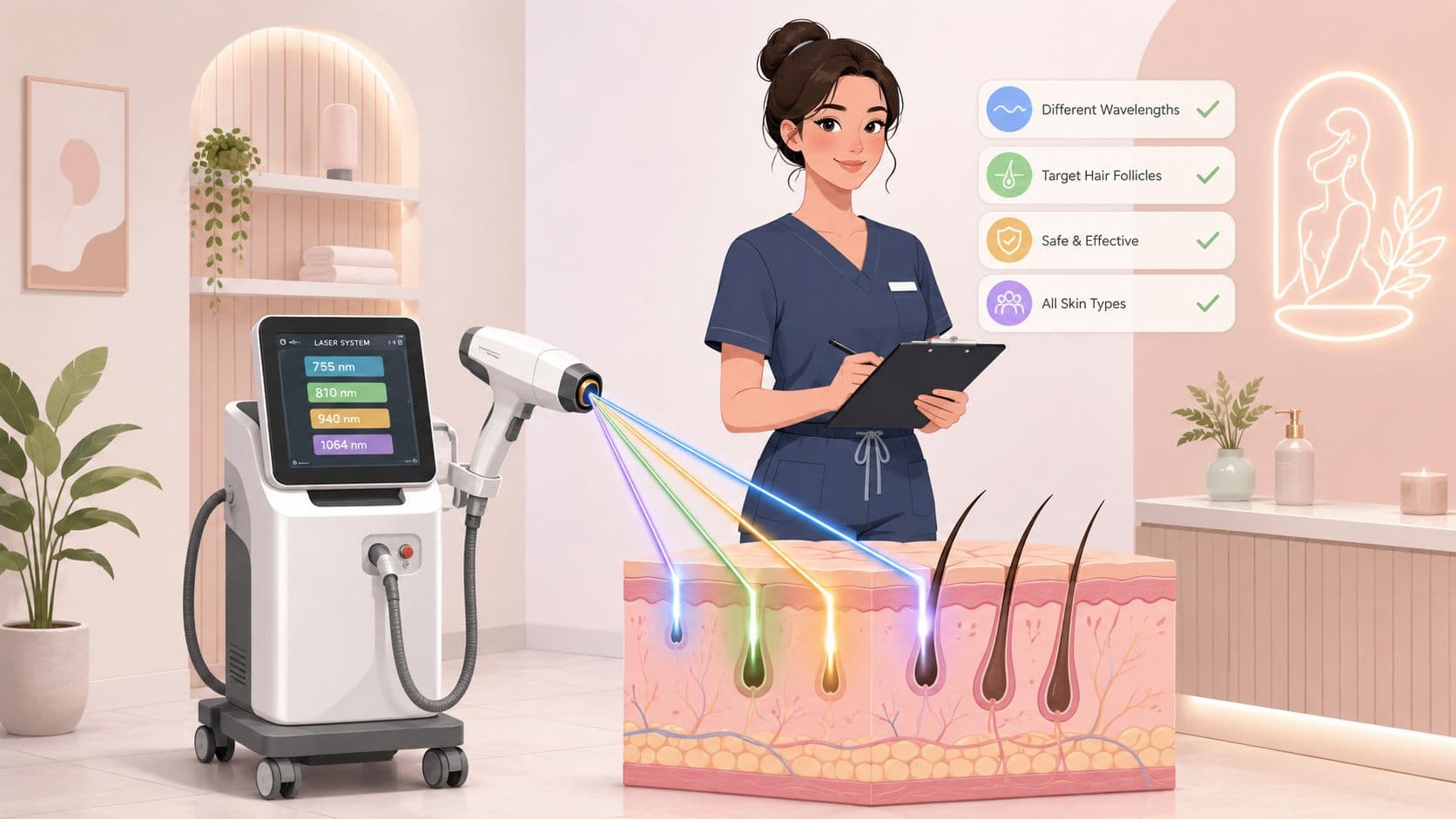
Think of wavelength like tuning a radio. Each frequency is better at reaching a specific station. In laser hair removal, the “station” is melanin in the hair follicle. The goal is to deliver light that melanin absorbs efficiently, convert that light into heat, and damage the follicle while protecting surrounding skin.
That balance is why wavelength selection matters so much in real practice. Too generic a system can narrow your safe treatment range. Too much reliance on broad claims about comfort can distract from whether the machine is suited to your patient mix.
One of the most useful anchor points is the diode platform. According to the technical buying guidance published here, professional diode laser equipment operates most effectively at an 808 nm wavelength, the optimal absorption peak for melanin. This minimises heat absorption by surrounding tissue, enabling safe, full-body treatment across all Fitzpatrick I-VI skin tones and achieving 80-90% long-term hair reduction after a full course of 6-8 sessions in the diode laser technical overview.
For clinic owners comparing energy-based modalities, this also helps clarify the difference between laser platforms and broader light-based systems. A useful starting point is this overview of IPL and laser hair removal differences, especially if you're deciding between lower-barrier entry and stronger clinical precision.
How the main technologies differ
The core wavelengths in professional hair removal systems each have a different practical role.
| Technology | Best practical use | Main buying implication |
|---|---|---|
| Alexandrite 755 nm | Often chosen for lighter skin types | Fast and effective in the right patient group, but not the universal answer for a diverse South African base |
| Diode 808 nm | Broad versatility across skin tones | Often the workhorse option when you need safe, repeatable, full-body treatment |
| Nd:YAG 1064 nm | Important for darker skin types | Valuable where deeper penetration and epidermal protection are priorities |
| Multi-wavelength platforms | Clinics serving mixed demographics | Broader treatment flexibility, but only if the system is well built and well supported |
Many buying conversations go off track. Owners hear “multi-wavelength” and assume that automatically means better outcomes. Not always. A wider wavelength mix only helps if the machine delivers stable energy, appropriate cooling, and usable parameter control.
A broader specification sheet doesn't automatically produce a broader safe treatment range.
What to look for in a modern platform
When evaluating laser hair removal equipment professional systems, focus less on hype and more on the interaction between five elements:
Wavelength fit
The platform should match the skin types and hair profiles your clinic sees.Energy delivery
Consistent output matters more than a dramatic sales pitch about power.Cooling quality
Cooling isn't just about comfort. It supports epidermal protection and repeatable treatment settings.Pulse control
Adjustable pulse width matters because hair calibre and skin sensitivity vary.Workflow stability
A machine that slows down, overheats, or needs frequent resets will break booking capacity even if the treatment science is sound.
A modern clinic in South Africa rarely treats a narrow patient demographic. That's why technology choice is never a purely technical issue. It's a service range issue, a risk issue, and a positioning issue. The right platform expands who you can treat confidently. The wrong one forces constant workarounds.
Evaluating Clinical Efficacy and Safety
A machine earns its place when patients see meaningful reduction and your team can deliver that result without avoidable complications. Clinical performance and safety have to be judged together. A laser that produces good clearance in ideal candidates but creates hesitation in darker skin types, or discomfort in full-body workflows, won't hold up operationally.

What results actually justify the investment
The clearest benchmark is how professional equipment performs against home-use devices. Clinical evidence shows that professional laser hair removal equipment achieves an average hair reduction of 85% to 88% after six sessions, significantly outperforming home-use devices which only reach 46% to 52% reduction. Patients typically see a 10% to 25% reduction after just the first treatment in the clinical review on laser hair reduction outcomes.
Those numbers matter commercially for two reasons. First, they support package-based treatment planning with realistic expectations. Second, they help your team explain why clinic-grade systems occupy a different category from retail devices and casual beauty-room treatments.
If a patient asks whether laser is “permanent”, your answer should stay medically accurate. It produces long-lasting reduction, but it isn't absolute permanence in every case. That distinction matters for consent, trust, and retention.
For readers comparing longer-term hair removal approaches across markets, this external resource shares Swiss insights on permanent hair removal and can help frame those expectation-setting conversations.
Safety on darker skin types
In the ZA market, safety isn't a generic talking point. It's central to device selection because clinics regularly treat Fitzpatrick IV-VI skin types. That means your machine has to do more than “work”. It has to allow precise treatment while limiting the risk of burns, blistering, pigment change, and scarring when used properly.
A well-chosen professional platform gives the operator enough control over fluence, pulse duration, and cooling to match the patient in front of them. That's the difference between a clinic building trust and a clinic constantly retreating to conservative settings that reduce effectiveness.
Use this practical safety filter when assessing a system:
Cooling first
Strong epidermal cooling supports comfort and helps reduce thermal injury risk.Parameter control
Operators need the ability to adjust settings to skin response and hair characteristics, not rely on vague presets alone.Training depth
Safe treatment on darker skin types depends on operator judgement, not just the machine interface.Provider discipline
Even high-quality equipment becomes risky in untrained hands.
If your team doesn't feel confident treating the full range of skin tones you market to, the machine isn't integrated yet. It's only installed.
Navigating Regulatory and Certification Hurdles
The clinical side gets most of the attention, but compliance is what keeps the service legally operable, insurable, and defensible. A professional laser purchase isn't complete when the machine arrives. It's complete when the paperwork, operator pathway, and internal governance all line up.

What the certifications tell you
International certifications are often used loosely in sales conversations, so owners need to ask what they mean in practice.
A concise interpretation looks like this:
FDA-related documentation
Indicates the device has met specific regulatory requirements for the market it applies to. It's not a shortcut around local obligations.CE marking
Signals conformity with applicable standards in its intended regulatory framework. You still need to confirm relevance to the exact device configuration being sold.Quality system credentials such as ISO13485
These matter because they point to manufacturing and process discipline, which can affect service reliability, clinic confidence, and insurability.
None of these should be accepted as a sales slogan. Ask for the documents. Match the paperwork to the exact platform, model, and handpieces being offered.
What South African clinics can't ignore
The local regulatory requirement is more specific and more important. In South Africa, any class 3 or class 4 laser hair removal equipment must be registered with the South African Health Products Regulating Authority (SAHPRA), and a licensed Laser Safety Officer (LSO) must be assigned per machine. IPL and LED devices do not require this licensing according to the South African laser regulation guidance.
That has immediate business implications. A class 3 or 4 laser isn't just a machine purchase. It creates a compliance framework around that machine. If the vendor avoids the SAHPRA conversation or treats the LSO requirement as an afterthought, that's a red flag.
A few practical consequences follow:
Insurance exposure
Non-compliant operation can complicate claims and weaken your risk position.Staffing impact
You need a defined operational owner for each machine.Training burden
Compliance isn't solved by a one-day handover if your team turnover is high.Reputation risk
Clients increasingly expect medical-aesthetic standards, not improvised workflows.
Aesthetic practices also handle sensitive client information, treatment history, photography, and consent records. While the legal framework differs by jurisdiction, broader healthcare privacy discipline still matters. This Guide to HIPAA for healthcare practices is useful as a systems-thinking reference for clinics improving data handling and administrative controls.
Compliance costs money up front. Non-compliance usually costs more, and it costs at the worst possible time.
Integrating the Equipment into Your Practice
The machine itself doesn't create profit. The service model does. Clinics often underestimate how much discipline is required after installation, especially when laser is added to an already busy treatment menu.
Think in total cost of ownership
The underserved issue in South Africa is total cost of ownership, not just purchase price. A critical market gap is the lack of transparent, clinic-specific TCO data for professional laser systems in the ZA region, with practitioners often underestimating long-term expenses by up to 40% by focusing only on the upfront purchase price in this discussion of equipment planning for clinics.
That gap matters because laser ownership includes far more than the machine invoice.
Here's the TCO lens I use with clinic owners:
| Cost layer | What to ask internally |
|---|---|
| Compliance | Who handles the LSO function, licensing obligations, records, and audits? |
| Training | How often will new staff need onboarding and competency review? |
| Maintenance | What happens if the system is down during a full week of bookings? |
| Consumables and wear | Which parts or accessories will need replacement over time? |
| Operational drag | How many missed calls, rebooks, and consultation gaps happen if demand rises faster than admin capacity? |
The machine with the lower sticker price can become the more expensive asset if it needs frequent intervention, lacks usable support, or can't be smoothly integrated into your staffing model.
Operational fit decides profitability
Profitability comes from match, not theory. You need enough suitable clients, enough trained operators, and enough scheduling discipline to keep the machine producing without causing bottlenecks elsewhere in the clinic.
A practical operating plan usually includes:
Clear treatment boundaries
Define which skin types, hair types, medications, and contraindications your team will accept.Consult-first workflow
Don't let promotions outrun assessment. Good consultations protect outcomes and reviews.Package design
Build offers around a full treatment course, not isolated single sessions, so patient planning and cash flow align.Rebooking standards
Laser works best when follow-up timing is protected. Your front desk process has to support that.Room efficiency
Turnaround, photography, consent, and patch-test protocols should be standardised.
One factual example of a market-relevant solution is that Omega Lasers supplies professional hair removal platforms designed for salon and clinic use, including four-wavelength systems, alongside training and business support through its website. That doesn't remove the need for due diligence. It reflects the kind of vendor package that matters when you're assessing long-term business fit, not just hardware.
Launch discipline matters more than hype
A laser launch doesn't need flashy promises. It needs clarity.
Start with the client groups you can treat confidently, train the team on one booking pathway, and market from actual clinic capability.
When the service goes live, focus on three things:
Staff confidence at consultation level
Every operator should be able to explain candidacy, treatment intervals, expected reduction, aftercare, and risk.Consistent messaging
If social posts, front desk scripts, and therapist consultations say different things, trust drops fast.Follow-through systems
Pre-treatment instructions, reminders, review scheduling, and maintenance guidance should be built into the workflow from day one.
The clinics that get return fastest usually aren't the loudest. They're the ones that operationalise the service properly.
Choosing a Vendor for Training and Support
Most owners assess the machine first and the partner second. In practice, the partner often determines whether the machine stays productive. Support quality shows up when staff change, when a handpiece issue interrupts a booked list, or when operators need help adjusting treatment protocols safely.
A cheap machine can become the costly option
Professional systems from top-tier brands are described as engineered for high-speed performance and consistent clinical outcomes day in, day out, without overheating or stalling, which is essential for clinics seeking stronger earning potential across the full Fitzpatrick I-VI spectrum in this industry video discussion on professional platform performance.
The operational lesson is simple. Consistency matters more than showroom excitement. A machine that performs smoothly under repeated daily use protects your schedule, staff confidence, and client retention.
When assessing vendors, compare them on four fronts:
Training quality
Initial training should cover more than button-pushing. It should include skin typing, contraindications, parameter logic, and complication response.Warranty clarity
Read what is covered, what is excluded, and how claims are handled.Service responsiveness
Ask how faults are triaged, what support is remote versus onsite, and how long you might be offline.Business enablement
Some suppliers stop at installation. Others provide clinical refreshers, launch guidance, and post-sale support.
Questions that expose weak support
A vendor's weak points usually emerge when you ask operational questions instead of technical ones.
Ask these directly:
- If the machine fails midweek, what's the service pathway?
- Who trains new hires six months after installation?
- How are software, calibration, or performance issues documented and resolved?
- What proof of competency is given to operators after training?
- What ongoing support exists after the handover period?
If you want to assess what a structured service relationship can look like, review a dedicated after-sales service framework for aesthetic equipment. It's the kind of detail every buyer should request in writing from any supplier.
You're not buying a one-day demo result. You're buying the vendor's behaviour over the life of the asset.
Your Final Decision Checklist
By the time you reach final quotations, the biggest risks aren't technical ignorance. They're overlooked assumptions. Consequently, disciplined questions save money and protect your clinic from a poor fit.

The questions to ask before you sign
Use this as a final vendor checklist.
Technology fit
Which wavelengths are included, and which patient profiles are they most appropriate for in your clinic?Cooling and control
How does the system protect epidermal safety during full-body and darker-skin treatments?Regulatory proof
Can the supplier show the compliance documentation relevant to South African operation, not just overseas marketing paperwork?LSO planning
Who will hold responsibility per machine, and how will that role be maintained if staff change?Training depth
Does training cover consultation, contraindications, skin typing, settings logic, aftercare, and incident response?Service continuity
What happens if the system is down and you have a booked treatment list?Maintenance visibility
What ownership costs should be expected beyond purchase, and what's included versus excluded?Workflow fit
Can your current front desk, room turnover, consultation process, and rebooking system support the treatment properly?Marketing honesty
Are your promises aligned with what the team can safely deliver from day one?Return model
Will the machine generate revenue because demand is real and operationally supported, or because the sales presentation felt persuasive?
A final buying decision should feel less exciting than most owners expect. That's usually a good sign. It means the decision is grounded in fit, compliance, safety, and business reality.
If the answers stay vague at this stage, walk away.
If you're evaluating a professional laser platform for South African practice conditions, Omega Lasers is one option to review for SAHPRA-aligned aesthetic equipment, training, and post-sale support. The right next step is a proper commercial and clinical assessment. Ask for documentation, ask hard operational questions, and make sure the machine fits the clinic you're building.