



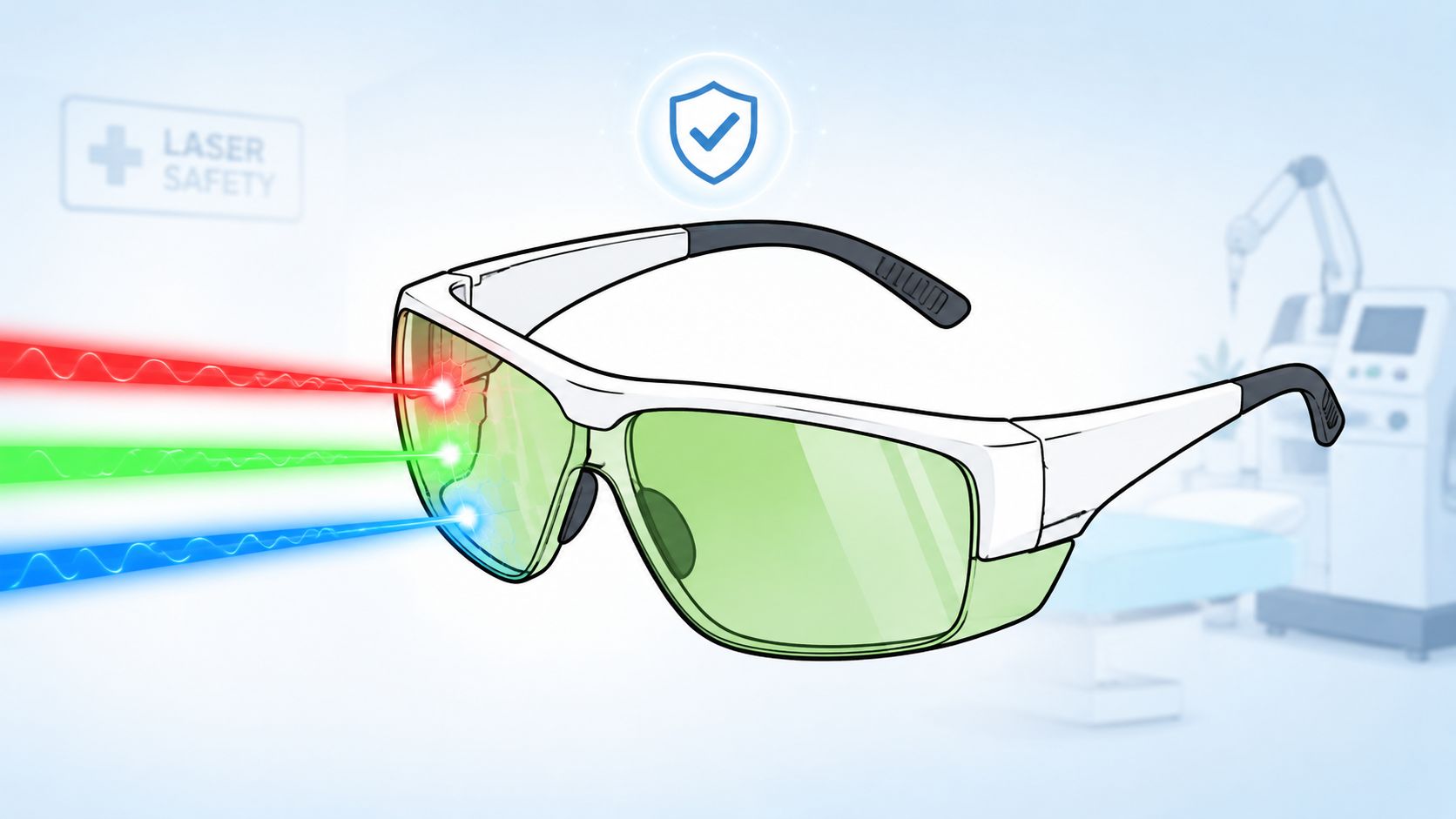
A treatment room can be fully prepared, the device serviced, and the practitioner trained, yet one unsafe decision can undermine the whole system. A pair of tinted workshop glasses sits beside the console, a patient is already in position, and the correct laser goggles are in another room. Reaching for the nearest pair may feel harmless. With aesthetic lasers, it can expose the eyes to a hazard that ordinary protective eyewear was never designed to control.
Protection glasses for eyes must be selected for the device's wavelength, output and exposure conditions. In South Africa, that selection also sits within a formal safety framework involving occupational rules, SANS standards and SAHPRA guidance. The practical question isn't whether a pair looks protective. It's whether the eyewear has been tested and marked for the radiation that can reach the eye.
Índice
- Why Generic Safety Glasses Fail in Laser Clinics
- Understanding Wavelengths and Optical Density
- South African Compliance Standards Explained
- Operator Eyewear Versus Patient Eye Protection
- How to Choose and Verify Protection Glasses
- Cleaning and Maintenance Routines
- Documentation and Compliance Records
Why Generic Safety Glasses Fail in Laser Clinics
A patient is ready, the device is powered, and the correct goggles are in another room. At the treatment station, clear safety spectacles are within reach. A darker pair sits on the trolley. Choosing either one may feel practical, but neither is suitable unless its markings match the laser hazard.
Impact-resistant spectacles and tinted workshop glasses aren't automatically laser protection. A lens may resist fragments or reduce visible glare while transmitting a hazardous laser wavelength with little reduction. Colour provides no reliable indication of protection.
Laser radiation cannot be assessed by brightness alone. The filter must absorb or attenuate the specific wavelength sufficiently and remain intact for the expected exposure. The eye can focus incoming radiation onto a small retinal area, concentrating energy and potentially causing permanent injury. A lens that looks dark may still provide inadequate protection for the device in use.

Why reflection matters
A direct stare is not required for an eye injury. Glossy instruments, jewellery, polished surfaces and poorly positioned accessories can produce hazardous reflections. Clinic owners should configure the room for those foreseeable paths, not only for the intended beam.
SAHPRA's safe-use guidance requires laser protective eyewear to withstand direct or diffusely scattered beams. The filter's damage threshold must be assessed against a specified exposure time, benchmarked at 10 seconds. This requirement affects purchasing decisions. Generic safety glasses may assist with mechanical hazards, dust or splashes, but they do not demonstrate laser resistance or coverage across every wavelength used in a multi-device clinic.
Regra prática: If the product documentation does not identify the protected wavelength, optical density and applicable laser standard, keep the eyewear out of the treatment room.
One pair rarely covers every device safely. A clinic using different laser platforms may need dedicated eyewear for separate wavelength groups, with clearly labelled pairs kept beside the relevant equipment. Staff should be able to identify the correct protection before treatment begins, rather than relying on lens colour or availability.
South African occupational rules also place eye protection within workplace hazard control. The General Safety Regulations require employers to provide suitable goggles, spectacles, face shields, welding shields, visors and related equipment whenever needed to prevent bodily injury. They also require eyewash facilities where workers may face biological or chemical eye hazards, as set out in the South African General Safety Regulations. For a laser clinic, eyewear is one control within the wider safety system, alongside room design, access control and operating procedures. It is not a decorative accessory or a substitute for those controls.
Understanding Wavelengths and Optical Density
A laser filter is more like a radio tuned to selected frequencies than a pair of sunglasses. A radio designed to receive one band doesn't automatically handle another. In the same way, goggles designed around a 755 nm alexandrite wavelength shouldn't be assumed to protect against a 1064 nm Nd:YAG wavelength, even though both technologies can be used for hair removal.
Two specifications deserve immediate attention:
- Wavelength coverage, which identifies the radiation the filter is designed to attenuate.
- Optical density, or OD, which describes how much the filter reduces transmission at that wavelength.
Optical density is logarithmic. OD 5 reduces beam intensity by a factor of 100,000, rather than by a simple fivefold amount. That distinction matters when a supplier presents a large OD figure without showing where it applies. The rating may be strong at one wavelength and unsuitable elsewhere.
Read the label as a matching exercise
Start with the treatment device, not the colour of the glasses. Record each platform's emitted wavelength or wavelength range, then compare it with the eyewear marking and certificate. A multi-wavelength device may require protection that covers several bands, while separate platforms may be better served by dedicated pairs.
The minimum OD also depends on the device's maximum output, beam characteristics and exposure conditions. A manufacturer or laser safety professional should confirm the required rating. Don't treat a table like a substitute for the device manual or a formal risk assessment.
| Tipo de laser | Wavelength (nm) | Typical Minimum OD | Common Treatments |
|---|---|---|---|
| Alexandrite | 755 | Específico do dispositivo | Hair removal and pigmentation work |
| Díodo | Específico do dispositivo | Específico do dispositivo | Depilação |
| Nd:YAG | 1064 | Específico do dispositivo | Hair removal and vascular applications |
| CO₂ | Específico do dispositivo | Específico do dispositivo | Resurfacing and ablation |
The table is a starting point for inventory mapping, not a purchasing certificate. A clinic using an Nd:YAG platform should verify its eyewear against the exact emitted wavelength and output rather than relying on the general label “laser safety glasses”. Clinics evaluating Nd:YAG applications can also review the Nd:YAG laser treatment platform information alongside their device documentation.
Damage thresholds are not optional details
SAHPRA specifies that protective eyewear must withstand direct or diffusely scattered beams, with a filter damage threshold benchmarked at 10 seconds of exposure (SAHPRA's requirements for safe laser use). A filter that cracks, burns through or delaminates under the relevant exposure isn't suitable merely because its printed OD appears high.
For Class 4 lasers, SAHPRA positions specifically designed eye protection as an administrative requirement when engineering and procedural controls don't adequately eliminate exposure. The sequence matters. Enclosures, barriers, controlled access and correct operating procedures come first. Eyewear is the backstop, not permission to operate an uncontrolled beam path.
Selection principle: Match wavelength first, verify OD second, and confirm damage resistance before considering colour, style or price.
South African Compliance Standards Explained
A clinic can buy eyewear with a convincing label and still fail a practical inspection. General protective eyewear compliance and laser-specific protection address different risks. SANS 50166:2018 represents South Africa's adoption of European EN166 eye-protection requirements. Its value in procurement is traceability: the lens and frame should carry visible markings, while the supplier should provide independent test documentation, as outlined in this South African eyewear standards overview.
Inspect the physical product, not only the catalogue page. A CE or EN statement has limited value if the delivered eyewear lacks identification linking it to a valid certificate. European requirements may provide the technical basis, but purchasing and inspection must follow the applicable South African adoption.
Know which standard addresses which risk
SANS 50166:2018 covers general eye protection, including optical quality and mechanical performance. Laser goggles require a more specific assessment. South African-facing legislation identifies EN 207:2009 for laser goggles, including direct-hit testing. Generic impact spectacles are not designed for that exposure, as explained in this South African eye-protection legislation.
Radiation type also changes the selection. Government-referenced standards identify SANS 50170 for ultraviolet filters e SANS 50171 for infrared filters, with requirements for transmittance and intended use. A clinic running IPL and Nd:YAG equipment therefore needs an inventory tied to each hazard. In a multi-wavelength treatment room, one dark-looking pair rarely provides suitable coverage for every device.
Use the applicable South African standard as the starting point, then verify the actual marking, certificate and wavelength range. A lista de verificação de conformidade regulamentar helps organise that review before equipment or eyewear enters service. Per SAHPRA's safe-use requirements, the clinic should also be able to show that its controls and protective equipment match the laser work being performed.
What to inspect on the product
Check each pair for:
- Manufacturer identification, linking the physical eyewear to its documentation.
- Optical class, showing the claimed level of optical clarity.
- Mechanical-strength symbols, where the design requires them.
- Resistance indicators, including markings for fogging and surface damage.
- Wavelength and OD information, clear enough for staff to match the pair to a device.
South African marking requirements describe identification on both lenses and frames, including manufacturer ID, optical class, mechanical-strength symbols, and resistance indicators for fogging and surface damage. A marketing sticker without verifiable markings is not an adequate basis for issuing eyewear to staff. Remove it from service until the supplier supplies acceptable evidence.
Operator Eyewear Versus Patient Eye Protection
The operator and the patient don't occupy the same risk position. The practitioner needs to see the treatment field, assess skin response, operate controls and move safely around the room. The patient needs protection suited to the procedure and the position of the eyes, often with comfort and stable placement taking priority.
Buying one identical pair for everyone looks efficient, but it usually creates compromises. Operator eyewear that is too dark can obscure treatment endpoints and encourage staff to lift the glasses. Patient eyewear that is unnecessarily restrictive can cause discomfort, interfere with positioning or fail to suit different facial shapes.
| Operator requirements | Patient requirements |
|---|---|
| Wavelength-specific high protection | Protection matched to the procedure and exposure path |
| Clear enough vision for treatment monitoring | Secure placement during movement |
| Comfortable for extended wear | Suitable for the patient's anatomy and treatment position |
| Side coverage against scattered light | Easy hygiene control and inspection |
EN 207 certification requires direct-hit testing for laser goggles, while visibility and protection trade off against each other. Clinics therefore need to balance operator needs and patient comfort with measurable, wavelength-specific protection (South African eye-protection compliance guidance).
The multi-wavelength complication
A clinic may use diode, alexandrite, Nd:YAG and CO2 technologies in the same treatment area. A four-wavelength hair-removal system can create a similar issue within one platform, because the required protection must account for the active treatment mode.
Broadband eyewear can be useful when its documentation demonstrates adequate protection across the relevant range. It can also create a visibility compromise if the filter is heavily attenuating across multiple wavelengths. Separate, clearly labelled pairs may be safer operationally when staff switch between devices frequently.
A simple inventory audit should ask:
- Which devices are used in each room?
- Which wavelengths can reach staff or patients?
- Is the pair assigned to the operator, the patient or both?
- Can staff identify the correct pair without relying on colour?
- Does the documentation cover every treatment mode?
Patients may also ask about everyday visual comfort, which is separate from laser safety. For general guidance on ways to protect eyes from screens, provide an ordinary eye-care resource, but never present screen eyewear as a substitute for laser protection.
How to Choose and Verify Protection Glasses
A product listing is not a compliance file. Before approving protection glasses for eyes, verify the physical pair, the supplier's documentation, and its suitability for every device that may be used in the room. In a multi-wavelength clinic, one pair rarely provides the correct coverage for every treatment mode.
Start with the certificate
Request the manufacturer's EN test certificate. It should identify the product model, applicable standard, wavelength range, optical density and test conditions. The certificate must relate to the supplied eyewear, not only to a similar product family.
Compare those details with the pair in hand. Differences in model numbers, lens markings or filter specifications require clarification before purchase or issue.
Use a physical inspection checklist
South African marking requirements set out identifying information for compliant safety eyewear on both lenses and frames. Check for the manufacturer ID, optical class, mechanical-strength symbol, and resistance indicators for fogging and surface damage.
Before issuing a pair:
- Confirm lens and frame markings: Identification should be visible and consistent.
- Match the wavelength: Compare the marked range with each device specification, never with lens colour.
- Verify OD coverage: Confirm that the rating applies across the wavelengths and treatment modes used in the clinic.
- Assess the fit: Check for gaps, pressure points and movement when the wearer turns or leans.
- Check side protection: Wraparound coverage or suitable side shielding can limit exposure from scattered light.
- Confirm supplier credentials: Use an authorised distribution route where possible and retain the purchase trail.
Prescription spectacles can create gaps or pressure points. Over-glasses designs, prescription inserts or a suitable frame shape may solve the problem, but coverage must remain intact. A practitioner who repeatedly removes uncomfortable goggles creates an operational failure, even when the certificate is technically valid.
Separate, clearly labelled pairs may be safer when staff move between diode, alexandrite, Nd:YAG and CO2 devices. Broadband eyewear is acceptable only when its documentation covers the relevant range and the filter does not obstruct safe viewing. Staff should identify the correct pair from markings and room procedures, not colour alone.
Darkness does not prove quality. The same distinction applies outside clinical work, where consumers compare polarized sunglasses for eye health without separating glare reduction from wavelength-specific protection. Polarisation or tint may improve comfort, but neither proves laser attenuation.
Cleaning and Maintenance Routines
Laser goggles are precision optical equipment. Treating them like disposable workshop PPE can damage the filter, obscure vision or hide defects that should trigger retirement.
At the end of each treatment day, remove visible debris with a clean, soft lens cloth. Follow the manufacturer's cleaning instructions and use only a compatible lens solution. Don't reach for abrasive household cleaners, solvents or rough paper products, because they can mark surfaces or affect coatings.
A routine that staff can follow
Daily care should be simple enough to happen consistently:
- Inspect before use: Look for cracks, deep scratches, clouding, peeling, bubbles or colour changes.
- Clean correctly: Use the specified solution and a suitable lint-free cloth.
- Check the frame: Examine hinges, straps, side shields and nose supports for looseness.
- Return the pair to its case: Avoid placing lenses face down on a trolley or console.
- Record defects immediately: Remove questionable eyewear from service rather than leaving it available.
A weekly review can be more deliberate. Hold each lens under good ambient light and inspect it from different angles. Look for micro-scratches that interfere with viewing treatment endpoints, coating delamination and areas where the filter appears uneven. Test the fit on the people who use the pair, since a frame that suits one operator may leave another person's eyes or temples inadequately covered.
Maintenance warning: A scratched or delaminating filter isn't “nearly good enough”. Quarantine it until the manufacturer confirms whether it remains suitable.
Control the storage environment
Store eyewear away from direct sunlight, heat, chemicals and the immediate vicinity of active laser equipment. Keep each pair labelled with its wavelength and intended user group. Separate operator and patient eyewear so staff don't select the wrong category during a busy appointment.
Maintain an inspection log with the pair's identifier, date checked, person responsible, observed condition and action taken. Replace eyewear when the manufacturer's instructions require it, when damage affects the lens or frame, or when the clinic can no longer verify the product's markings and documentation. Maintenance costs are easier to manage than an emergency created by untracked, deteriorating equipment.
Documentation and Compliance Records
A clinic may own suitable eyewear and still struggle during an inspection if it cannot show how each item was selected, issued and maintained. Keep records that connect every pair with a specific hazard, device, user group and training process.
South Africa's General Safety Regulations place eye protection within the employer's workplace safety duties. Suitable goggles, spectacles and related equipment must be provided where needed to prevent bodily injury, with selection linked to hazard control and worker training, per the General Safety Regulations.
Build one usable compliance file
Keep the following records together:
- Device register: List every laser or energy-based platform, its treatment modes and emitted wavelengths.
- Eyewear register: Assign an identifier to each operator pair, patient pair and shield.
- Certificate pack: Store purchase documents, manufacturer certificates and applicable standard information.
- Wavelength mapping: Show which eyewear is approved for each device and operating mode.
- Training sign-offs: Record that staff were trained to select, wear, inspect and store the correct protection.
- Inspection logs: Document routine checks, defects, quarantine decisions and replacements.
- Incident records: Record suspected exposure, damaged eyewear or procedural deviations, together with corrective action.
SAHPRA's hierarchy of controls should guide the file. Engineering controls and operating procedures reduce exposure first. Purpose-designed eyewear addresses the remaining risk when those controls cannot remove it. Document the clinic's consideration of room access, barriers, beam paths, reflections, warning controls and procedures before relying on PPE.
O record-keeping resources can help structure a repeatable administrative process. The register still needs to reflect the devices, wavelengths and eyewear present in the clinic.
Audit after every equipment change
Run an audit whenever a device is added, removed, upgraded or moved to another room. In a multi-wavelength treatment room, one pair rarely covers every device. Eyewear suitable for one platform may provide inadequate protection for another, while outdated habits can lead staff to select the wrong pair.
During each audit, locate every pair, read its markings, compare them with the certificate and check its physical condition. Confirm that staff can identify the correct eyewear without guesswork. Government guidance on eye-protection markings also makes traceable identification important. If a pair has no supporting documentation, remove it from service until the supplier provides evidence.
Omega Lasers supplies laser protection goggles manufactured to EN207 standards for the wavelengths used with its equipment. Its set packages include two pairs of laser protection goggles within the package price. Visit Lasers Omega to discuss equipment, training and eyewear documentation for a safer, better-organised treatment environment.