




A client arrives for laser hair removal expecting smooth skin after one appointment. She has taken time off work, paid a deposit, and assumed the treatment will start immediately because that's what the receptionist implied. Instead, the clinic is running behind, a different practitioner is treating her, the appointment takes longer than promised, and nobody explains when to expect a response if she has questions afterwards. Even if the device performs exactly as intended, the client may leave feeling that the clinic failed.
That complaint rarely starts in the treatment room. It begins with an unclear booking promise, an optimistic timeline, an inconsistent handover, or a follow-up process that exists only in someone's memory. Managing client expectations in an aesthetic laser clinic is an operational discipline, not merely a consultation technique.
Índice
- Why Client Complaints Start Before the Treatment Begins
- Building a Consultation Framework That Prevents Mismatches
- Communicating Risks and Consent in the South African Context
- Managing Operational Expectations During the Visit
- Designing a Follow-Up System That Sustains Trust
- Training Your Team to Embed Expectation Management Daily
- Turning Expectation Management into Revenue Protection
Why Client Complaints Start Before the Treatment Begins
A client's expectations form from every interaction with your clinic. The booking confirmation creates one expectation, the receptionist creates another, the consultation adds more detail, and the treatment-room experience either confirms or contradicts the promise. When those touchpoints don't agree, the client experiences the gap as poor service, even when the clinical treatment itself is appropriate.
Consider a common South African clinic scenario. A prospective client asks how long a treatment will take and receives a casual estimate. The booking team schedules appointments too close together, leaving no allowance for assessment, preparation, cleaning, documentation, or questions. By the afternoon, the clinic is late. The client waits without an update, then discovers that the practitioner she expected is unavailable. Nothing dramatic has happened, but the clinic has broken several small promises before treatment begins.
The hidden promises in your booking flow
Your booking process communicates more than a date and time. It tells clients:
- How promptly you respond: A fast reply can create an expectation of fast support throughout the journey.
- How long the visit will take: An appointment duration becomes a practical promise, especially when the client has arranged transport, work, childcare, or other commitments.
- Who will provide the service: If the client was told to expect a particular practitioner, a substitution requires transparent communication.
- What the price includes: Deposits, package terms, preparation requirements, and possible additional services should be clear before arrival.
- What happens next: Clients want to know whether the clinic will contact them, when they can ask questions, and how concerns will be handled.
A South African study of hair salons and spas found that owners can shape customer perception through skilled staff, effective time management, and appropriate servicescape standards, all of which help the business deliver the service it promised. The implication for aesthetic clinics is direct: complaints often reflect a mismatch between the promised experience and the delivered experience, rather than a failure of the treatment alone. Read the South African study on service delivery in hair salons and spas.
Why polished scripts still fail
A well-written consultation script cannot compensate for a clinic that routinely runs late or gives clients conflicting information. If one practitioner describes gradual improvement while another implies a dramatic result, the client will usually remember the more optimistic version. If the front desk promises a same-day reply but the clinical team checks messages irregularly, the clinic has created a service failure through its own wording.
Regra prática: Every promise made during marketing, booking, consultation, treatment, and aftercare must be deliverable by a named person through a documented process.
Audit the client journey as a mystery shopper would. Record the response time, the wording used, the appointment duration, the arrival instructions, the handover between staff, and the follow-up commitment. Then compare those promises with what your clinic can consistently deliver. Your patient satisfaction process should address the full journey, not only the consultation conversation.
Building a Consultation Framework That Prevents Mismatches
A consultation should leave the client with a clear understanding of what the treatment can reasonably achieve, what may influence the outcome, when progress may become visible, and how the clinic will support them. It shouldn't function as a sales performance. The strongest consultation protects the relationship by making the boundaries visible before payment or treatment.
A South African client-relations study found that clients expected frequent interaction, feedback, regular follow-ups, easy access to consultants, and clear guidance about what could realistically be delivered. The study also identified expectation management around deliverability as a positive condition for sustaining the relationship. Review the South African client-relations findings.
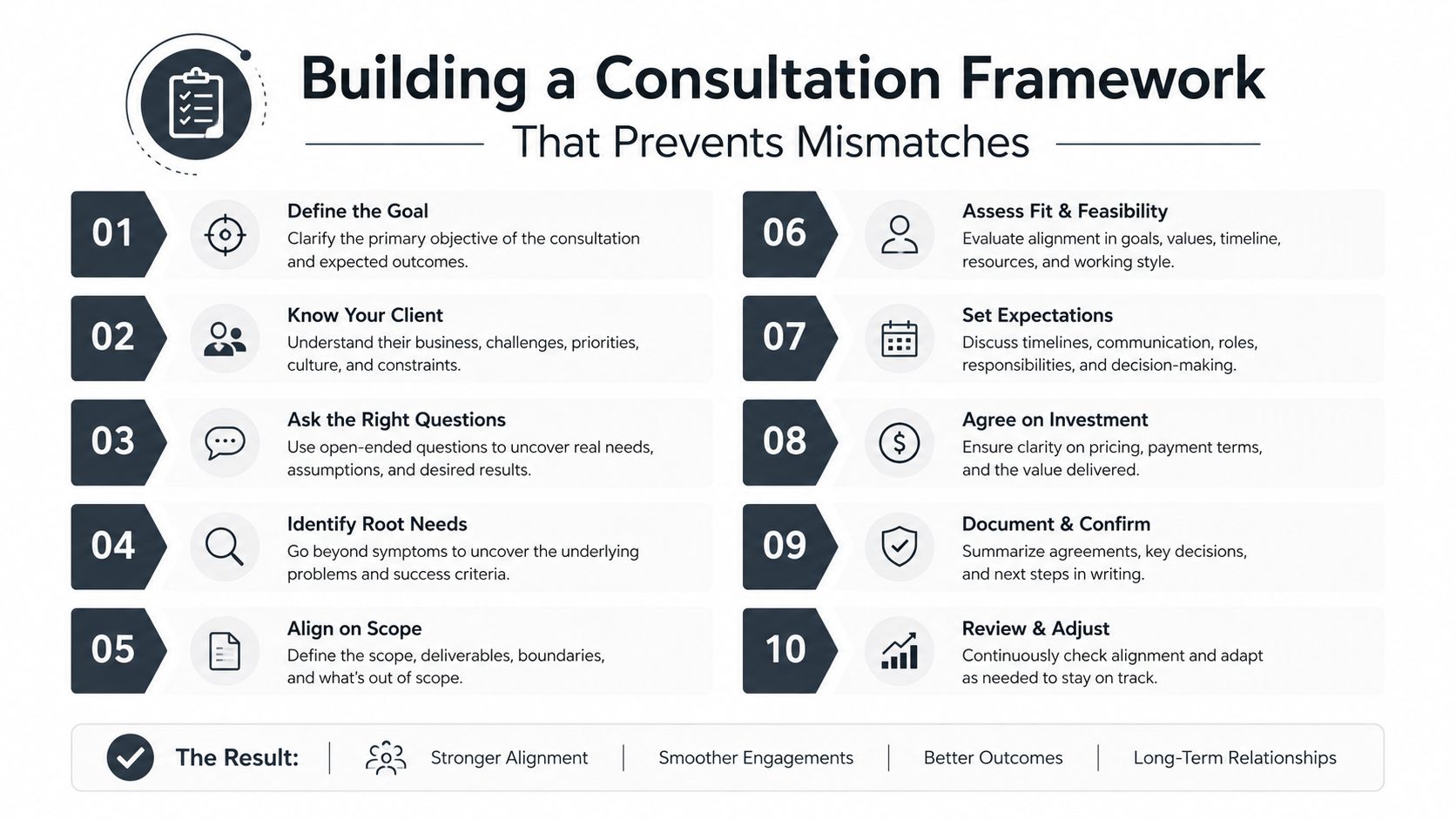
A practical consultation sequence
Clarify the client's desired outcome. Ask what the client wants to change, how they'll judge progress, and whether the concern is cosmetic, functional, or both. “I want smooth skin” may mean reduced daily shaving, fewer ingrown hairs, or complete hair removal. Those are different expectations.
Assess suitability and relevant history. Document skin characteristics, hair characteristics, previous treatments, medication considerations, tanning or pigment concerns, and any contraindications within your clinical scope. Don't promise a result before the practitioner has assessed the person.
Explain the treatment mechanism in plain language. Clients don't need a technical lecture, but they do need to understand why results develop progressively and why treatment response can vary.
Set an outcome boundary. Replace absolute language such as “permanent removal” or “no downtime” with a precise explanation of the intended result, possible variability, maintenance needs, and what the clinic can and cannot guarantee.
Separate the treatment timeline from the appointment timeline. Tell the client how long the visit is expected to take, then explain when changes may become noticeable and why assessment may require more than one appointment.
Explain preparation and aftercare. Give written instructions covering what the client should do before arrival, what to avoid afterwards, and which symptoms require contact with the clinic.
Confirm cost and scope. State what the quoted fee includes, which areas are covered, whether review appointments are included, and what happens if the client needs additional clinical assessment.
Define communication availability. Don't say “contact us anytime” unless the clinic can support that promise. State the approved contact channel, expected response window, and out-of-hours process.
Check understanding. Ask the client to explain the plan back in their own words. This reveals assumptions that a simple “Do you understand?” often misses.
Provide written confirmation. Send the agreed treatment, expected timeline, risks, aftercare, costs, and next appointment details through a controlled record. A central sistema de gestão de doentes can help staff work from the same information.
Scripts that protect trust
For laser hair removal, a useful explanation might be: “The aim is progressive reduction, not an instant change after one visit. Your response will be assessed over the treatment course, and we'll review the plan if your progress differs from what we expect.”
For a multi-modality facial treatment, say: “We're combining approaches to address more than one concern. We'll prioritise skin safety and response, so the sequence or intensity may change if your skin shows that it needs a slower approach.”
The important detail is not the exact wording. It's the alignment between the promise and your clinic's capacity to deliver the stated timeline, follow-up, and escalation process.
Communicating Risks and Consent in the South African Context
Consent is not a signature collected at the reception desk. It's a clinical communication process that helps the client make an informed decision and gives the practitioner a documented record of what was discussed.
South African law requires health-care providers to explain a patient's health status, available diagnostic and treatment options, the benefits, risks, costs, and consequences of each option, as well as the patient's right to refuse treatment. Read the South African legal discussion of patient information and consent. For aesthetic laser services, that means consent should address more than the desired cosmetic outcome.
What the client should understand
Before proceeding, the practitioner should explain:
- The intended benefit: What the treatment is designed to improve.
- The likely course: How progress will be assessed and why results may vary.
- The relevant risks: Including common and clinically significant adverse events.
- Alternatives: Other suitable options, including choosing not to proceed where appropriate.
- Costs and consequences: The financial commitment, expected aftercare, possible downtime, and implications of postponing or stopping treatment.
- The right to refuse: The client can decline treatment or ask for more information before proceeding.
A review of light-assisted hair removal complications identifies reported adverse events including burns, blisters, dyschromia, scarring, pain, folliculitis, paradoxical hypertrichosis, and pigmentary changes. Review the documented complications of light-assisted hair removal. The presence of risk doesn't mean a treatment is inappropriate. It means the practitioner must assess, explain, document, and respond appropriately.
Common Laser Treatment Adverse Events
| Adverse Event | Descrição | Duração típica |
|---|---|---|
| Redness or erythema | Visible reddening or warmth in the treated area | Explain the expected course for the specific treatment and client |
| Pain or tenderness | Discomfort during or after energy delivery | Discuss expected intensity, cooling, and when persistent pain requires contact |
| Folliculitis | Inflammation around hair follicles | Explain possible delayed changes and the clinic's advice process |
| Burns or blisters | A more significant skin reaction requiring prompt assessment | Tell the client to contact the clinic promptly rather than self-treating |
| Dyschromia or pigmentary change | Darkening or lightening of the skin | Explain that pigment changes can be visible and may need clinical review |
| Cicatrizes | A potentially persistent change in skin texture | Discuss risk factors, prevention, and escalation procedures |
| Paradoxical hypertrichosis | Unexpected increased hair growth in a treated area | Explain that an unexpected response needs assessment and plan review |
The “typical duration” column should never become a universal promise. Duration depends on the treatment, settings, area, skin response, aftercare, and clinical assessment. Your consent form should use treatment-specific language rather than vague reassurance.
Consent should make uncertainty visible. A client who understands what may happen can evaluate a gradual or unexpected response more fairly than a client who was promised a flawless result.
Document the assessment, information provided, questions asked, alternatives discussed, and the client's decision. If your team needs guidance on protecting the practice while maintaining a fair process, review the role of professional indemnity for aesthetic practitioners.
Managing Operational Expectations During the Visit
A clinic can lose trust in the first ten minutes of a visit. The client arrives, waits without explanation, repeats their details, and eventually learns that the appointment will take longer than planned. Staff may consider the delay minor. The client experiences uncertainty, inconvenience, and a lack of control.
South African customer-experience research reported that speed of resolution was the top satisfaction driver for 37% of respondents. The same survey reported frustration with agents lacking knowledge among 79%, multiple transfers among 89%, and repeating information among 64% of local respondents. Review the 2022 State of CX in South Africa findings. Although the research covers service interactions broadly, the operational lesson applies directly to clinics: speed matters, but informed ownership matters too.
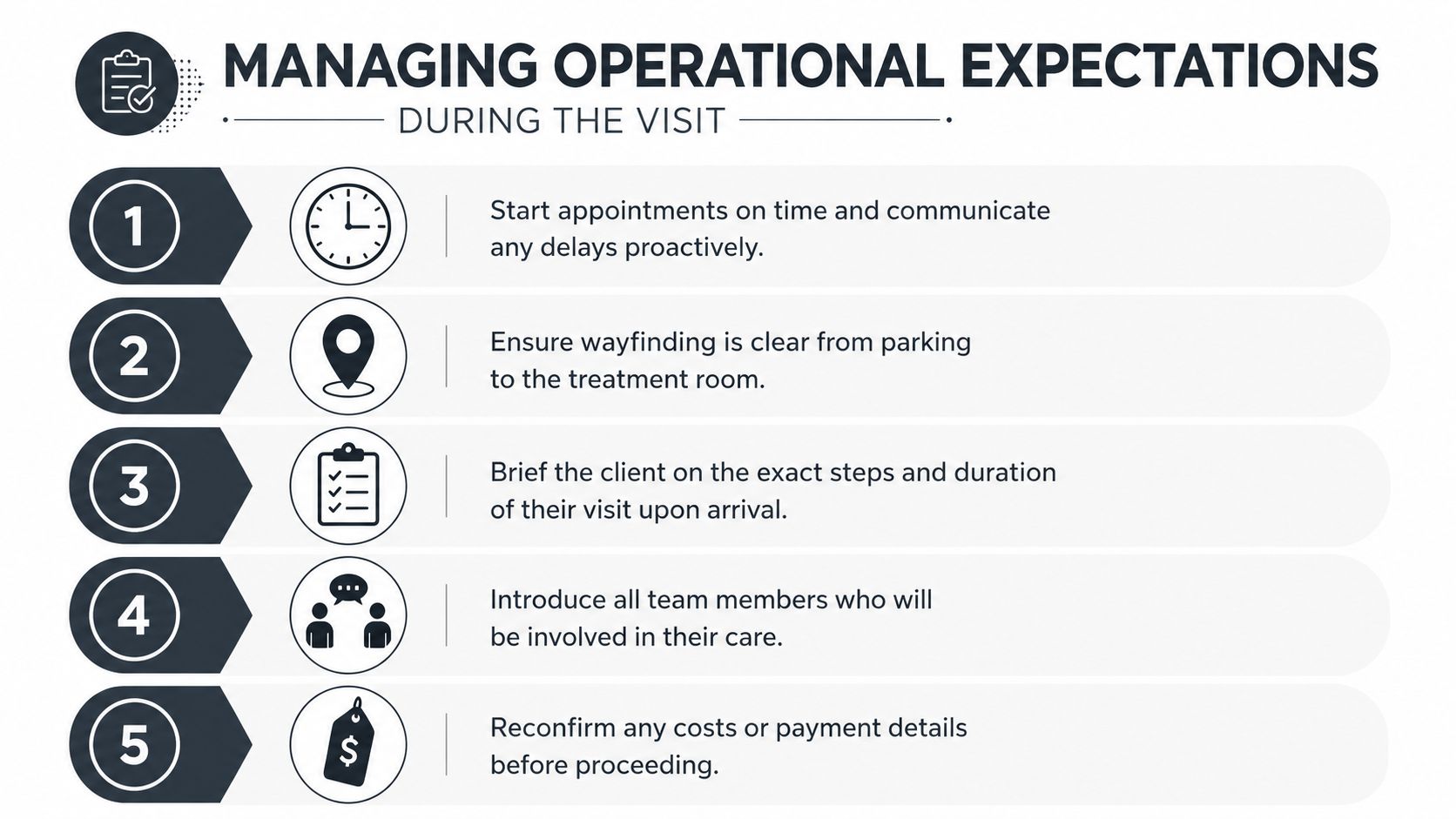
Make the visit predictable
At arrival, assign one staff member to own the client's experience. That person should confirm the appointment, explain the next steps, check whether anything has changed since the consultation, and give an honest estimate of the waiting time.
If the clinic falls behind, don't hide the delay. Say: “Your practitioner is completing the previous client's assessment, and we expect to start in approximately 20 minutes. You're welcome to continue waiting, reschedule, or speak with the practitioner before deciding.” The client may still be inconvenienced, but they can make an informed choice.
Protect consistency across practitioners
A less experienced practitioner should never be introduced as equivalent without context. If a colleague is covering, explain the change and confirm that the practitioner is appropriately trained and authorised within the clinic's process. If the client expected someone else, obtain consent for the change rather than treating it as an administrative detail.
Use room-level checklists for preparation, treatment steps, photography, parameters where clinically appropriate, aftercare, and record completion. Standardisation shouldn't remove professional judgement. It should prevent avoidable omissions when the clinic is busy.
Handle time overruns early
When a treatment will take longer, update the client before the original estimate expires. “The assessment has shown that we need additional preparation, so today's visit will take longer than the booking estimate. I'll explain why before we continue” is more trustworthy than allowing the client to discover the delay by watching the clock.
The same principle applies to costs. Reconfirm any charge, package condition, or change in scope before proceeding. A client should never learn about a financial consequence after the clinical decision has already been made.
Designing a Follow-Up System That Sustains Trust
Follow-up is where many clinics reveal whether their promises were genuine. A client may tolerate gradual results or mild discomfort when the clinic explains what's happening and responds within a clear window. Silence turns uncertainty into suspicion.
A follow-up system needs three parts: a predictable communication cadence, a named owner, and an escalation route. The cadence should match the treatment and the client's risk profile. It shouldn't be identical for every service.
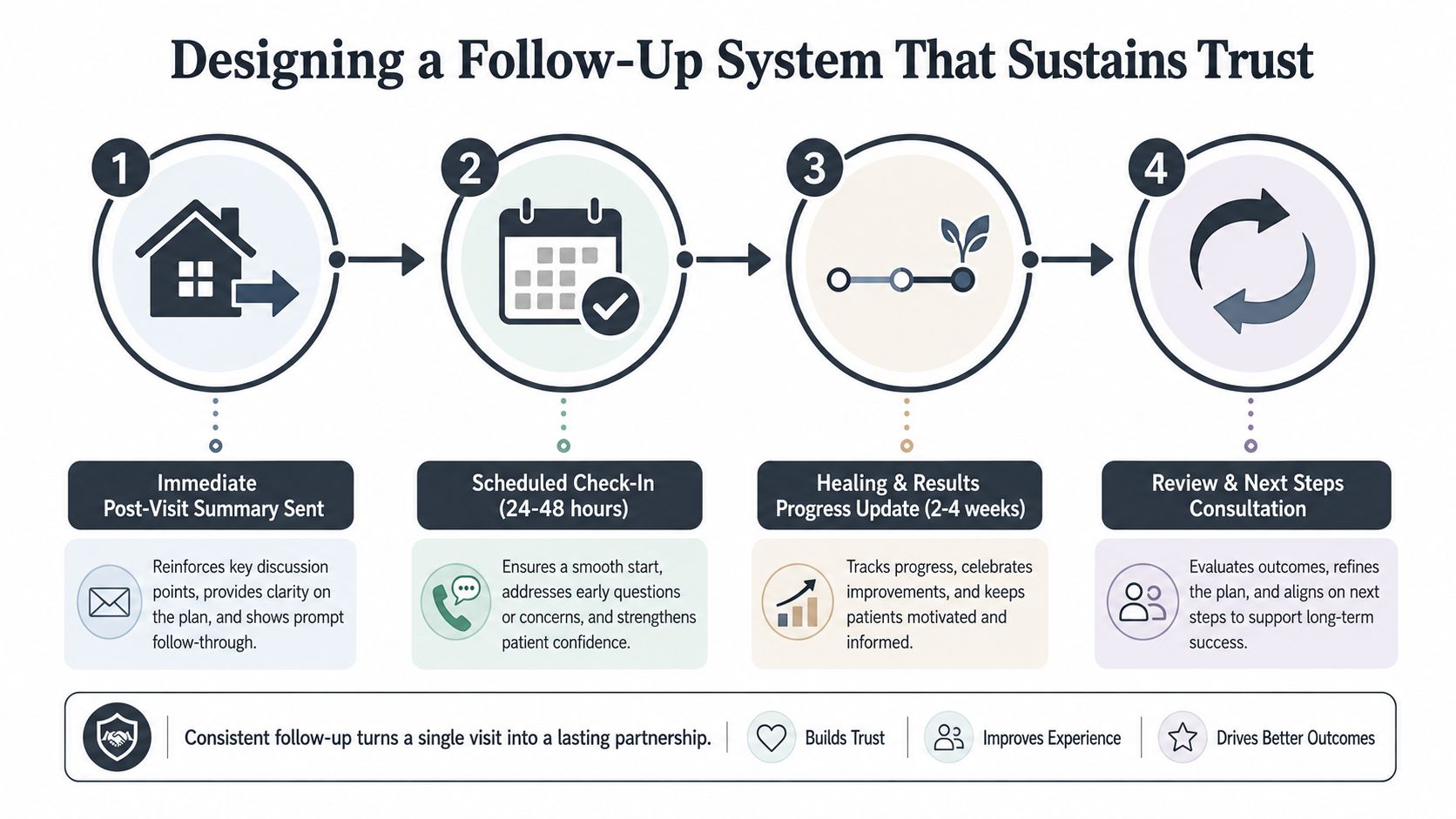
Set response windows you can keep
A 2024 South African Customer Experience Report found that 36% of consumers expect a same-day response, 15% expect resolution within 48 hours, and only 3% are willing to wait a full week. It also found that 45% expect immediate or near-immediate support. Read the 2024 South African Customer Experience Report.pdf). These figures don't mean every clinical concern can be resolved immediately. They show why your response promise must be explicit.
Separate acknowledgement from resolution. Your clinic may be able to confirm receipt quickly, then arrange practitioner review when the necessary information is available. A message such as “We've received your concern and a practitioner will review it within the stated response window” is more responsible than promising an instant diagnosis.
Use a written cadence
Send an immediate post-visit summary with the treatment completed, aftercare, warning signs, contact route, and next planned step. Then schedule a check-in appropriate to the treatment. Ask specific questions rather than sending “How are you?” alone:
- Is the treated area more painful than expected?
- Have you noticed blistering, marked pigment change, or another concerning reaction?
- Are you following the aftercare instructions?
- What questions have appeared since the appointment?
If the client reports an unexpected reaction, route the concern to the practitioner responsible for clinical review. Don't let front-desk staff improvise medical reassurance.
Resolve complaints without overpromising
A complaint needs acknowledgement, investigation, and a documented decision. Avoid automatic promises of a free retreatment or refund before the practitioner understands what happened. A touch-up may be clinically appropriate in one situation and unsuitable in another.
A fair resolution starts by separating the client's experience from the clinical finding. Validate the frustration first, then investigate the treatment record, consent, timing, aftercare, and outcome.
Close the loop in writing. Explain what the clinic found, what it recommends, who owns the next action, and when the client should expect the next update.
Training Your Team to Embed Expectation Management Daily
Expectation management becomes reliable only when the whole team can deliver the same message under pressure. Reception staff, therapists, practitioners, managers, and owners all influence the client's interpretation of the service.
A South African review of laser hair removal reports that there is no legislation governing who may perform laser treatments or what qualifications are required, and that informal supplier training may last only 2 a 4 dias. Read the South African review of laser hair-removal regulation and training. This makes internal competency standards especially important. Clients may assume that every operator has comparable training, even when the market can include significant variation.
Train for decisions, not memorised lines
Run role-play sessions around real clinic situations:
- The unrealistic outcome: The client demands a guaranteed result by a specific date. The practitioner explains what can be assessed, what may vary, and what the clinic won't guarantee.
- The unexpected reaction: The client sends a distressed message after treatment. The team member acknowledges the concern, asks the approved questions, and escalates without diagnosing outside their scope.
- The delayed appointment: The front desk communicates the delay, offers options, and records the client's decision.
- The practitioner change: The clinic explains who will provide care and confirms the client is comfortable proceeding.
- The package question: The staff member explains what is included and refers uncertain details to the responsible manager.
Build a daily control system
Give reception staff a short reference guide containing approved response windows, escalation contacts, preparation requirements, cost explanations, and phrases that must be avoided. Review one client journey during team huddles and ask where the clinic made a promise, who owned it, and whether the promise was fulfilled.
New practitioners should shadow consultations and follow-up calls before managing complex expectation conversations alone. Managers should audit records for consistency, not merely for completeness. If one practitioner documents outcomes carefully and another uses vague phrases, clients will receive different standards from the same clinic.
Omega Lasers provides training that includes consultation techniques, assessing client needs, managing expectations, and building trust. That kind of education is most useful when the clinic incorporates it into supervised practice, scripts, audits, and ongoing feedback rather than treating training as a once-off event.
Turning Expectation Management into Revenue Protection
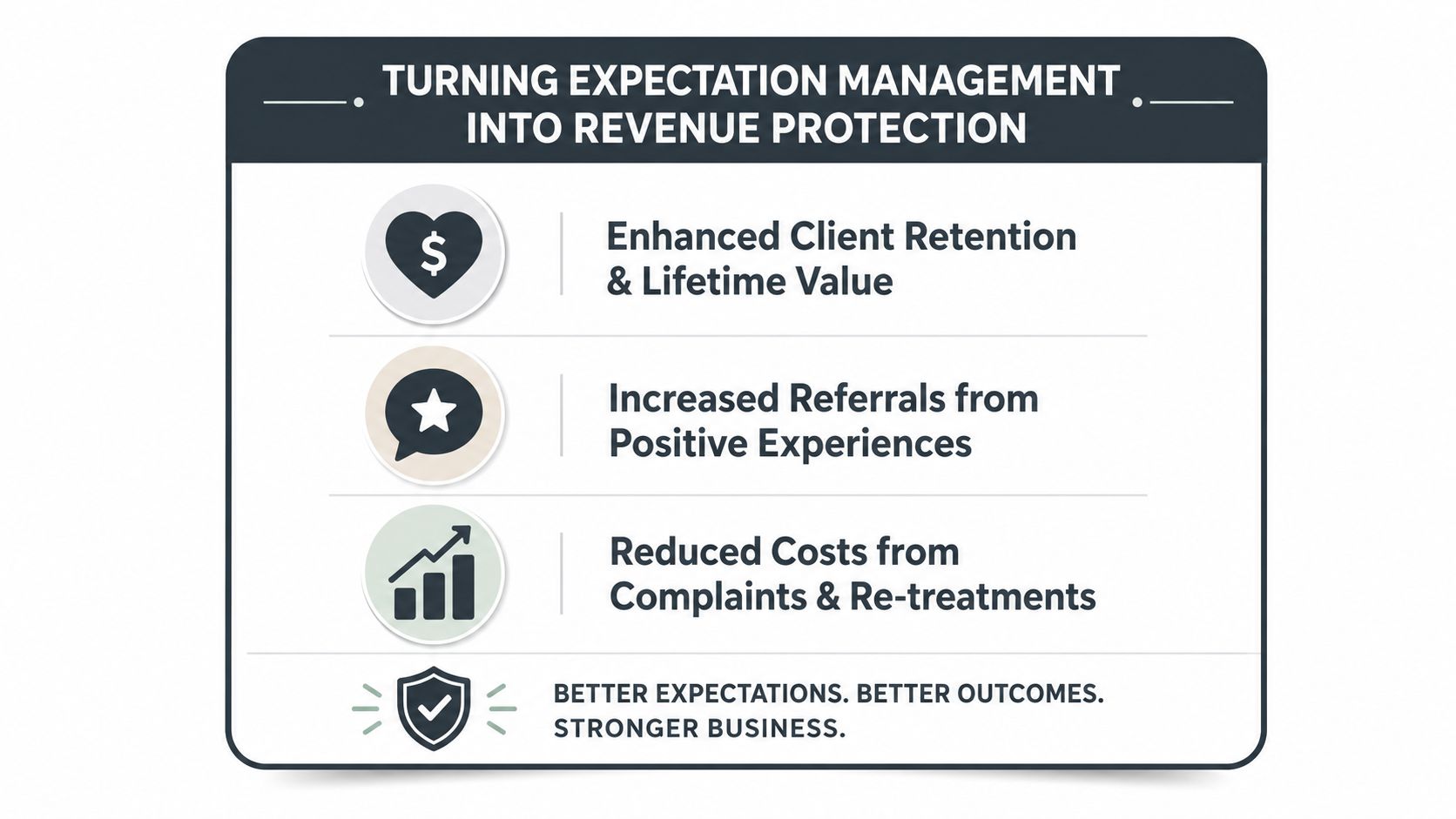
A clinic that manages expectations consistently protects more than its reputation. It protects appointment capacity, package continuity, practitioner time, and the cost of resolving avoidable complaints. A client who understands the treatment course is more likely to evaluate progress realistically, attend planned reviews, and raise concerns early enough for the clinic to respond constructively.
The opposite pattern is expensive. Overpromising creates pressure for unnecessary concessions. Poor booking flow produces cancellations and rescheduling work. Inconsistent practitioner communication creates repeat explanations, disputed outcomes, and manager involvement. Those costs may not appear under a single line item, but they consume the capacity that should support clinical delivery.
Track the signals that reveal expectation gaps
Measure the process, not just the final complaint count. Useful operational indicators include:
- Booking accuracy: Compare the promised appointment duration with the actual time required.
- Delay communication: Record whether clients receive an update before the scheduled start time passes.
- Handover quality: Check whether the client repeats their history or treatment plan after moving between staff members.
- Follow-up completion: Review whether the promised message or check-in was sent by the assigned owner.
- Escalation consistency: Confirm that clinical concerns reach the appropriate practitioner without informal reassurance.
- Expectation-related complaints: Categorise complaints by timing, cost, outcome, staff communication, and aftercare.
A thirty-day audit can start with a small sample of recent bookings, consultations, treatment records, and follow-up messages. Look for repeated wording such as “I was told,” “nobody explained,” “I thought,” or “I'm still waiting.” Those phrases identify the point where the clinic's promise became unclear.
Turn the audit into action
Fix the earliest recurring mismatch first. If delays are common, change booking capacity and communication ownership before rewriting the consultation script. If clients misunderstand results, improve written outcome boundaries and practitioner training before offering more promotions.
Revenue protection starts before the sale. A clear promise that the clinic can fulfil is worth more than an optimistic promise that creates a difficult complaint later.
Use the audit to assign one owner to each improvement, define the new process, and review whether staff follow it consistently. Managing client expectations becomes commercially valuable when it reduces uncertainty without adding disorder to the team's workload.
Omega Lasers supports aesthetic practices with advanced laser and multi-technology platforms, practitioner training, technical support, marketing assistance, and business-development guidance. To strengthen your clinic's consultation, treatment, and follow-up systems alongside suitable technology, visit Omega Lasers and speak with the team about building a more consistent client experience.