




You're probably seeing the same pattern many clinic owners see right now. Clients want results, but they don't want downtime, aggressive recovery, or another treatment that feels too medical for a salon environment and too “soft” for a results-driven clinic. At the same time, you can't justify floor space, training time, and capital spend on a modality that only does one thing.
É aí que low level laser therapy earns attention. Used properly, it isn't just a niche add-on. It can sit between facials and higher-intensity energy devices, support healing after procedures, open a pain-management service line, and give staff a treatment they can confidently package into courses. In the South African market, the opportunity is real, but so are the practical constraints. Device selection, SAHPRA compliance, treatment protocols, safety processes, and staff training all matter more than the sales pitch.
Índice
- The Next Step in Non-Invasive Treatments
- Unpacking Photobiomodulation How LLLT Works
- Key Clinical Applications in Aesthetics
- Summarising the Clinical Evidence
- LLLT Dosing and Sample Treatment Protocols
- Choosing a Device and Navigating Regulations
- Integrating LLLT into Your Clinic Workflow
The Next Step in Non-Invasive Treatments
A client finishes microneedling on Friday and has a work event on Monday. She wants less redness, less downtime, and a treatment plan that feels medically sensible, not sales-driven. That is the kind of gap low level laser therapy, or fotobiomodulação, can fill in a clinic.
For a South African practice, the appeal is practical. LLLT adds a non-thermal, non-invasive option that can sit around existing services rather than compete with them. It can support skin rejuvenation, post-procedure recovery, pain management, and hair-focused services, which gives the clinic more than one way to use the same capital purchase. That matters in a market where equipment budgets are tight, utilisation rates decide profitability, and every new modality needs to justify staff time.
The strongest clinics position LLLT correctly from day one. It is a support treatment with defined indications and realistic outcomes. It does not replace higher-intensity resurfacing, injectables, or other procedure-led revenue. It improves the client journey around those services and can widen your entry-level offering for patients who want lower commitment, lower discomfort, or a gentler first step.
That has clear commercial value.
Aesthetic clinics usually start looking at LLLT for three reasons:
- Recovery support after active treatments. Clients want post-treatment care that may help settle visible irritation and keep them comfortable after procedures such as peels or microneedling.
- A lower-barrier anti-ageing option. Some patients are interested in skin health but are not ready for aggressive intervention.
- Broader service overlap. Clinics with an aesthetic and wellness client base can often use the modality across cosmetic concerns and selected comfort-focused indications, depending on scope of practice and device claims.
The business case improves when the treatment is built into workflow rather than sold as a once-off add-on. In practice, that means attaching it to recovery protocols, creating prepaid courses, and training therapists to identify suitable candidates without overpromising. A device that stands idle between occasional bookings is expensive. A device used across multiple treatment pathways is easier to justify.
The South African context adds another layer. Before a clinic buys any light-based system, the owner should check the supplier's documentation, intended use, training support, and SAHPRA position. Marketing language is cheap. Compliance, usable protocols, and staff competence are what protect the business. If you are comparing categories, a useful reference point is the clinic use case for LED lamp therapy systems, especially when you need to decide whether a device fits your menu, team skill level, and pricing model.
Market interest in LLLT is clearly increasing, but demand alone is not a strategy. Profit comes from choosing a device with credible specifications, training the team properly, and placing the treatment where it improves outcomes clients can see and value.
Unpacking Photobiomodulation How LLLT Works
A clinic owner usually asks the same question before adding any light-based modality. What is the tissue response, and can the team deliver it consistently enough to justify the spend? Photobiomodulation answers that question at the cellular level. Low level laser therapy uses specific wavelengths and controlled energy delivery to trigger a biochemical response without creating an ablative or thermal injury.
The mechanism matters because many buying mistakes start at this point. If staff describe LLLT as “red light that helps healing,” they are missing the part that affects outcomes, protocol design, training, and device selection.
Why cells respond to light
The main intracellular target discussed in the literature is the mitochondrion, with cytochrome c oxidase commonly identified as one of the chromophores involved. When the delivered wavelength reaches the target tissue at an appropriate dose, cells may increase ATP production, alter reactive oxygen species signalling, and shift gene expression linked to repair and inflammation control. In clinic terms, that can support recovery, reduce inflammatory activity, and improve tissue function in the right indication.
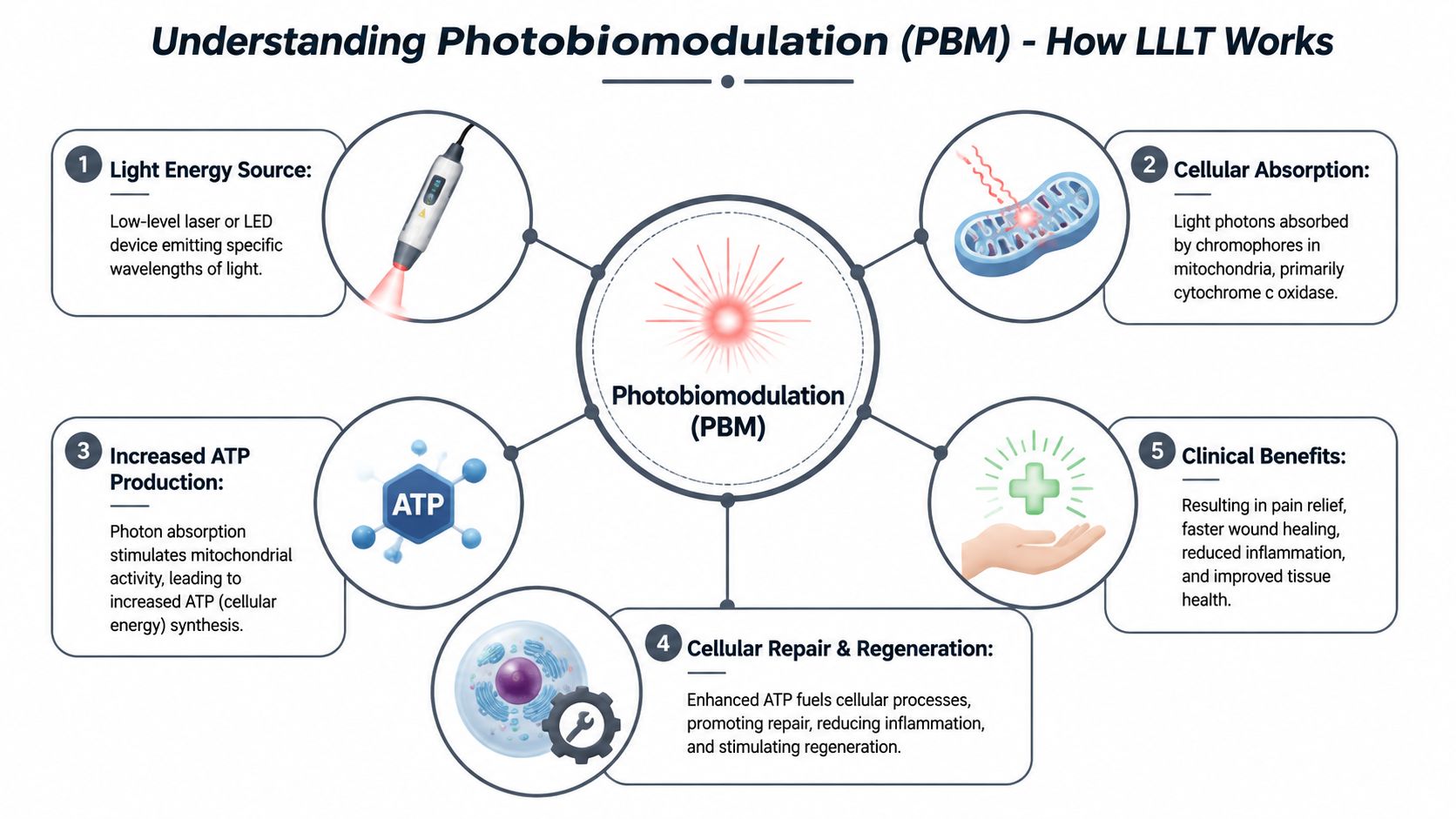
This is also why device categories should not be treated as interchangeable. A panel, lamp, or laser system may all sit under the broad “light therapy” label, but wavelength range, beam profile, irradiance, and treatment geometry change what reaches the tissue. If you are comparing modalities for clinic use, this overview of LED lamp therapy systems for aesthetic treatment settings é um ponto de referência útil.
The parameters that decide outcomes
In practice, results depend less on marketing language and more on parameter control. Three variables shape the biological effect.
- Comprimento de onda: This influences penetration depth and target selection. Red wavelengths are generally used for more superficial tissue. Near-infrared wavelengths are chosen when the target sits deeper.
- Power or irradiance: This describes how quickly energy is delivered. If irradiance is too low, the tissue may receive an ineffective stimulus. If it is too high, you can move outside the optimal dose window.
- Fluence or total dose: This is the total energy delivered over the treatment area. It is one of the main reasons protocols that look similar on a brochure can perform very differently in a treatment room.
This is where training protects both outcomes and compliance. Staff should be able to explain, in plain language, what the device is delivering, why a protocol differs for post-procedure skin versus hair support, and why longer exposure does not always mean a better result. In the South African setting, that standard also supports safer delegation and more defensible treatment records if your clinic is ever asked to justify how a device is being used relative to its intended use and supplier training.
One more concept deserves attention. Photobiomodulation follows a biphasic dose response, often linked to the Arndt-Schulz principle. A low to moderate dose may stimulate a useful response. An excessive dose can reduce the effect you were trying to achieve. Experienced operators do not chase intensity for its own sake. They work within a defined therapeutic window, then adjust according to tissue depth, indication, and the stage of healing.
Key Clinical Applications in Aesthetics
A client books for microneedling on Friday because she needs to be back at work on Monday looking presentable, not irritated. Another asks whether thinning hair can be treated without surgery. A third wants body contouring, but will only commit if the treatment feels low risk and easy to repeat. Those are the primary entry points for LLLT in a South African clinic. The commercial value comes from placing it against clear client concerns, then delivering it within the scope of your device indications, staff training, and record-keeping standards.
Where it fits in a real treatment menu
Hair regrowth support is often the easiest aesthetic starting point. The right candidate usually presents with thinning or early pattern loss, wants a non-surgical option, and understands that progress takes a course of treatment rather than one dramatic session. From a clinic owner's perspective, that creates repeat visits and measurable follow-up photography. It also requires disciplined consultation, because unsuitable cases, unrealistic expectations, and poor home compliance will hurt retention.
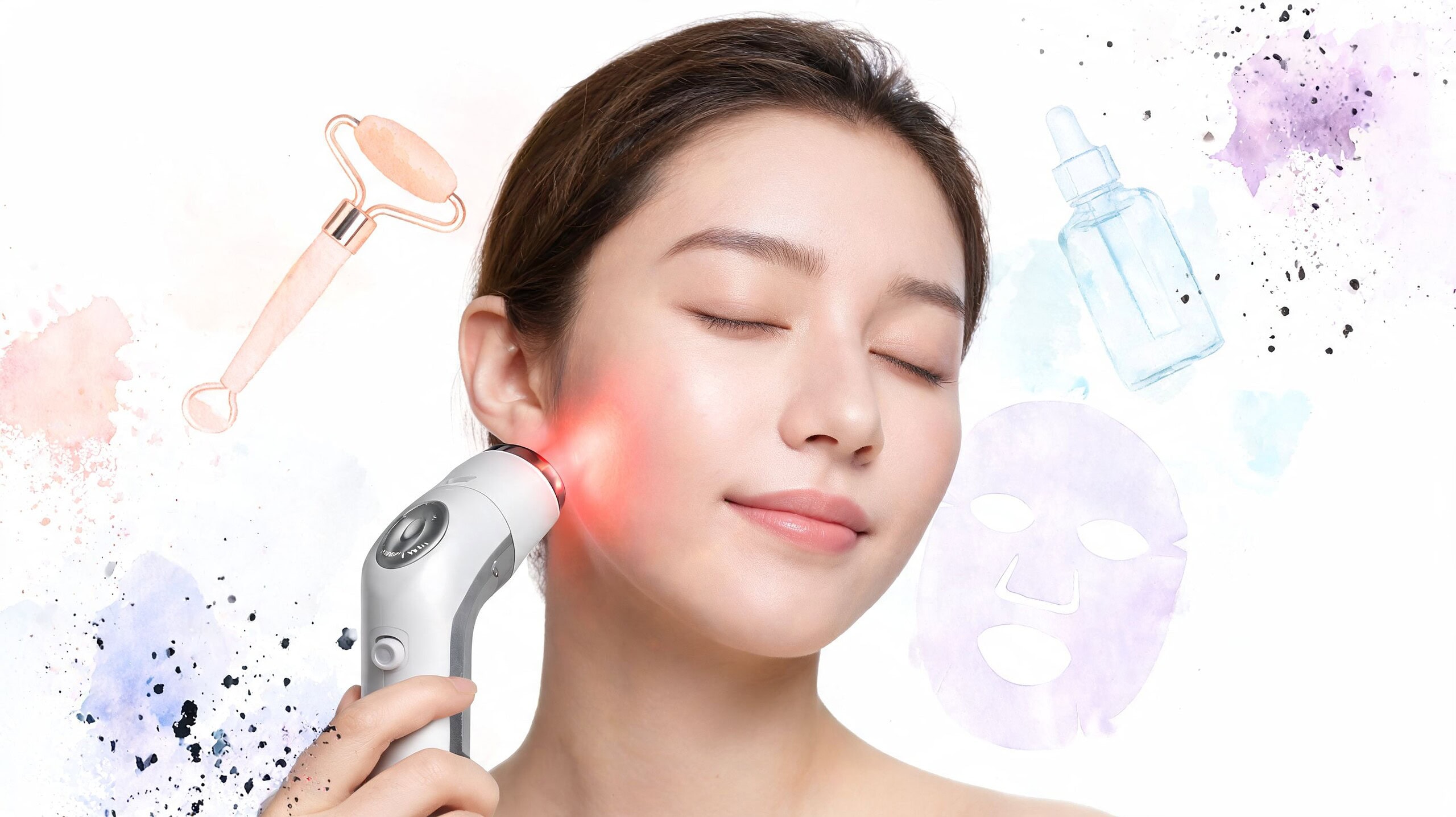
Skin rejuvenation sits in a different commercial category. These clients tend to prioritise low downtime, comfort, and gradual improvement in tone, texture, and post-procedure recovery. LLLT works well here as either a standalone service for maintenance-focused clients or as an add-on after more aggressive treatments where visible calm-down time affects satisfaction. In practice, the add-on model often produces better uptake because the client can feel where it fits in the treatment journey.
Post-procedure support is one of the most useful applications for clinics that already perform microneedling, chemical peels, or higher-energy device work. Recovery influences reviews, rebooking, and whether clients feel confident enough to continue with a package. If LLLT helps reduce visible redness and supports a calmer healing phase, it improves the full treatment experience rather than competing with your core service.
Pain and inflammation management can widen your revenue base if your clinic has the right setup and trained staff. This area sits closer to wellness and adjunctive care than pure aesthetics, so scope, claims, and documentation matter more. In the South African context, clinic owners should be careful here. SAHPRA alignment, supplier training, and intended use are not admin details. They shape what you can market, what staff can safely perform, and how defensible your protocols are if questioned.
What clients actually pay for
Clients do not buy photobiomodulation as a technical concept. They buy a practical outcome.
- Hair clients want a structured plan and honest timelines.
- Skin rejuvenation clients want visible improvement without obvious downtime.
- Post-procedure clients want the skin to settle quickly and predictably.
- Pain-focused clients want better comfort and day-to-day function.
- Body contouring clients want convenience, repeatability, and realistic circumference change over a series.
Some clinics also add body-focused services, especially where inch-loss consultations already form part of the business model. In that setting, LLLT is usually positioned as a course-based support treatment rather than a substitute for weight loss. If body contouring is already part of your offer, a clinic-grade lipo laser machine for non-invasive body contouring can sit logically alongside other aesthetic services, provided your team is trained to discuss candidacy, protocol adherence, and expected outcomes in plain language.
The trade-off is straightforward. The broader your treatment menu becomes, the tighter your operational discipline needs to be. Clinics that do well with LLLT choose a small number of indications, build clear consent and photography processes around them, and train staff to explain who is likely to benefit, who is not, and why repeated sessions are usually part of the model.
Summarising the Clinical Evidence
A clinic owner in Johannesburg or Cape Town does not need another vague promise about “healing light”. You need to know where low level laser therapy is likely to produce measurable outcomes, where the literature is inconsistent, and where SAHPRA-compliant marketing language needs to stay conservative.

Where evidence is strongest
The strongest support is in pain modulation and tissue recovery. Across the wider photobiomodulation literature, pain scores often improve more reliably than functional disability scores. That distinction matters in practice. A client may report less discomfort after a series, while objective function, range, or daily limitation improves more slowly or less consistently.
For aesthetic clinics, that makes LLLT most defensible in three settings. Post-procedure support is one. Adjunctive use in inflammatory skin presentations is another, provided claims stay within the device indication and staff document response carefully. Hair restoration programmes also sit in a more credible position than broad anti-ageing promises, because treatment courses, photography, and adherence can be structured and reviewed over time.
Body-focused applications sit in a middle ground. Some clinics do see repeatable circumference change over a treatment series, especially when client selection, hydration guidance, and scheduling are tightly controlled. The commercial risk is overpromising. In the South African market, body contouring clients are exposed to aggressive advertising and unrealistic before-and-after claims. A clinic that presents LLLT as supportive, protocol-driven care will usually retain trust better than one that sells dramatic inch loss too early.
Where clinics need restraint
The weak point is not that LLLT has no effect. The weak point is variation. Studies use different wavelengths, power outputs, treatment frequencies, endpoints, and patient groups. That makes it hard to turn a positive headline into a reliable clinic protocol without further work.
Low back pain is a good example. Some trials report meaningful pain relief, but disability outcomes are less consistent. The same pattern appears in aesthetics. Skin quality, redness, healing time, and hair response can improve, but results depend heavily on dose, indication, and treatment consistency. A device with poor training support can produce average outcomes even when the underlying modality is sound.
This is also where regulation matters. SAHPRA does not reward creative interpretation of evidence, and neither do informed patients. If your device registration, intended use, and marketing claims are not aligned, the legal and reputational cost can outweigh the revenue from the service.
If a supplier cannot show you the treatment parameters, contraindications, staff training pathway, and intended use, you are buying a sales story rather than a clinical service.
The practical position is straightforward. Use LLLT where the evidence base is credible, where outcomes can be photographed or tracked, and where your team can repeat the protocol accurately. Avoid turning mixed evidence into bold promises. Clinics that treat it as a disciplined adjunct tend to get better client satisfaction, cleaner compliance, and a stronger return over time.
LLLT Dosing and Sample Treatment Protocols
Dosing is where many clinics get into trouble. They buy a device, get a short handover, and then treat every indication with nearly the same timing and contact pattern. That approach wastes sessions and creates the impression that low level laser therapy is vague. It isn't vague. It's dose-sensitive.
What dose means in practice
Three terms should be operational, not theoretical, in your clinic:
- Fluence: Total energy delivered over area.
- Irradiance: Power density at the tissue.
- Modo: Continuous wave or pulsed delivery.
For musculoskeletal and deeper tissue work, the World Association for Laser Therapy gives a useful anchor point. Their recommendations for GaAlAs class 3B lasers in the 780 to 860 nm range include 4 J for lateral epicondylitis, 8 J for carpal tunnel syndromee 16 J for the lumbar spine, as shown in these WALT dosage recommendations.
The same guideline set also notes that once inflammation subsides, dose can be reduced by 30%, and that a therapeutic window of ±50% should be respected. That matters because post-procedure support and pain work often need protocol adjustment across the treatment course, not identical repetition.
Sample LLLT starting-point protocols
These are starting-point references drawn from WALT-style dosing logic in the 780 to 860 nm range. They are not a substitute for device-specific training, indication selection, or scope-of-practice judgement.
| Indicação | Total Energy (Joules) | Application Points | Notas |
|---|---|---|---|
| Lateral epicondylitis | 4 J | 1 to 2 points/cm² | Use irradiance at or below 100 mW/cm² |
| Carpal tunnel syndrome | 8 J | 2 to 3 points | Minimum 4 J per point |
| Supraspinatus and infraspinatus | 8 J | 2 to 3 points | Useful where shoulder discomfort is part of the complaint |
| Patellar tendon | 8 J | 2 to 3 points | Apply with anatomical precision |
| Cervical spine | 16 J | 4 to 12 points | Broader field requires structured point mapping |
| Lumbar spine | 16 J | 4 to 8 points | Deeper tissue work often needs disciplined spacing |
For aesthetic practice, the lesson from these protocols isn't that you should treat every cosmetic concern with tendon settings. It's that dose planning by tissue and target matters. Post-procedure skin support, for example, should be approached conservatively and with clear endpoint logic. You want enough stimulation to support recovery, not a one-size-fits-all timer setting.
Choosing a Device and Navigating Regulations
A clinic owner orders an LLLT unit after a strong demo, plans a launch around post-procedure recovery, then discovers the paperwork, staff training, and treatment claims are not as straightforward as the sales conversation suggested. That mistake is expensive. It delays revenue, creates uncertainty at reception and in the treatment room, and can leave you defending a purchase you cannot deploy properly.
Device selection should be handled as a compliance decision and a commercial decision at the same time. In South Africa, that means checking SAHPRA status early, confirming the intended use of the device, and making sure the supplier can support implementation beyond delivery day.
What to verify before signing off
Start with the use cases you want to offer in clinic. A device that suits wound support, post-procedure calming, or adjunctive pain applications may not suit every aesthetic workflow equally well.
Check these points in order:
- Intended clinical use: Confirm what indications the device is cleared and documented for. Do not rely on broad marketing language.
- Wavelengths and output parameters: Match the platform to the tissue targets and protocols you plan to run.
- Applicator design and ergonomics: Handpiece shape, contact method, and treatment speed affect consistency, especially in a busy rooming schedule.
- Parameter control: Staff need access to settings that allow protocol-based treatment, not fixed presets with little clinical flexibility.
- Supplier training and after-sales support: Ask who trains your team, what that training covers, and how protocol questions are handled after installation.
- Safety equipment and process: Eye protection, room rules, and session documentation must be in place from day one. Clinics should stock appropriate óculos de proteção contra laser and train staff on correct use for operators and patients where applicable.
One market option in this category is Lasers Omega, which supplies SAHPRA-licensed medical-aesthetic systems and training support in South Africa. That mention is not a substitute for due diligence. It is an example of the supplier profile worth prioritising if your clinic wants local compliance alignment, documented training, and accessible technical support.
Why SAHPRA status changes the buying decision
SAHPRA status affects more than paperwork. It affects how quickly you can launch, how confidently you can market the service, and how comfortably your team can answer patient questions.
I advise clinics to request the registration details, intended-use documentation, user manuals, safety guidance, and training pathway before paying a deposit. If a supplier becomes vague at that stage, expect problems later. The strongest purchasing decisions are usually the least exciting ones on demo day, because they are built around documentation, support, and realistic treatment delivery.
There is also a practical trade-off here. A lower-cost platform can look attractive if capital is tight, but weak documentation, limited local support, or unclear compliance status often creates more cost in delays, underuse, and retraining. A clinic does not profit from a machine that sits idle because staff are unsure how to use it within scope or because the owner is hesitant to promote it.
Buy the device you can document, train on, and put into service with confidence in a South African clinic setting.
The right LLLT system is not the one with the longest feature list. It is the one that fits your treatment plan, your staffing model, and the regulatory standard you are expected to meet.
Integrating LLLT into Your Clinic Workflow
A good LLLT device doesn't become profitable on its own. Clinics make money from systems they can schedule, repeat, package, and delegate safely. Integration is where the commercial result is decided.

Training and treatment delivery
Start with staff competency, not marketing. Your team should understand indication selection, contraindication screening, eye safety, dose logic, treatment sequencing, and how to document each session. If they can't explain why they're treating a specific area, they shouldn't be delivering the session.
In practice, smooth integration usually follows this sequence:
- Choose limited launch indications: Start with two or three use cases only, such as post-procedure recovery, skin rejuvenation support, and pain relief.
- Build fixed protocols first: Don't ask new staff to customise from day one.
- Create consultation language: Give staff plain-English scripts for expected outcomes.
- Track repeatability: Note which protocols are easiest to deliver consistently.
- Audit uptake monthly: Review attachment rates to existing treatments and course conversions.
The provided South African gap analysis also notes a training shortfall in the market. That's why clinics that build formal internal training usually outperform those that rely on supplier demos.
Packaging and profitability
The simplest way to sell low level laser therapy is to stop selling it as a standalone novelty. Package it into outcomes.
Examples include:
- Post-treatment recovery add-ons: Attach to microneedling, peel, or resurfacing bookings.
- Course-based anti-ageing plans: Position as regular skin support rather than a once-off.
- Pain support programmes: Offer as structured sessions with review points.
- Hair support packages: Build a repeat schedule and tie it to home care and review imaging.
The commercial numbers in the provided data are useful because they're concrete. With the right training and marketing, clinics can achieve a 3 to 6 month ROI on an LLLT device. At R1,500 per session, treating 10 clients a week pode gerar R600,000 in annual revenue, based on this LLLT ROI overview.
That doesn't mean every clinic will hit that figure. It means the pathway to profitability is straightforward if utilisation is planned.
A few operational habits usually make the difference:
- Book the next session before the client leaves: LLLT often works best as a series.
- Use before-and-after tracking where appropriate: Especially for skin and hair journeys.
- Train reception staff as well: They help convert enquiry into course commitment.
- Keep claims disciplined: Confidence sells better than exaggeration.
Low level laser therapy works best in clinics that treat it seriously. The science matters. The protocol matters. The SAHPRA status matters. The training matters. When those pieces are in place, it becomes more than an add-on. It becomes a useful, repeatable service line.
If you're evaluating how to introduce low level laser therapy into your practice, Lasers Omega offers SAHPRA-licensed medical-aesthetic systems along with training, technical support, and implementation guidance that can help clinics build a compliant and commercially workable treatment pathway.