




The most popular advice about buying an IPL machine is to compare the headline specifications and choose the most powerful device the budget allows. That's a poor way to procure clinical equipment. The best choice is the one that fits the clinic's treatment mix, can be operated competently, meets applicable South African requirements and remains viable after servicing and consumable costs are counted.

Índice
- Why the Right IPL Machine Matters
- Understanding How Broad-Spectrum Light Works
- Match Applications to Handpieces and Controls
- Compare Professional IPL and Diode Options
- Build a Safe Clinic Treatment Workflow
- Verify South African Compliance and Competency
- Calculate Running Costs and Illustrative ROI
- Use the Final IPL Machine Buying Checklist
Why the Right IPL Machine Matters
A salon owner comparing polished quotations may find that every machine promises a broad treatment menu, comfortable sessions and attractive commercial potential. Yet a long list of indications doesn't show whether the quoted filters suit the clinic's intended services, whether the supplier can document its South African licensing, or whether the machine will be economical once training, servicing and lamp replacement are included.
An IPL machine is a clinical, operational and financial commitment, not a screen on a trolley. Its value depends on the whole system: light source, handpieces, filters, cooling, operator competence, maintenance and support. A capable device can still be the wrong purchase if the clinic won't use its extra functions or lacks the training and protocols to deliver its intended treatments responsibly.
Start with the treatment menu
Before requesting quotations, the owner should define the services the clinic realistically plans to offer. Hair reduction, pigmentation concerns, vascular lesions and photorejuvenation may all be part of an IPL menu, but each application needs suitable optical components, operating guidance and a trained operator. A device's marketing list is not proof that every configuration included in the quotation supports every listed treatment.
South African evidence makes this more than a technical distinction. A University of Johannesburg study focused on Gauteng found that IPL and laser treatments had become increasingly popular, while somatologists showed inadequate adherence to treatment protocols and limited participation in workshops and device training. The study also described a regulatory gap in which the devices were not governed by specific legislation or licensing requirements in the settings it examined. The Gauteng study on adherence to IPL and laser protocols offers a clear reason to treat documented training and operating procedures as core procurement requirements, not optional extras.
Regra prática: A quotation is incomplete until the clinic understands what it can treat, who can operate the device, how the supplier will support it and what ownership will cost.
A disciplined buying process weighs treatment fit alongside purchase price. The sections below give salon and clinic owners a framework for comparing systems, checking operational readiness and testing the business case without relying on hype.
Understanding How Broad-Spectrum Light Works
Intense pulsed light (IPL) produces broad-spectrum light, not a single laser wavelength. A filter acts like a selective gate: it blocks part of the emitted spectrum so that the remaining light is more appropriate for a particular treatment purpose. That distinction matters when comparing specifications. An IPL machine isn't a laser because a supplier or treatment menu uses the terms loosely.
Light interacts with targets in the skin that absorb it. Depending on the application and the system's design, those targets can include pigment or structures associated with hair follicles. Absorbed light becomes heat, so the operator must understand how the device delivers energy and how the skin is assessed and protected. Filters help shape what reaches the treatment area, but they don't replace clinical judgement.
Read the parts as one system
A cut-off wavelength describes the lower boundary of the light allowed through a filter, rather than a single wavelength emitted by a laser. Buyers should ask which filters are supplied, what applications each is intended for, and what the manufacturer's documentation says about appropriate use. A list of filter names without that detail isn't enough to judge whether the configuration suits the planned treatment menu.
The handpiece brings the light to the skin. Its design affects the contact method, treatment ergonomics and the available spot size, meaning the area covered in each placement. A larger spot may suit broader areas, while a different handpiece may be designed for a more focused application. The quotation should identify each included handpiece and explain whether additional options carry separate costs.
The controls also work together. Fluência describes optical energy delivered over an area; pulse duration describes how long a pulse lasts; pulse sequencing describes how the energy is divided across pulses. Repetition rate affects how quickly pulses can be delivered, while spot size and contact cooling influence how treatment is administered. None should be judged in isolation, and no specification sheet justifies universal treatment settings.
Cooling supports the treatment process by helping manage heat at the skin surface. Buyers should ask how cooling works at the handpiece, what the operator needs to do to maintain effective contact, and how the system behaves during a session. The answer should be specific to the quoted configuration and manufacturer's instructions.
A clinic should request a demonstration of the actual handpieces and filters included in its offer. It should also obtain written training material and intended-use documentation, so the team can connect each control to its purpose rather than treating a larger screen or longer feature list as evidence of better fit.
Match Applications to Handpieces and Controls
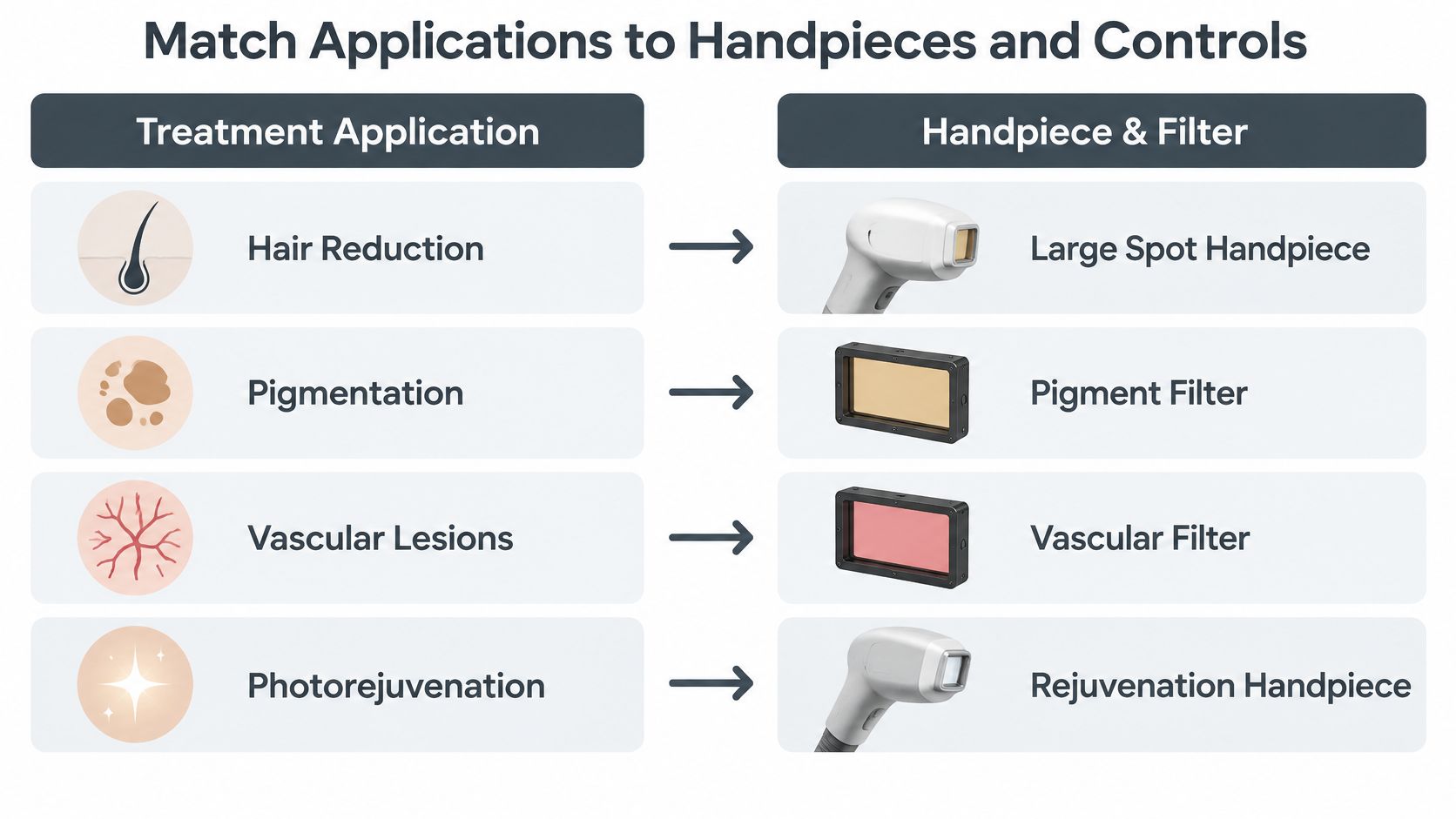
A useful specification comparison starts with the clinic's intended services, then checks whether the quoted handpieces and controls support them. Hair reduction, pigmentation, vascular lesions and photorejuvenation are distinct applications. A broad IPL spectrum doesn't mean one filter or handpiece is automatically suitable for all four.
| Intended application | Procurement question |
|---|---|
| Redução de pêlos | Does the supplied handpiece suit the areas and treatment flow the clinic plans to provide? |
| Pigmentation | Which filter and spot sizes are intended for the lesions the clinic expects to assess? |
| Lesões vasculares | What handpiece, filter and manufacturer guidance apply to the planned treatment scope? |
| Photorejuvenation | Which configuration supports the intended service, and what training accompanies it? |
A hair-focused clinic should scrutinise treatment ergonomics, handpiece handling and the supplier's training for the intended service. A pigmentation-focused buyer should investigate the available filters, spot sizes and documented use for the lesion types the clinic expects to assess. Both should ask the supplier to explain fluence control, pulse duration and sequencing in practical terms, rather than accepting a specification list without context.
Skin assessment changes the purchasing question
A clinic's patient population and intended services shape which system makes sense. Fitzpatrick skin type, hair calibre and pigment contrast influence treatment planning, so the buyer should ask for training and operating guidance that address the clinic's actual patient mix. Cooling, patch testing where required by the manufacturer, conservative escalation and careful endpoint observation belong in the operating approach, not just the sales demonstration.
South African clinical evidence provides a useful caution. In a Cape Town study involving Fitzpatrick skin types III and IV, professional diode laser treatments produced approximately 85% and 88% axillary hair reduction on the treated sides, em comparação com 52% and 46.3% for a home-use device. The study also found greater residual hair counts in type IV than type III. It evaluated diode laser, not IPL, so those outcomes shouldn't be presented as IPL results; they do reinforce the value of professional assessment and skin-type-aware planning in local practice. The Cape Town study of professional and home-use hair-reduction devices is relevant when considering how device category and patient characteristics shape a treatment plan.
For a general overview of how a clinic may describe IPL services, Athena Plastic Surgery's IPL treatments page can provide useful consumer-facing context. It doesn't replace a supplier's intended-use documentation or the clinic's own assessment of its equipment, training and scope of practice.
Compare Professional IPL and Diode Options
Professional IPL, home-use devices and diode laser systems aren't interchangeable purchases. They differ in light source, intended use, operator context and the questions a buyer needs to resolve before committing. Professional status alone doesn't prove suitability; the configuration, training, cooling and service arrangements matter.
| Consideration | Professional IPL machine | Dispositivo para uso doméstico | Laser de díodo |
|---|---|---|---|
| Fonte de luz | Broad-spectrum light shaped by filters | Consumer-oriented light source and controls | Laser light at a selected wavelength |
| Typical flexibility | Multiple applications may be possible when filters and handpieces support them | Generally intended for personal use and a narrower operating context | Often considered for a focused hair-reduction service |
| Treatment context | Clinic or salon workflow with professional assessment and records | Personal use under the device's instructions | Professional setting with operator training and protocols |
| Requisitos para os operadores | Competent operator, documented procedures and device-specific training | User follows consumer instructions | Competent operator, appropriate training and documented procedures |
| Economic question | What do configuration, lamp life, servicing and support cost? | What are device life and replacement terms? | Does expected hair-service demand justify a dedicated system? |
IPL offers broader treatment flexibility when its filters and handpieces match the clinic's intended services. A diode laser may be the stronger investment for a business prioritising high-volume hair removal, particularly if broader IPL applications won't be used. For a concise treatment-focused overview, the guide to Depilação por luz pulsada e a laser covers the distinction without making a multi-application platform the default answer. The Tetra Cool diode hair-removal machine is a reference point for clinics assessing a dedicated diode option.
Don't confuse home and professional categories
A home-use device isn't a like-for-like substitute for professional equipment. South African research identified weaknesses in formal operator preparation: 68.89% of surveyed operators received training through tertiary institutions, yet the study reported that those operators did not receive practical training; 60.87% considered their training insufficient. The study also found that 42.86% of respondents had no experience performing laser or IPL hair removal. The South African study of laser and IPL training concluded that consistent minimum requirements for theoretical and practical education were lacking.
A clinic should look for theory, supervised practical instruction, assessment and continuing education, rather than assuming that a short demonstration creates competence. For broader context on how IPL and laser can be positioned for skin concerns, Spa Black's IPL-versus-laser discussion may help frame the consumer conversation. The investment decision still belongs to the clinic: select the technology that fits its services, patient mix and operating capability.
Build a Safe Clinic Treatment Workflow
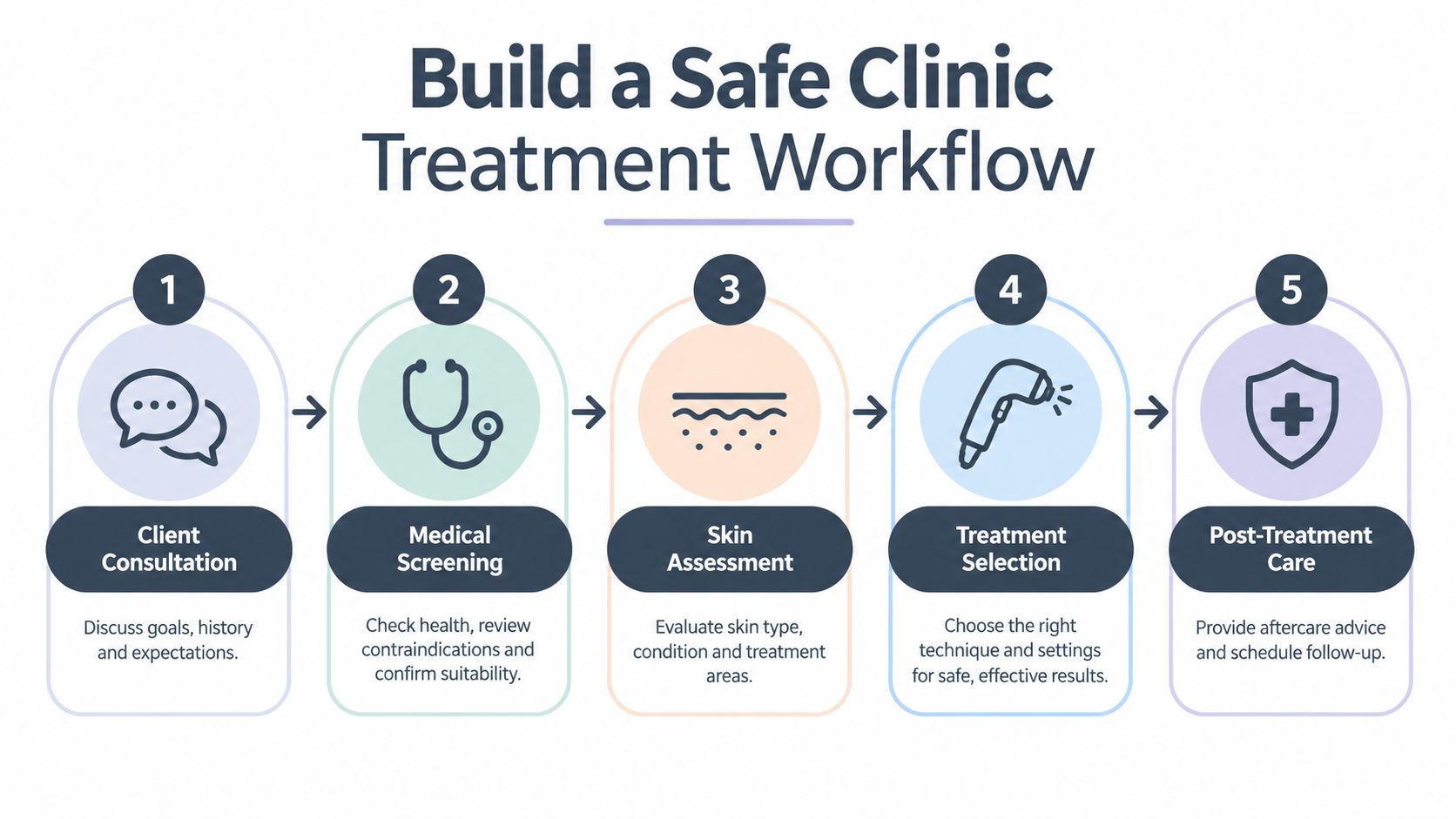
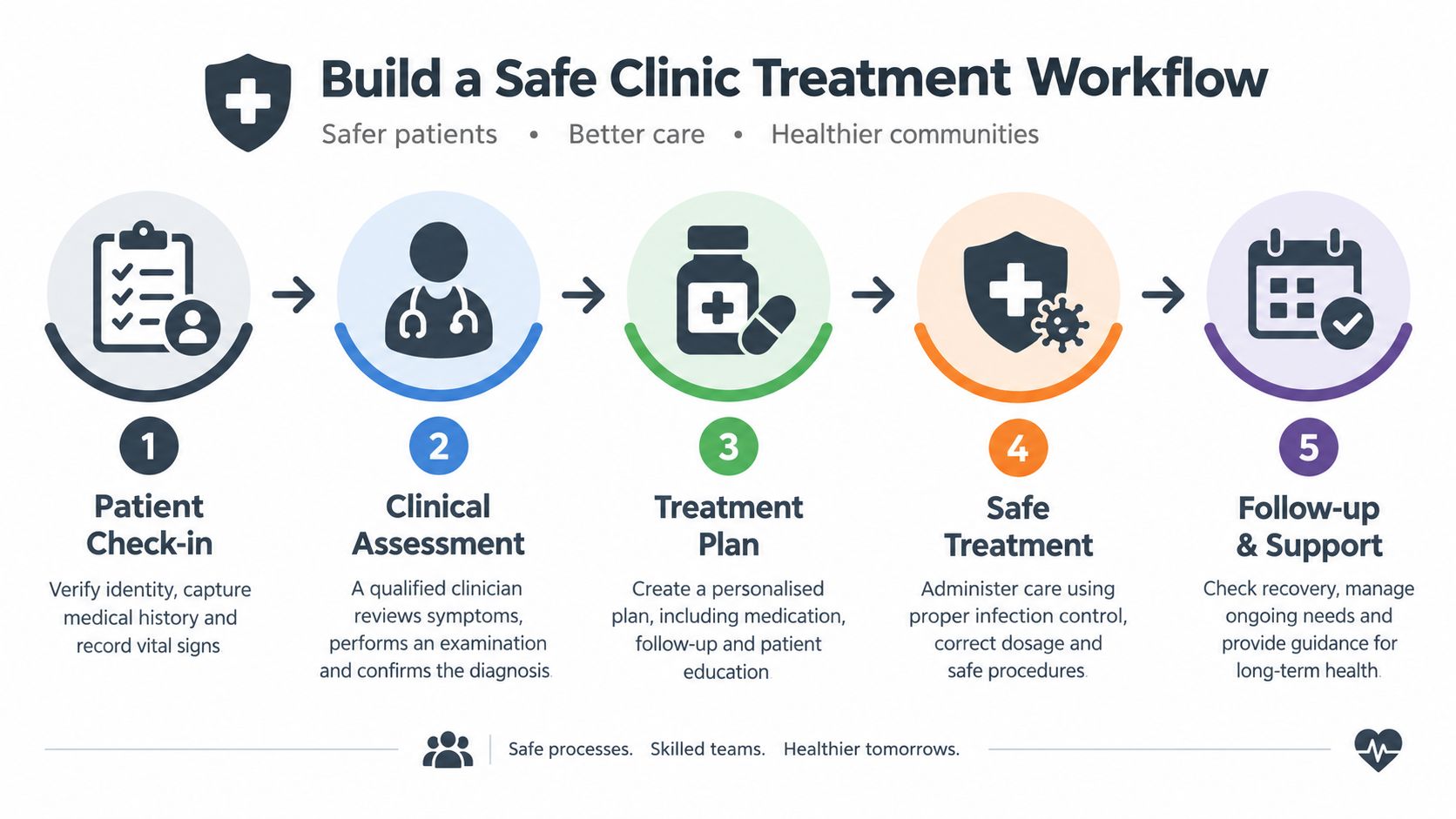
A professional IPL service needs a repeatable workflow that connects patient assessment to device use and follow-up. The clinic should document who is authorised to assess clients, who may operate the equipment and what happens when a planned treatment falls outside the practitioner's competence or the manufacturer's guidance.
Make each stage auditable
A practical workflow should cover the following:
- Consultation and screening: Record the client's concerns, relevant medical history, medications and any other factors that may affect suitability. Refer or decline treatment when the clinic's protocols require it.
- Baseline assessment: Document the area, skin characteristics, hair calibre or lesion features as relevant. Assess Fitzpatrick type and pigment contrast before selecting a treatment approach.
- Consent and planning: Explain the intended service, likely course of care, limitations, possible adverse effects and aftercare. Record informed consent and the practitioner responsible for the plan.
- Treatment preparation: Confirm the selected handpiece and filter, check that the device is serviceable, and apply protective measures in line with manufacturer guidance. Conduct patch testing when the manufacturer's protocol calls for it.
- Delivery and follow-up: Use settings selected by a competent operator according to the device's instructions and the assessment. Observe the skin response, document treatment details and provide aftercare and escalation guidance.
Records are part of the treatment
Cooling, skin-type stratification and endpoint observation support a controlled process, but none turns an unsuitable treatment into a safe one. The operator should stop or escalate when the observed response, client history or equipment behaviour raises concern. Clinics should define who handles adverse events and how incidents are documented and reviewed.
Aftercare instructions should be clear and matched to the treatment delivered. For patient-facing context on recovery and possible reactions, Beverly Wilshire Aesthetics' guide to what to expect after an IPL photofacial can help inform the clinic's educational approach. The clinic should still use its own practitioner-approved advice and the device manufacturer's instructions.
For each appointment, keep a record of the assessment, consent, device and handpiece used, relevant treatment parameters, operator, observed endpoint, aftercare and any adverse reaction. That record supports continuity between visits and gives the clinic a basis for reviewing its protocols. It also makes clear whether a decision followed manufacturer guidance, professional judgement or a local compliance requirement.
Verify South African Compliance and Competency
Before payment, buyers should verify the supplier's authority to supply the machine and the clinic's obligations for its intended use. A device registration or supplier licence claim doesn't prove that clinic staff are trained or that daily procedures are adequate. Procurement must verify both the paperwork and the operating system around the equipment.
SAHPRA states that a medical-device establishment needs a valid licence before manufacturing, distributing, importing, exporting or selling medical devices. Its framework distinguishes establishment activities, so the clinic should request documentary evidence that the supplier is licensed for the relevant activity and that the device falls within the authorised scope. SAHPRA's medical-device licensing information also notes that licensed establishments must provide evidence of ISO 13485 certification at licence renewal. Buyers should ask to review relevant quality-system documentation, servicing arrangements, complaint handling and traceability procedures.
Check use-licence implications separately
SAHPRA's non-ionising radiation guidance states that a licence for use is required for listed electronic products that emit non-ionising radiation and for Class 3B and Class 4 laser devices. Buyers should ask the supplier to identify the IPL device's classification and confirm what Radiation Control requirements apply to the device and its intended use. SAHPRA's guidance on non-ionising radiation and medical devices can inform that check, but the clinic should obtain device-specific documentation rather than infer its obligations from a generic marketing claim.
South African training evidence adds another reason to demand proof of competence. The tertiary-institution survey found that only 27.78% of institutions offered laser hair-removal training; among those institutions, 20% provided no practical training and 50% reported that they didn't provide a practical examination. The same study noted that incorrectly used laser and IPL sources can cause burns, pigmentary changes and scarring. A certificate or supplier demonstration alone doesn't establish that an operator can assess a client, select a suitable treatment or respond appropriately to an adverse event.
Procurement sequence: Request the supplier licence and authorised scope first, then device classification and intended-use documents, followed by training records, maintenance terms and the clinic's operating procedures.
Before signing, obtain the local authorised-representative details, conformity evidence, maintenance schedule, service and traceability arrangements, operator training records, consent forms and adverse-event procedures. A practical South African IPL safety and compliance checklist can help organise the clinic's review. The final test is whether the clinic can show who does what, which documents govern the work and how the machine will be supported after installation.
Calculate Running Costs and Illustrative ROI
A purchase quotation shows only part of the investment. The custo total de propriedade can include acquisition, installation, training, consumables, lamp or flash-lamp replacement, servicing, downtime, insurance, marketing and working capital. Buyers should also check whether warranty exclusions leave key parts or service labour uncovered.
Lamp or shot life affects the effective cost of each treatment, but suppliers should substantiate the terms for the specific configuration. Ask how life is defined, what happens at end of life, whether replacement is included in the warranty and what service is required. A low purchase price can prove expensive if lamp replacement, handpiece wear or long downtime erodes treatment capacity.
A clearly hypothetical Rand model
The following example is not a market price, forecast or guarantee. Every value is an editable assumption intended to show the calculation, not to describe an actual supplier quotation or clinic result.
| Assumption or output | Illustrative value | How to adapt it |
|---|---|---|
| IPL machine purchase price | R300,000 | Replace with the written quote for the exact configuration |
| Setup and initial training | R15,000 | Add actual installation and training charges |
| Total initial investment | R315,000 | Add purchase, setup and other upfront costs |
| Preço médio do tratamento | R1,200 | Use the clinic's planned price and service mix |
| Tratamentos por mês | 30 | Model conservative demand, not just a full diary |
| Custo variável por tratamento | R200 | Include consumables and a lamp-replacement allowance |
| Monthly fixed operating allocation | R5,000 | Include service, insurance and other regular costs |
| Monthly contribution after variable costs | R25,000 | (R1,200 − R200) × 30 − R5,000 |
| Simple payback period | 12.6 months | R315,000 ÷ R25,000, excluding financing and tax |
The example's break-even point for monthly operating contribution is five treatments, using the stated assumptions: R5,000 in fixed monthly costs divided by R1,000 contribution per treatment before fixed costs. That isn't a claim about the market. It's a sensitivity check a buyer can edit; if demand is lower, prices change or costs rise, the recovery period stretches.
A clinic should compare conservative, expected and stronger-demand scenarios, then include downtime and working capital rather than assuming every treatment slot will be sold. The IPL cost-benefit analysis framework can support that exercise. The decision should rest on written supplier terms and the clinic's own defensible assumptions, not a sales projection.
Use the Final IPL Machine Buying Checklist
Procurement should begin with the clinic's intended treatment mix, not a shortlist built around screen size or promotional claims. Before approving a quotation, the owner or manager should be able to explain why the machine's filters, handpieces, controls, cooling and support fit the services the clinic plans to deliver.
From enquiry to signed quotation
Use this checklist to structure supplier discussions and the internal decision:
- Define the service mix: Identify which treatments the clinic intends to offer and which are realistic for its staff and patient base.
- Confirm the configuration: Ask the supplier to demonstrate every included handpiece and filter, and to identify any options priced separately.
- Interrogate the controls: Request an explanation of wavelength cut-offs, fluence control, pulse duration, pulse sequencing, repetition rate and spot sizes in the context of the planned services.
- Assess cooling and ergonomics: Observe how the handpiece is handled and ask how cooling is maintained during treatment.
- Verify professional-use documentation: Obtain intended-use documents, conformity evidence and device classification information.
- Demand practical training: Confirm who will be trained, what supervised practice and assessment are included, and how new staff can maintain competence.
- Price ownership, not just purchase: Record lamp or shot-life terms, replacement costs, servicing, warranty exclusions, downtime arrangements and response times.
- Check local compliance: Review establishment licensing, authorised scope, Radiation Control implications and local authorised-representative details.
- Test the business case: Use a worked ROI model with conservative demand assumptions, variable costs and a realistic downtime allowance.
- Run a relevant demonstration: Ask to see the treatment workflow and controls for the clinic's chosen application. A demonstration shows how the system operates; it doesn't prove every clinical outcome or remove the need for appropriate assessment.
A good quotation makes the configuration, training, maintenance and compliance evidence easy to verify. If essential costs or responsibilities remain unclear, the clinic doesn't yet have a fair basis for comparing offers.
Final questions clinic owners should ask
How should quotations be compared? Compare identical configurations and written terms, including filters, handpieces, training, warranty, replacement parts and service. A lower price isn't comparable if it excludes equipment or support included elsewhere.
How should lamp economics be assessed? Ask for the supplier's documented lamp or shot-life terms, replacement cost, warranty coverage and the assumptions behind any cost-per-treatment estimate. Then test the calculation against the clinic's own expected use.
When should a diode system be shortlisted? When hair removal is the clinic's priority and a broader IPL treatment menu won't be used enough to justify its added cost and complexity. The choice should reflect the intended services, operator competence and local patient mix.
Omega Lasers supplies professional IPL machines and can discuss configurations, training and support for South African salons and clinics. Clinic owners can enquire about professional IPL machine options and assess each proposed system against their treatment plan, compliance responsibilities and ownership calculations.
Omega Lasers supplies professional IPL and multi-technology equipment alongside training and technical support for aesthetic practices. Clinics can explore the company's offerings at Omega Lasers and request a discussion about matching an IPL system to their services, staffing and procurement requirements.