




Um cliente entra com “pigmentação” e aponta três problemas diferentes como se fossem um só. Há uma máscara castanha irregular nas bochechas, algumas manchas bem definidas nas têmporas e marcas antigas de acne ao longo da mandíbula. Se optar por um único aparelho e uma única configuração só porque tudo parece castanho, já está no caminho errado.
É por isso que as clínicas obtêm resultados inconsistentes no tratamento da pigmentação. O problema, normalmente, não é a falta de esforço. É a abordagem generalizada melasma, hiperpigmentação pós-inflamatória e danos causados pela exposição solar num único tratamento. Na prática sul-africana, esse atalho é arriscado, porque muitos doentes apresentam tipos de pele em que o excesso de calor, a inflamação ou o tratamento excessivo podem deixá-los numa situação pior do que quando começaram.
As clínicas que lidam bem com esta categoria não perguntam: “Qual é a melhor máquina para a pigmentação?” Fazem perguntas mais pertinentes. Que tipo de pigmentação é esta? Qual é a sua profundidade? O que a provocou? A pele ainda está inflamada? A energia vai ajudar ou vai provocar um efeito rebote? E, igualmente importante, o paciente está preparado para cumprir devidamente a parte mais chata, ou seja, os cuidados em casa, a proteção solar e a manutenção?
Essa mudança altera tudo. Transforma o tratamento da pigmentação de uma simples venda de equipamento num sistema clínico. Além disso, protege a rentabilidade. Resultados seguros e repetíveis resultam de uma seleção correta dos casos, de uma escalada conservadora e de planos de tratamento que os doentes consigam seguir. Um diagnóstico incorreto gera clientes insatisfeitos, tempo adicional na cadeira, trabalho de correção e danos à reputação.
Índice
- Para além do laser mágico: uma introdução
- A base diagnóstica para um tratamento eficaz
- Dominar os produtos tópicos e a fotoproteção em primeiro lugar
- Escolher a sua modalidade de tratamento na clínica
- Conceção de protocolos de combinação avançados
- Cuidados pré-tratamento, pós-tratamento e gestão de complicações
- O negócio do tratamento da pigmentação
Para além do laser mágico: uma introdução
Os casos de pigmentação mais difíceis são os casos mistos. Essa é a regra, não a exceção.
Um doente pode apresentar um melasma de longa data, sobreposto a um escurecimento recente induzido pelas férias, além de marcas pós-acne que surgiram após surtos de acne e manchas solares isoladas que responderiam bem a um tratamento específico. Se se tratar tudo de forma agressiva só porque uma parte do caso é simples, a parte instável costuma agravar-se primeiro. É assim que as clínicas provocam pigmentação de rebote e depois culpam a tecnologia.
Regra prática: A cor castanha não corresponde a um único diagnóstico, e um diagnóstico não corresponde a um único tratamento.
O trabalho começa antes da primeira esfoliação, pulso ou passagem. É necessária uma estrutura que indique o que pode ser melhorado, o que pode ser controlado e o que deve ser deixado em paz até que a pele esteja mais calma. Na prática, isso significa identificar se o fator determinante é hormonal, inflamatório ou a exposição cumulativa à luz e, em seguida, decidir se a primeira medida deve consistir em reduzir a produção de melanina, diminuir a inflamação, acelerar a renovação celular ou atuar diretamente sobre os depósitos de pigmento existentes.
Há também uma realidade comercial a ter em conta. Os doentes com problemas de pigmentação chegam frequentemente frustrados. Muitos já experimentaram uma combinação variada de produtos caseiros e tratamentos ocasionais. Não precisam de mais entusiasmo. Precisam de um planeamento disciplinado. A clínica que explica claramente as vantagens e desvantagens e organiza o tratamento de forma adequada conquista a confiança mais rapidamente do que aquela que promete uma solução milagrosa numa única sessão.
Existem três hábitos que, normalmente, distinguem um trabalho com pigmentos fiável de um trabalho com pigmentos inconsistente:
- Diagnosticar antes de tratar: Não deixes que a presença de um dispositivo dite o plano.
- Trate tanto a causa como a cor: A acne persistente, o atrito, a irritação e a exposição aos raios UV ou à luz visível continuarão a estimular a pigmentação.
- Aumentar a intensidade com cautela em peles de cor: Uma abordagem conservadora, a realização de testes pontuais quando necessário e um tratamento gradual têm quase sempre melhores resultados do que a ousadia excessiva.
Quando os médicos aprendem a tratar a pigmentação de forma estratégica, os resultados tornam-se mais previsíveis. Não são perfeitos, porque a biologia da pigmentação não funciona de forma perfeita, mas são suficientemente previsíveis para elaborar protocolos, formar o pessoal e proteger as margens.
A base diagnóstica para um tratamento eficaz
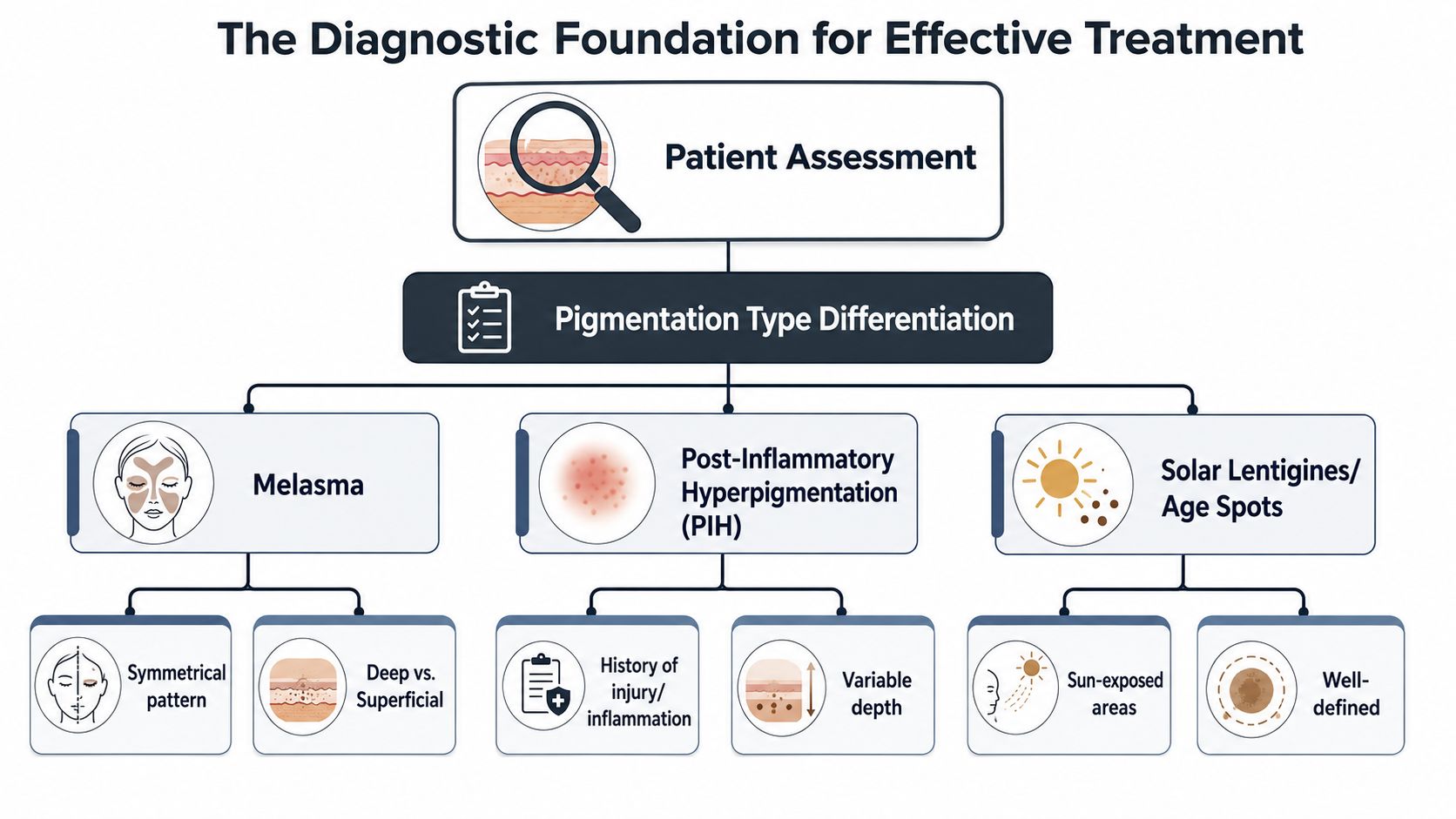
A maioria das falhas de pigmentação começa por ser uma falha de diagnóstico. Se a avaliação for superficial, o plano de tratamento também será superficial.
Começa por conhecer a história antes de tocares num dispositivo
Uma boa avaliação começa pela história clínica, não pelo «hardware». Pergunte o que surgiu primeiro, há quanto tempo está presente, se agrava após a exposição ao sol, ao calor, a surtos de acne, à depilação com cera, ao barbear, ao eczema ou a procedimentos anteriores, e se o doente ainda apresenta inflamação ativa. Uma marca resultante da acne comporta-se de forma diferente da pigmentação simétrica nas bochechas, que aparece e desaparece.
No caso da PIH, o momento em que surge é importante. A literatura de revisão relevante para a África do Sul refere que o tratamento deve ser iniciado precocemente, começando pelo controlo da condição inflamatória inicial, seguido da aplicação de agentes despigmentantes tópicos e de protetor solar como terapia de primeira linha, enquanto procedimentos como a quimioesfoliação e o laser devem ser adicionados de forma ponderada em casos selecionados (análise sobre a PIH na pele de cor).
Esse único aspeto altera o comportamento na consulta. Se a acne ainda estiver ativa, se um doente estiver a coçar as áreas afetadas pelo eczema ou se houver fricção contínua, o seu primeiro “tratamento da pigmentação” poderá consistir em eliminar o fator desencadeante. As clínicas que ignoram o fator desencadeante acabam, normalmente, por andar em círculos.
Separar o padrão do gatilho
O padrão visual proporciona-lhe um novo nível de clareza.
O melasma apresenta-se frequentemente como uma pigmentação mais difusa e simétrica, geralmente nas bochechas, no lábio superior, na testa ou na linha da mandíbula. A PIH surge na sequência de uma lesão ou inflamação, pelo que tende a corresponder à localização do problema original. As lentigines solares e outras lesões relacionadas com os danos causados pela exposição solar são mais discretas e melhor definidas, especialmente em áreas cronicamente expostas ao sol.
Utilize o Escala de Fitzpatrick como uma ferramenta de avaliação de risco, e não como um rótulo. Ajuda a estimar a facilidade com que um doente bronzeia, sofre queimaduras e desenvolve alterações pigmentares induzidas pelo tratamento. Nos fotótipos mais escuros, o limiar para provocar PIH é mais baixo, pelo que a intensidade do tratamento tem de ser ajustada em conformidade.
Um fluxo de trabalho prático numa clínica inclui frequentemente:
- Avaliação visual sob luz neutra: Verifique a simetria, a definição dos contornos, a distribuição e o eritema associado.
- Mapeamento de botões: Estabeleça uma relação entre o pigmento e a acne, o eczema, o calor, as hormonas, a exposição à luz, o atrito ou procedimentos anteriores.
- Classificação de risco: Tenha em conta o fotótipo, os antecedentes de PIH, a sensibilidade e a tolerância aos cuidados domiciliários ativos.
- Suporte de imagem: Sempre que disponível, um sistema de análise da pele pode ajudar a padronizar a fotografia de referência e apoiar as discussões sobre a gravidade e a evolução da doença. Um sistema dedicado aparelho de análise da pele para consulta e planeamento do tratamento é útil porque proporciona à sua equipa um processo de avaliação repetível, em vez de depender da memória e de comparações subjetivas.
Se não conseguir explicar ao doente que tipo de pigmentação tem e por que razão se formou, não está preparado para prescrever um procedimento.
A profundidade altera todo o plano
A profundidade da pigmentação é o ponto-chave no planeamento do tratamento. A pigmentação epidérmica costuma responder melhor à supressão tópica e a intervenções direcionadas para a superfície. A pigmentação dérmica ou de profundidade mista é mais lenta, mais resistente e mais fácil de agravar.
A lâmpada de Wood pode continuar a ser útil na prática, especialmente quando utilizada como parte de uma avaliação mais abrangente, em vez de como um diagnóstico isolado. A análise digital confere maior consistência, mas não substitui o julgamento clínico. A anamnese, a morfologia e a resposta a tratamentos anteriores continuam a ser importantes.
Eis o quadro prático para a tomada de decisões:
| Conclusão | Implicações prováveis | Consequência clínica |
|---|---|---|
| Pigmentação superficial bem definida | Mais provavelmente epidérmico | Mais indicado para peelings conservadores ou tratamentos à base de luz cuidadosamente selecionados |
| Manchas faciais difusas ou mistas | Muitas vezes, não é assim tão simples | Dar prioridade à supressão, ao controlo dos gatilhos e ao aconselhamento realista |
| Marcas resultantes da inflamação | Padrão PIH | Trate primeiro a causa e, depois, a pigmentação |
| Pigmentação profunda ou de longa data | Resposta mais lenta | Percurso terapêutico mais longo, menor tolerância a intervenções agressivas |
Os profissionais de saúde que querem saber como tratar bem a pigmentação costumam progredir mais rapidamente quando deixam de perguntar qual é o tratamento mais potente e passam a perguntar qual é a camada que pretendem atingir.
Dominar os produtos tópicos e a fotoproteção em primeiro lugar
As clínicas que ignoram a preparação básica da pele acabam, normalmente, por ter de realizar mais tratamentos corretivos posteriormente. A pigmentação é uma área em que a impaciência sai cara.
Por que razão a preparação da pele é determinante para o resultado final
As orientações sul-africanas são claras quanto à abordagem de referência. A Artigo de revisão publicado em 2022 na Revista Sul-Africana de Dermatologia Clínica afirma que A fotoproteção e o protetor solar são os pilares do tratamento, recomendando especificamente um protetor solar de amplo espectro, com óxido de ferro, com FPS superior a 30, e identifica hidroquinona 4% ou terapia combinada com hidroquinona, como tratamento de primeira linha, com um duração máxima recomendada de 6 meses. A mesma análise refere que a terapia tópica é mais eficaz no caso da pigmentação epidérmica e que a pigmentação mais profunda responde menos bem (Análise sobre a hiperpigmentação facial na África do Sul).
Isso é importante porque muitas clínicas ainda tentam “contornar” os cuidados domiciliários inadequados. Mas isso não é possível. Se um doente não se estiver a proteger contra os raios UV e a luz visível, ou se estiver a utilizar princípios ativos irritantes de forma irregular, todos os resultados obtidos na clínica tornam-se menos fiáveis.
Na prática, o pré-condicionamento desempenha quatro funções ao mesmo tempo:
- Reduz a estimulação dos melanócitos
- Melhora a função de barreira
- Reduz o risco de PIH induzida pelo tratamento
- Ajuda-o a ver o que ainda falta tratar
É também aqui que a gestão das expectativas se torna realista. Os produtos tópicos não fazem desaparecer todas as manchas e, por si só, não resolvem os problemas de pigmentação mista profunda. No entanto, muitas vezes tornam os procedimentos posteriores mais seguros, mais direcionados e mais rentáveis, porque a pele fica mais calma e o objetivo final é mais claro.
As categorias temáticas que importam
Nem todos os produtos clareadores merecem um lugar num protocolo clínico. Concentre-se nos princípios ativos com uma função definida.
- Hidroquinona: Continua a ser uma opção de primeira linha na revisão sul-africana acima referida. Utilize-o de forma ponderada, acompanhe a resposta e respeite o período de tratamento recomendado.
- Ácido azelaico: Útil quando se necessita de um suporte pigmentar com um perfil mais suave, especialmente nos casos em que a acne e a sensibilidade se sobrepõem.
- Ácido kójico e arbutina: São bons complementos, especialmente quando se trata de criar um plano de cuidados domiciliários combinados, em vez de depender apenas de um único medicamento ativo.
- Retinóides: Útil para a renovação celular, a dispersão de pigmentos e a preparação do protocolo em doentes adequados.
- Apoio relacionado com os retinóides: A reparação da barreira cutânea, os produtos de limpeza não irritantes e a hidratação são mais importantes do que muitas clínicas admitem.
Uma abordagem simples à prescrição ajuda:
| Quadro clínico do doente | Um foco mais precoce é melhor | Evite, numa primeira fase |
|---|---|---|
| Inflamação ativa e marcas | Acalme o gatilho e simplifique a rotina | Combinar vários branqueadores irritantes |
| Pigmento epidérmico superficial | Supressão e fotoproteção | Intervenções precoces e agressivas |
| Pele sensível ou reativa | Plano que privilegia as medidas de proteção, com uma introdução mais gradual dos agentes ativos | Esfoliação de alta frequência |
Os doentes pensam frequentemente que os procedimentos são o tratamento e que os cuidados em casa são apenas um apoio. No tratamento de manchas de pigmentação, os cuidados em casa fazem parte do tratamento.
A fotoproteção merece uma abordagem mais rigorosa. A utilização diária não é opcional. No caso de padrões de pigmentação sensíveis à luz visível, o componente de óxido de ferro é importante, e não apenas o valor do FPS. Se a adesão ao tratamento for insuficiente, adie os tratamentos baseados em energia. Essa decisão protege o doente e evita que a clínica tenha de lidar com complicações evitáveis.
Escolher a sua modalidade de tratamento na clínica
Assim que a pele estiver preparada e o diagnóstico for correto, a escolha da modalidade torna-se muito mais fácil. O erro é tratar os dispositivos como rivais. São ferramentas com funções diferentes.

Os peelings e os tratamentos à base de luz não são intercambiáveis
Peelings químicos Funcionam bem quando a área pigmentada é superficial e quando se pretende uma esfoliação controlada com um protocolo previsível. São frequentemente o ponto de partida mais seguro para tratar casos de tom de pele irregular generalizado, PIH epidérmica ligeira e certos casos de danos causados pela exposição solar. O ponto forte dos peelings é o controlo. A limitação é a profundidade.
IPL pode ser eficaz no tratamento de pigmentação discreta relacionada com a exposição solar em doentes devidamente selecionados, especialmente quando as lesões estão bem definidas e o tipo de pele permite um tratamento seguro. O problema é que a luz de amplo espectro e o calor podem ser mal tolerados em casos de melasma instável ou em peles de maior risco, caso o operador aplique um tratamento demasiado agressivo.
Eis o compromisso em termos simples:
- Os peelings são, normalmente, mais indicados para correções superficiais de grande área
- A IPL é normalmente mais indicada para alvos pigmentares específicos e bem delimitados, em doentes adequados
- Nenhuma das duas opções deve ser utilizada como um atalho para contornar um diagnóstico inadequado
Quando o microneedling e o laser são adequados
Tratamentos a laser ocupam um lugar mais elevado na escala de intensificação do tratamento, pois podem ser altamente eficazes na indicação correta e extremamente perigosas na indicação errada. Para fotótipos mais escuros, as configurações conservadoras e a disciplina na definição dos parâmetros-alvo são mais importantes do que o nome da plataforma. Se o caso for misto, irregular, sensível ao calor ou com histórico de reações, a moderação faz parte da competência profissional.
Uma plataforma como, por exemplo, uma Sistema de laser Nd:YAG utilizado em tratamentos específicos de pigmentação pode ser integrada nos protocolos clínicos, desde que a indicação, a formação do operador e a seleção dos doentes sejam adequadas. Isso não significa que seja a solução para todas as manchas castanhas. Significa apenas que é uma das modalidades de um conjunto de ferramentas mais vasto.
Microagulhamento por radiofrequência ocupa uma vertente diferente. O seu valor reside frequentemente na remodelação da textura da pele e na estimulação dérmica controlada, especialmente quando a pigmentação coexiste com cicatrizes de acne ou flacidez. Não é um substituto direto da luz ou do laser direcionados para a pigmentação, mas pode ser útil no planeamento de combinações de tratamentos em que o objetivo vai além da cor propriamente dita.
Uma comparação prática entre modalidades
A forma mais simples de escolher é adequar o mecanismo à lesão.
| Modalidade | Função mais adequada | Principais cuidados |
|---|---|---|
| Peeling químico | Aperfeiçoamento superficial da pigmentação e do tom da epiderme | Esfoliação excessiva da pele reativa ou inflamada |
| IPL | Lesões selecionadas relacionadas com a exposição solar em tipos de pele adequados | Exacerbação desencadeada pelo calor em casos mal selecionados |
| Laser de comutação Q ou da classe dos picossegundos | Interrupção seletiva da pigmentação em casos específicos | Risco de HIP caso as configurações ou a indicação estejam erradas |
| Microagulhamento por radiofrequência | Melhoria da textura e dos pigmentos adjacentes | Não constitui um substituto direto da orientação específica para a lesão |
Algumas regras de seleção evitam que as clínicas se metam em apuros:
- Opte por esfoliações quando o problema for extenso e superficial
- Opte pela energia direcionada para a lesão quando a pigmentação for discreta e o diagnóstico for estável
- Adiar o tratamento agressivo se o doente ainda apresentar inflamação ativa
- Trate o melasma com cuidado, porque “mais claro hoje” pode tornar-se “mais escuro no próximo mês” se ignorar os fatores desencadeantes
A disciplina comercial também é importante. Uma clínica não precisa de todas as modalidades para criar um serviço de tratamento de pigmentação sólido. Precisa de uma variedade suficiente para tratar os casos mais comuns com segurança e de formação adequada para saber quando não deve tratar.
Conceção de protocolos de combinação avançados
Os melhores protocolos para o tratamento da pigmentação combinam, normalmente, vários mecanismos. Um tratamento inibe a melanogénese, outro elimina a pigmentação superficial, outro remodela a textura da pele e todo o plano assenta na manutenção.

Criar protocolos com base no mecanismo e não na tendência
O trabalho combinado só faz sentido quando cada elemento resolve uma parte diferente do problema.
Um doente com discromia superficial e textura áspera pode responder bem a um protocolo que comece com supressão tópica e preparação da barreira cutânea, passe depois por uma série de peelings superficiais e, por fim, reavalie se alguma lesão focal residual necessita de tratamento direcionado com dispositivos. Outro doente com PIH de longa data, aliada a alterações texturais causadas pela acne, poderá necessitar primeiro de cuidados domiciliários e, posteriormente, de um tratamento conservador de remodelação na clínica, assim que a pele já não estiver inflamada.
A lógica de sequenciamento costuma ser a seguinte:
- Suprimir e estabilizar com fotoproteção e tratamento tópico.
- Eliminar a componente superficial com um procedimento conservador, se indicado.
- Reavaliar o padrão de pigmentação residual em vez de repetir o mesmo tratamento cegamente.
- Aumentar a intensidade apenas no alvo restante, e não em todo o rosto, por hábito.
- Passar para a manutenção antes que a recaída volte a colocar o caso em causa.
Os bons protocolos de combinação não acumulam intensidade. Acumulam objetivos.
Esta abordagem é também mais vantajosa do ponto de vista económico para a clínica. Permite criar percursos de tratamento com pontos de verificação, análise fotográfica e consentimento informado sobre os motivos que justificam o passo seguinte. Os doentes mantêm-se empenhados quando conseguem compreender o raciocínio subjacente.
Um plano de escalonamento adequado para a PIH resistente
Os dados mais úteis relativos à África do Sul sobre a progressão da doença nesta área provêm da literatura de revisão sobre a hipertensão induzida pela gravidez em mulheres de pele de cor. Esse percurso começa frequentemente com retinóides tópicos. A revisão referiu uma melhoria parcial significativa após 12 semanas com tretinoína, adapaleno e tazaroteno nos estudos incluídos. Na coorte tratada subjacente, os retinóides tópicos foram a intervenção mais frequentemente relatada em 22%. Entre 165 doentes tratados, O 26% alcançou a resolução total, O caso 66% apresentou uma redução parcial da pigmentaçãoe O 33% não apresentou qualquer resposta. O laser foi a única modalidade num subgrupo a atingir resolução total em 26%, mas também pode agravar a PIH, pelo que é importante proceder a uma seleção conservadora das doadoras e a testes de avaliação (análise dos resultados do tratamento da PIH em peles de cor).
Esses números não significam que o laser deva ser a próxima medida a tomar por reflexo. Significam que o laser tem um papel a desempenhar quando o caso é cuidadosamente selecionado e a resposta ao tratamento tópico é inadequada após um período de avaliação razoável.
Um protocolo prático e avançado para a PIH segue frequentemente este padrão:
- Primeira fase: Controle o fator desencadeante da inflamação e simplifique os cuidados em casa.
- Segunda fase: Adote uma estratégia tópica à base de retinóides e acompanhe a evolução ao longo de cerca de 12 semanas.
- Terceira fase: Se a melhoria estagnar e a pele se mantiver estável, considere intensificar o tratamento.
- Fase quatro: Utilize configurações conservadoras, faça testes pontuais sempre que for adequado e agende uma revisão antes de repetir o tratamento.
- Fase cinco: Retome rapidamente a manutenção assim que o alvo tiver melhorado.
Nem todos os doentes se enquadram num protocolo avançado. Alguns precisam de um tratamento tópico mais prolongado. Outros precisam de controlar a acne. Outros ainda nunca devem ser submetidos a tratamentos intensivos, pois o risco de recorrência é demasiado elevado. Saber tratar bem a pigmentação implica saber quando não se deve intensificar o tratamento.
Cuidados pré-tratamento, pós-tratamento e gestão de complicações
Os resultados da pigmentação dependem, muitas vezes, do que acontece após o procedimento, e não durante o mesmo. As clínicas que tratam os cuidados pós-tratamento como uma mera formalidade administrativa costumam registar mais complicações que poderiam ser evitadas.

O que fazer antes do tratamento
Os cuidados prévios devem reduzir a irritação, diminuir a carga inflamatória e tornar a pele mais previsível no dia do tratamento.
Utilize uma lista de verificação que toda a equipa siga:
- Evite os fatores de irritação desnecessários: Reavalie os esfoliantes, os retinóides potentes e qualquer produto que tenha causado ardor ou irritação visível.
- Verificar os gatilhos ativos: Não avance de ânimo leve se a acne, a dermatite, o hábito de cutucar a pele, a fricção ou a exposição excessiva recente ao sol ainda estiverem a causar a pigmentação.
- Definir as expectativas em relação ao tratamento da dor: Se um procedimento exigir apoio para o conforto, utilize um produto como Creme anestésico Super Numb para determinados procedimentos realizados em consultório de acordo com o protocolo e a adequação do tratamento.
- Tire fotografias de referência adequadas: Uma iluminação e ângulos consistentes contribuem tanto para o julgamento clínico como para a comunicação com o doente.
O que protege o resultado posteriormente?
Os cuidados pós-tratamento devem ser suficientemente simples para que os doentes os possam seguir e suficientemente rigorosos para evitar que os próprios doentes comprometam o seu tratamento.
O essencial é simples:
| Palco | Prioridade | Instruções para o doente |
|---|---|---|
| Imediato | Acalma a pele | Limpeza suave, proteção da barreira cutânea, sem coçar nem esfregar |
| Recuperação precoce | Prevenir a irritação | Evite ingredientes ativos agressivos até que a pele se tenha estabilizado |
| Em curso | Proteger o ganho | Uso diário de protetor solar e evitar os fatores desencadeantes |
| Manutenção | Guardar o resultado | Reintroduzir os ingredientes ativos de forma controlada |
Os doentes tendem frequentemente a exagerar nos cuidados com a pele após os procedimentos, porque querem “ajudar” a obter o resultado. É aí que acabam por provocar inflamação adicional. As suas instruções de cuidados pós-tratamento devem eliminar qualquer ambiguidade. Indique-lhes exatamente o que devem evitar, o que devem usar e quais os sinais de alerta que exigem que entrem em contacto.
O erro mais comum nos cuidados pós-operatórios não é fazer muito pouco. É fazer demasiado, demasiado cedo.
Quando um tratamento corre mal
As complicações exigem um protocolo sereno. O pânico leva a más decisões e a uma documentação deficiente.
Se suspeitar de inflamação excessiva, formação inesperada de bolhas ou agravamento da pigmentação induzido pelo tratamento:
- Interromper imediatamente a escalada: Não repita o tratamento enquanto a pele estiver instável.
- Avaliar a causa provável: Diagnóstico errado, calor excessivo, espaçamento inadequado, preparação inadequada ou cuidados posteriores inadequados.
- Primeiro, acalmar; depois, corrigir: Concentre-se na reparação da barreira e no controlo da inflamação antes de considerar outra intervenção.
- Documente tudo detalhadamente: As fotografias, os parâmetros, o momento em que se verificam os sintomas e o cumprimento das orientações de cuidados domiciliários são todos fatores importantes.
- Fazer um acompanhamento proativo: Os doentes toleram melhor os contratempos quando a clínica é bem organizada, atenciosa e honesta.
A hiperpigmentação pós-inflamatória após o tratamento é a complicação que as clínicas de estética observam com maior frequência nesta categoria. A solução raramente consiste em “tratar com mais intensidade”. A solução consiste, normalmente, em dar um passo atrás, deixar a pele estabilizar e redefinir o plano.
O negócio do tratamento da pigmentação
A pigmentação pode ser uma linha de serviços de grande potencial, mas apenas se a consulta for conduzida de forma rigorosa. Esta categoria premeia as clínicas que vendem percursos de tratamento, e não sessões pontuais.
Consultas que geram conversões sem exagerar na venda
Uma boa consulta sobre pigmentação cumpre três objetivos. Identifica o diagnóstico provável, explica claramente os limites do tratamento e mostra ao doente por que razão um plano por fases é mais seguro do que um plano apressado. Esse tipo de consulta costuma ter melhores resultados porque soa credível.
Utilize uma linguagem que os doentes compreendam. Informe-os se a pigmentação é provavelmente superficial, mista ou induzida por fatores desencadeantes. Explique o que pode melhorar, o que pode voltar a ocorrer e o que depende da adesão do doente ao tratamento. Se quiser um ponto de referência útil sobre o quanto o feedback dos doentes pode reforçar a credibilidade, vale a pena analisar como outras clínicas orientadas para o serviço apresentam a prova social. Pode Descubra as experiências dos clientes da Forever Dental And Skin para perceber como a apresentação de testemunhos contribui para criar confiança sem fazer afirmações irrealistas.
Organizar adequadamente os percursos de tratamento das embalagens
Os serviços de pigmentação devem ser estruturados com base na lógica, e não em descontos. Um pacote pode incluir consulta, fotografias, orientações para cuidados a casa, tratamentos faseados na clínica e um momento de avaliação em que se decide se se deve manter o tratamento ou intensificá-lo. Essa estrutura aumenta o compromisso e ajuda a clínica a prever a utilização dos serviços.
Existem algumas regras comerciais que costumam funcionar bem:
- Considere o percurso, não apenas o pulso: Incluir a avaliação e o acompanhamento no valor, e não apenas o tempo do procedimento.
- Incluir marcos de revisão da compilação nos pacotes: Isto permite que o tratamento se adapte ao comportamento real da pele.
- Formar toda a equipa para que se expresse de forma coerente: Mensagens contraditórias na receção, na sala de tratamento e no acompanhamento pós-tratamento minam a confiança.
- Utilize imagens de «antes e depois» de forma ética: A coerência e a honestidade são mais importantes do que uma apresentação dramática.
As clínicas que fazem isto bem acabam normalmente por ficar conhecidas por serem cuidadosas, que é exatamente o que os pacientes de pigmentação procuram.
Se estiver a criar ou a aperfeiçoar um serviço de pigmentação, Lasers Omega apoia as clínicas com tecnologia médico-estética, formação e orientação operacional, para que a sua equipa possa realizar tratamentos com maior confiança, escolher as modalidades de forma mais criteriosa e obter resultados mais seguros e mais consistentes.