



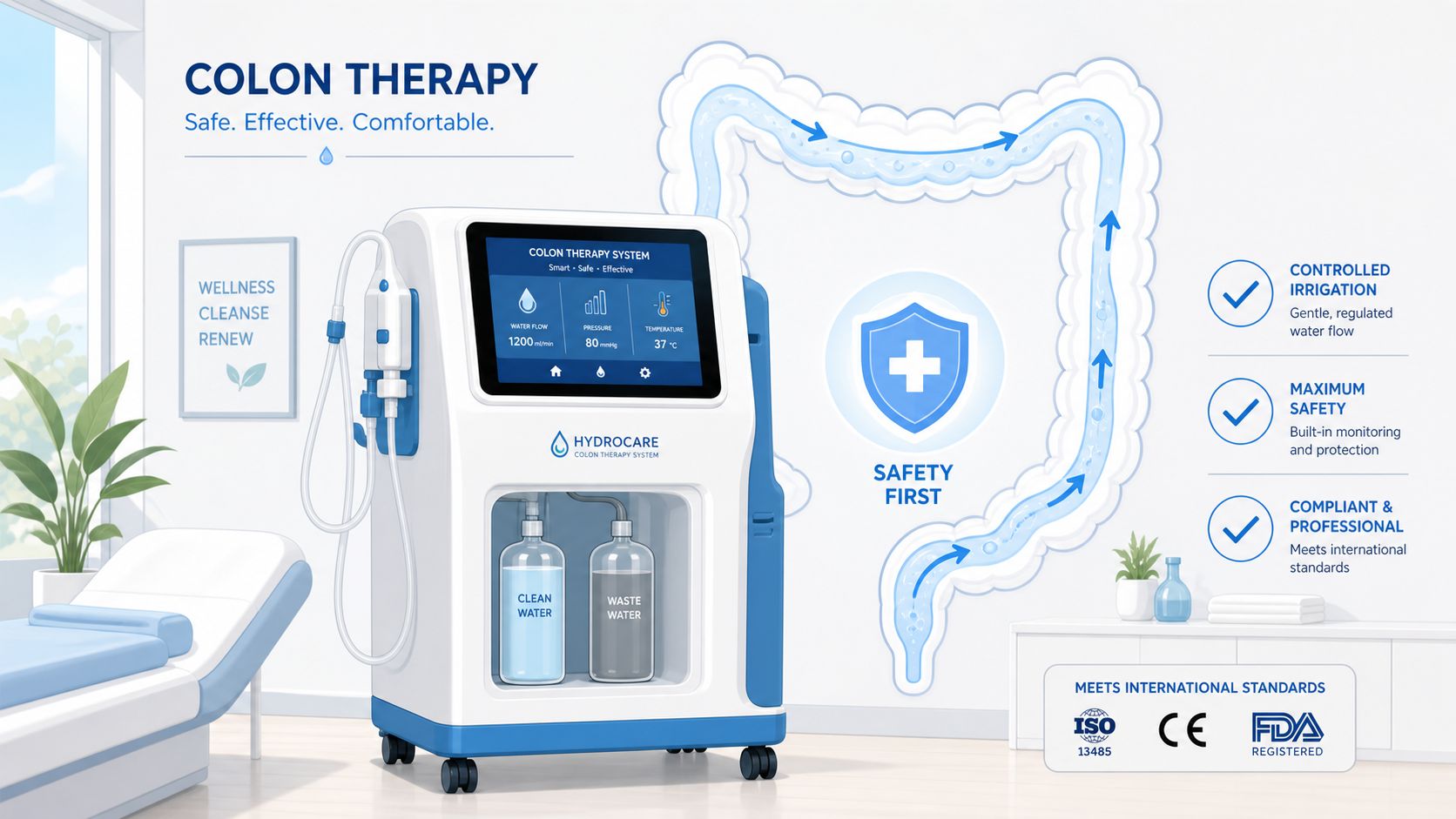
A client walks in asking for a “detox” treatment, and your team needs a straight answer, not a sales pitch. If you're running an aesthetic clinic, spa, or medical room in South Africa, a colon therapy machine is not something to buy on impulse and hope the wellness label covers the rest.
The hard part is that the device sits between two worlds. In one, it's marketed like a comfort service. In the other, it's a regulated medical device with real screening, consent, and compliance duties. That boundary matters because the wrong setup, the wrong indication, or the wrong operator can turn a simple request into a legal and clinical problem.
Índice
- The Clinic Request That Raises Red Flags
- What a Colon Therapy Machine Actually Is
- How the Machine Works and Treatment Protocol
- When the Device Helps and When It Does Not
- Safety Risks and SAHPRA Compliance Rules
- Device Features Training and Business ROI
- Post Treatment Care and Clinic Takeaways
The Clinic Request That Raises Red Flags
A receptionist books a client for a “colon cleanse”, the therapist thinks it sounds like a routine wellness add-on, and the owner assumes it can sit beside other aesthetic services. That's exactly the kind of moment where a clinic can drift into trouble if nobody has checked the device's regulatory status, the operator's training, or the treatment's actual clinical purpose.
A colon therapy machine used for therapeutic colon irrigation sits inside a compliance framework, not a casual spa category. In South Africa, device suppliers need to work within SAHPRA's medical-device registration and licensing expectations, because therapeutic colon irrigation is treated as a medical device matter, not a free-form wellness gadget. That means the clinic should be asking who can lawfully supply it, who may operate it, and what documentation must be in place before the first session.
The best clinics treat that first request as a screening moment. If the client wants detox, weight loss, or a vague “reset”, the answer needs to stay honest, because routine colon cleansing for general wellbeing isn't the same as a documented bowel-cleansing use case. If your team is already reviewing room readiness and device setup, it can help to cross-check your broader clinic infrastructure against a practical equipment-screening resource before you commit to any purchase.
Regra prática: if the request is vague, slow the conversation down. Ask what the client is preparing for, who referred them, and whether a regulated indication actually exists.
The safest clinic culture is simple. No one treats a colon therapy machine like décor, and no one sells it with loose promises. The device belongs in a process with documentation, screening, and a clear reason for use.
What a Colon Therapy Machine Actually Is
A colon therapy machine is best understood as a controlled irrigation system for the large bowel. A simple household analogy helps. It can be compared to a gentle, managed reverse-flow rinse through a narrow pipe, not a forceful blast and not an improvised wash. The point is to move fluid in a controlled way, then manage outflow safely and predictably.
The historical context matters because it explains why the device looks so different in modern clinics. A review of the field links colonic irrigation to the old, now-discarded theory of autointoxication, which became widely accepted in the late 1800s and early 1900s, and notes that modern colonic machines were developed about 100 years ago as a gentler alternative to surgery and harsh purgatives. In South Africa and the broader ZA region, a locally hosted historical paper says colon irrigations and colonic hydrotherapy were still common in hospitals and nursing homes until the mid-1960s, then most equipment had been removed by the early 1970s in favour of colostomy, Fleet enemas, and prescription laxatives. That shift explains why today's market is shaped by private clinics, training, and compliance rather than routine hospital adoption. Historical review of colonic irrigation and adverse effects
The broader historical pattern also shows that the therapy was once institutional. One account places peak popularity in the United States in the 1920s and 1930s, when colonic irrigation machines were common in hospitals and physicians' offices, while another review notes that the Harrogate spa reportedly delivered irrigations to 15,000 patients annually around 1905. That history is useful, but for a South African clinic the key lesson is different. The machine is no longer carried by default as mainstream hospital equipment, so modern use depends on private-sector discipline and proper governance. Historical account of colon irrigation use in early clinics
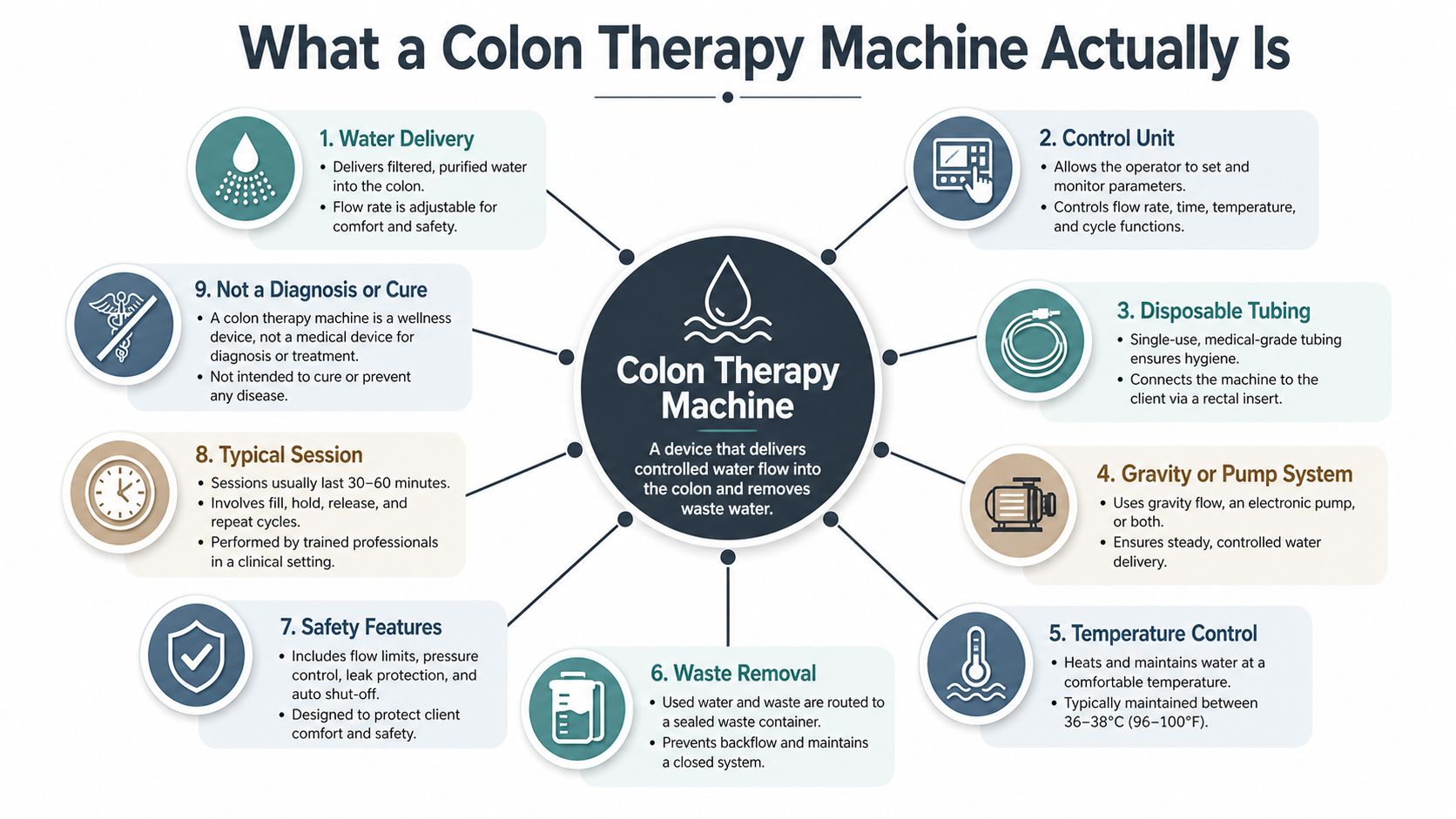
The device is not defined by the brand or the room. It's defined by controlled water delivery, safe outflow, and the clinic's ability to document what happens around the session.
How the Machine Works and Treatment Protocol
The operating principle is straightforward. Water is introduced under controlled conditions, the client's comfort is monitored, and outflow is managed so the process stays contained and predictable. In FDA-cleared design descriptions, controlled water temperature and gravity-induced flow through the nozzle are core safety functions, which is exactly why pressure, temperature, and flow controls matter so much in clinic procurement. FDA design description for a colonic irrigation system
A practical session usually begins with a consultation. Staff confirm the reason for treatment, review contraindications, explain what the client can expect, and make sure consent is specific rather than vague. After that, the disposable nozzle or catheter is positioned, water moves in timed cycles, and the therapist watches for comfort, response, and any sign that the treatment should stop. The room should feel controlled, not rushed.
Commercial units commonly specify water temperature control around 10°C to 40°C, maximum liquid flow near 2 L/min, filtration accuracy up to 1 µme noise below 65 dB. Those numbers matter operationally because they affect comfort, workflow, and the atmosphere in a treatment room. A unit that holds temperature and flow more steadily is easier to supervise, and a quieter machine is less disruptive in a small clinic. Commercial operating specifications for a colon hydrotherapy unit
Operating Parameters for Colon Therapy Machines
| Parâmetro | Typical Specification |
|---|---|
| Water temperature control | Around 10°C to 40°C |
| Maximum liquid flow | Near 2 L/min |
| Filtration accuracy | Up to 1 µm |
| Noise level | Below 65 dB |
A clean protocol also includes end-of-session handling. Waste is managed, disposables are removed, the area is disinfected, and the therapist documents the session properly. That last part often gets treated as admin, but in a real clinic it's part of the treatment itself.
Perspetiva operacional: the smoother the control over temperature, flow, and turnover, the easier it is to train staff consistently and keep the room ready for the next client.
When the Device Helps and When It Does Not
The most useful way to think about a colon therapy machine is not as a general wellness tool, but as a narrow clinical instrument with limited legitimate use. The strongest practical use case is as a preparation aid before radiological or endoscopic examinations, or as a remedial option when bowel prep has failed. That's very different from the broad detox language often used in marketing.
A retrospective study in PLOS One found that remedial colon hydrotherapy device enemas were effective, efficient, well tolerated, and associated with a low incidence of adverse events in patients with inadequate colonoscopy preparation. That doesn't turn the machine into a cure-all. It does show why some clinics and practitioners view it as a back-up bowel-cleansing method in a narrowly defined context. Retrospective study on remedial colon hydrotherapy device enemas
The other side of the ledger is just as important. Routine colon hydrotherapy for detoxification or weight loss remains unsupported, and the public-facing appeal of “cleansing” can blur the line between evidence-based use and marketing fantasy. A clinic that overstates what the machine does risks disappointing clients and misleading them about what their body needs.
The easiest way to keep that boundary clear is to compare the two use cases directly:
- Documented bowel-cleansing need: tied to a procedure or failed prep, with a clear clinical reason.
- Vague detox request: no procedure, no diagnosis, and no reliable basis for claiming benefit.
- Operationally appropriate referral: a client arrives with a defined treatment pathway.
- Marketing-driven request: the client wants a sensation, a promise, or a quick fix.
Medical guidance remains cautious because routine colon cleansing can cause harm, and there's no good reason to treat it like a universal reset button. If your team is deciding whether any bowel-cleansing workflow belongs in your clinic, the answer should depend on clinical need and governance, not on slogans. For a broader view of how compliant documentation fits into treatment selection, see this compliance checklist resource.
Safety Risks and SAHPRA Compliance Rules
A colon therapy room can look calm and still carry real risk. That matters because the safety profile is not theoretical. Independent clinical sources warn that colonic cleansing can lead to dehydration, electrolyte imbalance, infection, and bowel injury or perforation, and they also note that no FDA-approved system exists for routine colon cleansing to improve general wellbeing. In a South African clinic, that means screening and explicit consent are part of the job, not optional extras. Clinical warning on colon cleanse safety
The compliance side is just as narrow. In SAHPRA terms, a therapeutic colon irrigation device sits in the medical-device lane, so South African clinics and suppliers need to work within the Medicines and Related Substances Act framework, with the relevant registration and licensing requirements in place before supply. If a clinic cannot show where the device came from, how it is approved, and who is authorised to use it, the problem is not only operational, it is regulatory. SAHPRA medical-device FAQ and compliance overview
The practical response is to build safety into the paperwork and the room. Screening should catch risk factors, consent should explain the possibility of harm in plain language, and staff should know what to do if a client becomes unwell. The machine itself is only part of the control system. The rest is staffing, cleaning, escalation, honest documentation, and some insights from WipesBlog.com on hospital-grade disinfection.
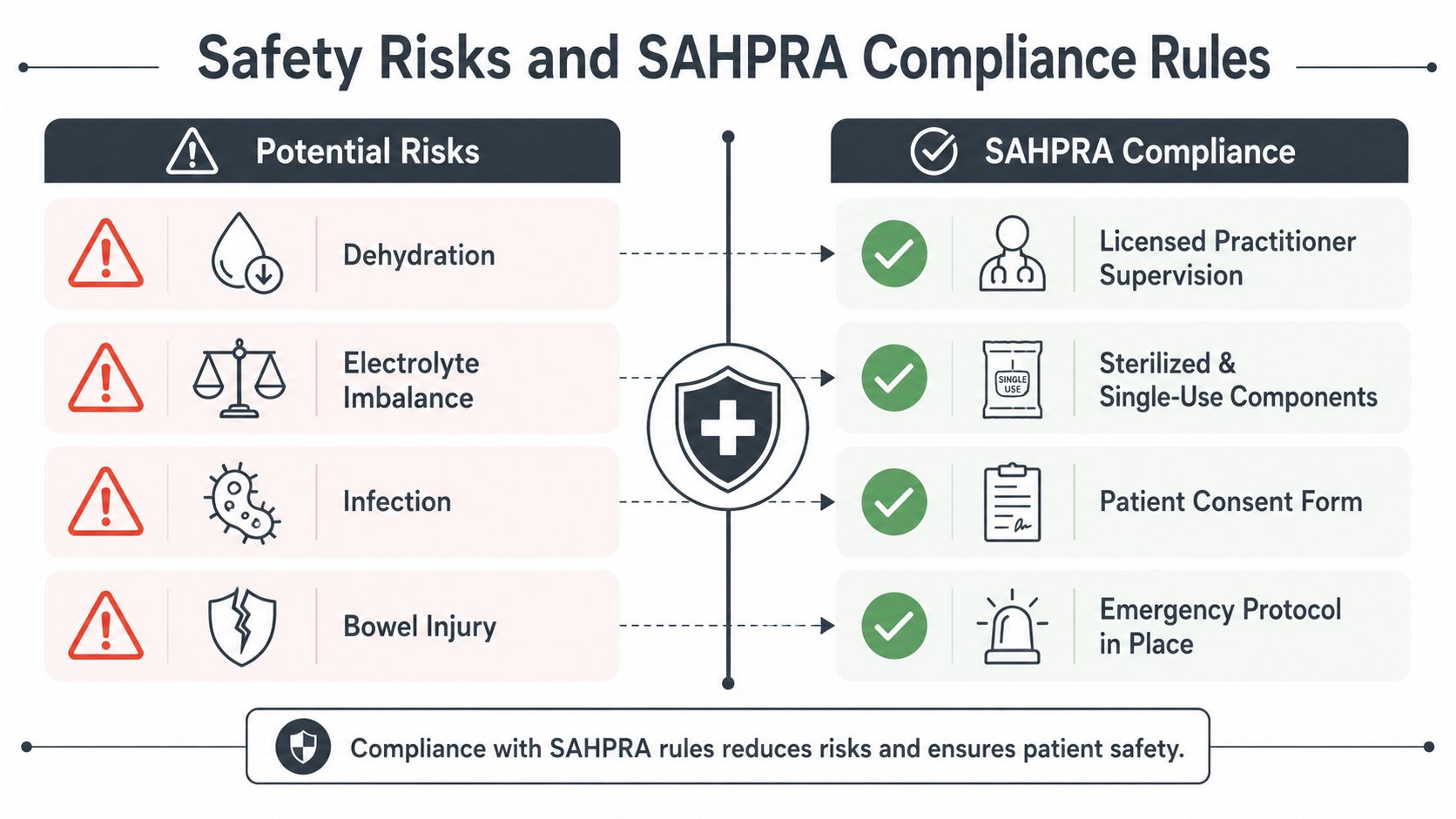
For a clinic team, that usually comes down to a few simple controls:
- Licensed practitioner supervision: no informal handover to untrained staff.
- Sterilised and single-use components: reduce avoidable contamination risk.
- Patient consent form: make the risks explicit before treatment.
- Emergency protocol in place: know how the team responds if symptoms escalate.
If your room cleaning flow still needs tightening, the same discipline used in infection-control planning should apply here. A colon therapy room does not get safer because it looks clinical. It gets safer because the team behaves as if every step matters.
Device Features Training and Business ROI
A clinic owner usually asks two questions. Can we run it safely, and can we run it profitably without cutting corners. The honest answer depends on whether the device fits the room, the staff, and the regulatory workload, not just on whether the treatment sounds marketable.
The procurement checklist should start with intended patient volume, room plumbing and drainage, ventilation, electrical needs, training, custo total de propriedadee licensing. Those are not background details. They decide whether the machine can operate smoothly in your centre or whether it becomes a source of stoppages and staff frustration. SAHPRA's emphasis on medical-device control also means the machine needs documented pressure, temperature, and flow controls, because the device has to be technically defensible as well as commercially usable.
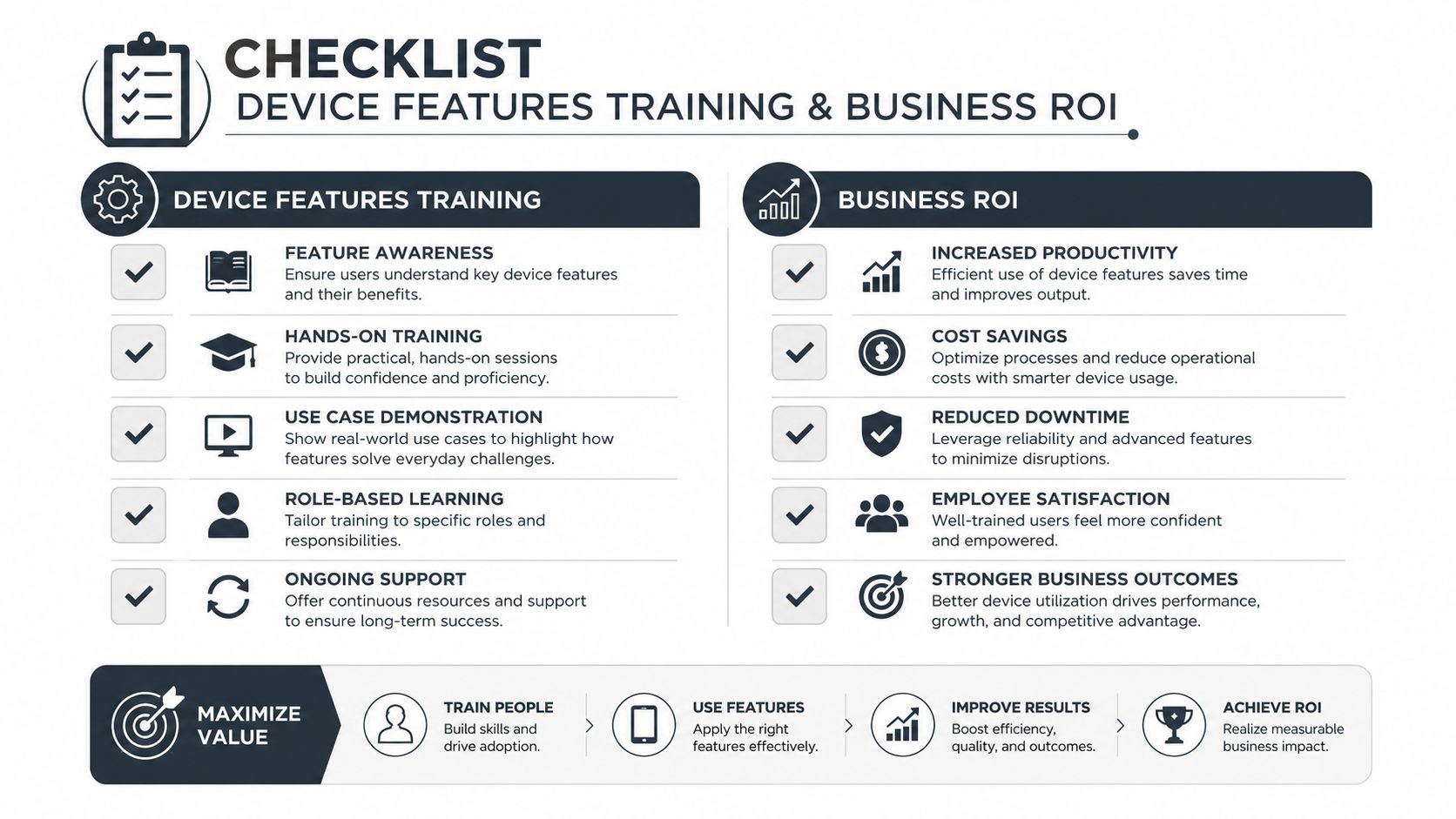
Training sits at the centre of the business case. A well-trained operator understands patient positioning, session pacing, cleaning between clients, documentation, and when to stop the treatment. That competence reduces avoidable mistakes and makes the service more consistent, which matters far more than flashy marketing language. If the staff can't explain the process confidently, the service won't feel credible.
A simple procurement lens helps owners avoid bad buys:
- Room fit: can the area handle plumbing, drainage, and turnaround?
- Workflow fit: can staff clean, reset, and document without rushing?
- Compliance fit: is the device supportable under the clinic's regulatory setup?
- Revenue fit: can the service be priced and packaged without leaning on unsupported claims?
For owners who finance equipment, it also helps to understand financing options for medical equipment before signing anything. The payment structure matters because a machine that looks affordable upfront can become expensive if maintenance, training, and compliance support were never budgeted properly.
A device pays for itself only when the clinic can keep it compliant, staffed, cleaned, and booked without improvisation.
Post Treatment Care and Clinic Takeaways
A client who has just finished a colon therapy session should not leave with vague reassurance. The handoff needs to be clear: encourage hydration, explain what symptoms to watch for, and tell the client which changes require prompt medical attention. That includes unusual pain, dizziness, or any feeling that something is not right after leaving the clinic.
Short, plain aftercare instructions work best. Explain what a normal recovery feeling looks like, remind the client to drink enough fluids, and give a direct contact route if concerning symptoms appear later. The same discipline used in infection-control protocols should shape room turnover, cleaning, and the client handoff, because the post-treatment workflow is part of the service, not an afterthought.
A useful way to explain it to staff is to treat aftercare like the final checkpoint before the client exits the clinic. If the checkpoint is rushed, important details are lost. If the message is simple and repeated consistently, clients are more likely to understand what is normal and what is not.
The larger takeaway is straightforward. A colon therapy machine belongs in a licensed, documented, compliance-first clinic, not in a room that treats it like a casual wellness add-on. In South Africa, that means the service must sit inside the clinic's regulatory setup, with screening, training, and honest indication boundaries guiding every session. When the team stays within those limits, it is less likely to overpromise or leave the client underprotected.
Before you buy, review the room, the paperwork, and the staff readiness. If those three pieces are weak, the machine is not the first problem to solve. A clinic that cannot support the workflow safely should fix the workflow first, then consider the device.