



If you're running a clinic in South Africa, you already know the pressure. Clients want results that last, margins need to make sense, and every new treatment has to justify the cost of training, consumables, compliance, and staff time.
That’s why permanent makeup keeps coming up in strategy conversations. It sits at the intersection of beauty, corrective work, and long-term client retention. It also isn’t a service you can bolt on casually. A weak course creates weak outcomes, and weak outcomes in PMU don’t just hurt reviews. They create corrections, complaints, and legal exposure.
The business case is real. The global permanent makeup market was valued at $154.2 million in 2023 and is projected to reach $332.6 million by 2033 at an 8% CAGR, according to Allied Market Research’s permanent makeup market analysis. But for South African clinics, the smarter question isn’t whether PMU is growing. It’s whether your training route equips you to deliver it safely, compliantly, and profitably.
A good PMU course should do more than teach brows. It should help you choose the right candidates, work responsibly across varied skin types, understand pigment behaviour, document properly, and build a service line that can handle both application and correction.
Table of Contents
- Introduction: The PMU Opportunity for South African Clinics
- The Core Curriculum: What a Comprehensive PMU Course Must Cover
- Navigating SAHPRA and Legal Compliance in South Africa
- How to Evaluate and Choose the Right PMU Training Academy
- Beyond Application: Integrating PMU with Advanced Aesthetic Tech
- Planning for Profit: PMU Pricing, Equipment and ROI
- Conclusion: Your Next Steps to Mastering Permanent Makeup
Introduction: The PMU Opportunity for South African Clinics
A clinic owner adds PMU after months of clients asking for brows and lip blush. Bookings come in fast. Then the harder questions start. Is the training good enough for Fitzpatrick diversity in a South African practice? Will your consent process and infection-control standards hold up if a complication occurs? Can you manage poor previous work, or will every correction case need to be referred out?
That is the genuine PMU opportunity for South African clinics. It is not just another beauty service. It is a treatment category that can strengthen retention, widen your case mix, and create repeat visits through touch-ups, colour refreshes, and corrective work.
Used well, PMU fits naturally into an aesthetic clinic that already handles skin health, age-management, and device-led treatments. Brows, lip colour enhancement, lash line procedures, scar camouflage, and selected correction cases can support a longer client journey instead of a once-off appointment model. The clinics that do well with PMU usually treat it as part of a systems-driven service line, with careful consultation, clear exclusion criteria, and a plan for maintenance and revision.
The South African context changes the decision. Client demand is real, but so is the risk of buying imported training that was built for a different legal and clinical environment. SAHPRA expectations around professional conduct, scope, devices, and patient safety matter. So do insurer requirements, record keeping, patch testing decisions where relevant, photography standards, and referral pathways when a result heals poorly or an old pigment behaves unpredictably.
Clinic owners also need to think beyond first-pass application.
In practice, PMU becomes far more valuable when the clinic can pair placement skills with correction options, skin preparation, and advanced laser support for fading, removal, or refinement. That matters commercially and clinically. A clinic that can assess an old brow tattoo, decide whether to work over it or lighten it first, and then complete the enhancement safely has a stronger service model than a clinic that only offers fresh sets.
A profitable PMU service is built on training depth, consultation discipline, pigment judgement, and correction capability. Artistic ability matters, but it does not protect the business from complaints, rework, or preventable complications.
The right course should help your clinic add PMU in a way that is safe to operate, realistic to insure, and sensible to grow over several years. That is the standard worth paying for.
The Core Curriculum: What a Comprehensive PMU Course Must Cover
A clinic owner usually sees the problem once the first correction case walks through the door. The original work may look acceptable in a training portfolio, but healed colour has shifted, the shape sits poorly on the face, and the client now expects your clinic to fix it safely. That is when the quality of training shows. A PMU course should prepare the practitioner for healed outcomes, complication prevention, client selection, and revision planning, not only clean work on day one.
A serious syllabus feels closer to procedural training than a beauty demo. If the academy spends more time selling lifestyle outcomes than explaining skin behaviour, pigment placement, or complication handling, it is the wrong investment for a medical aesthetic clinic.
Theory before technique
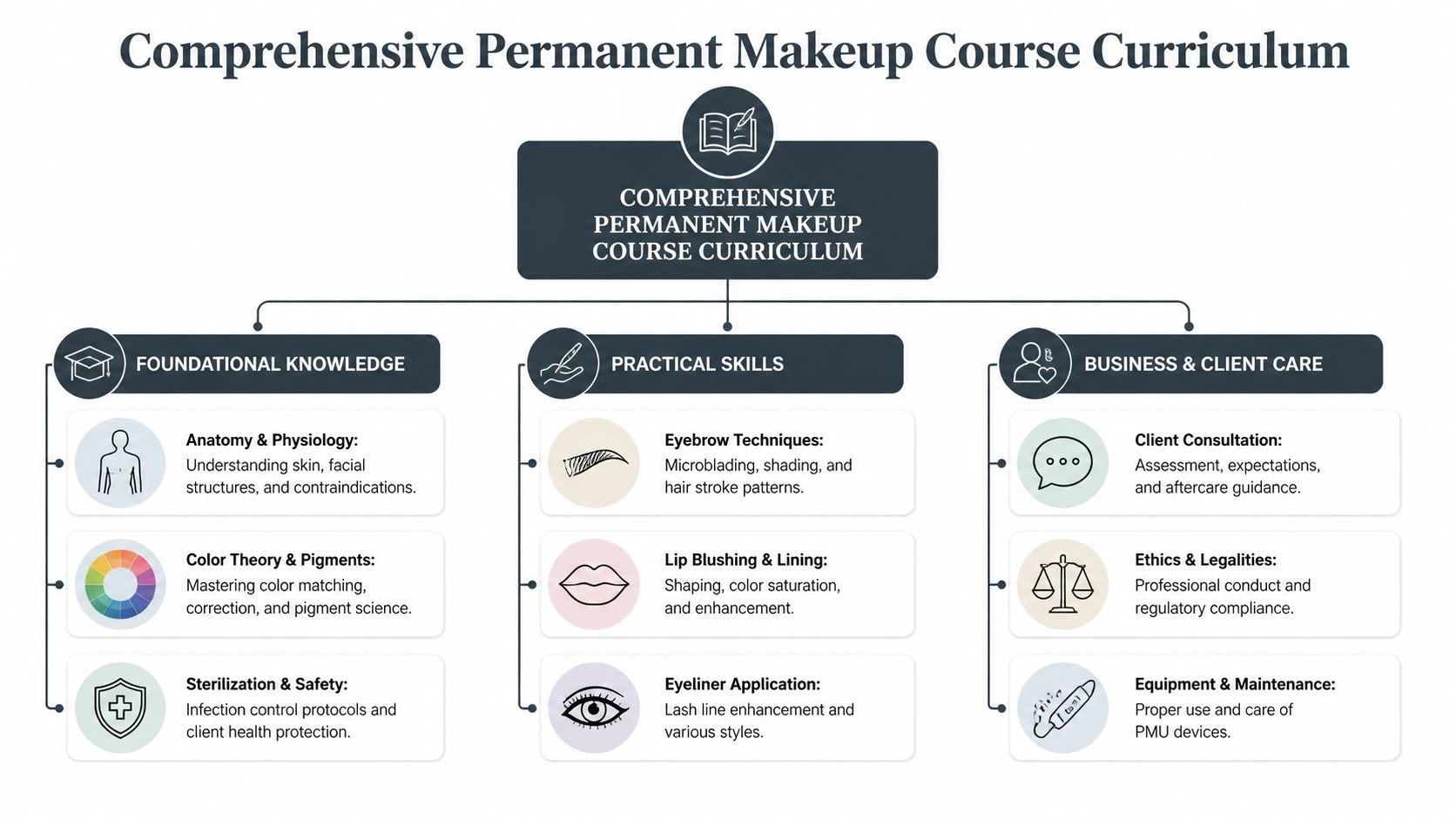
The best academies start with the reasons PMU succeeds or fails in healed skin. Students need a working understanding of epidermal and dermal structure, inflammation, wound healing, skin thickness by treatment area, and how pressure, depth, and repeated passes affect retention and scar risk. In clinic practice, weak theory shows up quickly. The practitioner chases colour, overworks tissue, and creates a touch-up problem that should never have existed.
Course content should also cover:
- Infection prevention and aseptic handling: barrier methods, hand hygiene, sharps disposal, cartridge safety, and workstation turnover
- Consultation and exclusion criteria: skin disease, medication history, keloid tendency, active acne in the treatment zone, unrealistic expectations, and previous tattoo history
- Consent, photography, and aftercare systems: records that protect the client and the clinic
- Machine and needle literacy: stroke, speed, needle configuration, stretch, angle, and maintenance
For South African clinics, I would also expect the trainer to explain where cosmetic PMU ends and where medical tattooing or device-based correction creates a different operational risk. If they cannot discuss that clearly, the course is being taught too narrowly for a real clinic environment.
Pigment knowledge separates safe operators from expensive mistakes
Colour theory is not a side topic. It is one of the main reasons clients return happy, return disappointed, or return asking for removal.
In South Africa, this becomes more important because clinics often treat a broad range of Fitzpatrick types and undertones in the same week. Training should cover undertone assessment, pigment temperature, opacity, healed fade patterns, saturation control, and the limits of working over old pigment. It should also address what to do when previous PMU is unsuitable for immediate cover work.
A weak course teaches students to match a tray colour. A better course teaches them to predict a healed result.
That difference affects profitability. Poor pigment judgement leads to more review appointments, more corrective work, more difficult client conversations, and a higher chance that laser fading will be needed before the result can be improved. Clinics planning to add PMU as a serious revenue line should want practitioners who can recognise early when correction, staged fading, or referral is the better decision.
Comfort products have a place in treatment setup, but they do not replace skill. Products such as topical numbing cream for cosmetic procedures can support client tolerance during a session. They do not correct poor mapping, poor depth control, or poor pigment selection.
Practical training should reflect real clinic work
Hands-on practice still matters, but the structure matters more than the certificate. Look for supervised model work, close feedback on healed results, and case discussion that includes poor outcomes as well as polished ones. A student who has only worked on latex and one ideal model is not ready for normal clinic variation.
A strong curriculum usually covers:
- Brows: powder techniques, machine hairstroke or nano approaches where appropriate, and realistic guidance on where microblading is a poor choice
- Lips: border design, mucosal limits, saturation control, swelling management, and healed colour expectations
- Eyeliner: ocular safety, client screening, conservative design, and clear contraindications
- Touch-ups and revisions: how to assess under-saturation, asymmetry, migration, and disappointing healed colour
- Legacy work assessment: deciding whether to proceed, postpone, lighten first, or decline treatment
That last point is often missing, and it should not be. PMU no longer sits in isolation. The clinics that perform best over time are usually the ones that can assess an old brow tattoo, decide whether it is workable, and, if needed, pair PMU planning with advanced laser options for fading or correction. Training should at least introduce this treatment pathway, because it changes consultation quality, treatment planning, and risk control.
A course should teach judgement, not only procedure steps
The strongest graduates are not always the fastest artists. They are the practitioners who know when to proceed conservatively, when to stop, and when a correction pathway will protect the clinic better than pushing through a poor indication.
For a clinic owner, that is the professional standard. Choose training that builds technical control, pigment judgement, consultation discipline, and correction awareness in the South African context. Anything less tends to create rework, refunds, and unnecessary exposure.
Navigating SAHPRA and Legal Compliance in South Africa
Many clinic owners assume training is the hard part and compliance can be sorted later. In practice, it’s the opposite. A decent clinician can improve technique over time. A clinic that launches without a proper compliance framework can create avoidable legal and insurance exposure from the first client onward.

Why imported training often leaves dangerous gaps
A major problem in this category is that many international providers teach application well enough for their own market, but they don’t teach South African operational realities. That leaves clinic owners with a certificate and a long list of unanswered questions.
The gap is documented. A significant knowledge gap exists for South African professionals around SAHPRA licensing, professional body registration, and insurance requirements for medical tattooing, and many international courses don’t cover ZA-specific regulatory frameworks, according to Hyperreal Academy’s discussion of the South African compliance gap.
That gap affects real decisions, including:
- Scope of service: Cosmetic brow work and medical tattooing don’t necessarily carry the same practical risk profile.
- Insurance wording: Your insurer may treat cosmetic tattooing, paramedical work, and corrective procedures differently.
- Device and product compliance: Clinics need to know which equipment, topicals, and adjunctive systems fit their regulatory obligations.
- Documentation standards: Consent forms, photography, aftercare records, and adverse-event notes should be robust enough to protect both client and clinic.
A common mistake is assuming that if a trainer says a course is “fully accredited”, that solves the local legal question. It doesn’t. Accreditation can refer to the training provider’s internal or international status, not your clinic’s compliance obligations in South Africa.
If the academy can’t tell you how its certification translates into South African practice, you’re still carrying the compliance burden yourself.
What your clinic should have in place before launch
Before offering PMU, a clinic should work through compliance as an operational checklist, not a vague intention.
Start with internal governance. Decide who may perform the service, who signs off consultations, how complications are escalated, and whether any part of your menu crosses into medical tattooing or restorative work that requires extra caution.
Then review the physical environment. A PMU room should support clean workflow, single-use handling where appropriate, proper sharps disposal, and clear separation between treatment and general traffic. Consumable storage, pigment handling, and surface disinfection procedures should be written down and trainable.
The administrative side matters just as much. Build a file structure that includes:
- Medical history screening
- Contraindication checks
- Pre-treatment instructions
- Patch or sensitivity protocols if used in your practice
- Photography consent
- Procedure consent
- Aftercare issue reporting
- Touch-up and correction notes
Finally, check your service language. Don’t advertise in a way that blurs cosmetic work with medical claims unless your clinical governance supports that category of treatment. That’s where many clinics create unnecessary risk.
The safest route is simple. Choose permanent makeup courses that treat legal compliance as part of competence, not as an afterthought left to the student.
How to Evaluate and Choose the Right PMU Training Academy
A clinic owner pays a deposit for PMU training, then discovers the trainer has limited treatment hours, no clear assessment standard, and no answer when a student asks about correcting poor healed work. That mistake is expensive. It delays launch, exposes the clinic to avoidable risk, and usually leads to paying for second-round training elsewhere.
Choosing an academy is a business decision tied to patient safety, insurer confidence, and long-term service viability. Marketing polish is easy to buy. Competent education is harder to find.
A useful starting point is to compare PMU education against wider beauty training standards for clinic-based aesthetic professionals. That gives you a better benchmark for supervision, practical hours, support after certification, and whether the provider teaches in a way that fits a treatment business rather than a hobby market.
What to ask before you pay a deposit
Ask the academy the same way you would question a device supplier or a new senior hire. Who teaches, how skills are assessed, what happens when a case goes wrong, and whether the course reflects South African operating realities.
| Category | Question to Ask | What a Good Answer Looks Like |
|---|---|---|
| Instructor background | Who is actually teaching the course? | A named trainer with proven treatment experience, healed case examples, and correction knowledge |
| Curriculum depth | How much teaching time is given to consultation, colour theory, skin assessment, and complication prevention? | The academy can break down the syllabus clearly and explain how each part supports safe treatment outcomes |
| Practical training | How much supervised hands-on work is included? | Students perform structured practical work with direct trainer oversight, not just observation |
| Techniques taught | Which procedures are covered, and why those choices? | The provider can explain the commercial demand, client suitability, and limitations of each technique |
| Live models | Do students work on live models, and how is that managed? | Model sessions are supervised closely, with clear consent and trainer intervention where needed |
| Safety systems | How do you teach infection control, consent, patch protocols if used, and adverse-event handling? | The academy uses written protocols, not verbal advice alone |
| South African fit | How does this training prepare a clinic to work within South African compliance expectations? | The provider can discuss scope, documentation standards, and where SAHPRA-related boundaries may affect service positioning |
| Correction planning | Do you teach removal, colour correction, or referral pathways for poor previous work? | Students learn when to treat, when to pause, and when advanced laser support is the better option |
| Support after training | What support exists after the course ends? | There is a defined process for case review, mentoring, or troubleshooting during early client work |
| Equipment bias | Must students buy a specific machine or pigment line? | Product recommendations are justified clinically and commercially, without pressure selling |
| Assessment | How do you decide a student is ready to treat paying clients? | Readiness is based on observed competence, case quality, and judgment, not attendance alone |
Strong academies answer these questions directly. Weak ones redirect you to sales language.
What separates a clinic-ready academy from a certificate seller
The best providers teach beyond first application. They teach decision-making. That includes client selection, healed-result analysis, correction planning, and the limits of PMU on difficult skin, old pigment, scar tissue, and unrealistic expectations.
For South African clinics, local fit matters. An academy does not need to provide legal advice, but it should understand the difference between cosmetic tattooing taught for private aesthetic practice and claims or treatment positioning that could create regulatory problems. If the trainer cannot explain where cosmetic services stop and higher-risk representations begin, the clinic owner is left to fix that gap later.
This also affects profitability. A clinic that trains only for basic brow placement may bring in entry-level bookings. A clinic that understands assessment, revision strategy, and how PMU interacts with advanced laser correction has a stronger service model. That clinic can manage unsuitable cases properly, keep more corrective work in-house where appropriate, and protect its reputation when old pigment or poor prior work appears in consultation.
Red flags that usually cost more later
Poor training often shows up before enrolment if you know what to watch for.
- One-day mastery claims: PMU requires judgment, repetition, and supervised correction of mistakes.
- Certificate-first selling: A certificate has little value if the therapist cannot manage consultations or healed outcomes.
- No healed work shown: Fresh results are marketing. Healed results show whether the method works.
- No refusal framework: Good training teaches when not to proceed.
- No discussion of correction or removal: Real clinics see old pigment, migration, colour shift, and disappointing previous work.
- Hard selling on kits: Product margin should not be the academy’s main business model.
- No post-course review: New PMU practitioners need feedback once real client variables start appearing.
Industry bodies such as the Society of Permanent Cosmetic Professionals reflect the same reality. PMU is a continuing-education field. Techniques change, pigments behave differently across skin types, and correction work keeps expanding as the market matures. Any academy presenting PMU as a once-off skill purchase is training students for the easiest cases only.
Choose the provider that prepares your clinic for the cases that are profitable, the cases that are risky, and the cases you should decline. That is the standard worth paying for.
Beyond Application: Integrating PMU with Advanced Aesthetic Tech
A client books for brow work, then arrives with blue-grey pigment from an old treatment, post-inflammatory sensitivity, and no clear record of what was implanted before. That consultation is not an artistic exercise. It is a risk assessment, a treatment planning decision, and in a South African clinic, a compliance issue as well.

Clinics that add PMU without building correction capability often create a weak service line. The profitable cases do not stop at first-time brows and lip blush. They include faded work, misplaced shape, pigment migration, undertone shifts, partial removal planning, and clients who need a safer phased approach. If your team can assess only application, higher-value corrective cases will either be declined or mishandled.
That gap matters commercially. It also matters clinically.
South African clinic owners need to think beyond pigment placement and ask a harder question. Can this service sit safely inside a medical-aesthetic environment shaped by SAHPRA expectations, informed consent standards, infection control, device governance, and the distinct possibility that correction may involve laser-based treatment rather than more tattooing? Training should prepare the practitioner to identify when enhancement is appropriate, when correction should happen first, and when the client should not be treated at all.
Advanced aesthetic technology changes the quality of those decisions. Laser and light-based systems can support a correction pathway for selected cases of unwanted pigment, while skin-focused treatments can improve tissue condition before any further implantation is considered. The point is not to add gadgets to the room. The point is to reduce poor outcomes, expand treatment options, and protect clinic reputation.
Skin preparation deserves more attention than many PMU courses give it. Texture irregularity, chronic inflammation, barrier impairment, acne activity, and scar history can all affect pigment retention and healing. In practice, a clinic may need to delay PMU, stabilise the skin first, then reassess. Some owners also review microneedling system options for aesthetic practices as part of pre-treatment planning for suitable patients, separate from the PMU procedure itself and with clear timing protocols.
The strongest PMU training academies teach service integration, not just hand speed. That includes:
- assessing legacy pigment before agreeing to fresh work
- understanding when laser removal or lightening may be safer than camouflage
- documenting contraindications, patch testing decisions, and informed consent properly
- planning treatment intervals that respect skin healing instead of rushing revenue
- coordinating PMU with other aesthetic services so one treatment does not compromise another
Laser knowledge is particularly useful for clinic owners building a long-term business instead of a single-service offering. A practitioner does not need to perform every corrective modality personally, but the clinic should understand referral thresholds, treatment sequencing, and the limits of camouflage. Covering unstable colour with more pigment can turn a manageable correction into a longer, more expensive problem.
Clients notice the difference. A clinic that can assess, prepare, treat, review, and if necessary correct, is easier to trust than one that offers application alone. That model usually produces better retention, stronger word of mouth, and fewer costly disputes after healing.
PMU becomes more valuable when it is integrated into a wider treatment strategy with clear safety rules, realistic correction pathways, and equipment decisions that support both outcomes and risk control.
Planning for Profit: PMU Pricing, Equipment and ROI
A clinic owner signs up for PMU training, buys a machine, copies nearby pricing, and expects the service to start paying for itself within weeks. Six months later, the diary is busy but the margin is thin, touch-ups are swallowing chair time, and one correction case has already wiped out profit from several straightforward brow bookings.
That outcome is common when PMU is treated as a beauty add-on instead of a regulated clinic service with a real cost structure.
For South African clinics, profitability depends on three decisions made early. Price from actual delivery cost. Buy equipment that matches your service plan. Keep enough financial headroom for correction, documentation, and compliance. Clinics that ignore those points often discover that a full booking column does not always equal a healthy service line.
What the investment usually includes
Course fees are only one part of the spend. A proper launch budget usually includes:
- Training costs: Foundation training, model work, possible advanced upskilling in lips, eyeliner, colour correction, or saline and laser-related referral protocols.
- Core setup: PMU device, cartridges or needles, pigments, mapping tools, measuring calipers, lighting, treatment bed support, trolley organisation, sharps disposal, and photography equipment.
- Room readiness: Barrier protection, clinical waste handling, cleaning products, consent forms, record-keeping systems, and space preparation suited to an invasive aesthetic procedure.
- Consumables: Numbing support where permitted within your operating framework, disposables, cleanser, gauze, pigment cups or rings, gloves, and aftercare packs.
- Business overhead: Insurance updates, marketing, admin time, review scheduling, and staff training on consultation flow and booking policies.
Equipment decisions also affect risk. A cheaper machine may reduce your opening spend, but poor needle stability, inconsistent depth, or weak manufacturer support can create more retention problems and more remedial work. That is a false saving.
South African owners also need to think beyond first application revenue. If the clinic intends to handle fading, old pigment assessment, or laser referral and co-management, the commercial model changes. The PMU service becomes part of a longer treatment pathway, not a once-off ticket.
Pricing needs to reflect chair time, risk, and aftercare load
Copying another clinic's menu is one of the fastest ways to underprice PMU. Two clinics can offer "brows" at very different cost bases. One may have a junior operator in a beauty setting. Another may be running a medically aligned aesthetic clinic with stronger documentation, stricter screening, higher rent, insurance obligations, and a plan for correction support.
Set pricing from procedure economics:
- Direct consumables per treatment.
- Practitioner time for consultation, treatment, photography, and notes.
- Admin time before and after the appointment.
- Review or touch-up time included in the package, if any.
- Overhead contribution for the room, utilities, software, and support staff.
- Margin for complications, rework, and slower early-case productivity.
Then split your menu by complexity. Virgin brows, lip blush, colour refreshes, and corrective work should not sit under one lazy pricing logic. Correction work carries more uncertainty, usually needs longer consultations, and can expose the clinic to higher dissatisfaction risk if expectations are not managed tightly.
A simple rule helps here. If a case needs more explanation, more documentation, and more follow-up, it needs a different price.
ROI is clearer when you calculate break-even properly
Omega Lasers recommends that clinic owners calculate two break-even lines before offering PMU publicly.
| Cost area | What to include |
|---|---|
| Training recovery | Course fees, travel, model costs, time out of clinic production |
| Setup recovery | Device, pigments, consumables opening stock, room preparation, photography setup |
| Per-treatment delivery cost | Disposables, pigment use, aftercare, practitioner and admin time |
| Review burden | Included follow-up visits, minor adjustments, communication time |
| Revenue per case | Actual collected fee, not the headline menu price if discounts are common |
The first figure is how many paid procedures are needed to recover training. The second is how many are needed to recover the full launch spend. Those numbers matter because PMU often starts slower than expected. Early cases take longer. More review time is needed. More photos are taken. More care is needed with mapping, consent, and aftercare explanations.
Clinic owners who plan for that slower start tend to make better decisions. They preserve margin, book enough time, and avoid panic discounting.
PMU becomes more valuable when it sits inside a wider clinic model
This is also where the South African market offers a practical advantage. A clinic that already understands device-based aesthetics can build PMU into a broader treatment pathway that includes skin preparation, pigment assessment, and correction planning. In some cases, advanced laser capability or a trusted laser referral partner changes the economics of PMU because the clinic is not trapped into accepting unsuitable camouflage work just to keep revenue coming in.
That matters for risk management. If previous pigment is poorly placed, migrated, or chemically unstable, the profitable decision may be to delay fresh PMU and first discuss lightening or removal options within an appropriate clinical framework. For clinics working with SAHPRA-conscious procurement and device governance, that approach protects both outcomes and reputation.
A stronger PMU service line usually has these business traits:
- Filtered consultations: Fewer unsuitable bookings and fewer disputes after healing.
- Separate pricing for initial work, refreshes, and correction: Better margin control.
- Defined referral thresholds: Clear decisions on when to proceed, when to defer, and when laser assessment is the safer route.
- Retention across services: PMU clients often return for skincare, rejuvenation, and corrective aesthetics when the treatment journey is managed properly.
PMU can produce solid returns. It does not produce them automatically. Clinics make money from PMU when training, compliance, pricing, and correction planning are built into one service model from the start.
Conclusion: Your Next Steps to Mastering Permanent Makeup
Permanent makeup can become a strong clinic pillar, but only when the foundation is solid. The right course teaches more than strokes and shapes. It teaches consultation, colour judgement, hygiene, documentation, and the discipline to work within safe limits.
For South African clinics, the decision carries extra weight because local compliance, insurance, and SAHPRA-related considerations can’t be treated as side notes. The training provider you choose should make your business safer, not just your Instagram feed prettier.
Use a simple next-step checklist. Shortlist academies. Audit the curriculum. Test the provider’s understanding of South African practice. Price the service from your actual cost base. Then decide whether your clinic also wants capability in correction, removal, or pre-treatment skin optimisation.
Done well, permanent makeup courses don’t just train a technician. They help build a more complete, more defensible, and more profitable clinic service.
If you’re planning to add PMU alongside corrective or device-based aesthetics, Omega Lasers supplies SAHPRA-licensed, FDA-approved and CE-certified aesthetic technology, along with training and clinic support that can help you build a broader treatment offering around safety, compliance, and practical business growth. Enquire about permanent makeup training.