




A client asks a simple question. “How much is laser hair removal?” Most clinics answer with a price list. The stronger clinics hear a second question underneath it. “Why does your treatment cost what it costs, and is it worth it?”
That’s where most owners either protect margin or gradually lose it.
The phrase laser treatment for hair removal cost sits on the client side of the conversation, but the decision sits on yours. A client sees an underarm session, a bikini package, or a full leg quote. You see treatment time, technician utilisation, compliance, machine finance, marketing support, and whether this service will still be profitable after the excitement of launch fades.
Decoding the True Cost of Laser Hair Removal
A clinic owner in Johannesburg, Cape Town, Durban, or a smaller regional centre usually faces the same moment early in the sales cycle. A prospective client compares your quote with one from a salon, one from a medspa, and one from someone advertising on social media. If your answer is only “we charge less” or “our machine is better”, you’ve already weakened your position.
Clients want clarity. Owners need a model.
The true cost of laser hair removal has two layers. The first is what the client pays for each session or package. The second is what the clinic must recover through that pricing. Those are not the same thing, and treating them as if they are leads to weak packages, inconsistent margins, and confusion at consultation level.
Practical rule: If your receptionist can quote prices but can’t explain what makes one treatment safer, faster, or better suited to different skin types, your pricing will feel arbitrary to the client.
Good pricing starts with a realistic client-facing benchmark. Then it moves into operational detail. How long does a session take? How many sessions are typically sold? How much support, training, and maintenance come with the device? Which costs are fixed, and which are attached to each treatment delivered?
That’s why the clinics that do well with hair removal don’t treat it like a menu item. They treat it like a business unit.
What South African Clients Expect to Pay
A client in Sandton may accept a higher underarm price than a client in a smaller town, but both still ask the same question at consultation. What am I paying per session, and what will the full course cost me?
In South Africa, clients usually expect laser hair removal to be quoted either as a single-session fee or as a package covering a planned series. Packages are often easier to explain and easier to sell because they match the way hair reduction is delivered in practice. One session starts the process. A series produces the result.
Price expectations also tend to follow treatment area. Smaller zones are the entry point for first-time buyers. Larger zones raise the total ticket value and force a clearer conversation about time, comfort, and likely session count. Clinics that handle this well give clients a realistic range early, then adjust after assessment of hair density, skin type, and treatment history.
Typical price ranges by area
A practical South African benchmark comes from local clinic pricing. Med House lists laser hair removal from R750 for the upper lip, R1,000 for underarms, and R3,400 for full legs. That spread is useful because it reflects what clients already see in the market. Small facial or underarm areas are expected to sit at the lower end. Full legs sit much higher because they take longer and consume more operator time.
| Treatment Area | Average Price Range (ZAR) |
|---|---|
| Underarms | Around R1,000 |
| Full legs | Around R3,400 |
| Other treatment areas | Varies by size and time required |
These figures are not a national tariff. They are a market reference point. A clinic in an affluent urban node with stronger consultation standards, faster technology, and better treatment tracking may price above them. A price-led salon model may sit below them.
Per-session pricing versus packages
Per-session pricing is easy for clients to understand, but it often creates hesitation because the client keeps re-evaluating the decision after every appointment.
Packages usually produce a better commercial result and a better treatment journey.
- For the client: The total commitment is clearer, budgeting is easier, and the treatment plan feels structured.
- For the clinic: Revenue is less erratic, forecasting improves, and rebooking is built into the sale.
- For outcomes: Clients are more likely to complete the recommended series instead of stopping after early improvement.
In many clinics, package pricing also protects margin. Selling six sessions upfront at a controlled discount is often healthier than selling one cheap session at a time and hoping the client returns.
What clients are really paying for
Clients do not judge price on area size alone. They judge it against confidence.
A lower quote can still feel expensive if the consultation is rushed, the session count is vague, or the operator cannot explain why a specific platform suits that client’s skin tone and hair profile. A higher quote often feels reasonable when the clinic maps the area properly, explains the treatment interval, and sets a realistic expectation for reduction rather than promising perfection.
From an owner’s side, consumer pricing and business planning converge. If your clinic uses a platform with better treatment speed, stronger cooling, and broader skin-type flexibility, the client experience improves and your room utilisation often improves with it. That gives you more room to defend your fee. If you are positioning around technology such as an advanced diode platform, including Omega Lasers systems as a benchmark category in the South African market, the price conversation has to connect the machine capability to a visible client benefit. Shorter appointments, better comfort, and more consistent protocols are easier to sell than specifications alone.
“The price must feel justified before session one, and the plan must still feel worthwhile by session three.”
That standard matters. A client who understands why underarms are priced differently from full legs, and why a package may cost less per session than ad hoc bookings, is far less likely to reduce your service to a simple price comparison.
Key Factors That Influence Your Pricing Power
A clinic doesn’t earn pricing power by printing a premium brochure. It earns it when the treatment experience, safety profile, and expected outcome justify the price.
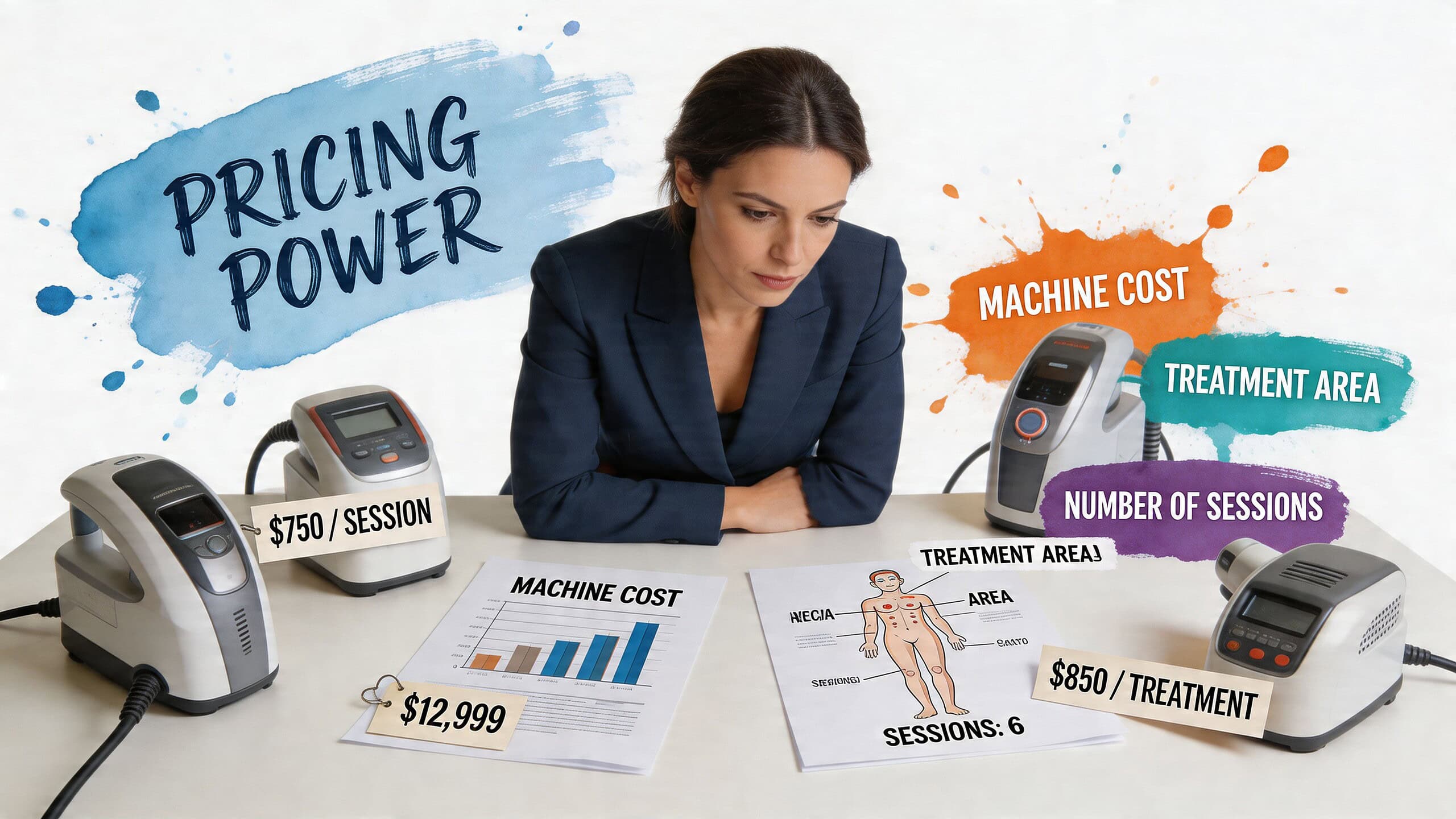
Technology changes what you can charge
Think of platforms the way you’d think about vehicles. A basic machine may get the job done. A more advanced one handles more conditions, works faster, and creates a smoother experience. Clients may not know the technical terms, but they notice comfort, speed, and consistency.
In the South African market, this matters because skin diversity is not a side issue. It’s central to treatment planning. Systems with broader treatment flexibility give clinics more confidence when pricing for mixed demographics, recurring bookings, and package-based sales.
What doesn’t work is trying to charge premium rates with commodity positioning. If your consultation sounds like every budget salon’s script, your premium price won’t hold.
Your operator standard is part of the fee
Clients often compare machine brands. They should also be comparing operator quality, even if they don’t realise it.
Your pricing has to account for:
- Consultation quality: Strong screening and expectation-setting reduce complaints later.
- Technique consistency: Same protocol, same documentation, same settings logic.
- Aftercare support: Clients remember whether your team was available and clear.
- Clinical judgement: Knowing when to proceed, when to adjust, and when to delay treatment.
This is one reason low-fee competitors often struggle to defend their prices over time. Cheap treatment that creates uncertainty isn’t cheap to the client. It’s risky.
Location shapes the ceiling
Urban clinics usually have more room to price confidently, but they also carry heavier pressure from rent, payroll, and local competition. Regional clinics can win on loyalty and convenience, yet they still need to avoid underpricing solely because the area feels less corporate.
The better question isn’t “What are nearby clinics charging?” It’s “What experience and outcome are we delivering relative to them?”
Commercial insight: If your clinic is in a high-overhead node, price should reflect the operational standard you maintain there. If you’re in a smaller town, price should reflect access, trust, and continuity of care.
What raises price resistance
Some factors increase quote friction immediately:
| Issue | Why clients hesitate |
|---|---|
| Vague explanations | They can’t tell why your clinic costs more |
| Poor skin-type confidence | They worry the treatment may not suit them |
| Session-by-session selling | They don’t see a clear end point |
| Discount-first marketing | It trains them to wait for a deal |
A clinic with strong pricing power does three things well. It explains suitability clearly, structures treatment as a plan, and ties cost to real value rather than generic promises.
The Clinic's Investment Understanding Total Cost of Ownership
A clinic owner in Johannesburg can buy a laser platform, launch with confidence, and still find the service underperforming six months later because the full expense sat outside the invoice. The purchase price matters. Ownership cost decides whether the treatment line produces healthy margin.
For a South African clinic, total cost of ownership usually includes the device, supplier training, launch support, warranty terms, servicing, and the revenue lost if the machine is offline. A useful starting point is this laser hair removal machine cost breakdown for South African clinics, which sets out the main cost categories buyers need to price in before they commit capital.
Purchase price is one line item
Clinic owners often compare handpiece specs and monthly repayment figures first. Patients never see that side of the decision, but they feel the outcome. Undertrained operators, weak treatment protocols, and service delays show up as inconsistent results, cancelled bookings, and price resistance.
That is why ownership cost has both a business effect and a patient-facing effect.
Typical cost areas include:
- Initial training: Operator skill affects treatment speed, safety, and repeat booking confidence.
- Onboarding and launch support: New services need treatment protocols, consent processes, and sales scripts that staff can use properly.
- Servicing and repairs: Downtime interrupts cash flow and creates rescheduling pressure.
- Warranty cover: Strong warranty terms reduce early exposure to unplanned spend.
- Marketing assets and promotion: A device does not create demand on its own.
A lower-priced machine can still become the more expensive option if support is thin and the clinic has to solve every operational problem itself.
The costs owners miss first
The biggest mistakes rarely sit in the headline quote. They appear later, once the machine is in use and the team is expected to fill the diary consistently.
| Cost area | Business impact |
|---|---|
| Staff retraining | New hires and operator turnover add repeat education cost |
| Missed utilisation | Empty appointment slots push your per-treatment cost up |
| Delayed repairs | Lost treatment days reduce revenue while fixed costs continue |
| Weak launch support | Slow uptake stretches the payback period |
| Consumables and admin time | Small recurring costs chip away at margin over time |
Often, clinics set treatment prices before they have mapped these inputs properly. As a result, the service can look busy on paper and still contribute less profit than expected.
Why bundled support changes the numbers
Bundled support changes total cost of ownership because it affects how quickly the clinic gets to stable utilisation. Training reduces operator error. Marketing support helps create early bookings. Service cover protects uptime. Better supplier support also shortens the learning curve for consultation, patch testing, treatment planning, and aftercare communication.
From a patient perspective, that structure supports a more reliable experience. From an owner perspective, it protects revenue and makes pricing easier to defend.
Ask a harder question before you buy. What will it cost to own this platform well, keep it booked, and keep it earning? That answer is more useful than the sticker price alone.
Calculating Your Per-Treatment Cost and ROI
A clinic buys a laser, launches with confidence, then realises three months later that a busy diary has not translated into healthy margin. That usually happens because the selling price was set first and the cost model was worked out later.

The starting formula is straightforward:
(Total ownership cost + operating costs allocated to the service) / total treatments delivered = cost per treatment
The hard part is using real inputs. In practice, that means treating laser hair removal as a service line with its own labour, machine time, admin load, and recovery target.
Build the model from clinic reality
A useful ROI model starts with what the clinic needs to recover over a defined period. For South African owners assessing capital recovery, this diode laser ROI breakdown for South African professionals gives a local benchmark for how clinics approach equipment payback, treatment pricing, and utilisation assumptions.
For patient pricing, public South African clinic menus are also more relevant than US finance content because they reflect what local clients already see in the market. That matters. If your internal cost says one thing and your catchment area accepts another, your margin will be won or lost in the gap between those two numbers.
A practical per-treatment worksheet
Use five inputs.
Recovery target
Set the amount you want the service to repay over a fixed period. That may include device finance or purchase cost, initial training, and support tied directly to launch.Monthly treatment capacity
Count realistic bookable sessions, not theoretical maximums. Use current therapist hours, room availability, and the treatment times your team can deliver consistently.Direct labour per session
Include operator time for consultation, setup, treatment, and notes. If a 15-minute treatment creates 35 minutes of staff time, cost the full 35 minutes.Variable session cost
Add consumables, cooling materials if used, patch test admin, payment processing, and any recurring software or booking cost linked to the treatment.Expected completion rate
A quoted package and a completed package are not the same thing. If clients drop off after two or three visits, your real return falls.
That last point gets missed often.
A clinic can appear profitable on the quote sheet and underperform badly once no-shows, delayed rebooking, and incomplete series are added back in.
What owners should calculate before setting prices
The internal cost per treatment is your floor, not your selling price.
If a clinic expects lower utilisation in the first few months, the early per-session cost will be higher because fixed ownership cost is being spread across fewer bookings. As utilisation improves, the same machine becomes cheaper to run per treatment. This is why launch discipline matters financially, not just operationally.
A sound worksheet should answer these questions:
| Question | Why it matters |
|---|---|
| How many sessions per week can the team deliver consistently? | This sets your real capacity ceiling |
| What does one treatment hour cost in therapist wages and room use? | This shows whether small areas are still worth offering individually |
| How many months will you allow for payback? | This shapes the revenue target the device must hit |
| What percentage of clients complete a package? | Completion affects actual yield, not just quoted revenue |
| How many idle slots can the business absorb? | Empty machine time pushes the per-treatment cost up fast |
A grounded ROI view
In a well-run clinic, ROI usually improves through volume control and treatment completion more than through aggressive discounting. I advise owners to test the model with conservative booking assumptions first. If the numbers only work at near-full utilisation, the pricing is too fragile.
That is also where the consumer and business views meet. Clients want a price that feels clear and fair. Owners need a price that includes therapist time, machine repayment, follow-up admin, and downtime risk. The clinics that hold margin explain pricing in a way that helps clients commit to the full course, while keeping enough room in the numbers to protect profit.
Operational habits have a direct effect on payback:
| Operational behaviour | Effect on ROI |
|---|---|
| Pre-booking the next session before the client leaves | Improves continuity and reduces drop-off |
| Quoting by full treatment plan, not isolated sessions | Raises package uptake and cash flow visibility |
| Reviewing machine utilisation weekly | Flags underused capacity before margin slips |
| Standardising consultation and consent steps | Improves conversion and reduces treatment delays |
One platform clinics often assess in this category is Omega Lasers Tetra Cool, a four-wavelength system used as a reference point for treatment speed, skin-type flexibility, and supplier support. The commercial question is straightforward. Can the team use the device confidently, keep treatment times efficient, and maintain enough completed courses each month to justify the capital outlay?
Poor ROI rarely comes from the purchase alone. It comes from weak utilisation, underpriced packages, and a clinic that never measured the service properly once the machine was installed.
Developing a Profitable Pricing Strategy
A client walks in asking for the cheapest underarm package in town. The clinic owner is looking at therapist time, machine finance, consumables, patch tests, admin, and the risk of missed follow-ups. A pricing strategy has to satisfy both sides or it breaks under pressure.
Cost-plus pricing gives you a floor. It does not give you a strong offer, a clear sales path, or enough margin protection when bookings slow down.
The clinics that price well build around treatment plans, not isolated sessions. They present hair removal as a course with a defined outcome, a review point, and a clear financial commitment. That improves conversion because the client understands what they are buying, and it improves forecasting because the clinic is not relying on one-off visits.
Why packages outperform one-off sales
Single-session pricing often looks attractive on a menu and weak on a profit report.
Packages improve behaviour and cash flow at the same time. A client who commits to a full course is more likely to attend on schedule, stay consistent enough to see visible reduction, and return later for maintenance or another area. From an owner’s side, package sales reduce revenue volatility and make staff allocation easier.
That does not mean every package should be heavily discounted. It means the package should offer a clear reason to commit now.
Practical models that hold margin
Simple pricing structures usually perform better than clever ones that need too much explanation at reception.
| Model | Best use |
|---|---|
| Area-based packages | Clear for underarms, legs, bikini, back |
| Multi-area bundles | Useful for clients treating several zones in one plan |
| Premium convenience packages | Strong for clients who value scheduling priority, reviews, and continuity |
Area-based packages suit first-time buyers because the decision feels contained. Multi-area bundles work well when consultation quality is high and the therapist can explain why treating related zones together may improve convenience. Premium options can support higher margins if the added value is concrete, such as longer appointment slots, flexible booking windows, or follow-up assessments.
For clinics using compliant systems such as FDA-approved laser hair removal devices, pricing can also reflect the strength of the platform, provided the team explains what that means in practical terms for comfort, suitability, and treatment consistency.
What weakens profitability
Three pricing habits cause trouble quickly.
- Launch discounts that run too deep: Clients anchor to the promotional price and resist standard rates later.
- Large areas priced too close to small areas: The quote may win the booking and still lose money.
- One script for every buyer: A student comparing underarm prices and a professional booking full legs plus bikini do not buy for the same reasons.
I advise clinic owners to test every package against two questions. Can the front desk explain it in under a minute? Can the clinic still protect margin if two appointments this week run over time?
Clients usually push back on confusion before they push back on price.
Good pricing sounds organised. It connects the fee to demonstrated value, expected session count, and the standard of care the clinic is set up to deliver. That is how you protect margin without sounding defensive or overpriced.
Using Safety and Approval to Build Client Trust
Low pricing can bring in enquiries. It doesn’t build trust on its own. In hair removal, trust comes from how safe the treatment feels, how confidently your team explains it, and whether your clinic can show that it takes compliance seriously.

Clients may not ask first about SAHPRA, FDA, or CE status. They often ask about pain, suitability, and side effects. But approval status sits behind all of those concerns. It gives your clinic a stronger basis for consultation and a more defensible position when clients compare you with informal operators. For clinics evaluating compliant systems, FDA-approved laser hair removal options are part of that conversation.
Approval supports premium positioning
A compliant platform helps your clinic communicate three things clearly:
- Safety standards matter
- The treatment has a credible clinical basis
- The clinic has chosen equipment with accountability attached
That message is valuable because many clients are not merely hunting for the cheapest session. They’re looking for a place where the treatment feels properly managed.
Trust is built in the consultation room
Approval logos alone don’t close sales. Staff behaviour does.
A consultation that builds trust usually includes:
| Consultation element | Why it matters |
|---|---|
| Clear explanation of suitability | It reduces fear and confusion |
| Honest discussion of treatment planning | It sets expectations early |
| Direct aftercare guidance | It shows professionalism |
| Calm explanation of credentials and device standard | It justifies premium pricing without sounding defensive |
Clients can sense when a clinic is hiding behind jargon. They can also sense when a clinic knows exactly what it’s doing. That difference affects conversion as much as price.
The practical lesson is simple. Use safety and approval as part of your value proposition, not as a footnote. When a clinic can connect compliance, comfort, and treatment quality into one coherent explanation, premium pricing becomes easier to defend.
Frequently Asked Questions About Laser Hair Removal
Is laser hair removal permanent
The most accurate client answer is that it delivers long-term hair reduction, not an absolute promise that every hair will disappear forever. For advanced four-wavelength diode systems in South Africa, the cited benchmark is 80 to 90% permanent hair reduction after 6 to 8 sessions, as noted earlier from the linked pricing data. That gives clients a realistic expectation without overselling.
How many sessions will I need
Most clients should be prepared for a treatment series rather than a once-off appointment. The common expectation in the South African pricing data is 6 to 8 sessions for meaningful reduction. During consultation, explain that treatment is scheduled as a plan because hair grows in cycles and not every follicle is equally treatable at the same time.
Why do some clinics charge more than others
Price differences usually come down to the platform being used, the operator’s training, the clinic’s consultation standard, and how much support is built into the treatment process. A quote that looks cheaper may exclude the structure, safety focus, and treatment planning that help clients complete the series properly.
Does the treatment hurt
Clients usually want an honest answer, not a sales answer. The sensation varies by person and area treated. In practice, the conversation should focus on comfort management, expected feeling during pulses, and why better cooling and operator technique matter. Avoid telling every client it is “painless”, because that creates mistrust if their experience feels sharper than expected.
Is it safe for darker skin tones
This depends on the system and the clinic’s judgement. For South Africa, this is a critical consultation point because the local client base includes a wide range of skin types. Clinics should explain suitability carefully, choose settings conservatively, and avoid making blanket promises before assessment. Clients with darker skin tones generally benefit from clinics using platforms designed to handle broader treatment needs rather than outdated one-size-fits-all approaches.
Should I buy single sessions or a package
Packages are usually the better route because they match the way treatment is delivered. They also help clients commit to the full course rather than stopping early and then deciding the treatment “didn’t work”. If a clinic can explain the treatment plan clearly, package pricing often feels easier for clients to justify.
What should I ask before booking
A useful consultation checklist includes:
- Which technology do you use for my skin type and hair type
- How will my treatment plan be structured
- What does the quoted price include
- Who performs the treatment and what training do they have
- What aftercare support do you provide
Those questions protect the client, and they help serious clinics stand apart from low-cost operators who rely on vague promises.
If you’re assessing whether laser hair removal will be a profitable addition to your clinic, Omega Lasers offers SAHPRA-licensed, FDA-approved, and CE-certified aesthetic platforms, along with training, support, and business guidance that help owners evaluate both treatment delivery and commercial viability before they invest.