




A therapist is halfway through a hair-removal treatment when the handpiece stops firing. An error code appears, the client is waiting, and reception is handling a billing query from a patient who wants to pause a package before travelling. The device fault needs technical support. The package request needs customer support. Sending both through one queue wastes treatment time and produces incomplete records.
The split between technical support and customer support determines ownership, response speed, patient safety, and clinic continuity. Technical support should handle faults that interrupt treatment or may affect safe device operation. Customer support should handle billing, package changes, documents, scheduling, and other account requests.
South African contact-centre benchmarking reports 27-second speed to answer, 4.2% call abandonment, and 86% first-contact resolution in a South African contact-centre benchmark guide. Clinics should demand clear routing from device suppliers, with the right team taking ownership at the first contact.
Table of Contents
- Why the Split Between Technical and Customer Support Matters in a Clinic
- Defining Technical Support and Customer Support Side by Side
- What Omega Lasers Support Actually Covers
- Matching Common Clinic Moments to the Right Team
- How to Engage Each Support Channel the Right Way
- SAHPRA, Language, and Support in Practice
- A Quick Decision Checklist for Your Practice
Why the Split Between Technical and Customer Support Matters in a Clinic
The therapist shouldn't be diagnosing calibration drift while a client is receiving treatment. Her job is to stop safely, record the device message, reassure the client, and contact the technical route. The engineer needs the device model, serial number, error code, operating mode, and any recent maintenance details. That information gives technical support a useful starting point instead of another vague “the machine isn't working” report.
The front-desk coordinator has a different responsibility. A request to pause a treatment package, clarify an invoice, replace a missing document, or schedule a training refresher belongs with customer support. Those cases concern the patient or the clinic relationship, not the device's electrical, software, or mechanical performance.
Practical rule: If the problem could damage the device, interrupt safe operation, or affect treatment delivery, technical support owns the first response. If it concerns people, paperwork, scheduling, payment, or product use, customer support owns the request.
This separation also protects the client experience. South African consumer research identified multiple transfers, repeated information, and agents lacking product knowledge as major frustrations, with 89% reporting multiple transfers, 64% reporting repetition, and 79% reporting poor agent knowledge in the cited survey reported by ITWeb. A clinic shouldn't recreate those failures in its supplier relationship.
Your staff also need a reliable method for explaining expected treatment outcomes and next steps. A practical resource such as this guide for manufacturers on retention can help suppliers think beyond the immediate fault and build support processes that preserve long-term customer relationships. Clinics should apply the same principle when managing client expectations, especially after a treatment interruption.
Defining Technical Support and Customer Support Side by Side
Technical support owns the device and its performance. It handles fault diagnosis, calibration concerns, firmware or software issues, handpiece repair, consumable-related errors, warranty assessment, and escalation under the service agreement. Think of this team as the engineering bench behind the treatment room.
Customer support owns the working relationship. It handles onboarding, training bookings, protocol questions, consumable reordering, account administration, billing queries, documentation requests, and coordination with the clinic manager. Think of it as the practice manager's operational partner.
The two functions must still cooperate. A reported fault may be a training gap rather than a component failure. A warranty repair may require customer support to arrange collection while technical support assesses the unit. A recurring complaint about a handpiece or interface should also reach the technical product team, because customer feedback can reveal where documentation or design needs attention.
Technical vs Customer Support at a Glance
| Support Type | Owns | Typical Requests | Who Answers |
|---|---|---|---|
| Technical support | Device operation, diagnosis, repair, calibration, and warranty assessment | Fault codes, a handpiece that won't fire, unusual sounds, software faults, calibration concerns | Technical engineer or specialist |
| Customer support | The clinic relationship, administration, training coordination, and account history | Billing, training dates, consumables, licensing documents, certificates, onboarding | Account coordinator or customer-support adviser |
| Shared triage | Correct classification and hand-off | A performance complaint that may involve technique, settings, maintenance, or hardware | Intake adviser, then the appropriate specialist |
A single intake point can work well, provided it classifies the request before assigning it. The clinic shouldn't have to decide which specialist understands every internal workflow. The intake adviser should capture the facts once, attach the record to the correct queue, and keep ownership visible.
The reason is practical. A misrouted ticket forces the therapist or manager to repeat the story, resend photographs, and explain what has already been tried. That delay is especially damaging during a live treatment day, when the device, room, therapist, and client are all unavailable for other work.
What Omega Lasers Support Actually Covers
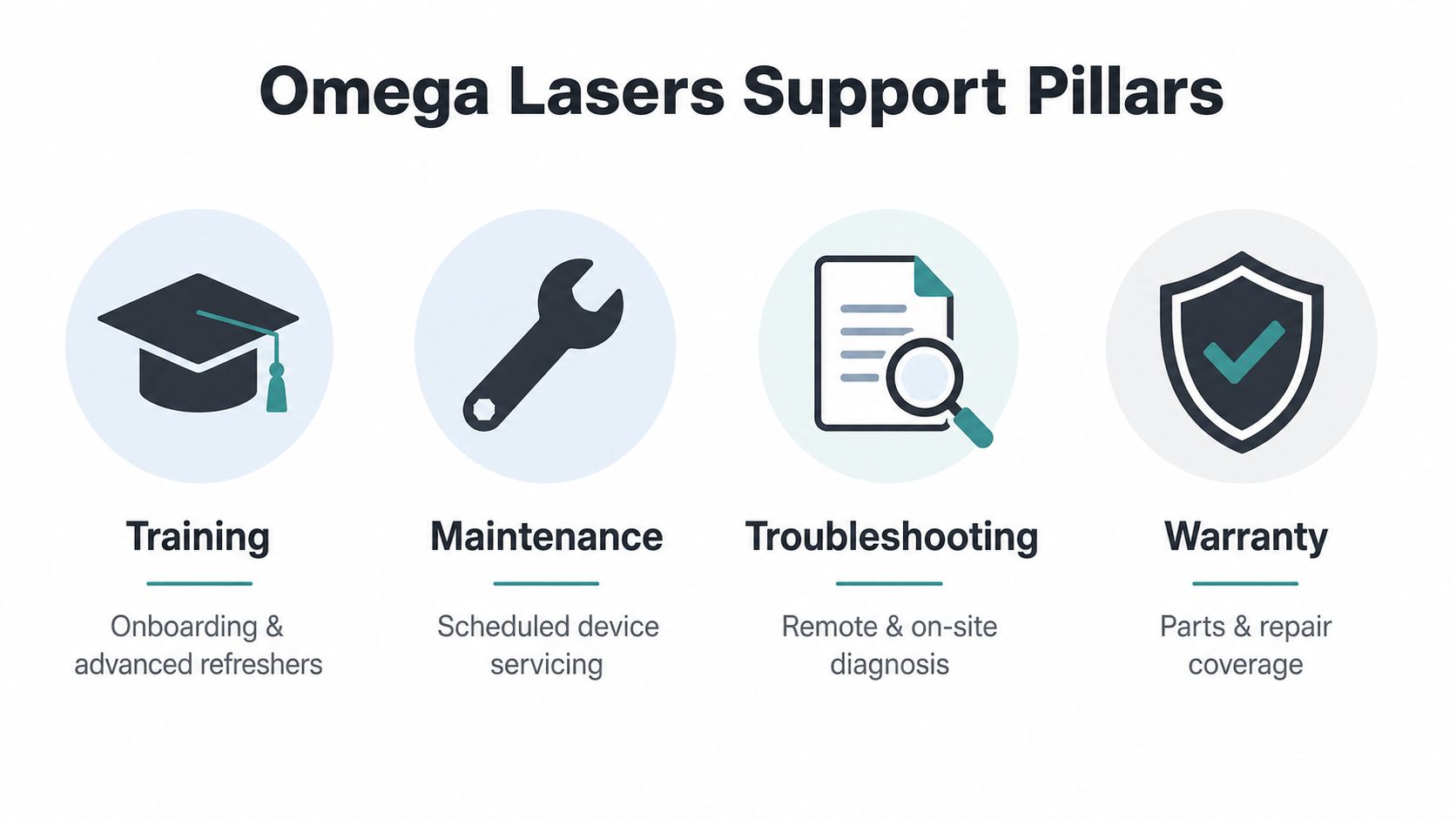
A useful support contract should describe what happens next, not just list a phone number. Omega Lasers structures its service around training, warranty, troubleshooting, and customer-support administration, giving a clinic distinct routes for clinical knowledge, equipment faults, repairs, and compliance-related paperwork.
Training prevents avoidable tickets
Training should start with device onboarding, room preparation, safe operation, and the clinic's treatment workflow. It should continue with advanced protocol refreshers and quarterly webinars for new therapists. Omega Lasers states a typical turnaround of five working days for a scheduled training session and twenty-four hours for an ad-hoc clinical question.
That distinction matters. A question about a setting or handpiece technique may be answered quickly, while a structured refresher needs a scheduled session with the right trainer and attendees. The coordinator should identify which one the team needs instead of marking every query as an emergency.
Warranty must define the physical scope
Warranty support covers manufacturing defects on the main unit, handpieces, footswitch, and goggles. The standard cover is twelve months, with an extension available to thirty-six months. Omega Lasers states a seventy-two-hour assessment turnaround, followed by a loaner unit dispatched within five working days if a repair exceeds forty-eight hours.
The clinic manager should keep the warranty record, purchase details, serial number, and service history accessible. A warranty claim isn't the place to search through old emails while the treatment room stands empty.
Troubleshooting is the live fault route
Troubleshooting covers fault codes, calibration drift, and consumable errors through phone, WhatsApp, and remote-diagnostic sessions. The stated first-response target is under thirty minutes during the contracted window. Staff should use this route when the device is not operating as expected or when continuing could create a safety or treatment-quality risk.
A clear internal guide can help therapists perform only the safe preliminary checks they're authorised to perform. Use guidance on troubleshooting common issues as part of induction, then escalate rather than improvising repairs.
Customer support carries the local paperwork
Multilingual, SAHPRA-aware customer support handles licensing documentation, Laser Safety Officer appointment letters, and consumable reordering in English, Afrikaans, and isiZulu, with a four-hour response target for written queries. This is the administrative layer that keeps the clinic from treating compliance documents as an afterthought.
Matching Common Clinic Moments to the Right Team
Front-desk staff shouldn't need to guess which queue applies. Use the following routing table as a working reference, then adapt it to the contracted hours and escalation terms in your own service agreement.
| Clinic Moment | Handles It | First Response | Channel |
|---|---|---|---|
| Handpiece won't fire mid-treatment | Technical engineer | Immediate during treatment disruption | Phone hotline |
| Clinician needs a parameter refresher | Customer support coordinates clinical training | Within twenty-four hours for an ad-hoc clinical question, or schedule a session | Dedicated WhatsApp line or ticket portal |
| Finance query about an invoice | Customer-support account coordinator | Same business day where possible | Ticket portal |
| Consumables reorder | Customer support | Within the written-query target | Ticket portal or dedicated WhatsApp line |
| Software licence expiry | Customer support, with technical escalation if the device is affected | Promptly, before the planned treatment session | Ticket portal |
| Warranty registration query | Customer support | Written-query target | Ticket portal |
| Error code on startup | Technical support | Immediate during the contracted window | Phone hotline or WhatsApp |
| Request for a Certificate of Conformity copy | Customer support and compliance coordinator | Written-query target | Ticket portal |
The channel should match the consequence
Use the phone hotline when a treatment is stopped, a safety concern is active, or the device cannot be used. Use WhatsApp for rapid information exchange, especially when a short video or photograph will help the engineer identify the issue. Use the ticket portal for billing, certificates, licensing, warranty records, and requests that need a searchable paper trail.
An on-site visit shouldn't be the default for every complaint. Technical support should begin with safe remote triage where appropriate, then dispatch an engineer when the evidence points to hardware, room setup, or a fault that can't be resolved remotely.
How to Engage Each Support Channel the Right Way
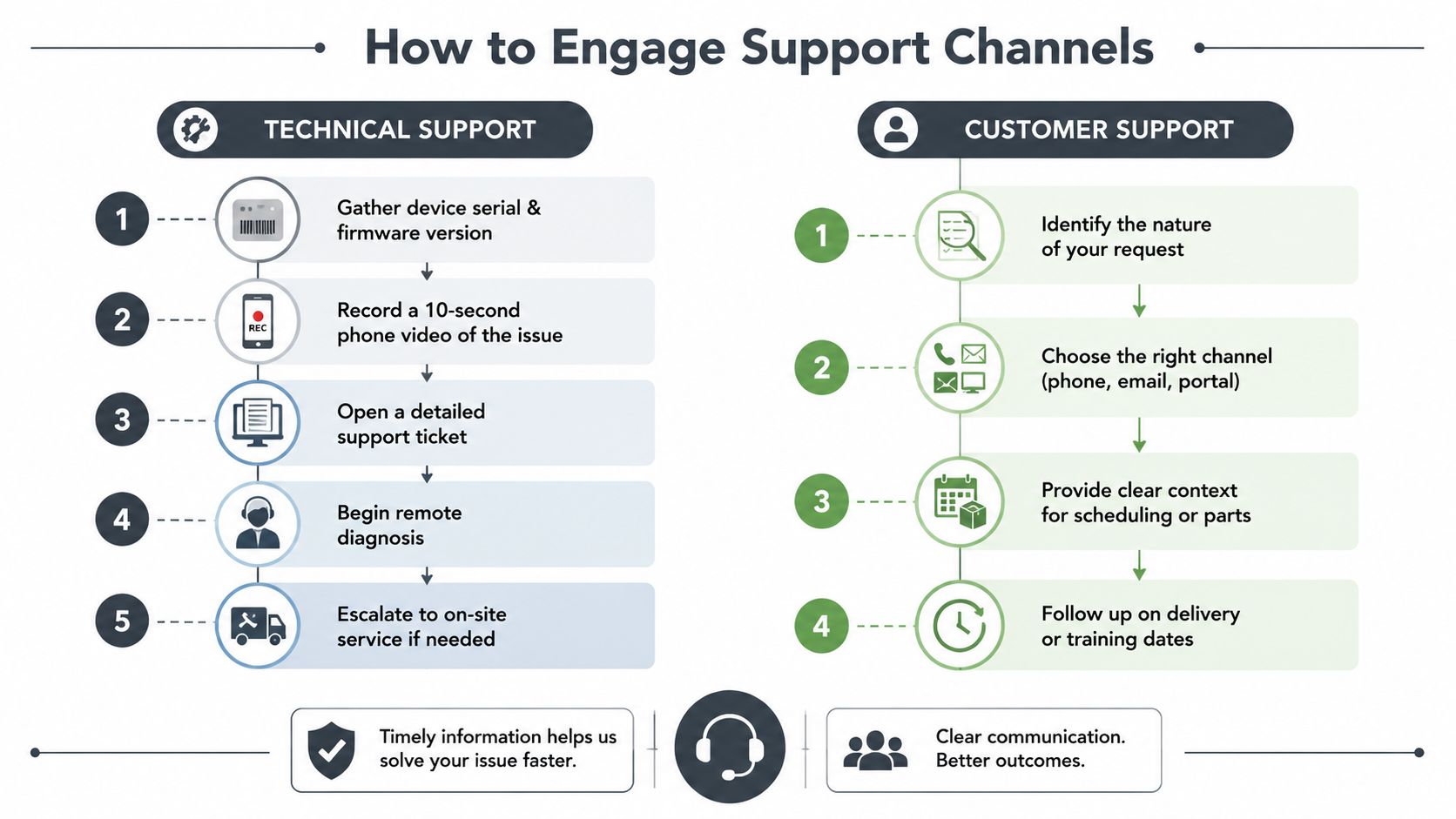
A support team can only work with the information it receives. Before opening a technical ticket, gather the device serial number, firmware version, exact error message, operating mode, and a ten-second phone video of the issue where recording is safe. Don't remove panels, bypass interlocks, or attempt a repair beyond your authorised training.
Technical support follows an evidence trail
Start with the phone hotline for a live treatment interruption or urgent operational concern. The engineer should confirm whether the device can remain in service, guide approved checks, and open or update the ticket. If remote diagnostics don't resolve the matter, the case should move to an engineer dispatch, parts assessment, or loaner-unit decision under the agreed service levels.
Escalation from an initial intake level to deeper technical support should happen when the fault persists after authorised checks, returns after reset, affects output or calibration, involves unusual heat or noise, or prevents safe treatment. A case should reach the highest technical level available when the engineer needs product-level investigation, controlled testing, or a repair decision that the first responder can't make.
Customer support keeps administrative cases moving
Route billing, training certificates, consumables, warranty registration, and SAHPRA paperwork through the dedicated account coordinator. The coordinator should acknowledge the request within the agreed target, confirm missing details, and provide a date for the next action rather than closing the conversation.
For scheduling, include the therapist's name, preferred dates, treatment platform, required topic, and whether the session is onboarding or a refresher. For documentation, name the exact document and device model. For consumables, include the item description, quantity requested, delivery address, and purchase-account details.
Good escalation practice: The clinic should never have to retell a technical fault because an administrative coordinator arranged a courier. The support record should travel with the hand-off.
After-hours calls should be reserved for the incidents defined as urgent in the service agreement, such as an active safety concern or a treatment-critical failure. A routine invoice question, certificate request, or training booking should receive a next-business-day response, not compete with a device fault that has stopped treatment.
SAHPRA, Language, and Support in Practice
A clinic can have a working device and still face a compliance failure. In South Africa, Class 3 and Class 4 laser devices must be registered with SAHPRA before use, and a Laser Safety Officer must be appointed in the clinic. IPL and LED devices fall outside those laser-specific requirements, according to South African laser-safety guidance. The first support question is therefore simple: what type of device does the clinic operate?
SAHPRA provides a formal application for a licence to use a medical laser. Treat licensing as part of commissioning, not paperwork to chase after installation. Customer support should identify the required records, explain when the application belongs in the setup process, and confirm where the clinic will store the approved documentation. Use the regulatory compliance checklist to keep those records organised.
Compliance belongs in the support record
South African guidance covers eye protection, controlled access, beam stops, locked panels, barriers, and administrative controls. A South African clinical laser review also discusses environmental controls, appointed safety personnel, and laser-safety training for staff operating these systems.
The support file should record the Laser Safety Officer appointment, staff training, room-readiness checks, service history, warranty documents, and Certificates of Conformity. Keep licensing evidence with the relevant device record. Sources also state that each laser model requires a separate licence and that the import licence must exist before user registration can proceed. The distributor and clinic should therefore assign documentation ownership for every model, rather than treating compliance as one general file.
Language affects resolution
A correct technical answer fails if the recipient cannot understand or apply it. Historical South African consumer research found that 86% of respondents were frustrated by not understanding the agent, as reported in the local contact-centre coverage. Language matching is a service requirement.
A clinic outside a major urban centre may need support in English, Afrikaans, isiZulu, or Sotho, depending on its staff and patient base. The account coordinator should record the preferred language in the support profile and follow verbal instructions with written steps. One coordinated support record covering compliance, training, documentation, and engineering gives the clinic manager a clear owner for each request and prevents instructions from being lost between separate contacts.
A Quick Decision Checklist for Your Practice
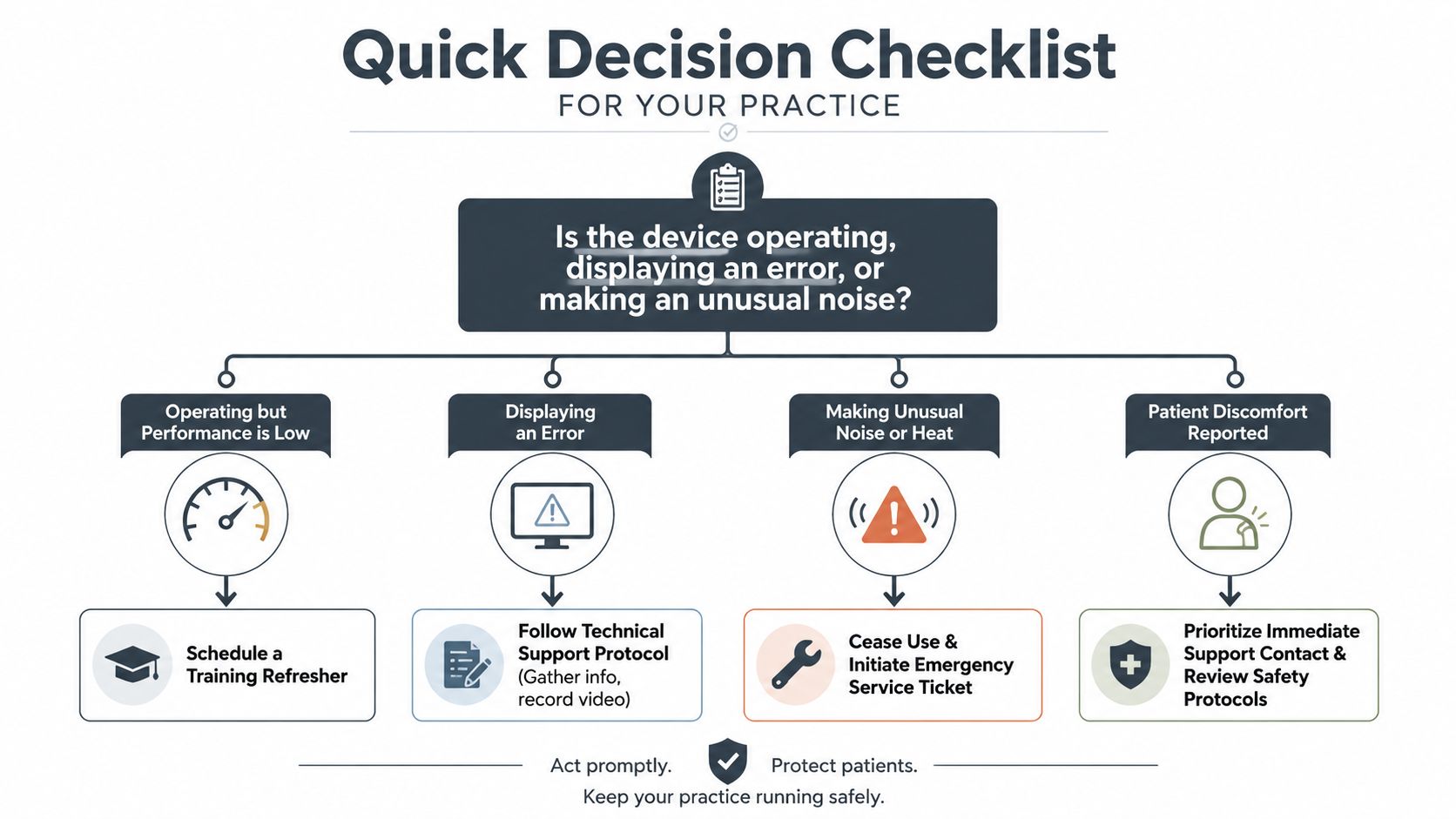
Pin this checklist beside every device. It gives a therapist one clear action when a disruption occurs and gives the support team the information needed to diagnose the issue without another round of questions.
First decide whether the device is safe
Ask whether the device is operating normally, displaying an error, making an unusual sound, overheating, leaking, or creating an active risk. If the answer is yes to any safety concern, stop the treatment, follow the approved shutdown procedure, move the device out of service where safe, and contact technical support.
Record the device model, serial number, exact message, operating mode, recent maintenance, and any visible change in performance. Preserve screenshots and logs. Don't restart repeatedly if the engineer has told you to leave the unit powered down, and don't continue treatment just because the client is waiting.
Route non-fault requests to customer support
If the device is safe but the team needs help with treatment protocols, handpiece handling, settings, consumables, refresher training, warranty registration, documentation, or a service visit, contact customer support. The coordinator can bring in a technical specialist without making the clinic complete a second triage process.
Use this quick route:
- Stop and assess: Identify any error, noise, heat, leak, performance change, or patient discomfort.
- Protect the patient: End or pause treatment according to the device's safety procedure.
- Capture evidence: Note the model, serial number, software or firmware version, message, mode, and recent maintenance.
- Choose the lane: Send operational faults to technical support. Send training, paperwork, billing, consumables, and scheduling to customer support.
- Use the correct channel: Call for urgent faults, message with supporting media where appropriate, and use the portal for traceable administrative requests.
- Wait for authorised direction: Never attempt repairs, bypass safeguards, or alter internal components without approval.
- Review the record: After resolution, document the action taken, the outcome, and any follow-up training or maintenance required.
Review the checklist during induction, after installation, and at every scheduled training or maintenance session. Keep product details, warranty records, software versions, and support contacts beside the device so a disruption doesn't turn into a search exercise.
The clinic manager should also check that every therapist knows who owns the decision to remove a device from service and who signs off a warranty parts order. Clear ownership prevents unsafe improvisation and gives the supplier a complete record for service-level review.
If your clinic needs a structured route for device faults, training, warranty coordination, and SAHPRA-aware administration, visit Omega Lasers. Omega Lasers offers medical-aesthetic technology alongside technical assistance, device training, regulatory support, and after-sales coordination, so your team can route each clinic moment to the right specialist quickly.